During some recent travel, I was reminded of the importance of walking to creativity and overall emotional health. In my neighborhood in suburban central Florida, or really anyplace in Florida, finding a safe place to walk can be a challenge. But research indicates walking really does contribute to creative thinking. I prefer urban hikes and include that in my travel plans. But our brains seem to benefit from walking anywhere, even on treadmills. Below are a couple of images from summer walks separated by (nearly) an entire country, from downtown Tampa, Florida (left) to San Francisco’s Bernal Heights neighborhood (right).


Traveling also gave me the opportunity to do a little more focused reading than I’m able to do in my noisy home neighborhood, starting with People of the Book by Geraldine Brooks. People of the Book is historical fiction that offers an imagined history for a real manuscript – the 14th century Sarajevo Haggadah, a beautifully illustrated manuscript that contains the Passover Haggadah. I don’t read a lot of historical fiction, and this is the first of Ms. Brooks’ novels I’ve read, but this is a beautifully written and well-researched story.

- P. 37: “All of you, from the safe world, with your air bags and your tamper-proof packaging and your fat-free diets. You are the superstitious ones. You convince yourself you can cheat death, and you are absolutely offended when you learn that you can’t. You sat in your nice little flat all through our war and watched us, bleeding all over the TV news. And you thought, ‘How awful!’ and then you got up and made yourself another cup of gourmet coffee.”
- P. 268: “Even in the crummy establishments in London, you can generally get proper tea, in a pot, unlike the bag on the side of a cup of tepid water that you often get even in high-end American places.”
I also read Christ Stopped at Eboli, Carlo Levi’s memoir of his months of political exile in Aliano (described as Gagliano in the book), Italy, during 1935-1936. As an outspoken opponent of the Mussolini government, Levi was exiled in this isolated region of Italy until Italy’s victory in its war against Abyssinia (today’s Ethiopia). Levi was a well-known artist who had also studied medicine, giving him a wide network in cultural and scientific communities, so sending him to a small, poor, southern village where he would be cut off from family, friends, and political contacts was intended to demoralize Levi and remove him from public view. I first became interested in Christ Stopped at Eboli after watching the 1979 film adaptation. If you can find the full version of the film, the 220-minute version that aired on Italian television, it’s fascinating. (At present, it’s streaming on The Criterion Channel.) While the film adaptation is generally faithful, the book contains much more depth regarding Levi’s experience and observations.
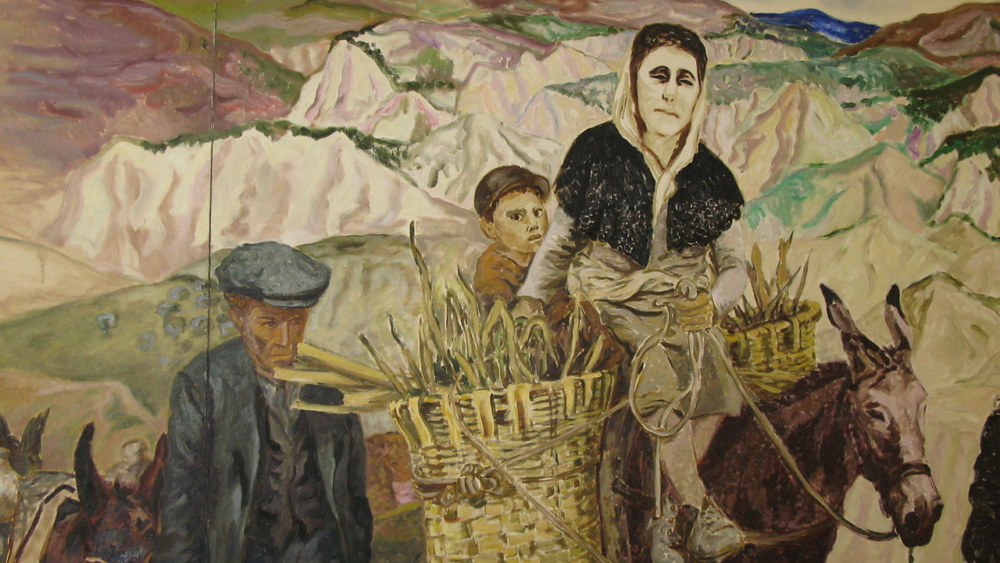
- P. 111: “Anything is possible, where the ancient deities of the shepherds, the ram and the lamb, run every day over the familiar paths, and there is no definite boundary line between the world of human beings and that of animals or even monsters.”
- P. 214: “Death was in the house: I loved these peasants and I was sad and humiliated by my powerlessness against it. Why, then, at the same time, did a great feeling of peace pervade me? I felt detached from every earthly thing and place, lost in a no man’s land far from time and reality. I was hidden, like a shoot under the bark of a tree, beyond the reach of man. I listened to the silence of the night and I felt as if I had all of a sudden penetrated the very heart of the universe. An immense happiness, such as I had never known, swept over me with a flow of fulfillment.”
I’m now well into Barney’s Version, my first experience with Mordecai Richler, and it’s a hoot. I’ve seen the film adaptation but will need to watch it again for comparison.

 The Creative Life Adventure
Leave a comment