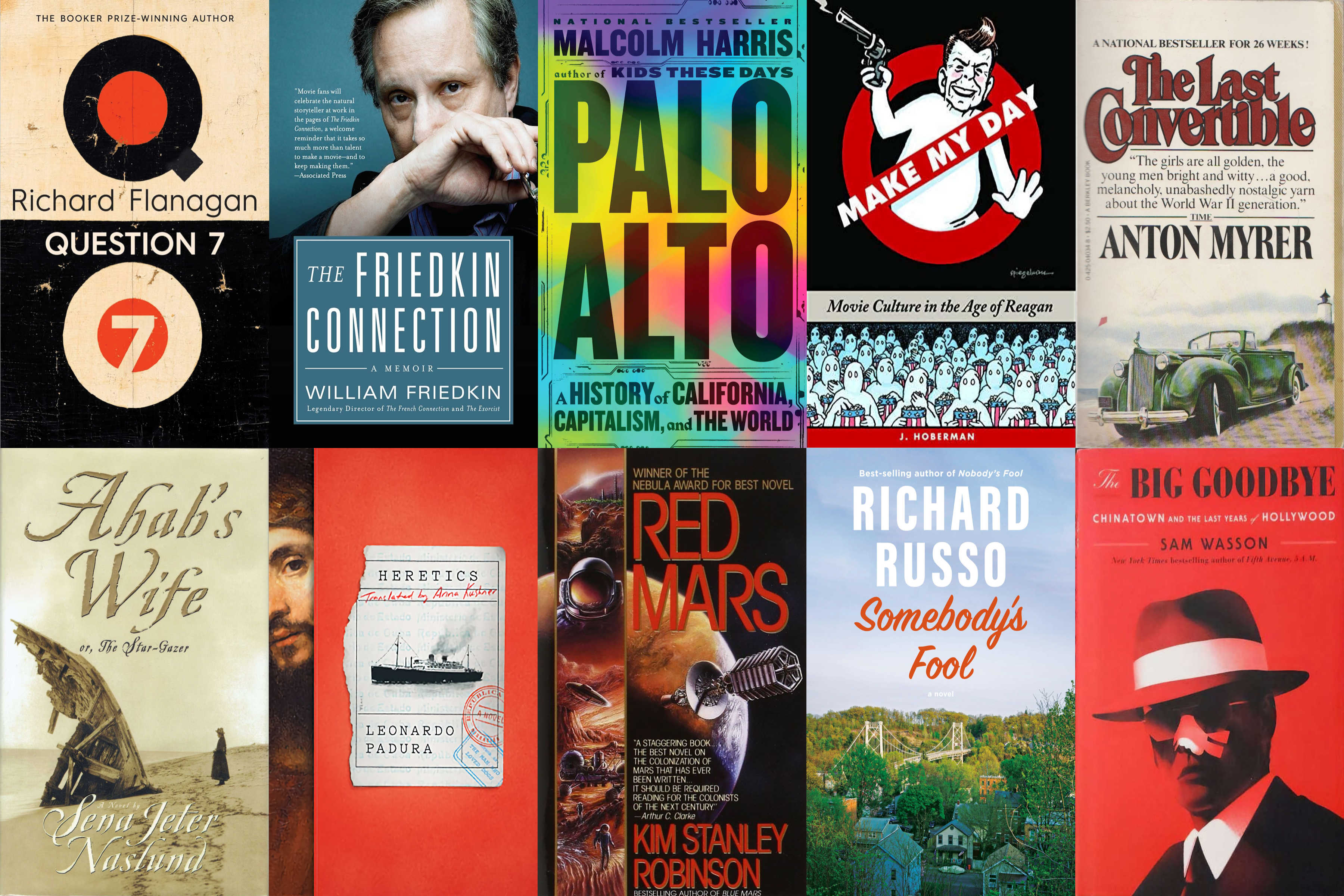
As I’ve done in previous years, this is the annual list of my favorite books of 2025. These are books I read during the year, regardless of when they were published. As always, I’m including fiction and non-fiction because both are important. This is not a ranked list, but ordered alphabetically by the author’s last name. I’ve written about some of these books during the course of the year, so forgive me a line or two of repetition. (Please note that my annual list of favorite movies will soon be posted at my Letterboxd account.)

Question 7 by Richard Flanagan
I’m embarrassed to say I purchased Richard Flanagan‘s Question 7 expecting a work of fiction. I have no idea why, as the book’s descriptions are accurate, or as accurate as is feasible for such a wide-ranging memoir that is really more than a memoir. (In fairness, The Guardian review described the book as auto-fiction, but I can’t say where the fiction shows up.) It turns out that Richard Flanagan exists partly because the U.S. dropped an atomic bomb on Hiroshima in 1945. And that is exactly the kind of ethical dilemma that Flanagan presents throughout this dark and inspiring and mind-blowing true tale.

The Friedkin Connection: A Memoir by William Friedkin
If you’re a movie lover, you’re certainly familiar with William Friedkin, even if you haven’t seen The French Connection (1971), To Live and Die in L.A. (1985), or Sorcerer (1977). I still haven’t seen The Exorcist (1973) in its entirety, because I’m too chicken. Friedkin’s memoir The Friedkin Connection, published 10 years before his death in 2023, touches on those career highlights and much more. Did you know that he also directed a number of operas? Friedkin was known as a man of strong opinions, but compassion and thoughtfulness also come through in his writing. He is forthright in acknowledging his own perceived mistakes over the years, and generally seemed to consider himself to be his own worst enemy.

Palo Alto: A History of California, Capitalism, and the World by Malcolm Harris
I wrote a lengthy post about Malcolm Harris‘ powerful book, Palo Alto, earlier this year. It’s a long book and fairly traumatizing if you don’t already understand how truly evil the forces of capital are. Harris traverses the history of the Silicon Valley area from the arrival of the first Europeans – who quickly displaced the original occupants, the Ohlone – to the early 21st century. The people and events of Palo Alto have influenced national and global events a lot more than most of us realize. Trains are a recurring symbol of the inhumanity of our monster-god The Economy. If you read Palo Alto and Robert Caro‘s book The Power Broker, you will understand about 70% of why the U.S. is the way it is. (Spoiler alert: if you still think Melon Husk is a wise business leader, he isn’t.)

Make My Day: Movie Culture in the Age of Reagan by J. Hoberman
Make My Day: Movie Culture in the Age of Reagan completes J. Hoberman‘s Found Illusions Trilogy, following The Dream Life and An Army of Phantoms. Hoberman’s books are not traditional accounts of film history. His focus is the mutually reinforcing nature of politics and pop culture; the Found Illusions trilogy specifically covers the Cold War period. Hoberman was a film critic for the Village Voice for many years and Make My Day draws directly on some of his previous writings, along with a multitude of other sources. He also maintains a good sense of humor despite writing about some dark topics, including the highly visible line that connects the Gipper with the current fascist dictatorship. Hoberman is an insightful writer and I highly recommend the entire trilogy for students of film history or history in general.

The Last Convertible by Anton Myrer
I wrote an essay in June about my long history with The Last Convertible and how much I enjoyed revisiting the novel this year. The Last Convertible is a melodramatic tale of World War II and the impact it had on a generation of Americans with the courage to stand up to fascists. The story takes us to Harvard, Cape Cod, and small-town France during the war; among other things, the narrative gave me an appreciation of big band music that I wouldn’t have had otherwise. Author Anton Myrer is probably best known for the more hard-boiled war novel Once an Eagle, published in 1968, but The Last Convertible is just the ticket for this reader.

Ahab’s Wife or, The Star-Gazer by Sena Jeter Naslund
I confess, I haven’t read Herman Melville‘s Moby-Dick, so some of the symbolism in Ahab’s Wife or, The Star-Gazer was over my head. That doesn’t diminish how fascinated I was with this novel. Sena Jeter Naslund describes the adventurous life of her protagonist, Una Spenser, from childhood in Kentucky through (approximately) middle age in Cape Cod. Una, like her eventual husband Captain Ahab, spends part of her life on the sea. Also like Ahab, Una experiences great tragedy, but she chooses a different path than vengeance. If you want to avoid partial spoilers, read the novel before reading the account of the 19th century whaleship Essex, in which both Melville and Naslund found inspiration.

Heretics by Leonardo Padura Fuentes
Leonardo Padura Fuentes‘ novel Heretics, brilliantly translated into English by Anna Kushner, is a wild book that is almost three tales in one. Padura takes us from the studio of Rembrandt to modern-day emo culture, and from the Dutch Republic to Miami Beach to Havana in the 1930s and 21st century. Much of the action is generated by an alleged Rembrandt painting that may or may not have traveled across the Atlantic Ocean on the St. Louis, the passenger ship carrying 900 Jews fleeing the Nazis, only to be turned away by Cuban authorities. This is a book that takes its time, giving the reader time to dwell in the characters’ struggles with their faith.

Red Mars by Kim Stanley Robinson
I have a distinct memory of when I purchased mass market paperback editions of Kim Stanley Robinson‘s Mars Trilogy, back at the beloved and long-defunct Book Buyers in Mountain View, California. Published in 1992, Red Mars is an oustanding start to the trilogy, beginning with the 2026 voyage of the First Hundred aboard the ship Ares to colonize Mars. Covering more than thirty years, the book is broad and deep, covering numerous interpersonal conflicts as well as such diverse topics as climatology, geology, politics, history, urban planning, and ethics. While certain aspects of the book feel a little dated – even someone as clever as Robinson could not realistically have predicted the dystopian oligarchy we have surrendered to – it’s impressive how well Red Mars holds up more than thirty years later. I plan to re-read Green Mars, the second book in the trilogy, in 2026.

Somebody’s Fool by Richard Russo
Somebody’s Fool completes Richard Russo‘s North Bath Trilogy, named for the fictional New York town where this novel and its predecessors, Nobody’s Fool and Everybody’s Fool, take place. It’s not necessary to have read the previous books to enjoy Somebody’s Fool, but doing so will give you a deeper understanding of the characters’ and their various conflicts. The novel is loaded with characters and subplots, but they all get the time and space they need to develop and resolve. Nothing feels rushed. As I wrote earlier this year, forgiveness is an essential element of Somebody’s Fool, something we can all use more practice with, regardless of where we are in life.

The Big Goodbye: Chinatown and the Last Years of Hollywood by Sam Wasson
I read a lot about film history this year. Sam Wasson‘s The Big Goodbye is exactly what the subtitle promises: an account of the making of the 1974 classic Chinatown and the incredible alignment of talent that made it happen. It’s also an assessment of one of the more freewheeling periods in Hollywood’s history. You may come away from The Big Goodbye feeling that Chinatown marked the beginning of the end of the film industry’s most creative period. Nostalgia can be a dangerous thing, but I confess this book left me yearning for “the good old days.”
Honorable Mentions:
- The Tenth Man by Graham Greene
- Our Word is Our Weapon: Selected Writings by Subcomandante Marcos
- American Pharaoh: Mayor Richard J. Daley – His Battle for Chicago and the Nation by Adam Cohen and Elizabeth Taylor
- Tom Lake by Ann Patchett
- Wild Thing: A Life of Paul Gauguin by Sue Prideaux
I hope you have a great reading year in 2026, and a great year in general. At moments when life seems discouraging, remember the words of Winston Churchill: “Never, never, never give up!”


Leave a Reply