“The assumed right of the private motor car to go to any place in the city and park anywhere is nothing less than a license to destroy the city.”
Lewis Mumford, The City in History, P. 408
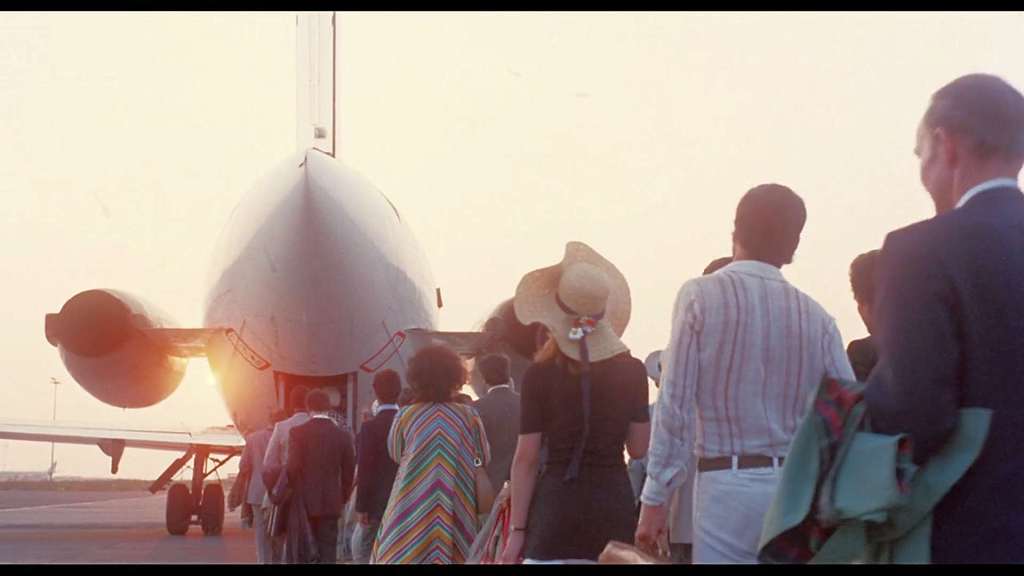
How far does a woman have to go to be seen in more than sexual terms? That’s the question I found myself asking after watching the 1974 Italian film Identikit (released in some countries as The Driver’s Seat). Described by some as a horror film, Identikit definitely has horrific moments, but the film’s overall surreal tone could have easily inspired David Lynch. Mostly I admire star Elizabeth Taylor for performing such an unusual role.

Identikit is a kind of road movie, with Lise (Taylor) traveling from Hamburg to Rome and encountering a variety of eccentric characters along the way. The technicolor dress she wears to Rome (“It was a dress that stood out a mile,” says one of the police investigators) distinguishes Lise and her dark mission from the masses, a mission that definitely does not involve the simplistic sexual encounter every man she meets wants from her. She gives us a clue to the type of man she’s looking for by carrying, in highly visible fashion, a paperback copy of the novel The Walter Syndrome by Richard Neely. Her motives are never revealed, but urban isolation appears to be a factor – just look at her reaction to the wooded landscape outside her hotel in Rome; it’s in a wooded park that she will fulfill her plan with the man she has chosen. And multiple shots of groups of mannequins imply Lise is disconnected from ordinary life. “I want to go back home to feel all my loneliness again,” she says late in the film, and she doesn’t mean home in the conventional sense. There’s a lot going on in Identikit that I don’t fully understand, but it’s a fascinating journey with some powerful cinematography. I’ll avoid spoilers, but I found the end of Identikit disturbing and imagine others will also.

And I continue reading The City in History by Lewis Mumford, published in 1961. The apparent decline of civilization we’re living through seems to have occurred during my lifetime. Of course the seeds were planted long before, as Mumford describes by taking a long-term historic view:
- Plate 64: “Whether our scientific technology should be controlled and directed for the purposes of life, or whether life shall be regimented and repressed in order to promote the ceaseless expansion of technology is one of the main questions before mankind today. Without conscious deliberation, indeed almost automatically, Western civilization during the last half century has moved far along the second course.”
- P. 444-445: “From the standpoint of an expanding capitalistic economy, indeed, capitalism’s prospects of profits, which rested on continuous turnover, demanded the continued destruction of old urban structures, for the sake of their profitable replacement at even higher rents. Heavy long term investments in buildings whose spacious surroundings would guarantee their continuity were not attractive to the capitalist investor, once he had emancipated himself from considerations of a safe return. …the capitalist even hastened the pace of destruction by begrudging the necessary investment for repair and renewal. For the twentieth century, unceasing destruction and replacement became the new rhythm of city development. In this, capitalism’s role was to liquidate the container.”
- P. 481: “Modern man’s only alternative is to emerge once more into the light and have the courage, not to escape to the moon, but to return to his own human center – and to master the bellicose compulsions and irrationalities he shares with his rulers and mentors. He must not only unlearn the art of war, but acquire and master, as never before, the arts of life.”
- P. 492-493: “Beginning as a mechanism of escape, the suburb has turned into its very opposite. All that is left of the original impulse toward autonomy and initiative is the driving of the private motor car; but this itself is a compulsory and inescapable condition of suburban existence; and clever engineers already threaten to remove the individual control by a system of automation. The current cost of this form of ‘freedom’ in the United States – 40,000 dead and more than a million people injured or maimed for life every year – must be partly debited from the favorable side of the suburban movement.”
- P. 494: “Not merely did the suburb keep the busier, dirtier, more productive enterprises at a distance, it likewise pushed away the creative activities of the city. Here life ceased to be a drama, full of unexpected challenges and tensions and dilemmas: it became a bland ritual of competitive spending. ‘Half your trouble,’ Rudyard Kipling wrote to William James in 1896, ‘is the curse of America – sheer, hopeless, well-ordered boredom; and that is going some day to be the curse of the world.’”
 The Creative Life Adventure
Leave a comment