…the photograph was a thing, not a being; it might make an identity card, but it was so much thinner than identity.
The Big Screen by David Thomson, p. 6
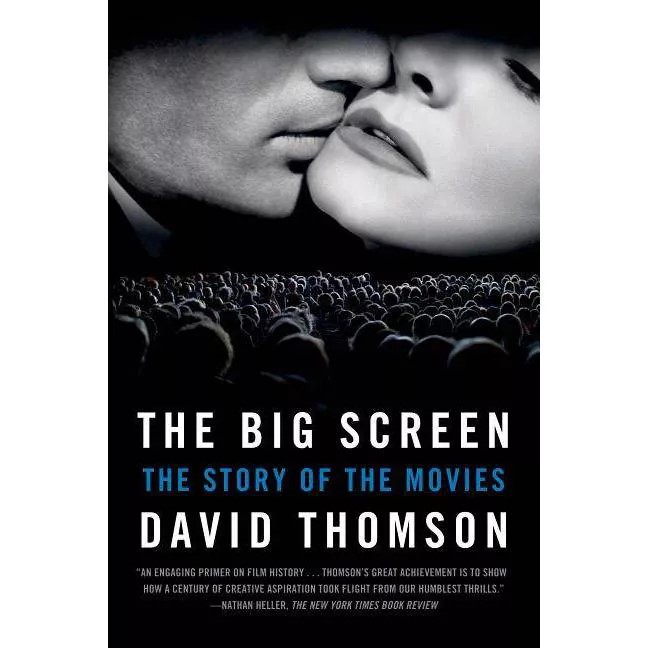
I started reading The Big Screen: The Story of the Movies by long-time film historian David Thomson this week. The book is a quite interesting film and cultural history combined with the author’s personal reflections. Thomson describes his book as an assessment of screens in our lives, from “Muybridge to Facebook,” and he does begin with a brief history of motion studies pioneer Eadweard Muybridge (1830-1904) before launching into the silent film era. The writing style is a bit stream-of-consciousness but so far I’m finding The Big Screen fascinating.
- P. 38: On F.W. Murnau‘s Sunrise (1927): “In one of the most striking moments, the City Woman and the man talk of visiting the city. It appears, like a glowing mirage on the horizon, and we see the backs of the two lovers as they watch and imagine they are there, just like members of the audience. It may be one of the first images within a film that says, this, this is what the movies are about, watching and dreaming.”
- P. 44: Quoting “The Cinema” by Virginia Woolf: “We behold [movies] as they are when we are not there. We see life as it is when we have no part in it. As we gaze we seem to be removed from the pettiness of actual existence.”
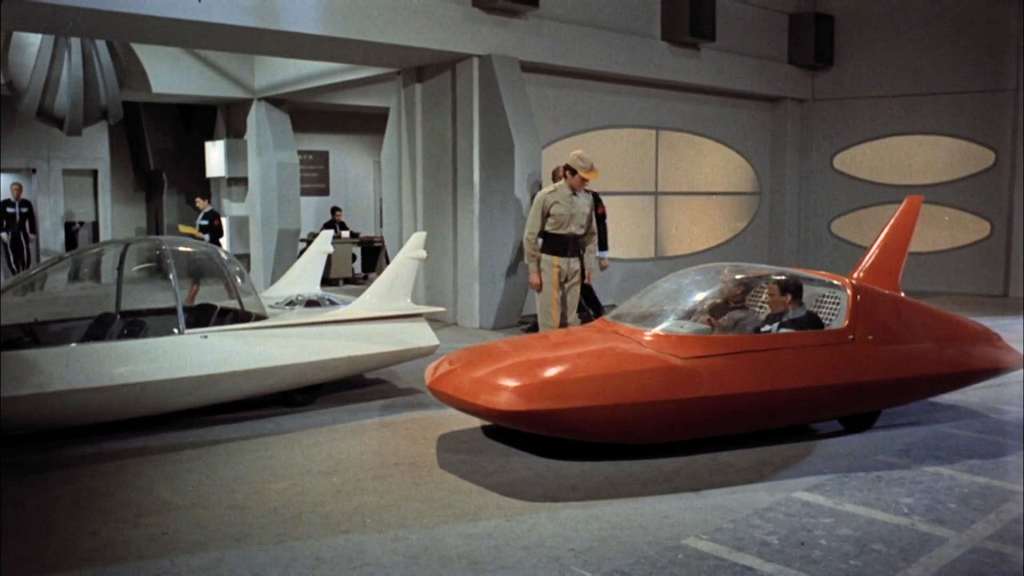
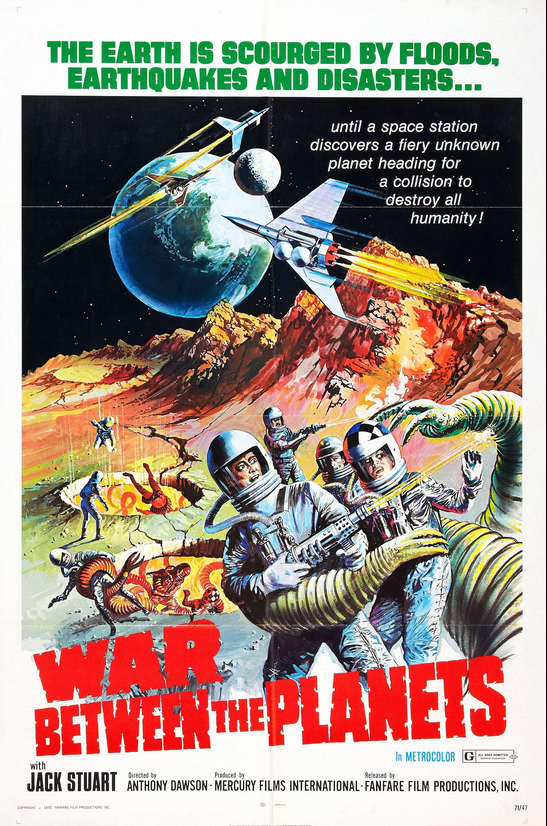
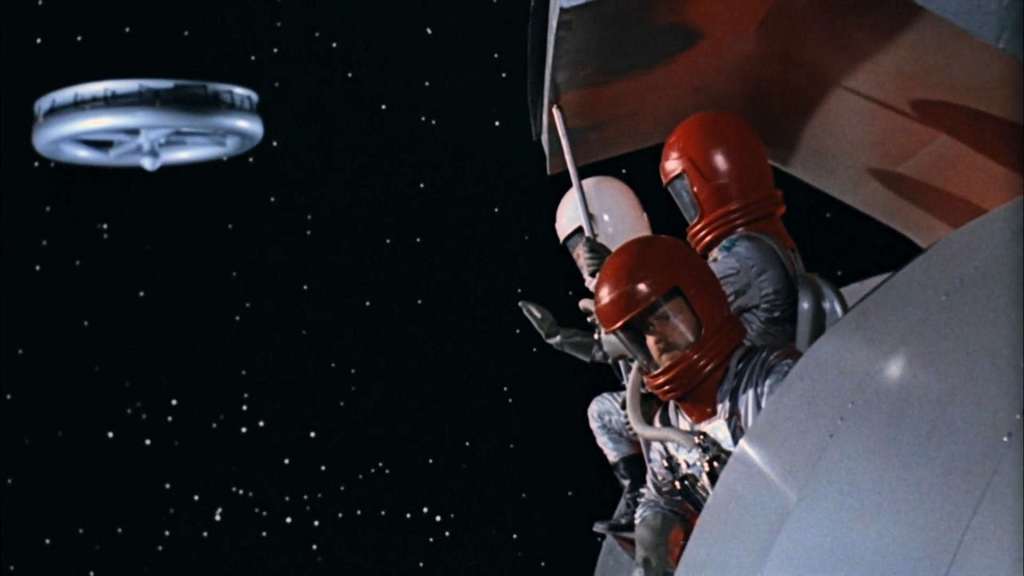
Speaking of movies, lately I’ve been in a mood to watch low-budget genre films, including Roger Corman‘s Swamp Women (1956) and Prisoners of the Lost Universe (1983). This week I watched War Between the Planets (1966) by Italian director Antonio Margheriti (1930-2002), known to many U.S. viewers by his pseudonym Anthony Dawson. The story involves an artificial killer asteroid threatening earth. (A similar premise would be used with greater sophistication in the original series Star Trek episode “The Doomsday Machine.”) I imagine Margheriti as something of an Italian Roger Corman, a director who loved film-making and was happy to make humble genre films with tight budgets and rapid shooting schedules. My first experience with Margheriti was several years ago, with his debut film, Assignment: Outer Space (1960), released internationally as Space-Men. Assignment: Outer Space is surprisingly good and features Rik Van Nutter (1929-2005), who later played Felix Leiter in Thunderball (1964). Both of these films are not exactly 2001: A Space Odyssey (1968), but they are entertaining escapist fare. War Between the Planets is the weaker of the two movies, but it does feature Giacomo Rossi Stuart with a hairstyle to rival Pike’s Peak.

I tend to prefer that movies and TV shows reflect the times in which they were made, meaning I’m not a fan of the “Special Edition” Star Wars films and prefer original over remastered Star Trek episodes. The visual effects and production design of Margheriti’s s-f films are clearly dated but they are quite good for their time and a lot of fun to look at. By coincidence, Tubi currently offers the 2013 documentary The Outsider: The Cinema of Antonio Margheriti. Besides s-f, Margheriti directed westerns, horror films, war movies, sword-and-sandal epics, and just about anything else. The next Margheriti work in my queue is Death Rage (1976), with Yul Brynner‘s final film performance.
I’m nearing the end of The City in History by Lewis Mumford, one of the most dense (in a good way) books I’ve read in a while. Reading the book more than 60 years after it was published, it’s easy to appreciate Mumford’s synthesis of thousands of years of history into a coherent narrative. As he approaches his own time period, Mumford’s writing becomes more informed by the myth of auto-dependency as “freedom” and by the fear of nuclear war that was so widespread at the time. It’s not something most of us give much thought to today – what with climate change, fascism, and ever-growing income inequality ever-present – but maybe we should. While the global nuclear stockpile has decreased dramatically since the 1980s, as of 2022 it was still estimated that 9 countries possessed a total of 12,700 nuclear warheads.
- P. 506: “Far from supplementing public rail transportation, the private motor car became largely a clumsy substitute for it. Instead of maintaining a complex transportation system, offering alternative choices of route and speed to fit the occasion, the new suburban sprawl has become abjectly dependent upon a single form, the private motor car, whose extension has devoured the one commodity the suburb could rightly boast: space. Instead of buildings set in a park, we now have buildings set in a parking lot.”
- P. 509: “Future generations will perhaps wonder at our willingness, indeed our eagerness, to sacrifice the education of our children, the care of the ill and the aged, the development of the arts, to say nothing of ready access to nature, for the lopsided system of mono-transportation, going through low density areas at sixty miles an hour, but reduced in high density areas to a bare six. But our descendants will perhaps understand our curious willingness to expend billions of dollars to shoot a sacrificial victim into planetary orbit, if they realize that our cities are being destroyed for the same superstitious religious ritual: the worship of speed and empty space.”
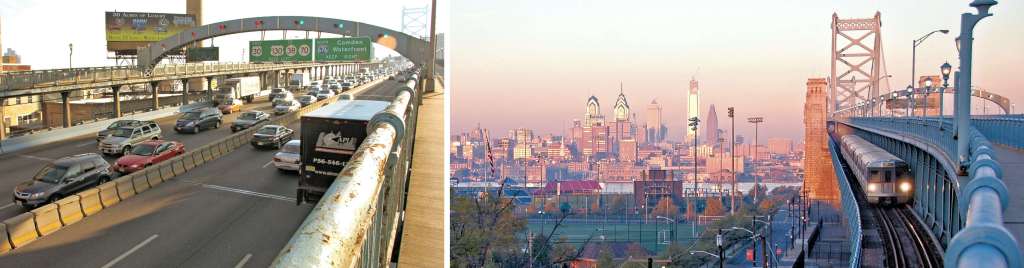
- P. 538: [On the role of mass media in sustaining the establishment]: “The final goal of this process would be a unified, homogeneous, completely standardized population, cut to the metropolitan pattern and conditioned to consume only those goods that are offered by the controllers and the conditioners, in the interests of a continuously expanding economy. In countries like the United States where this development has been swiftest, that goal is already clearly in sight. Need one wonder that in this country, during the past decade, something like twice the sum was spent per family on advertising as was spent on primary and secondary public education? Control without kingship: conformity without choice: power without the intervention of personality.”
- P. 544: “The form of the metropolis, then, is its formlessness, even as its aim is its own aimless expansion. Those who work within the ideological limits of this regime have only a quantitative conception of improvement: they seek to make its buildings higher, its streets broader, its parking lots more ample: they would multiply bridges, highways, tunnels, making it ever easier to get in and out of the city, but constricting the amount of space available within the city for any other purpose than transportation itself.”
- P. 545: “For unfortunately, once an economy is geared to expansion, the means rapidly turn into an end, and ‘the going becomes the goal.’ Even more unfortunately, the industries that are favored by such expansion must, to maintain their output be devoted to goods that are readily consumable, either by their nature, or because they are so shoddily fabricated that they must soon be replaced. By fashion and built-in obsolescence the economies of machine production, instead of producing leisure and durable wealth, are duly cancelled out by mandatory consumption on an ever larger scale.”


 The Creative Life Adventure
Leave a comment