Welcome back to the Creative Life Adventure.
I had the opportunity to read some outstanding books in 2023 and I hope you did, also. Last year I skipped this list, and can’t recall why. But here are my favorites among the books I’ve read in 2023, regardless of publication date. I’ve already mentioned a few of these books in blog posts throughout the year, but they’re all worth mentioning again. I read a mix of fiction and non-fiction, but for reasons I can’t explain, I’m finding that the older I get, the more I’m drawn to non-fiction. The books are listed alphabetically by author’s last name.
Also, this seems like a good time to remind you that my most recent novel Lost Souls is available from many classy (and not so classy) online retailers in print and digital editions.
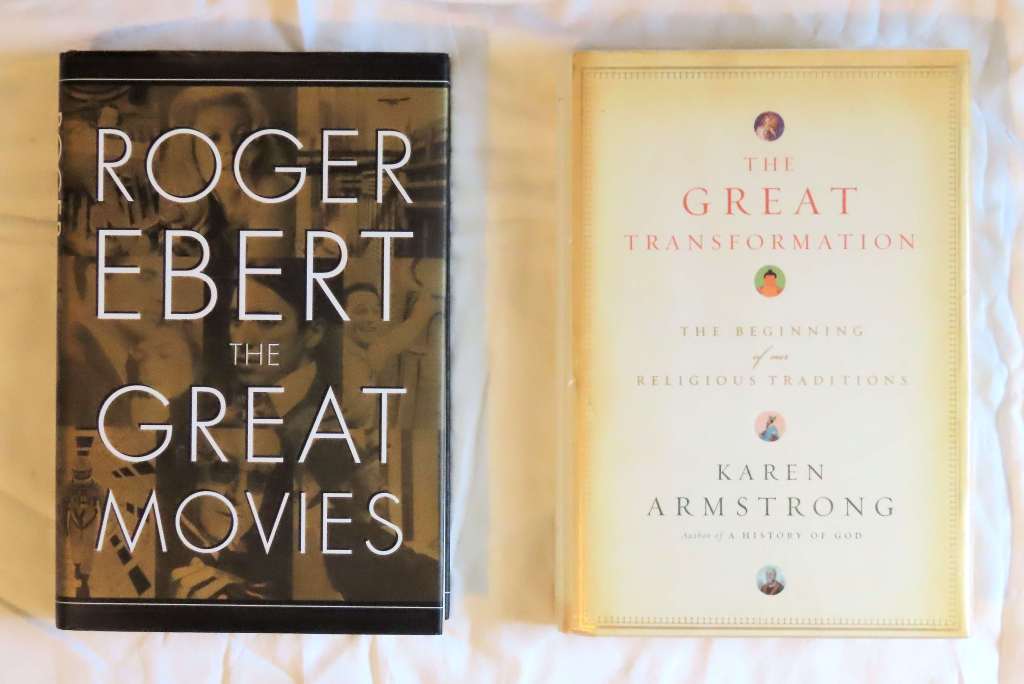
The Great Transformation: The Beginning of Our Religious Traditions by Karen Armstrong
I’m not a religious person, but religion has been, and remains, a driving force in human history. Karen Armstrong’s The Great Transformation describes the development of religious and philosophical thought during the Axial Age, focusing on China, India, Israel, and Greece. For such a broad and complex subject, Armstrong’s writing is very accessible for lay readers like myself. It’s a fascinating book about a period in history that influences much of human thought and behavior to this day.
The Outlier: The Unfinished Presidency of Jimmy Carter by Kai Bird
Many people believe Jimmy Carter’s presidency consisted of little more than the Iran hostage crisis and damage control for brother Billy’s tragic demons. Kai Bird’s The Outlier fills in all the details, and it’s more fascinating than you can imagine. This book is not a work of tribute – while Bird clearly admires Carter, he’s perfectly willing to explore the complex aspects of Carter’s personality, a president who was often his own worst enemy. However, The Outlier makes a compelling argument that Carter was often the smartest person in the room, and that the U.S. would be a better country today if more people had listened to him.
The Great Movies by Roger Ebert
I was a fan of At the Movies, the weekly film review TV series hosted by Gene Siskel and Roger Ebert, but I was never comfortable with the hosts’ constant sniping at each other. I appreciated the way Roger Ebert seemed to mellow with age. It’s heartbreaking to think of what written works Gene Siskel might have given us if he hadn’t died so young, but at least we have Ebert’s numerous books. The Great Movies is the first in a series of 4 Great Movies books by Ebert, collections of reviews/essays about movies Ebert considered important. Even when I disagree with him – I just don’t get McCabe & Mrs. Miller (1971), as much as I want to – he always offered interesting insights into the films he reviewed.
The Dream Life: Movies, Media, and the Mythology of the Sixties by J. Hoberman
Speaking of movies: J. Hoberman was a long-time film critic for The Village Voice and he continues to write about movies and film history. The Dream Life is the first in a trilogy on Cold War film history, followed by An Army of Phantoms and Make My Day. Hoberman’s interest in these books is not to tell a conventional historic narrative, but to study the ways in which movies and politics influence each other. (It’s surprising – and a little terrifying – how much of our political life is influenced by movies.) As a result, some of the 1960s films most commonly written about don’t appear in The Dream Life, and that’s fine, because Hoberman’s mission is compelling and brilliantly fulfilled.
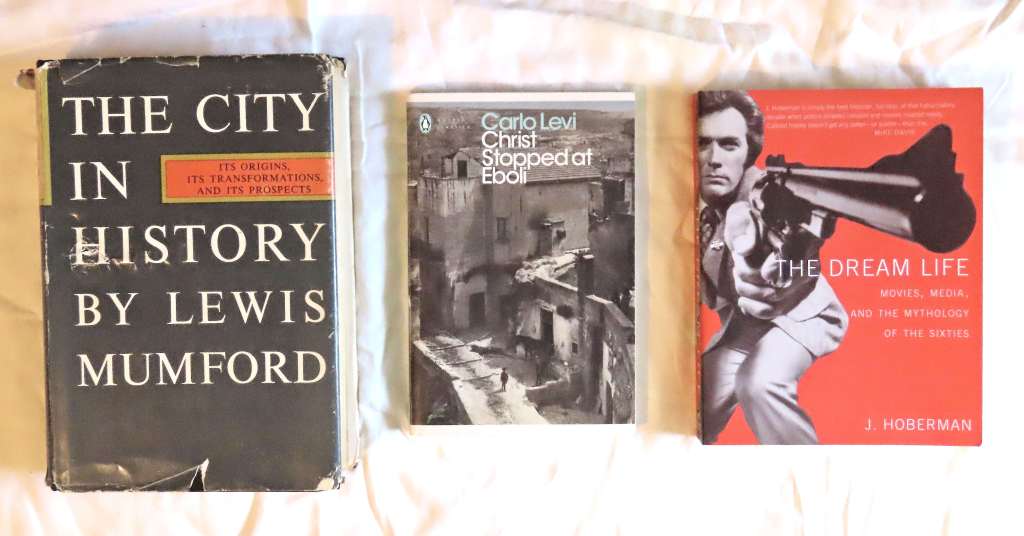
Christ Stopped at Eboli: The Story of a Year by Carlo Levi
I first learned about artist Carlo Levi’s year of exile in the deep south of Italy when I watched the 1979 film adaptation of his account on The Criterion Channel. Levi had angered the Mussolini government and was exiled to a remote area to keep him quiet. Released theatrically in a 150-minute version, don’t settle for anything less than the full 220-minute version that aired in 4 episodes on Italian television. The film adaptation is faithful, but Levi’s written memoir Christ Stopped at Eboli offers more depth on Levi’s own thinking and his growing sympathy for the isolation and desperate poverty of the tiny Italian village that welcomed him in 1935.
The City in History: Its Origins, Its Transformations, and Its Prospects by Lewis Mumford
Having read what many consider Lewis Mumford’s seminal work, the two-volume The Myth of the Machine, I was thrilled to come across a copy of The City in History in a used book store (in Quito, Ecuador, of all places). Published in 1961, Mumford was clearly becoming somewhat cynical about human behavior, but he wasn’t as pessimistic as he would become in later years. The City in History has a clear Eurocentric bias, but Mumford acknowledges this early on as a limitation of his experience. Mumford’s analysis really does go back to the beginning of human settlements and continues up to the time he wrote it. Mumford’s writing style is surprisingly academic for someone who never completed a college degree, but his insights are so interesting that persistence will be rewarded.
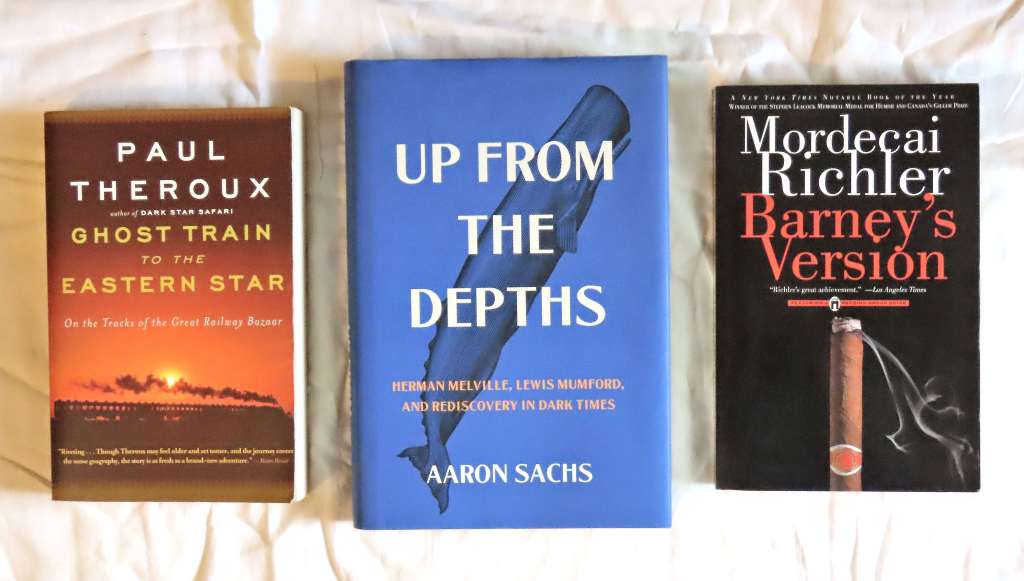
Barney’s Version by Mordecai Richler
I saw the film adaptation of Barney’s Version on DVD not long after it was released in 2010. It’s a highly entertaining and thoughtful blend of humor and human frailty. Had I read Mordecai Richler’s novel first, I would never have believed an effective film adaptation was possible. While the film reliably captures the novel’s tone, the novel has more depth and complexity that makes Barney Panofsky, the cantankerous protagonist/narrator who describes his life with an uncertain degree of accuracy, even easier and more difficult to feel compassion for.
Up From the Depths: Herman Melville, Lewis Mumford, and Rediscovery in Dark Times by Aaron Sachs
Speaking of Lewis Mumford, it was Mumford who wrote one of the early biographies of Herman Melville and established much of the foundation for the high regard we have for Melville today. Mumford found himself almost overwhelmed by immersing himself in Melville’s story and for the remainder of his life Mumford turned to Melville’s work for guidance. Aaron Sachs does a fine job of illuminating the parallels between the two lives and the ways in which they coped with personal tragedies and seemingly apocalyptic global changes. Up From the Depths doesn’t promise false hope, but it does remind us that the world has been ending for a long time, and maybe we can still find our way up from our own depths.
The American Way: A True Story of Nazi Escape, Superman, and Marilyn Monroe by Helene Stapinski and Bonnie Siegler
When I read The American Way over the summer, I declared it difficult to describe because of the myriad real people and true events the book portrays. Helene Stapinski and Bonnie Siegler use a rapid-fire series of brief chapters – like the panels in a comic book – to illustrate a vast web of connections and influences. Pursuing dreams, remaining open to possibility, and supporting the creative arts are all part of the journey. Superman confronting Hitler in 1944 must be one of pop culture’s greatest moments. And it’s a lesson we would be wise to heed today: rejecting Nazis is always a good idea.
Ghost Train to the Eastern Star: On the Tracks of the Great Railway Bazaar by Paul Theroux
Ghost Train to the Eastern Star is my first experience with Paul Theroux, and it’s so good I’m already reading more of his work. In the early 1970s, Theroux spent four months traveling by rail through Europe, the Middle East, India, southeast Asia, and Russia. The result was his first travel book, The Great Railway Bazaar. In 2006, an older and wiser Theroux attempted to retrace his journey, writing Ghost Train to the Eastern Star to describe his experience. The book is leisurely but hardly boring, packed full of anecdotes, conversations, and observations that amount to a compassionate assessment of the human condition.
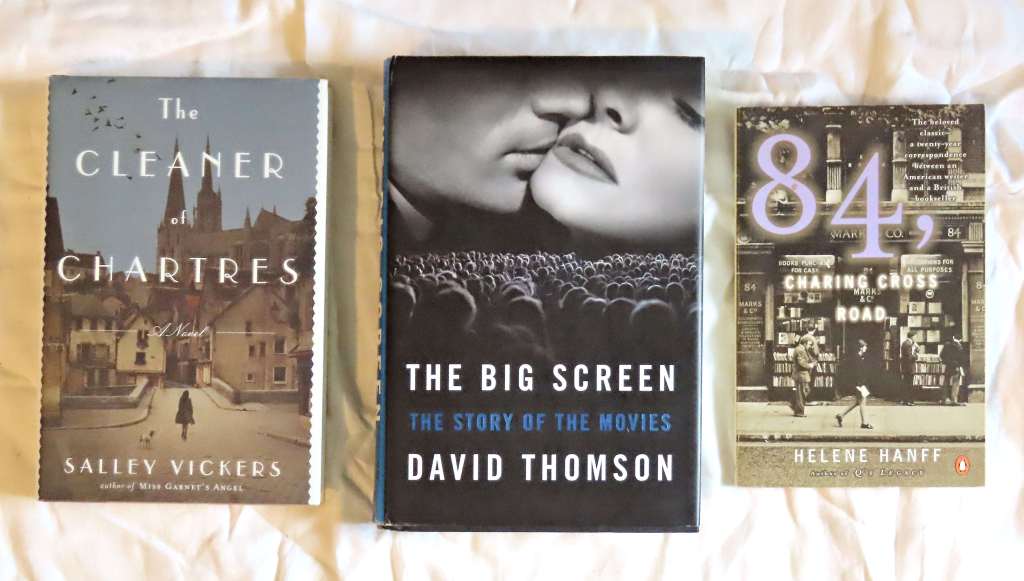
And rounding out my list with 5 honorable mentions:
84, Charing Cross Road by Helene Hanff
The Big Screen: The Story of the Movies by David Thompson
The Cleaner of Chartres by Salley Vickers
Timequake by Kurt Vonnegut
A Gentleman of France by Stanley J. Weyman
Have a wonderful 2024 and keep reading!
 The Creative Life Adventure
Leave a comment