Think good thoughts. Listen…listen – as we think, so we are. Both here and hereafter, in all the worlds. For thoughts are things, the parents of all actions, good and bad alike. And as the sowing has been, so the harvest will be.
The Years of Rice and Salt
by Kim Stanley Robinson
They’re Alright:
I watched the first season of the Amazon series Red Oaks this week. I’m generally skeptical of anything that comes of out Amazon, but Red Oaks is a lot of fun. I was first drawn to the series because it was executive produced by Steven Soderbergh, who I mentioned last week. The show’s creators clearly took a lot of inspiration from Caddyshack (1980), but Red Oaks is much better suited for the present day. The premise is simple: a college student in 1980s New Jersey becomes a tennis instructor at an upscale country club. Mayhem ensues. The ensemble cast gives us the pleasure of such veterans as Gina Gershon, Jennifer Grey, and Paul Reiser. Ennis Esmer as tennis pro Nash Nasser is another standout performance. I’ve just started the second season, and it doesn’t quite live up to the first; most notably in Skye Getty (Alexandra Socha) losing a lot of her snark and becoming more of a conventional girlfriend character. Still, while Red Oaks is not a great show, it’s an entertaining show with a superb cast. It’s currently free to watch on FreeVee.

The Original Flash:
I’ve also been watching the animated series The Adventures of Flash Gordon, which sometimes shows up as The New Adventures of Flash Gordon. The show had 32 episodes that were broadcast from 1979 to 1982. This version of Flash Gordon, as are most versions of Flash Gordon, is definitely aimed at young viewers. However, two things about the series caught my attention. One is that the first season is presented in serial format, similar to the Flash Gordon film serials of the 1930s, with each episode picking up where the previous one ended. (The animated series has a second season, and it’s presented in a more conventional collection of one-off episodes.) There may have been others, but I can’t recall another animated kids’ show from this time period that used a serial format.
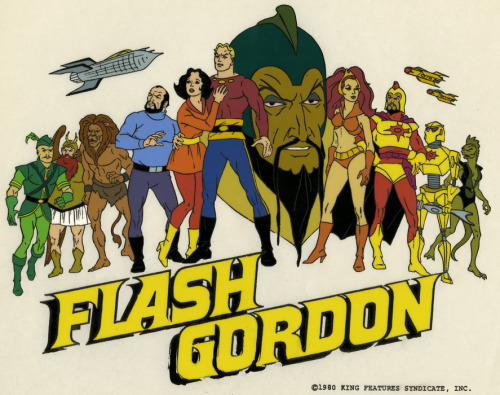
Secondly, I thought the animation style of The Adventures of Flash Gordon looked familiar. Sure enough, it was produced by Filmation, which also co-produced Star Trek: The Animated Series in the 1970s. Filmation produced an impressive catalog of animated and live-action works during the 1960s, ’70s, and ’80s. One of Filmation’s founders was Disney animator Hal Sutherland, who worked on such features as Peter Pan (1953) and Lady and the Tramp (1955). Filmation’s work wasn’t always of the highest quality, but they created some memorable shows featuring characters from DC and Archie Comics, among others. They also produced a live action show called The Ghost Busters, about three paranormal investigators with an office in a run-down building who used a “Ghost De-Materializer” to banish spirits back to where they came from. The 1984 feature Ghostbusters supposedly wasn’t based on the Filmation show, but the premise is suspiciously similar.

Either way, ST: TAS is a better-written show, but The Adventures of Flash Gordon is a pretty decent effort. Ming the Merciless is voiced by Alan Oppenheimer, who had an exhaustive list of film and TV appearances, including Westworld (1973), the first two seasons of The Six Million Dollar Man as Dr. Rudy Wells, and appearances in three different Star Trek series. This animated version of Flash Gordon is generally faithful to the original 1934 Flash Gordon comic strip by Alex Raymond and the 1936 film serial starring Buster Crabbe. The animated series is currently streaming free on Tubi along with some of the live-action serials.

Salt of the Earth:
…the word of God came down to man as rain to soil, and the result was mud, not clear water.
The Years of Rice and Salt
by Kim Stanley Robinson
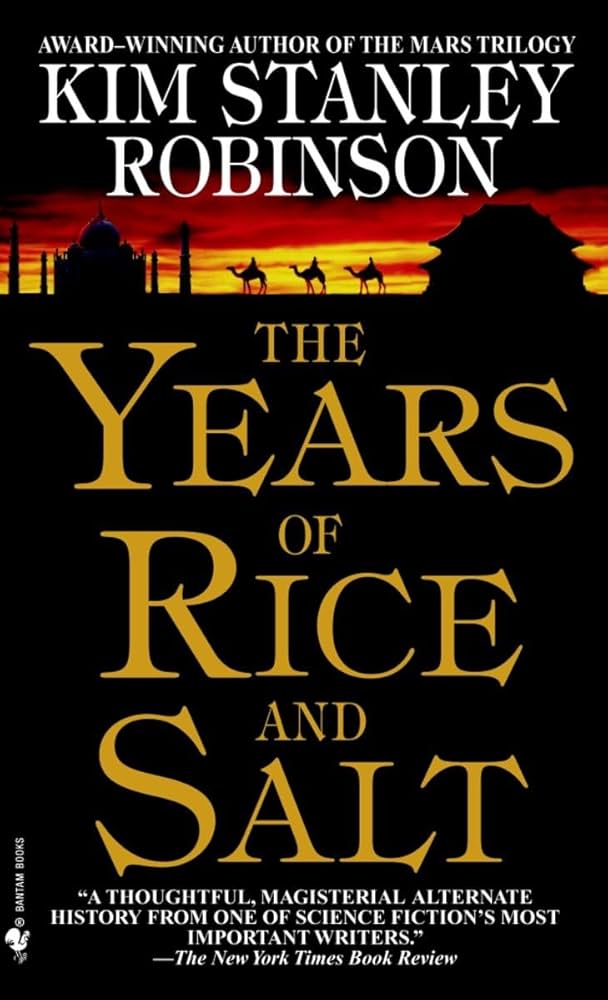
Finally, I’m reading The Years of Rice and Salt by Kim Stanley Robinson. This novel was published several years after the completion of Robinson’s Mars Trilogy, which is one of the most fascinating series of books I’ve ever read, genre or otherwise. I’m rarely interested in alternate histories, but I’ve read about one-third of The Years of Rice and Salt and I’m loving it so far. The premise is this: In the 1300s, bubonic plague killed about one-third of Europe’s population. Robinson’s book speculates what would have happened if, instead, the plague had killed 99% of Europe’s population. Clearly, world history would have unfolded very differently. The plot of The Years of Rice and Salt spans hundreds of years, and the book regularly sends me to the Web for research. For example, the novel includes an epigraph from the 16th century Chinese novel Journey to the West, and the opening pages are a direct reference to that historic work. Historic fiction that entertains and motivates me to learn more about the subject is just the ticket.


 The Creative Life Adventure
Leave a comment