Humans can never be trusted.
Kevin Durand as Proximus Caesar,
Kingdom of the Planet of the Apes
She’s Not Funny That Way
I’m a fan of Peter Bogdanovich: he came across as a fascinating person in interviews, I love a number of his movies, and his book Who the Devil Made It: Conversations with Legendary Film Directors is an inspiration. After listening to a series of conversations between Bogdanovich and Ben Mankiewicz for The Plot Thickens podcast, I sought out Bogdanovich films I hadn’t seen yet. On the streaming services available to me, I couldn’t find much besides the director’s last non-documentary feature, She’s Funny That Way (2014). It’s currently streaming on Tubi but I can’t honestly recommend it. Despite a strong cast and moments of clever dialogue, the screwball comedy is not very comedic. Imogen Poots‘ character speaks with a grating Brooklyn accent that is so phony it sounds like adult baby-talk. None of the characters are likeable. Stick with Bogdanovich’s previous films instead.

Let My Primates Go!
Kingdom of the Planet of the Apes is streaming on Hulu now, and that seems fast considering the film was just released theatrically in May. I don’t find Kingdom as astonishing as the earlier Rupert Wyatt / Matt Reeves trilogy, but it’s still an excellent addition to the Apes franchise. The collaboration between primates and eagles was fascinating. Peter Macon is perfect as Raka. My only real complaint is that the pacing of the film threw me off. It didn’t give the character dynamics enough time to develop. The first half moves at a deliberate pace, introducing the characters and establishing the world hundreds of years after the previous trilogy. The second half moved too quickly, so that the characters of Proximus Caesar, Sylva, Trevathan, and even Mae, get short-changed.
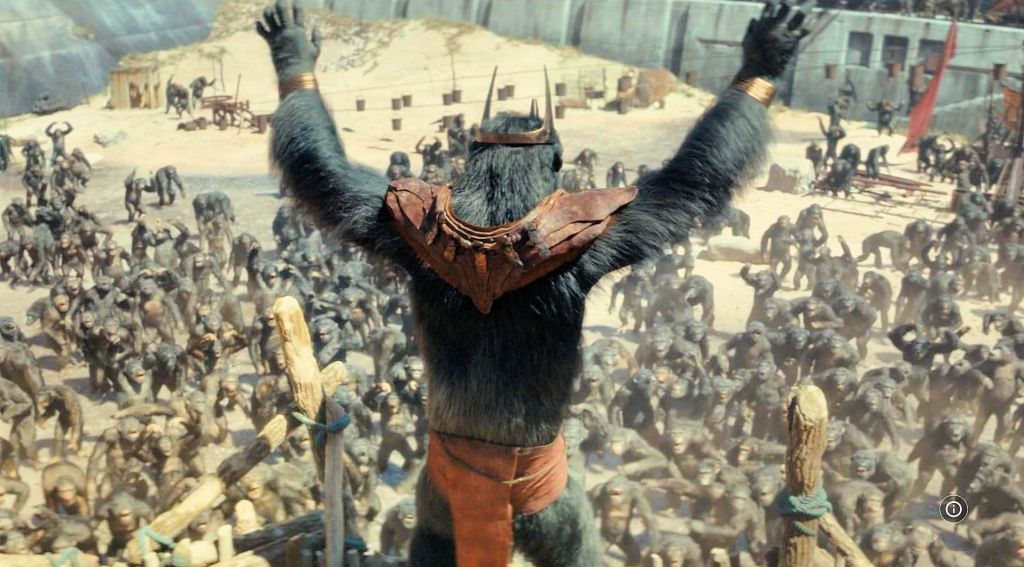
For example [Spoilers ahead, so skip down to the Kim Stanley Robinson section if you haven’t seen Kingdom yet.]: why is Proximus fascinated with Noa more than others? And how did Proximus convince so many other apes to follow him? (Maybe today’s Republican party is the explanation!) Caesar was something of a Moses figure in the previous Apes trilogy. Is Noa intended to remind us of Biblical Noah? He does, in a sense, lead his people through a flood. With Trevathan, I’m guessing that his name comes from the Old English reference to someone who lives near a village gate, as Trevathan does occupy a symbolic gateway between apes and humans. And the human doll, an obvious throwback to the 1968 film, distracted me: Kingdom appears to take place on the U.S. west coast, but Planet of the Apes was clearly set on the east coast. These elements all needed more development, but at nearly 2.5 hours, that might have required an entire additional movie. Either way, Kingdom is well-done and I look forward to the rest of this new trilogy.
Old Salt
How could one life encompass such change. Truly we live more lives than one.
The Years of Rice and Salt
by Kim Stanley Robinson
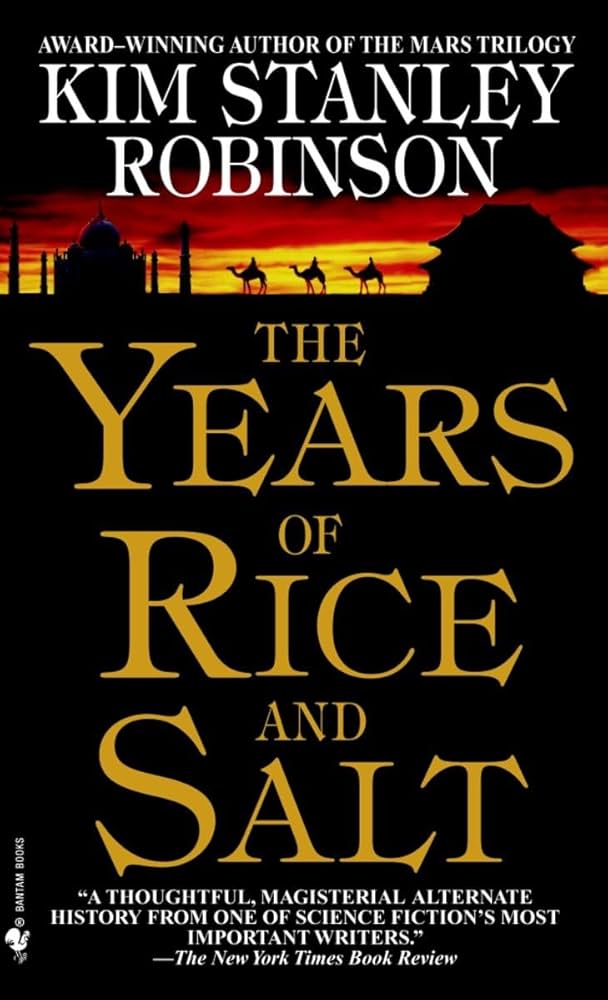
I continue reading Kim Stanley Robinson‘s alternate history novel The Years of Rice and Salt, which I mentioned last week. As I said then, I’m rarely a fan of alternate histories. In an interview with Science Fiction Studies, Robinson described my own limited thinking fairly accurately: “…the complaints about alternative histories being ‘too much like’ our history are always balanced, sometimes in the same commentator, by complaints that it is ‘too different to be possible,’ and I have concluded that really one can’t win: alternatives to our world history are in some deep sense unthinkable. The alternative history then becomes an exercise in pushing at that limit and always asking ‘why’ to one’s responses concerning ‘plausibility’ or the like.” Robinson’s book is not only a great read, but it’s giving me a whole new attitude toward alternate histories, just as his remarkable 2015 novel Aurora helped show me the limits of utopian thinking in stories of interstellar travel.




 The Creative Life Adventure
Leave a comment