No one wants to take the risks that a better life demands.
Robert Vaughn as the Symbol Maker’s Teenage Son
Teenage Caveman (1958)
Wise Running
For probably a year or more, various streaming services have listed the 1958 film Run Silent, Run Deep as recommended viewing for me. Despite the star power of Clark Gable and Burt Lancaster, I’ve ignored the suggestions because the algorithms are often wrong about me. Finally, I figured out that Robert Wise directed this movie and I caved in and watched it. Sorry I waited so long.
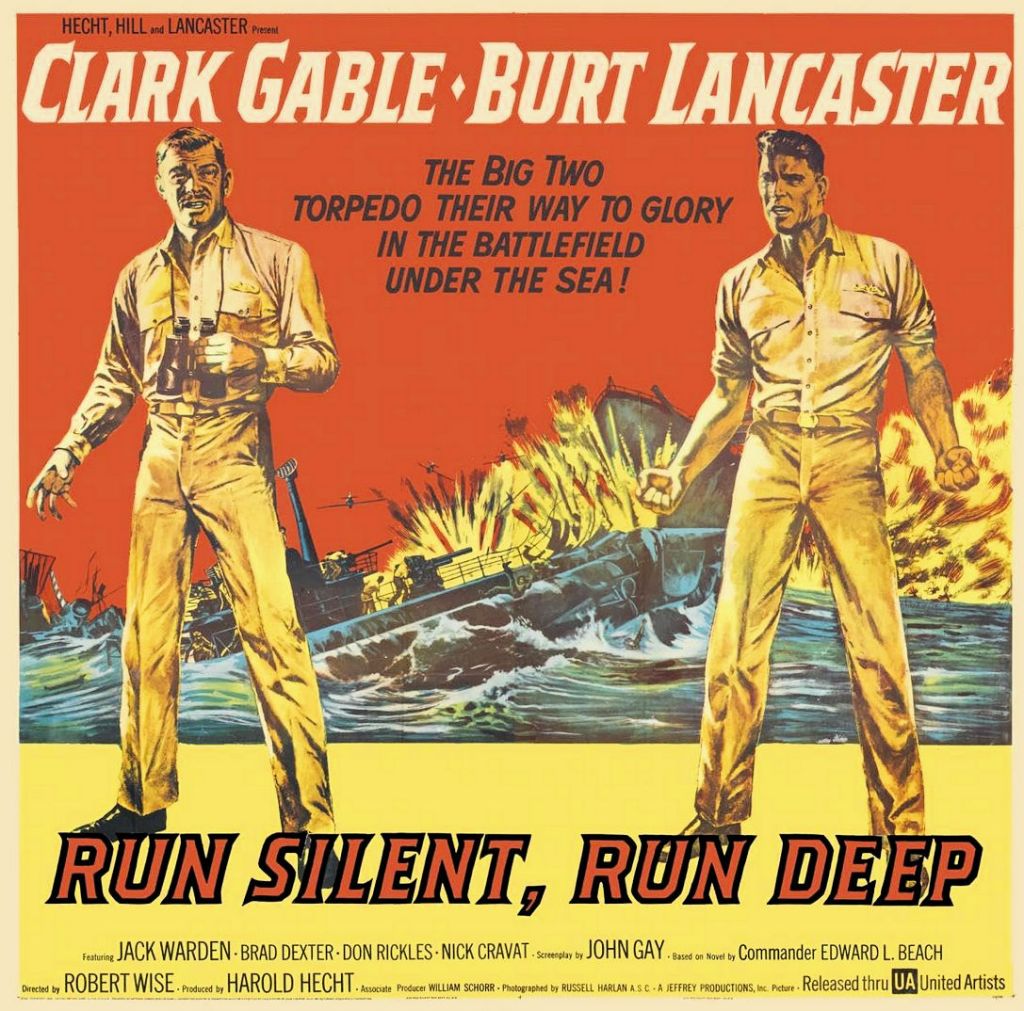
First, if you’re not familiar with Robert Wise’s work, what are you waiting for? He was a powerful and underappreciated director. Wise successfully directed films in a wide variety of genres: musicals, westerns, war movies, dramas, science-fiction, horror, you name it. The Day the Earth Stood Still (1951), West Side Story (1961), and The Sound of Music (1965) are only a few of his best known works. Star Trek fans remember him as the director of Star Trek: The Motion Picture (1979), a movie I appreciate more and more as I get older.

As for Run Silent, Run Deep, this black-and-white World War II drama was promoted as something of a mash-up of Moby-Dick and Mutiny on the Bounty, and it does strongly recall both of those stories. The premise: a bitter U.S. Navy commander (Clark Gable) pulls rank to take command of a submarine from another officer (Burt Lancaster) so that he can pursue the Japanese sub captain who sank his previous command. I can easily imagine Wise recalling this scenario when he directed a similar taking of command in Star Trek: The Motion Picture.
Revenge and obsession (Moby-Dick) is a classic theme; it’s really about coping, or failing to cope, with a profound loss, something we all experience at some point in our lives. Conflict over leadership or mission objectives (Mutiny On the Bounty) is an equally classic theme; if you doubt that, simply look at the U.S. during the 2000 or 2020 presidential elections. There’s a reason these types of stories show up so often – they reflect human behavior and frailty at the individual and collective levels. Even all these years later, Run Silent, Run Deep employs these elements in a well-paced, brilliantly acted film with visual effects that hold up equally well.
Not the Worst
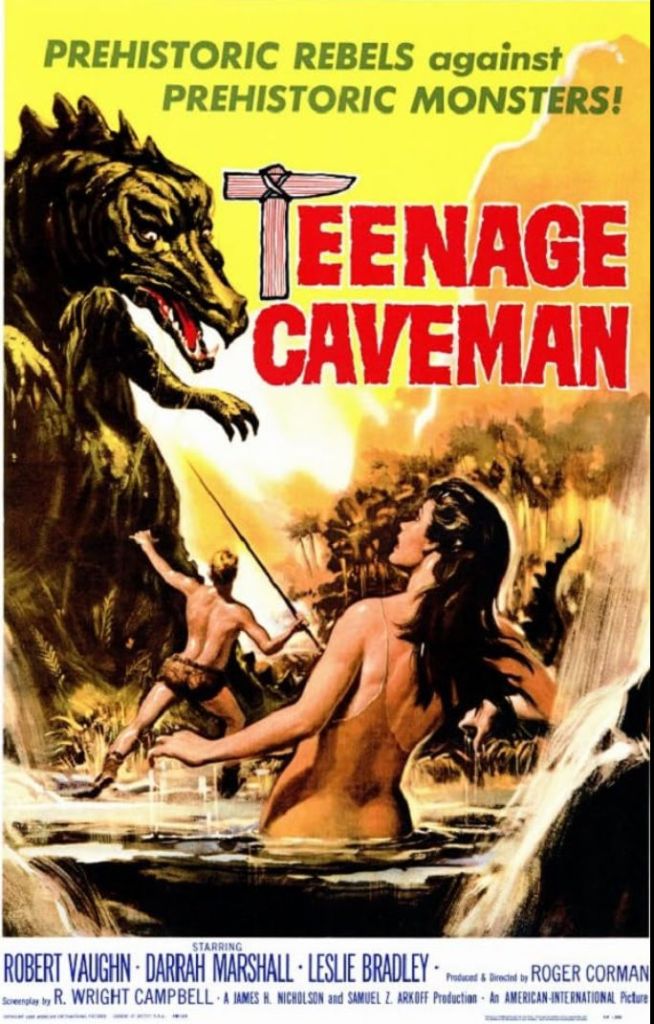
I also watched a pair of brief movies (65 minutes each) produced and directed by Roger Corman, who just passed away a few months ago: Teenage Caveman (1958) and The Viking Women and the Sea Serpent (1958). (There is some disagreement about Viking Women‘s release date – IMDB claims 1957, Wikipedia says 1958.) The actual title of the second film is The Saga of the Viking Women and Their Voyage to the Waters of the Great Sea Serpent, but, well, yawn. Neither film is all that great, but they are short and make an entertaining double feature. Teenage Caveman (a title that Corman rejected; he intended it to be Prehistoric World) has some interesting commentary on the dangers of fundamentalism and xenophobia but is hampered by serious over-acting, even by the Teenage Caveman himself, Robert Vaughn, at the ancient age of 25 when the movie was released. The twist ending will call to mind later films that I won’t name in the interest of avoiding spoilers. Vaughn later called it the worst movie ever made, but he obviously hadn’t seen Vivarium (2019), which is so bad I refuse to provide a hyper-link for it.
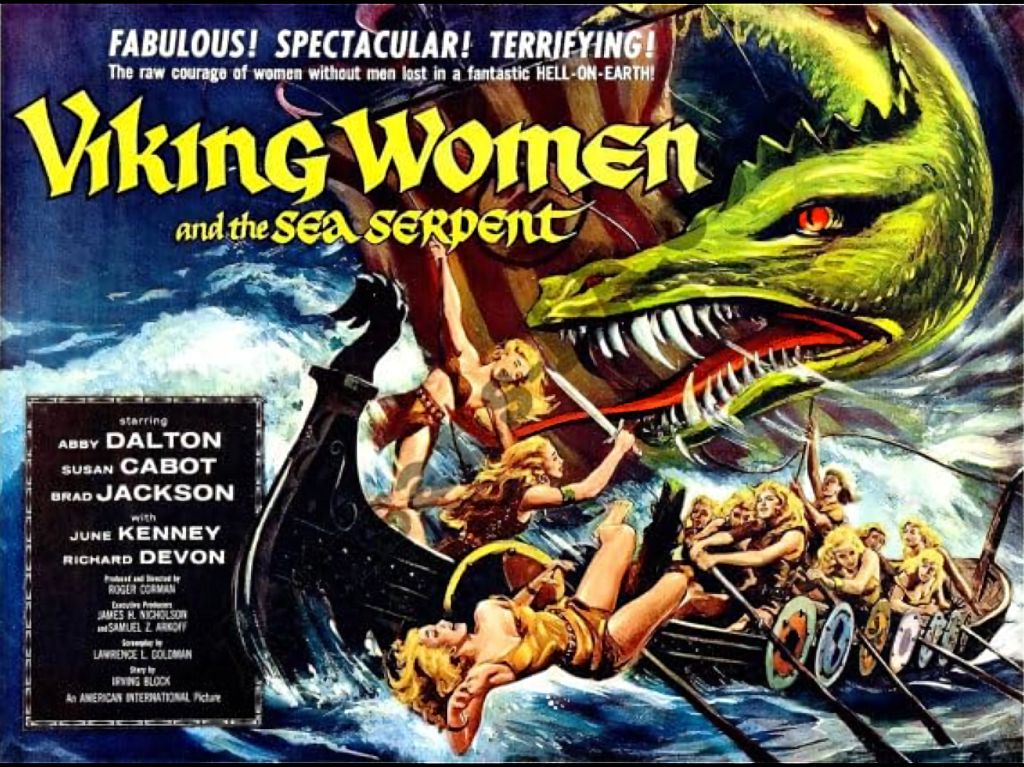
Viking Women is a bit schizophrenic when it comes to gender: a group of Viking women set out on a dangerous sea quest, which seems courageous, except their motive is to find their wayward men-folk because apparently no woman can imagine life without a man. “It’s ridiculous not to have a man,” Thyra (Betsy Jones-Morland) says early in the movie. Also, the sea serpent that’s so prominent in the title does not get much screen time. Still, the movie depicts the women repeatedly defending themselves against the evil Grimaults, which I guess is somewhat progressive by late 1950s standards. There’s also that dramatic sea launch when the women commence their journey. And the over-acting is not as severe as in Teenage Caveman.

A New World
The Buddha himself had said it: suffering is real. You have to face it, live with it. There is no escape.
The Years of Rice and Salt
by Kim Stanley Robinson
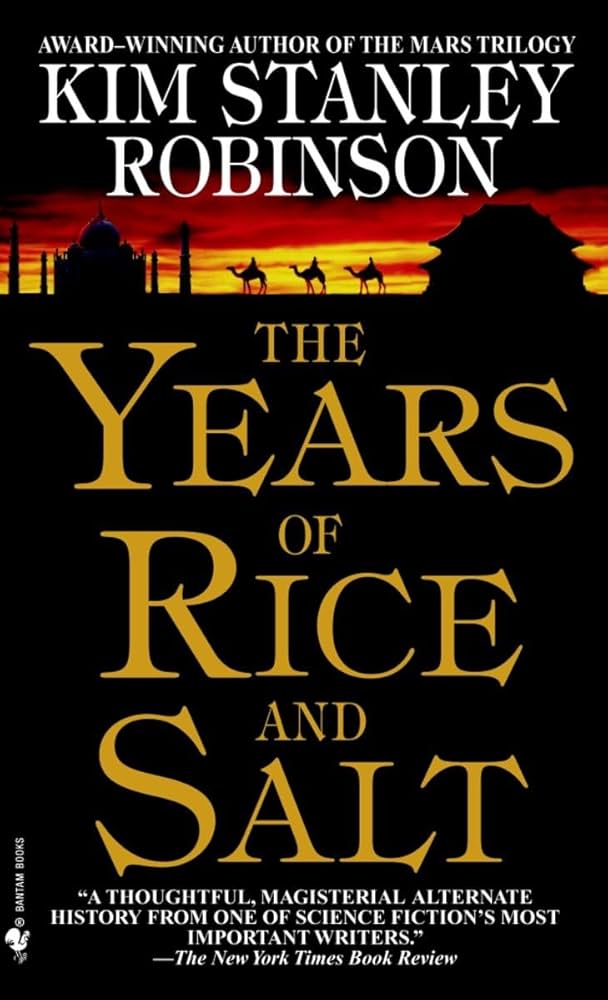
I’m finally near the end of Kim Stanley Robinson‘s alternate history novel The Years of Rice and Salt, mentioned last week and the prior week. One technique that Robinson uses in the novel is reminiscent of his earlier Mars Trilogy. In the Mars books, a genetic longevity treatment allows some of the central characters to live several hundred years, providing for common perspectives during the long-term terraforming efforts. In The Years of Rice and Salt, characters experience karmic rebirth. Each new life is influenced by their actions in their previous life while (typically) retaining no memories of those previous lives.
We are poor not for any material reason, but because of the way we are organized, do you see?
The Years of Rice and Salt
Kim Stanley Robinson
This collective reincarnation introduces the concept of a spiritual jati, a group of individuals linked across multiple generations of death-and-rebirth. It also emphasizes the repetitive nature of human history: despite change that is generally regarded as “progress,” conflicts over religion, resources, power, etc., result in cycles of warfare that prevent the full realization of human potential. At the same time, long-term progress is demonstrated by each generation learning from those who came before. A fascinating book, one I highly recommend.
Every day we wake up into a new world, each sleep causes yet another reincarnation.
The Years of Rice and Salt
by Kim Stanley Robinson
Steppin’ Out
Finally, this video fascinates me so much I wanted to share it. It was recorded 11 years ago but I only came across it this week. A complex, single-take video performed to a cool arrangement of a catchy tune by a legendary artist. From Herb Alpert‘s 2013 album Steppin’ Out. Enjoy.



 The Creative Life Adventure
Leave a comment