Look behind every new idea and you’ll find an old one…
The Campaign by Carlos Fuentes
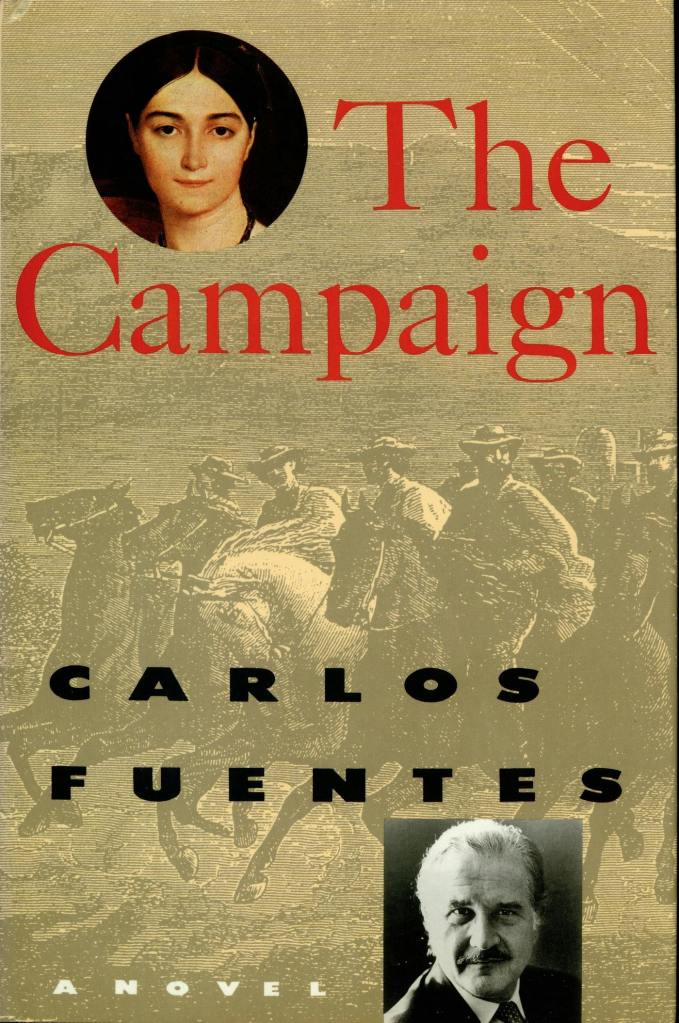
I’ve started reading The Campaign by Carlos Fuentes, published in 1990. (I’m actually reading the English translation published in 1991.) This is the first work I’ve read by the highly prolific writer and it’s a great starting place. Fuentes was part of the so-called “Latin American boom” of writers in the 1960s and 1970s that also included Julio Cortázar, Gabriel García Márquez, and Mario Vargas Llosa, among others. One significant aspect of Fuentes’ life is that, while he was born in Panama, his father was a diplomat from Mexico. As a result, his family lived in a number of international cities, giving him a more comprehensive Latin American perspective than many other writers.
Baltasar didn’t know if all the liberal constitutions in the world could be stronger than a simple patriarchal presence.
The Campaign by Carlos Fuentes
And that perfectly sets the stage for The Campaign, which takes place in Buenos Aires, the Argentine Pampa, Peru, Venezuela, Chile, and Mexico. Most of the action occurs in the 1800s and centers on young political revolutionary Baltasar Bustos, who switches the baby of a wealthy (and white) judge with the baby of a Black prostitute. Bustos falls in love with the judge’s wife on sight, and an unimaginable tragedy occurs, giving Bustos a long lesson on the personal consequences of national revolution. There is some historical context beyond my current knowledge, which seems appropriate for historical fiction. For example, the book begins in May, 1810, during the May Revolution in Buenos Aires and the beginning of the Argentine War of Independence, events I have no prior knowledge of. None of that diminishes my appreciation of the personal conflicts and the insightful characterizations. The Campaign is a slim-looking book but a grand tale.
He enjoyed all the elements: the earth that pulled him down, the air that drew him up, the fire that excited without destroying him, the water that liquefied every inch of his skin without breaking it. Everything was possible. Everything coexisted.
The Campaign by Carlos Fuentes
The Man Who Loved Boredom

I’ve enjoyed several earlier films by François Truffaut so this week I watched The Man Who Loved Women (1977). I admit, the premise sounded a little sketchy, but my streaming options are limited and this is the Truffaut work that was available. It’s simple: Bertrand (Charles Denner) is an aeronautical engineer whose primary interest is chasing women. The entire story is told in flashback – the movie opens with Bertrand’s funeral, attended only by his many conquests – much of which consists of Bertrand writing an autobiographical novel describing his numerous affairs. I trusted that Truffaut, the director of The 400 Blows (1959) for crying out loud, would put an interesting spin on this tale.
Never mind. The movie doesn’t fully stray into misogynistic territory – Bertrand claims that the women want exactly what he wants, and that generally seems true – but the slight attempts to give depth and motive to Bertrand’s behavior falls flat. We’re told that Bertrand provides happiness to untold women, but we only ever see Bertrand’s short-sighted perspective. I’m forced to agree with the opinion of the publisher evaluating Bertrand’s book late in the movie: “It’s the story of a womanizer who has never grown up.” Blake Edwards directed a U.S. remake with Burt Reynolds in 1983, and that doesn’t look any better.
Equal Opportunity Royale

Thankfully, I had a much better experience watching The Spook Who Sat By the Door (1973). Spook is a mashup of Blaxpoitation, action, speculative drama, and satire. The film was adapted from a 1969 novel by Sam Greenlee, a book that was based somewhat on Greenlee’s own experience in the U.S. Foreign Service. The author had to go all the way to London to get the book initially published. The premise is simple: The CIA is pressured to become racially integrated and does so, with great reluctance, by hiring one token Black employee, Dan Freeman (Lawrence Cook). (Free Man, get it?) Freeman plays a long game and learns as much as he can from the CIA. Then he takes that knowledge to Chicago and trains an army of Black militants. I’ll avoid any further description to avoid spoilers. Spook is not the most brilliantly made film – a few scenes play out a little awkwardly and a few of the fight scenes feel clumsily staged – but the movie’s premise and logic are pure genius. I could only find Spook on YouTube, but it has been released on DVD.
That’s significant, because the DVD release is part of Spook‘s history of suppression. The film didn’t stay in theaters long when it was initially released; Sam Greenlee believed the FBI was behind the movie’s quick disappearance. Actor Tim Reid had a lot to do with Spook finally being released on DVD in 2004 after finding a negative of the film in a United Artists vault. Except the studio had stored the movie under a different title in the hope that it would never be found. If you find that depressing, watch the movie for a little revolutionary hope.
 The Creative Life Adventure
Leave a comment