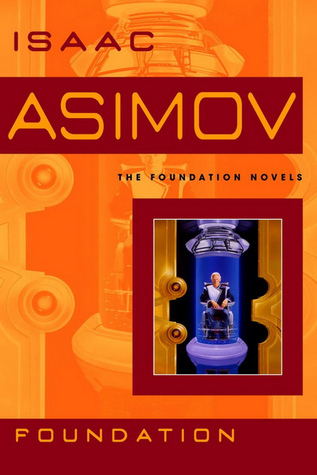
This week I was reminded that sometimes the “classics” don’t live up to their reputation. To begin with, I read the “classic” science fiction novel Foundation by Isaac Asimov. Yawn. Foundation was first published in book form in 1951, but the book collected a series of stories published in Astounding Science Fiction magazine in the early 1940s. The premise is straightforward – a Roman Galactic Empire is in its final days, and a Foundation (get it?) is created to reduce the length of the Dark Ages – er, dark age – until the next Empire strikes back arises. There’s a lot of talk of “psychohistory,” a “science” that can only be used to predict the behaviors of massive numbers of people, which is then used by individuals to manipulate other individuals in something of a self-fulfilling prophecy. The book was generally well received at the time, and Asimov made it a trilogy in 1952 and 1953. Then he wrote more Foundation books in the 1980s and 1990s, followed by even more Foundation books by other authors after Asimov’s death. The Foundation series is seriously considered a foundational (LOL! How original!) franchise for modern-day science-fiction. Why just look at the caliber of people who have been inspired by it – for example, Newt “Contract On America” Gingrich. Uh, well, how about Felon “I can’t spell so I’ll just call it X” Musk?
In fairness, plenty of decent people have also cited the Foundation series as influential, including Paul Krugman and Carl Sagan. But that doesn’t elevate my opinion of this snooze-fest. Asimov had a couple of thoughtful ideas but obscured them with lifeless characters and some of the silliest dialogue I’ve ever read in a work of fiction. The “good guys” are all marginally clever schemers and the bad guys are buffoons. And they’re all “guys,” because other than a vague mention of “wives and children” in Part 1, and a brief discussion of housewives and their need for home appliances in Part 5, there are exactly two female characters in the entire book. One is a nagging wife, and the other a dim-witted jewelry model whose sole dialogue is: “Oh!” I understand gender roles have changed since the 1940s, but a lot of people were talking about gender equality long before that; a genius futurist should have imagined more for women than simply being housewives. Other than making up a few clever futuristic gadgets – and relying heavily on the expected potential of nuclear power – Foundation hardly even qualifies as science-fiction. (My wife, on the other hand, is wisely reading Ursula K. Le Guin‘s The Left Hand of Darkness this week, and I may soon follow.)
Are You Sure You Want to Put “Stupid” in Your Movie Title?
Another “classic” is the work of director Billy Wilder (1906 – 2002). Many cinephiles consider Wilder one of the greatest movie directors of the 20th century. Wilder directed over 25 feature films and wrote or co-wrote even more. I’m sure he was a very nice person – and I don’t want to trivialize the profound trauma he experienced, losing his mother, grandmother, and stepfather in the Holocaust – but I had seen three of Wilder’s films before this week and only The Apartment (1960) really held my attention. This week I watched two more Wilder films to try and understand what all the fuss was about.
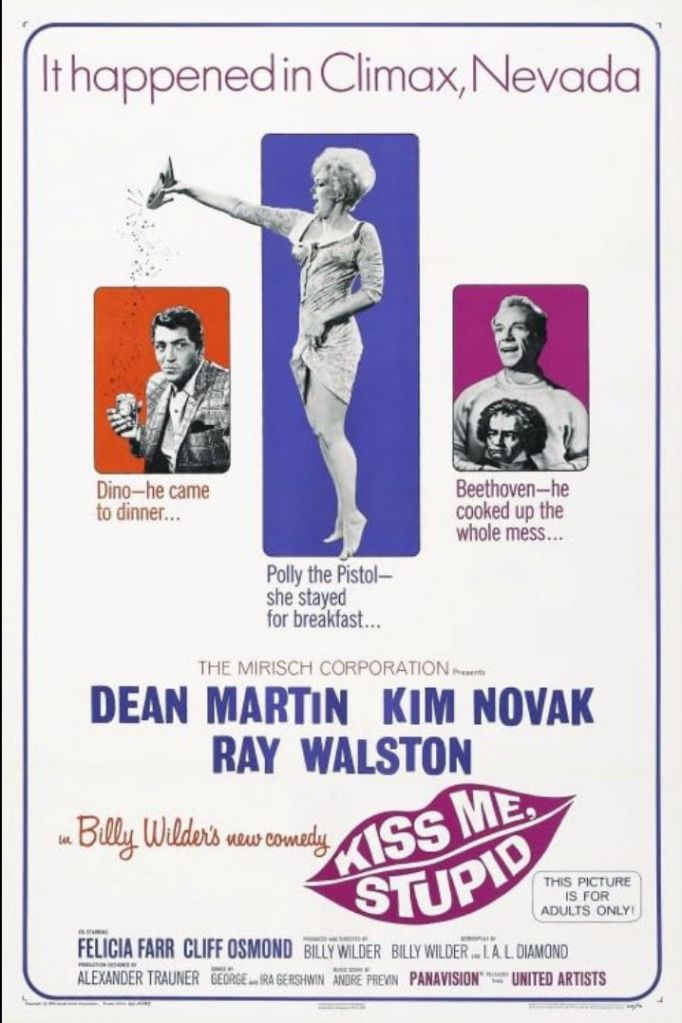
First, Kiss Me, Stupid (1964). The premise: two aspiring songwriters try to hit the big time by recruiting a prostitute to appease world famous singer and admitted sex-addict Dino. I’m not joking, that’s really what happens. “Dino” is Dean Martin in a self-parody that should have been funny; Martin was a better actor than he generally got credit for. The prostitute is played by Kim Novak, who never looked lovelier but was cursed by a role originally written for Marilyn Monroe. Monroe’s death in 1962 was one of several tragedies and setbacks that delayed the movie’s production. Novak seems to be impersonating Monroe throughout the movie, and I don’t know who came up with that idea, but it is as unpleasant as it sounds. And get a load of this dialogue: “A woman without a man is like a trailer without a car. You ain’t going nowhere.” Pure genius! This is the second film I’ve watched recently (the other being The Notorious Landlady (1962), also with Kim Novak) featuring a talented cast that deserved a much better script. Kiss Me, Stupid was more suited for a Love, American Style episode, not a feature film.
Witness This, Prosecution
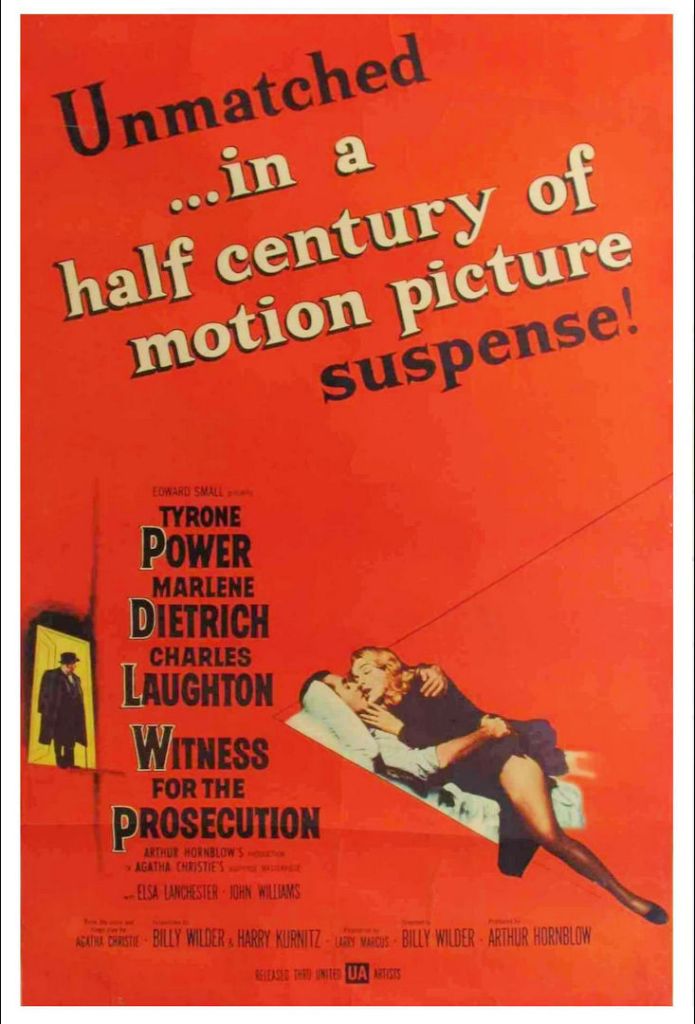
Finally, the second Billy Wilder film I watched this week was Witness for the Prosecution (1957). The premise: a man (Tyrone Power) is accused of murdering a wealthy woman who has named him as the prime beneficiary in her will. He’s defended by a famous barrister (Charles Laughton), and his primary witness is his suspicious-acting wife (Marlene Dietrich). Witness for the Prosecution at least had some entertainment value, but it took a long time to get going. Subplots about how the husband and wife met and about the barrister’s recovery from a heart attack contribute little to the story. The second half of the film, the actual trial, is far more interesting.
Not only do I not understand the high praise for Wilder’s movies, I’ve also never understood the public’s fascination with Marlene Dietrich. I simply find her uninteresting as an actor. Also, the studio, United Artists, included a request over the end credits that the audience keep Witness for the Prosecution‘s “surprise” ending to themselves. I’ll just say that nothing about the conclusion surprised me. Honestly, this entire movie has me stumped. It was nominated for a truckload of awards. The source material’s author, Agatha Christie, was very happy with the film. Reviewers today are so eloquent in their praise that I wonder if we’re watching different movies.
This may all seem very negative, and I generally try to stay positive in these Friday posts. But I think it’s important that we – whether we’re creating content or viewing it – not feel too much pressure when it comes to standards, classics, canon, or whatever other term is applied. Sometimes we just don’t connect with a story or how that story is presented. If you enjoy Foundation or the movies of Billy Wilder, then enjoy them. But it’s perfectly all right if you’re not a fan of Shakespeare or the Mona Lisa or Kurosawa or…well, you name it. The beauty of art is that we can each interpret it differently, and that sometimes includes not enjoying it at all. I’m sure even psychohistory allows for a few outliers.
 The Creative Life Adventure
Leave a comment