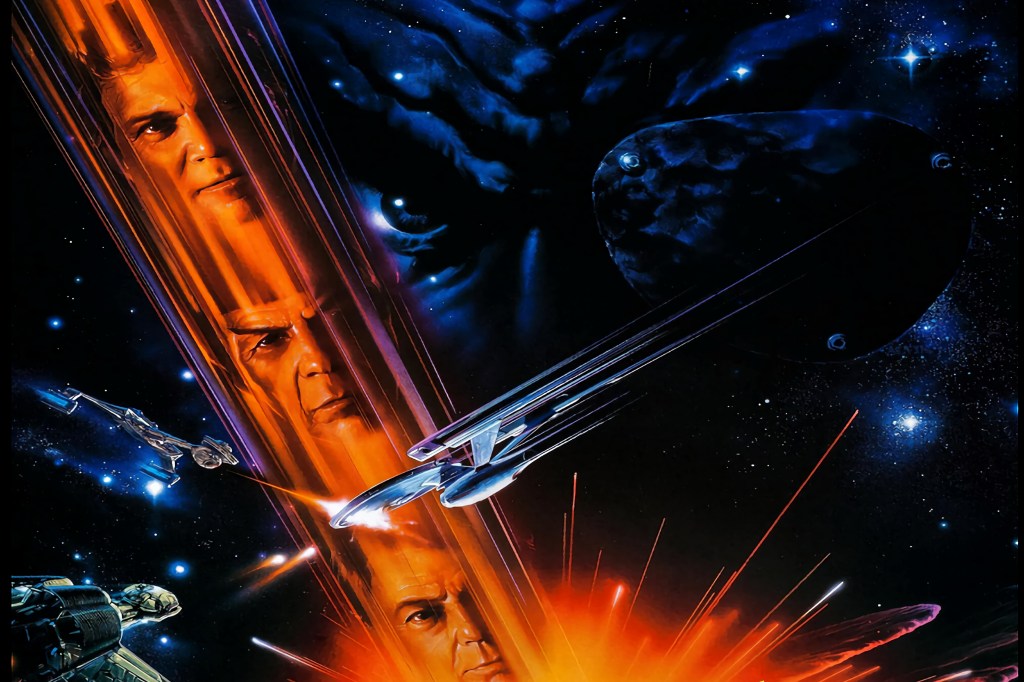
During 2020 – 2022, I wrote a series of essays about every episode of Star Trek: The Original Series. I’m finally expanding the work to include the original cast motion pictures. This is a link to the TV series essays. If you’re reading this, I assume you have already seen Star Trek VI: The Undiscovered Country. Also, if you enjoy this essay, please share it on your favorite social media platform so others can discover my work.
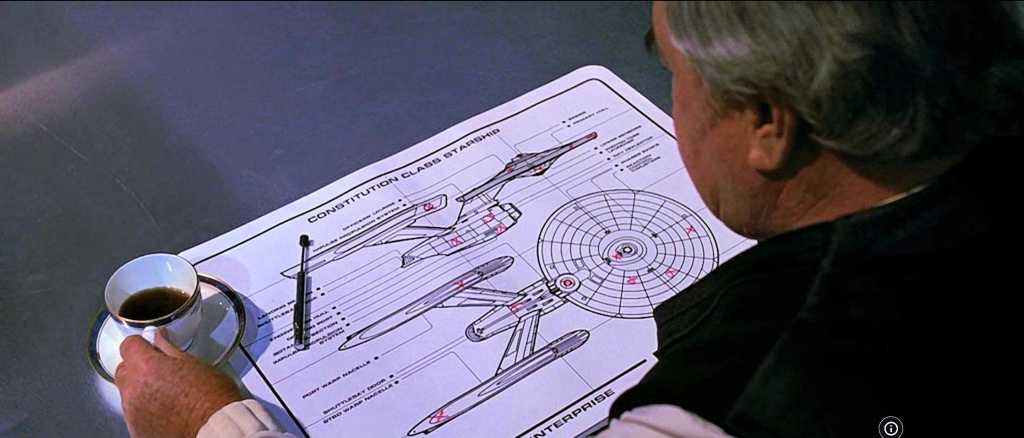
Release Date: 6 December 1991
Director: Nicholas Meyer
Composer: Cliff Eidelman
Crew Death Count: 2 (The traitorous Burke and Samno are killed. More crew members probably die in the final battle, but no individuals are identified.)
“Remember me.”
–Shakespeare, Hamlet—
Twenty-five years after our first adventure with the crew of the Enterprise, the long journey comes to an end in Star Trek VI (STVI). And we go out in grand style, concluding a long-arc storyline that goes back to the series’ first season and runs through Star Trek I, III, IV, and V. This time, the survival of the entire Klingon Empire is in jeopardy after the Klingon moon Praxis is destroyed by over-mining. Peace negotiations are undertaken between the Federation and the Empire, with the Enterprise crew assigned to escort Klingon Chancellor Gorkon (David Warner) through Federation space. The entire endeavor is sabotaged by a militant group of Klingons, Romulans, and Federation personnel (including at least one Vulcan). In a rousing climax, the crew defeats the conspirators and brings the Federation and the Empire together with the hope of a lasting peace.
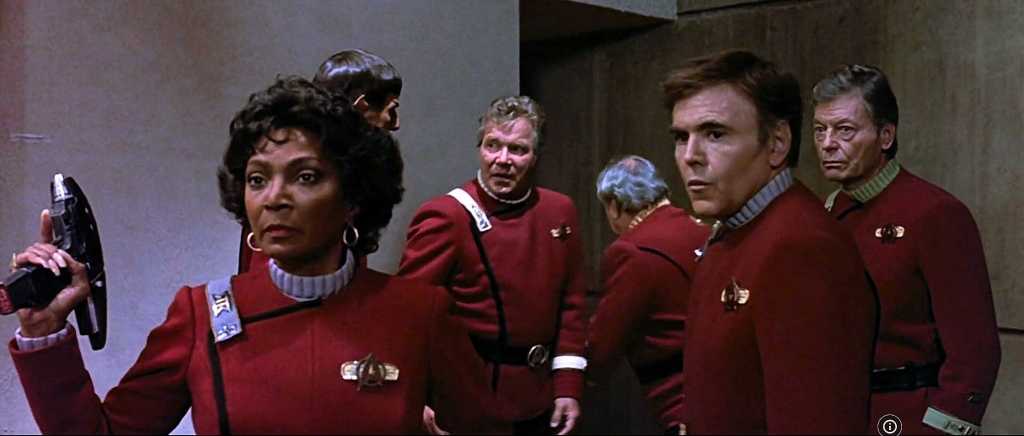
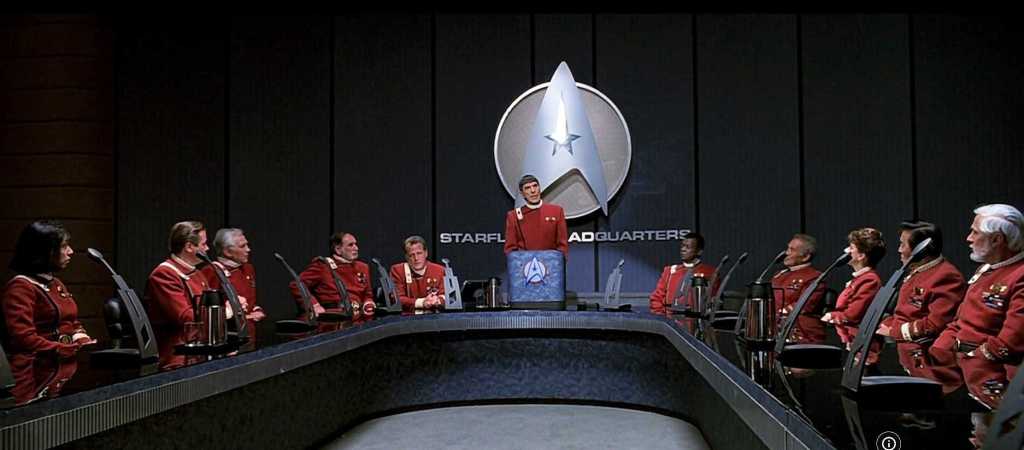
What’s initially surprising about STVI is how many of the senior crew members have moved on from their long-held positions. Uhura is chairing a seminar at Starfleet Academy. Scott has bought a boat – is he ready to retire? Sulu is captain of the USS Excelsior, the ship he so admired in Star Trek III. In leading the meeting of senior Starfleet personnel – sort of an uber-conference room scene – and negotiating with Chancellor Gorkon, Spock is informally following in his father’s ambassadorial footsteps. The status of Chekov, McCoy, and Kirk are not specified. Given Kirk’s assignment to escort Gorkon, we can assume he remains committed to his role as captain. It’s easy to imagine that McCoy and Chekov may be moving on in unspecified ways – McCoy was retired at the beginning of The Motion Picture (though he presumably sticks around, according to The Next Generation), and Chekov deserves to be in line to captain the Enterprise. Kirk does offer the vague proposition that “this crew is due to stand down in three months.” Are they “standing down” from service on the Enterprise? Kirk, more than anyone, should be troubled by this. Either way, we have returned to the inevitable course of life established with the Kobayashi Maru training sequence in Star Trek II; it was inevitable that the crew would have to move on eventually.
Like the Enterprise crew, the Klingon Empire has arrived at a crossroads. The Klingons were introduced in the first season episode “Errand of Mercy.” In that episode, the Federation and the Empire were already engaged in delicate negotiations. A conflict over the planet Organia resulted in the Treaty of Organia, which defined conduct within the Neutral Zone separating the two galactic powers. This status of an uneasy peace drove the conflict in three subsequent Klingon-centric episodes. In The Motion Picture, Klingons appeared only briefly during V’Ger’s approach to Federation space, but it was a reminder that both parties could be impacted by larger events (a dynamic explored in more detail in Deep Space Nine). The Kobayashi Maru test in Star Trek II reminded us of the sensitive nature of the Neutral Zone. Star Trek III, IV, and V further developed the Cold War conflict when the Federation and the Empire disputed the possession and use of the Genesis device. (Those movies also indicated that some type of negotiations were in progress.) The decision to put Kirk and McCoy on trial, rather than executing them outright, seems intended for public image, obtaining vengeance (a proportional response?) without committing an open act of war.

STVI clearly draws inspiration from the 1986 reactor explosion at the Chernobyl Nuclear Power Plant in an area of the USSR that is now part of Ukraine, “significantly” contaminating about 39,000 square miles with radiation. Mikhail Gorbachev claimed that the economic impact of Chernobyl was “perhaps the real cause of the collapse of the Soviet Union.” This provides a strong real-world parallel for STVI, as Praxis is the Empire’s “key energy production facility.” With fifty earth years of life left, the Empire has no choice but to seek assistance, and the right leader at the time turns to the Federation: Gorkon is the Empire’s Gorbachev equivalent, ready to lead his people into “the undiscovered country,” Shakepeare‘s description from Hamlet of a fear of the future and its many uncertainties:
     To grunt and sweat under a weary life,
     But that the dread of something after death,
     The undiscovered country from whose bourn
     No traveler returns, puzzles the will,
     And makes us rather bear those ills we have,
     Than fly to others that we know not of?
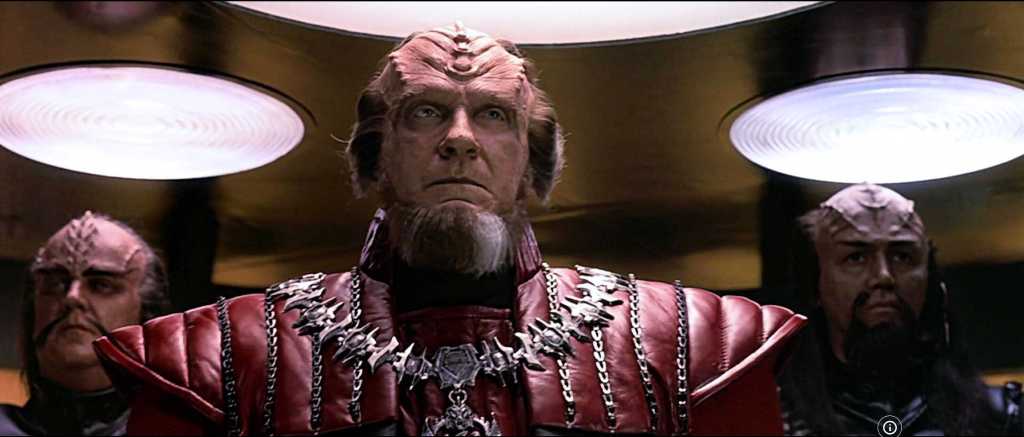
The name Praxis symbolizes this transformation. Greek philosopher Aristotle listed “praxis” as one of three basic human activities: theoria (thinking), poiesis (making), and praxis (doing). In the 1800s, philosophers August Cieszkowski and Karl Marx applied the term to society-changing action. We know humans resist societal change – the Civil Rights Movement and the assassinations of such transformative leaders as Abraham Lincoln and Emiliano Zapata confirm this – so it should be no surprise that a Klingon leader open to compromise would also be assassinated, as Gorkon is. (The deaths of the assassins, late in the film, prompt Kirk to say, “First rule of assassination: kill the assassins,” which feels like a reference to conspiracy speculation around the assassination of JFK and the subsequent murder of his assassin, Lee Harvey Oswald, on live television.) Yet Gorkon is, perhaps, too conciliatory, embracing drastic change faster than his people can accept, thus requiring his daughter Azetbur (Rosanna DeSoto) to maintain a tough line with the Federation while remaining open-minded and realistic about the Empire’s prospects. Azetbur is the third way, seeking an end to hostilities while not compromising Klingon heritage.
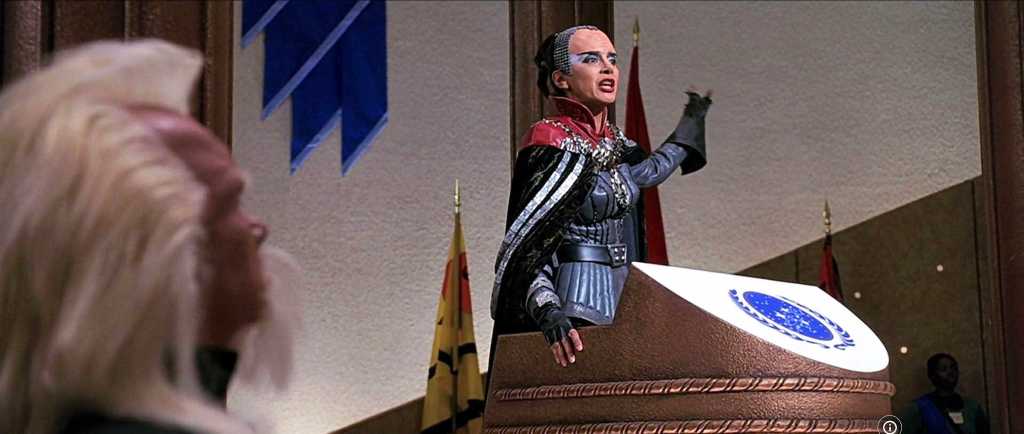
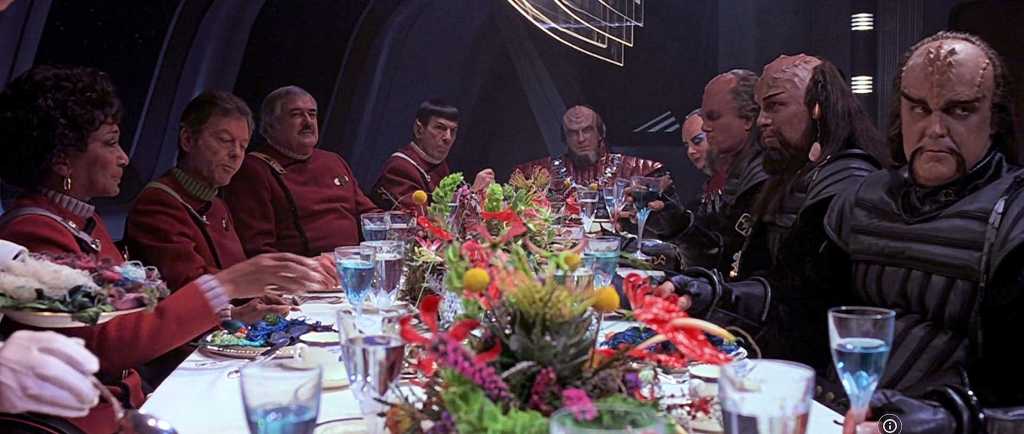
The prospect of the entire Klingon Empire taking shelter among the Federation fully reveals the bigotry and elitism inherent to the Federation, a fairly courageous story-telling decision considering how nobly the Federation is often portrayed. We see discrimination at the institutional level, when a Federation influencer like Admiral Cartwright (Brock Peters) predicts the Klingons will become the “alien trash of the galaxy,” dialogue that Peters found so offensive, he nearly choked on it. We also experience discrimination at the individual level when the Enterprise crew hosts a dinner with Gorkon and his senior officers; note Chekov’s clumsy use of the phrase “inalienable human rights.” Our “heroes” seem shocked that members of an entirely different culture might actually have different customs around food and social interactions. At one point, Scott even refers to Azetbur as a “Klingon bitch.” Even our most noble heroes are not infallible.
Beyond cultural discrimination, the stakes are also personal and again recall past adventures. “I can never forgive them for the death of my boy,” Kirk says, remembering the death of his son David Marcus at the hands of Klingons in Star Trek III. Acknowledging a mindset entrenched by the long shadow of history, Kirk asks, “But how on earth can history get past people like me?” Perhaps the question contains its own answer: the path forward will not be found “on earth,” but on neutral ground like Camp Khitomer. Gorkon also anticipates the necessity of a generational shift in attitudes when he tells Kirk, “If there is to be a Brave New World, our generation is going to have the hardest time living in it.” Yet Kirk’s reputation as a legendary Klingon antagonist is exactly what suits him for the role of “olive branch.” As Spock says, “Only Nixon could go to China.” Only an outspoken, anti-communist Cold Warrior like Richard Nixon would have been permitted political leeway to open U.S. negotiations with communist China of the 1970s.
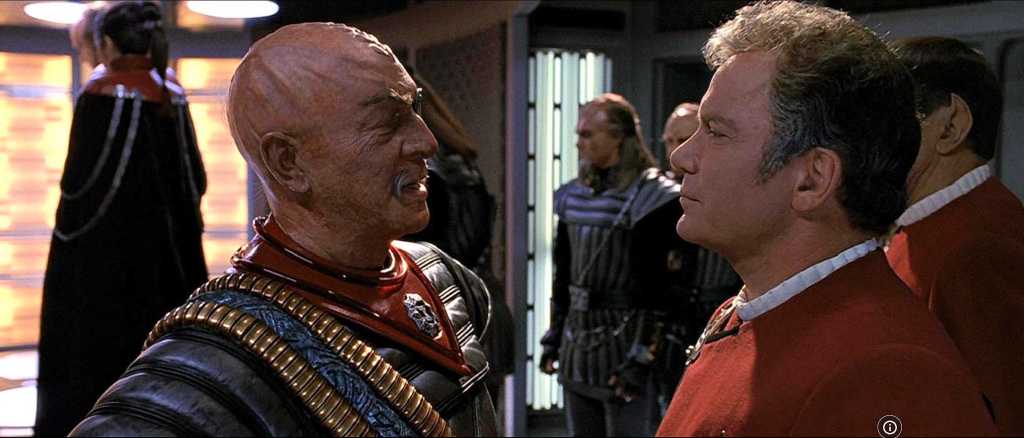
Spock, as he has so often been, is somewhat the moral compass of this story. (As is Gorkon, to a large extent.) Spock initiates the outreach to Gorkon and the Empire. As he has in the past – “The Menagerie” and “The Galileo Seven” come to mind – Spock initiates a bold move that is initially ridiculed but later proven correct. Spock has perhaps evolved more than any other character in the franchise, and here we see the culmination of wisdom earned in the series and the prior movies, fully integrating his Vulcan and human heritage: “Logic is the beginning of wisdom,” Spock tells his protege Valeris (Kim Cattrall), “not the end.” The Kirk-Spock friendship is severely tested, much more so than with the Sybok debacle in Star Trek V, by Kirk’s resistance to Klingon peace overtures. Despite his wisdom, Spock still doesn’t fully understand the depth of Kirk’s anger toward his decades-long nemesis, particularly after David’s death.

Spock’s judgment is also clouded in his relationship with Valeris. With Saavik out of the picture – early plans intended her to be the turncoat, but Gene Roddenberry wisely refused – Valeris is now Spock’s resident Vulcan apprentice. Valeris does seem a bit emotional for a Vulcan – her enthusiasm for taking Enterprise out of spacedock on impulse power, for example – which may be a red flag as to her true nature. The private conversation between Spock and Valeris almost has romantic undertones. He also imparts to Valeris a variation on the classic Star Trek wisdom that we weren’t meant for paradise: the Marc Chagall painting Adam and Eve Expelled from Paradise is Spock’s reminder “that all things end.” A collapse of the long-time Cold War conflict between the Federation and the Empire will have a significant outcome on millions, perhaps billions of inhabitants throughout the galaxy.
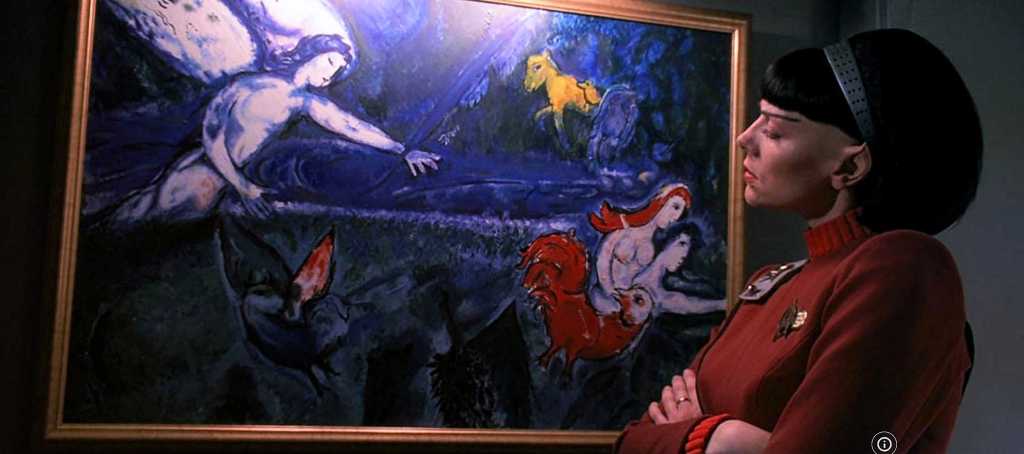
Is the loss more personal, and more opaque, than we might first believe? Has the accumulation of time and risk and sacrifice culminated in a loss of innocence? The crew that once boasted of its advanced mindset is now possessed by bigotry. Spock, more than the others, is personally offended by Valeris’ choices, fully revealing his human character when he tells her: “What you want is irrelevant. What you’ve chosen is at hand.” And Spock’s assault of Valeris, on Kirk’s order, while the entire bridge staff watches, only gets harder to watch with time. This endorsement of torture is an extreme version of the aggressive Spock we occasionally saw, primarily in Season One, as when Spock urged Kirk to assassinate Gary Mitchell in “Where No Man Has Gone Before,” a willingness to shoot first if it saved the crew. Is this egregious act the real “expulsion from paradise”? Among even this crew, Spock understands sacrifice better than anyone, as he reminds us: “I’ve been dead before.”

“So, this is goodbye,” Chekov says at the end. It’s not just the Federation/Empire feud that is ending; this is the last time the entire original cast appeared on screen together, and it is a fitting send-off. McCoy wields his medical skill in a more down-to-earth manner than ever, applying CPR in a desperate attempt to save Gorkon. Chekov, Uhura, and Scott all have their moments as beloved senior officers. Sarek (Mark Lenard) makes a brief return, as does Rand (Grace Lee Whitney), along with the Klingon Ambassador (John Schuck). Sulu shines at key moments, particularly when the Excelsior saves the day at the end. Yes, there are a few clunky moments: the scene where the crew consults vintage language texts to sneak past a Klingon sentry is a sample of lazy writing; shape-shifter Martia (Iman) feels shoe-horned in to provide Kirk and McCoy a means of escape from Rura Penthe. But, like Star Trek II, the stakes are both local and cosmic, with consequences that will reverberate for years.
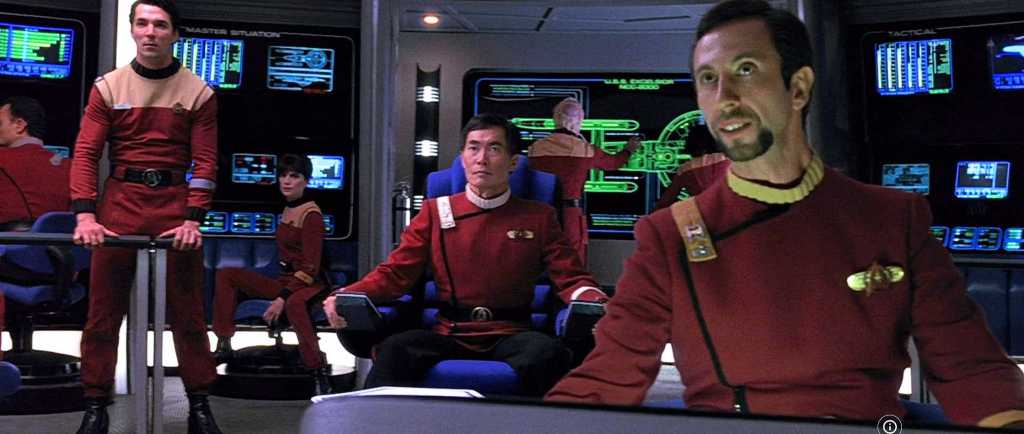
Much of STVI’s success, of course, is thanks to director and co-writer Nicholas Meyer. We can also thank Meyer for generous references to Shakespeare and Sherlock Holmes; that’s a delightful consistency in world-building, as the original series cited Shakespeare in numerous episodes. Besides Hamlet, other works cited from the Bard, primarily by Chang, include Julius Caesar (“I am constant as the northern star.”), Henry IV Part 2 (“Have we not heard the chimes at midnight?”), Henry V (“Once more unto the breach, dear friends.”), The Merchant of Venice (“Wrong us, shall we not revenge?”), Richard II (“Let us sit upon the ground and tell sad stories…”), Romeo and Juliet (“Parting is such sweet sorrow.”), and The Tempest (“Our revels now are ended.”). Being a Sherlock Holmes fan, Meyer also delivers a murder mystery; he had previously written the 1974 Holmes novel The Seven-Per-Cent Solution and the screenplay for the Oscar-nominated film adaptation. He later wrote (so far) five more Holmes pastiche novels, the most recent published in 2024. Spock even paraphrases Holmes – or, really, Holmes’ creator, Arthur Conan Doyle – when he says, “An ancestor of mine maintained that if you eliminate the impossible, whatever remains, however improbable, must be the truth.” Was Spock’s mother Amanda descended from Sherlock Holmes? Stranger things have happened.
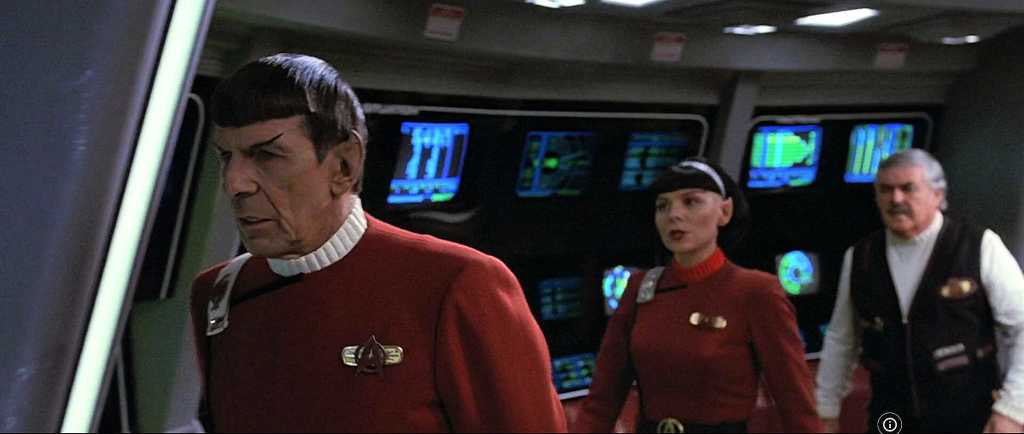
If we look too closely at the story’s implications, we can imagine there is still a rocky road ahead. If the entire population of the Klingon home world intends to settle in Federation territory, that is bound to lead to challenges. And a conspiracy involving Federation officers, Klingon officers, and the Romulan ambassador, must be more wide-spread than the individuals currently identified. Militant elements within all three governments can be expected to cause further trouble – as we’ve learned in our time, Nazis are never entirely defeated. If our Star Trek VI parallel is Chernobyl and the collapse of the Soviet Union, one look at the current state of politics in Russia tells us that a happy ending is not guaranteed. The struggle never ends. Kirk’s statement to Azetbur, “We haven’t run out of history quite yet,” cuts both ways.
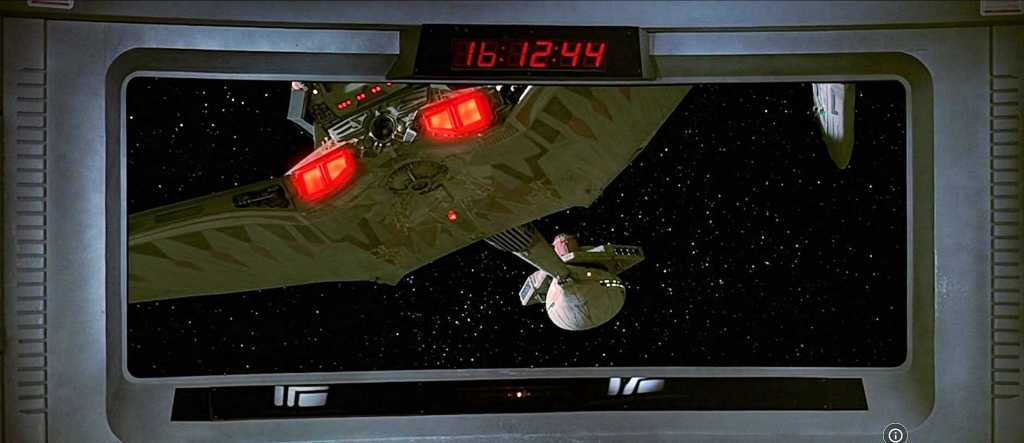
Kirk’s observation is a reference to the dim-witted essay “The End of History?” by neocon pseudo-intellect Frances Fukuyama, who claimed that the fall of the Iron Curtain proved the ultimate global conquest by “liberal democracy,” by which he meant Western monied elites. While that conquest has transpired in much of the world, it was clearly a gross oversimplification of global trajectories, not to mention ignoring the inevitable consequences of climate change. Still, we should savor our victories when we can, and if we must yield to the march of time, STVI is a satisfying farewell to our gallant crew. According to the Blu-Ray commentary, it seems both Nicholas Meyer and co-writer Denny Martin Flinn were not fans of the cast signatures that appear over the end credits, but I confess to getting misty-eyed every time I see those names backed by Cliff Eidelman’s rousing score. And it’s not just the crew we’re saying goodbye to; STVI was the last Trek production completed during Gene Rodenberry‘s lifetime, and the film is dedicated to him.
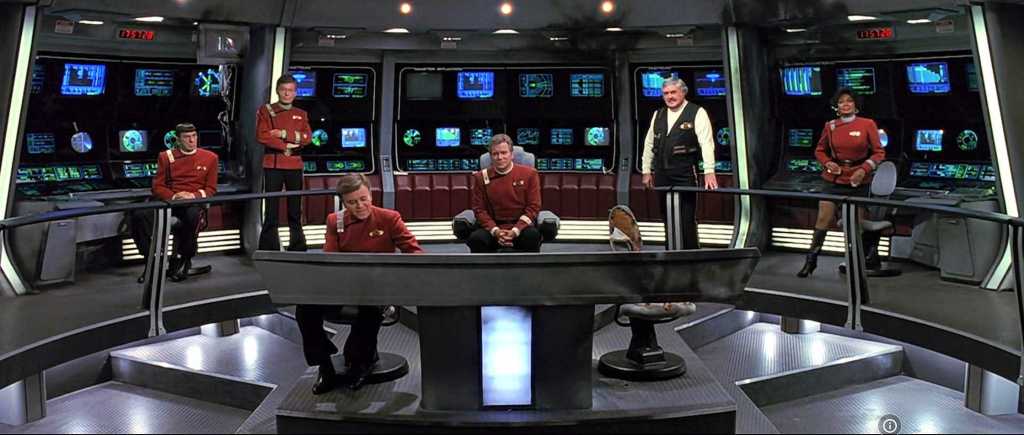
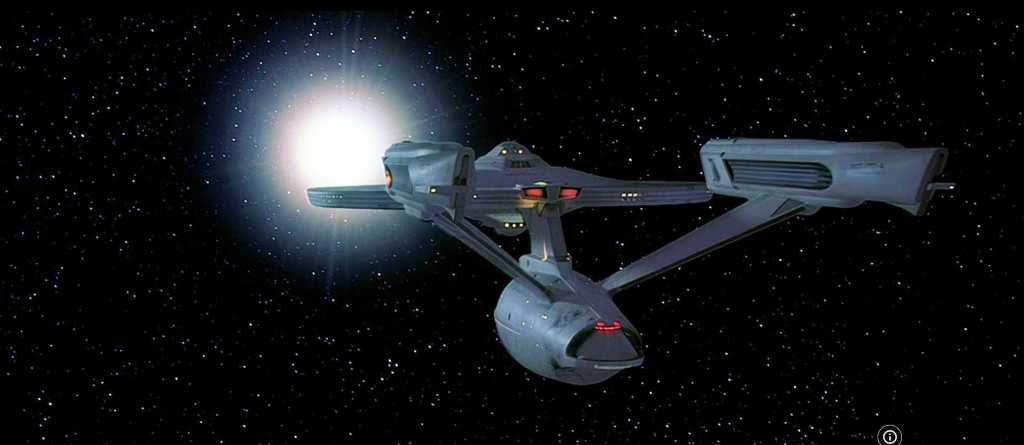
“Second star to the right,” Kirk says when Chekov asks for a final course heading, “and straight on till morning.” That’s one last literary reference, this time to Peter Pan; or the Boy Who Wouldn’t Grow Up, by J.M. Barrie. The line was originally in the script for Star Trek II but ended up being cut. The actual text of Barrie’s book is this:
     “Second to the right, and straight on till morning.”
     That, Peter had told Wendy, was the way to the Neverland; but even birds, carrying maps and consulting them at windy corners, could not have sighted it with these instructions. Peter, you see, just said anything that came into his head.

In other words, the destination is not literal, but metaphorical. It's easy to interpret Kirk's order as a longing to remain forever young and child-like, but this crew is too experienced for such false nostalgia. In truth, as I wrote in my essay on "Miri," Kirk is really asking for one last trip around the galaxy, not to seek the thrills of youth, but to reflect on all they have seen and accomplished. Despite their flaws, by the end of this mission the crew has even more wisdom to  impart to future generations.  We have been through so much together. "They have been," as the film's first theatrical trailer reminded us, "our guides, our protectors, and our friends." As much as time takes away, it also endows the journey with gravitas. Hope has always been one of Star Trek's most important messages, and we couldn't ask for a more hopeful ending. Parting may be sweet sorrow, but what a glorious journey it has been.

 The Creative Life Adventure
Leave a comment