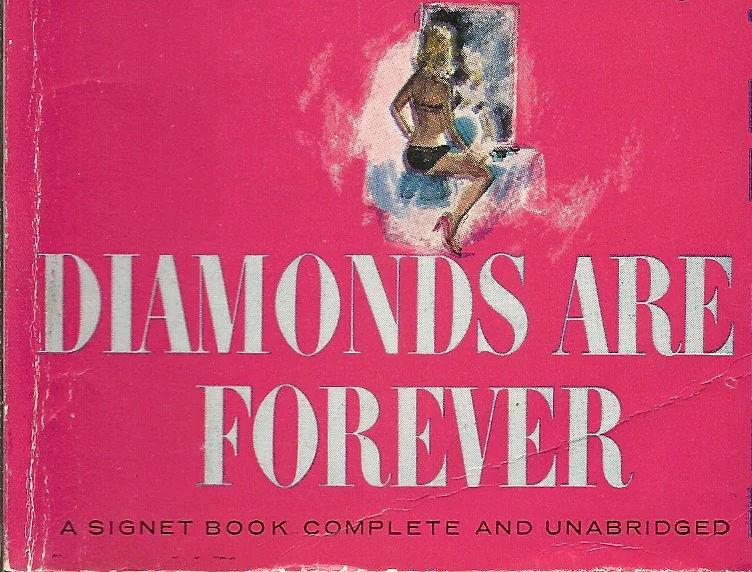

Diamonds Are Forever (1956) was Ian Fleming‘s fourth James Bond novel. Fleming developed the idea for the novel after reading a 1954 article about diamond smuggling in The Sunday Times. Typically, Fleming based much of the book on his own research and experience. He interviewed Sir Percy Sillitoe (1888 – 1962), formerly of MI5 and working for De Beers at the time. He traveled to Saratoga Springs, New York, visiting an actual mud bath and meeting someone who really did own a Studillac (see Chapter 10). And he traveled to Los Angeles and Las Vegas for additional research.
As with the previous three Bond novels, this is my informal Diamonds Are Forever reader’s guide regarding brand and place names, historic references, themes, and character development. A few references are repeated from previous books, in which case I’ve generally copied those entries. I haven’t included page numbers as this will vary by edition. I’m reading the 1961 Signet Books mass market paperback. Mr. Fleming was kind enough to divide his books into brief chapters, so references should be easy to find in the text. I’m only human, so if I’ve made any factual errors, please feel free to reach out to me via the Contact Me page.
Last updated 31 December 2025
1: The Pipe Line Opens
Pandinus scorpion:

The novel opens with a symbolic predatory scene (“Greed had won over fear.”) of a scorpion killing a beetle. For some reason, Fleming spells it pandenus, but the Pandinus scorpion is large and typically dark-colored. Their sting is rarely fatal to humans and they are sometimes kept as pets.
Kissidougou:
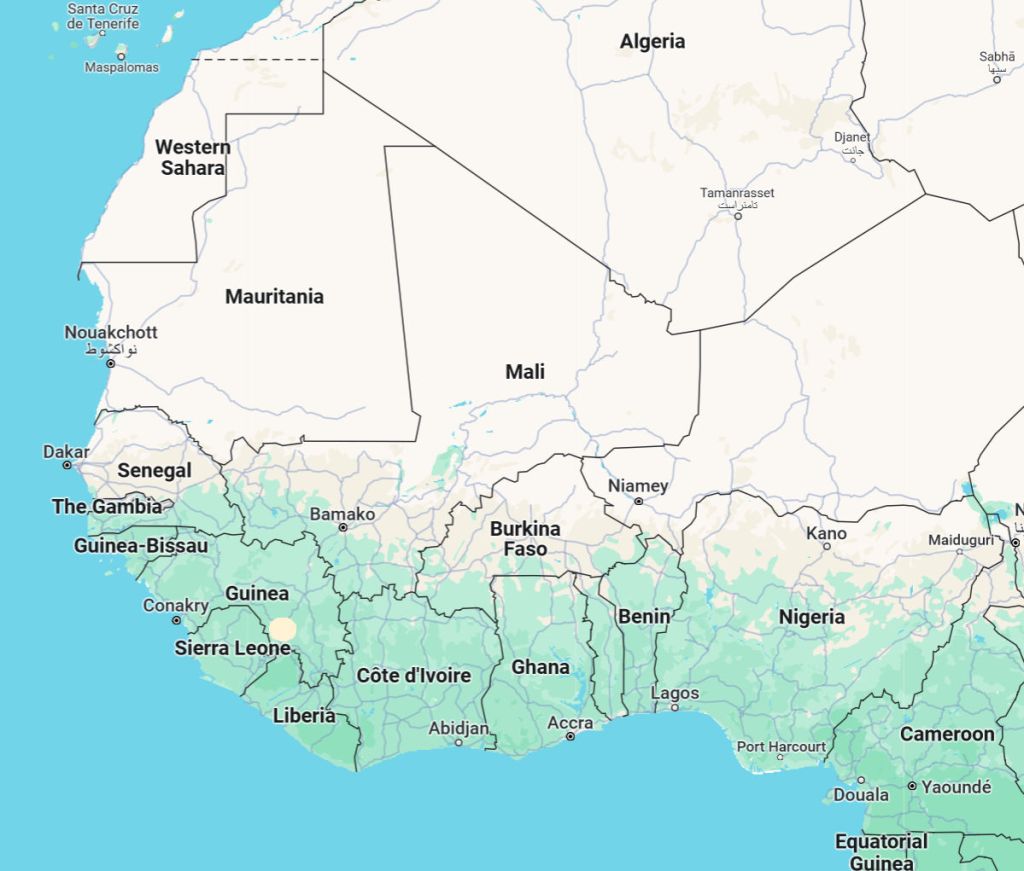
Fleming establishes the beginning of the diamond smuggling pipeline as 40 miles south of Kissidougou in French Guinea. French Guinea was a French colonial nation in West Africa. When France adopted a new constitution in 1958, only two years after Diamonds Are Forever was published, French Guinea voters rejected it and formed the independent nation of Guinea. The city of Kissidougou was established in the 1700s and the name means “place of refuge” in the language of the Malinké people who were among the area’s first settlers. It became exactly that in the 1990s when refugees from Sierra Leone and Liberia settled there.
Liberia and Sierra Leone:
Fleming identifies the location as only a few miles from both Liberia and Sierra Leone. Indigenous people have populated the area at least as far back as the Stone Age, but modern-day Liberia was established by the American Colonization Society in the 1800s as a settlement for free-born and formerly enslaved Black Americans with the hope that they would enjoy greater liberties than in the U.S. (The project was opposed by a great many Black Americans.) The settlement declared itself an independent nation, the Republic of Liberia, in 1847. Liberia was a founding member of the United Nations and in the 1950s experienced considerable economic growth. A military coup in 1980 led to a long period of instability, but democratic elections were restored in 2017. Sierra Leone, also long-populated by indigenous peoples, was a British colony in the 1800s. In the 1950s the country began assuming local control and became fully independent in 1961. See map above for location of both countries.
Sefadu:
Fleming also mentions Sefadu, also known as Koidu City. Koidu is the capital of the Eastern Province, which as the name implies is in eastern Sierra Leone. Diamond mining is still big business in the area, and two of the world’s largest rough diamonds were found nearby.
Pillion:
The angry smuggler’s motorcycle has a pillion, which is simply an additional seat for a passenger behind the driver.
Afrikaner:
The smuggler, a dentist, is identified as an Afrikaner, a white South African descended mostly from Dutch settlers who arrived in the 1600s and 1700s. Afrikaners were the primary architects of South Africa‘s apartheid system that lasted until the early 1990s. The dentist is clearly committed, because he hates the black scorpion as much as he hates Black people.
Reichsdeutscher:
The helicopter pilot is identified as a Reichsdeutscher, people who were loyal to the German Reich of 1871 – 1949. They would have been supporters of Hitler and the Nazis.
Galland:
The pilot was in the Luftwaffe, the aerial warfare branch of the German armed forces, during World War II, serving under Adolf Galland (1912 – 1996). Galland flew over 700 combat missions during the war and was shot down four times, surviving on every occasion. He even survived a brief period of house arrest after a very public dispute with Reichsmarschall Hermann Göring (1893 – 1946) over how best to conduct the air war.
Sillitoe:

The smuggling dentist frets over the arrival of “this man Sillitoe.” Sir Percy Sillitoe (1888 – 1962) was a former police constable who ran MI5, Britain’s internal security and counter-intelligence service, from 1946 to 1952. Later, Sillitoe was part of the International Diamond Security Organization (ISDO), formed by De Beers Diamond Consortium to investigate diamond smuggling. The ISDO was closed down in 1957. Fleming met Sillitoe while researching Diamonds Are Forever. Later, in 1957, Fleming published The Diamond Smugglers, a non-fiction account of ISDO operations.
Sjambok:
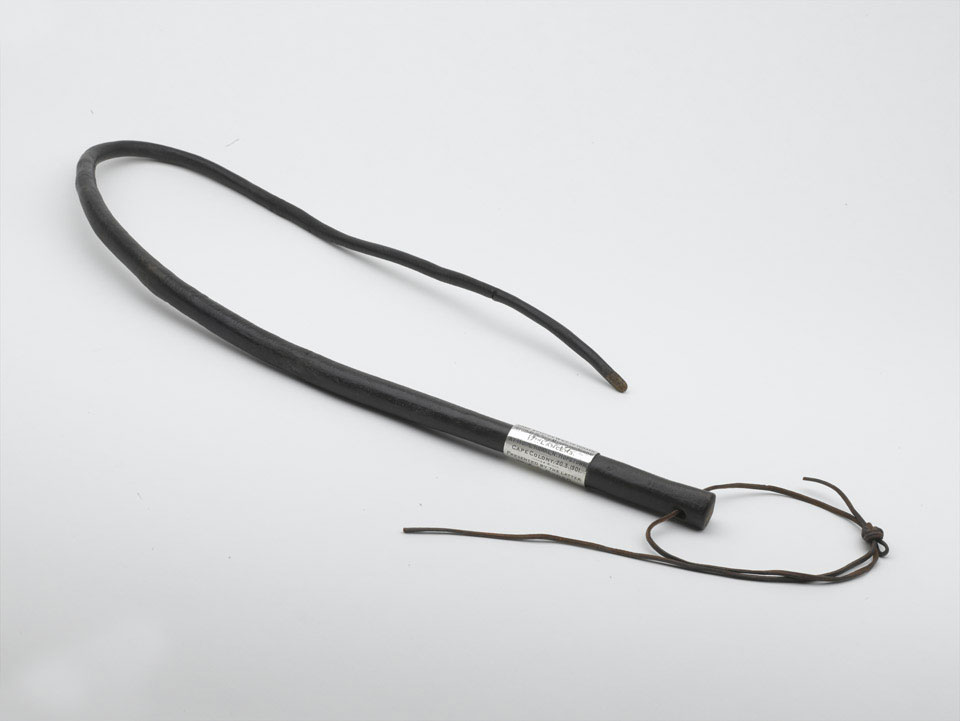
The Afrikaner dentist demeans the Black mine workers, afraid they will give him up under torture and saying “they can’t stand up to a real beating.” Then he acknowledges, “I doubt anyone could stand up to the sjambok.” A sjambok is a sturdy leather whip, often made from the hide of a rhinoceros or hippopotamus, and three to five feet long. Originally derived to drive oxen or cattle, they were also popular among South African police during the apartheid era.
Daker:
The pilot promises to pass on the dentist’s demands to “Daker” and then London. It’s possible that Daker is a person, but I think he means the city of Dakar, which today is the capital of Senegal but in 1956 was the capital of French West Africa, a federation of eight West African territories that were French colonies at the time. See map under Kissidougou above for location.
Gelignite:
The pilot reminds the dentist that his predecessor kept gelignite under his bed, which is definitely an implied threat. Gelignite is an explosive made of nitrocellulose and nitroglycerin or nitroglycol. It was invented by Alfred Nobel (1833 – 1896) in 1875 and is relatively safe to handle as explosives go. Gelignite has commonly been used in mining, making it widely available to terrorists and other disreputable parties.
Tot siens:
The pilot leaves the dentist with, “Tot siens. Alles van die beste,” which is Afrikaans for “Goodbye. All the best.”
X-rays and castor oil:
The dentist reflects on the surveillance diamond mine workers are subjected to if they are ever allowed to leave the mines, including x-rays and castor oil. X-rays are commonly used for security purposes, including civilian air travel, but castor oil implies harsh treatment of people who probably work very hard to be paid very little.
Chapter 2: Gem Quality
M, Bond:
The chapter introduces us to M and James Bond, as M provides Bond with insight into diamond quality.
Summer in London:
The time of year is established as “late July.”
Passion:
Seeing a brilliant-cut diamond under the jeweler’s glass, Bond understands “…the passion that diamonds had inspired…” I’ve never personally understood what people find so fascinating about diamonds, but I’ve also never seen one as Bond has.
Beauty = Truth?:
After seeing the diamond up close, Bond reflects, “It was domination by a beauty so pure that it held a kind of truth…” Since Fleming burdens his villains with all manner of physical deformities, we can imagine that, conversely, he would equate “beauty” with “truth” or “goodness.” There might be a valid abstract argument there, but I’m not comfortable with Fleming, or any individual, defining “beauty” for the rest of us. Particularly considering that the diamond in question has been altered by humans and is not being seen in its natural state. Given the events of the story, it’s also possible that the “truth” represents the inevitability of mortality.
Jacoby:
We’ll actually meet him later, but M refers to Jacoby at the Diamond Corporation. I believe the Diamond Corporation is a fictional stand-in for De Beers, the joint British-South African business established in 1888. For over a hundred years, De Beers controlled 80% or more of the world diamond trade. There is a Diamond Corporation in operation in South Africa today, but it was formed in 1998.
Bronsteen:
M mentions Bronsteen, another character we’ll meet later.
Saint-Gothard Tunnel:
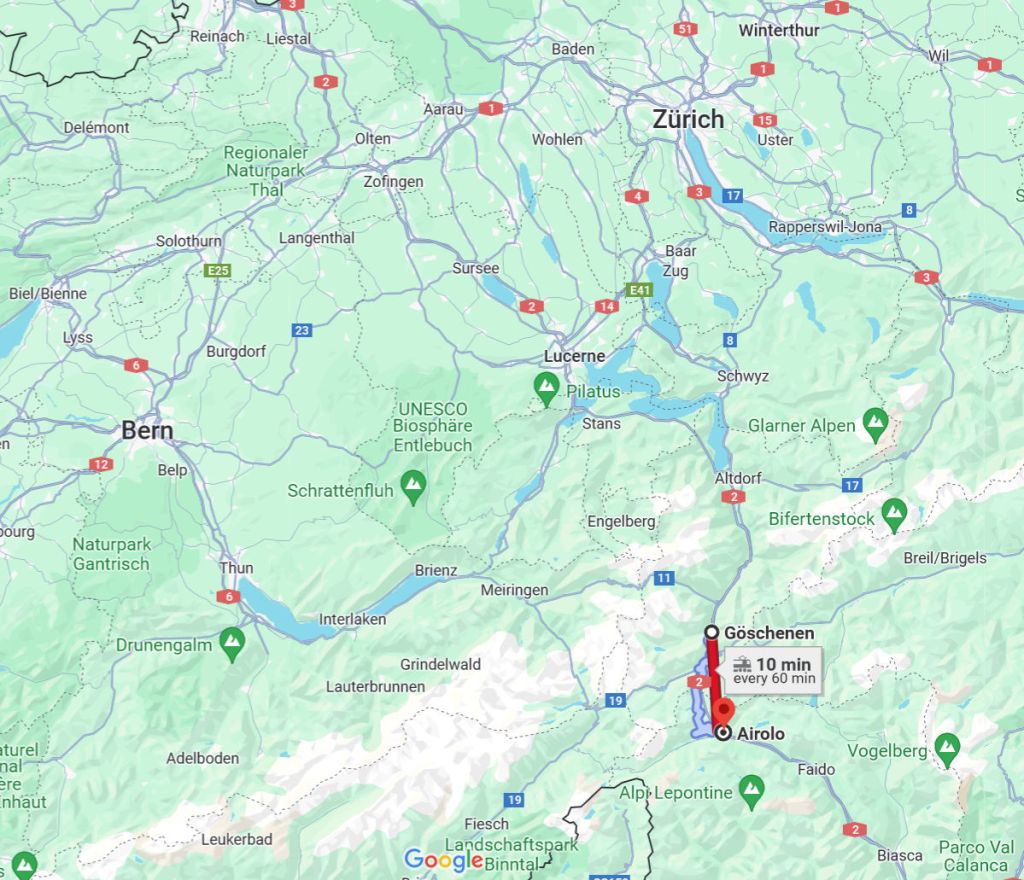
M shows Bond the kind of industrial diamonds used to cut the “Saint-Gothard Tunnel.” This is really the Gotthard Tunnel, a rail tunnel opened in 1882 and the longest tunnel in the world at the time. The Gotthard Tunnel is a little over 9 miles in length and connects the Swiss cities of Göschenen in the north and Airolo in the south. The name comes from the Saint-Gotthard Massif, the alpine mountain range the tunnel cuts through.
Bill and Lil:
Bond has brief interactions with M’s Chief of Staff, Bill Tanner, as well as the secretary for the 00 section, Loelia Ponsonby. Tanner, while not always specifically named, has been present in all of the Bond books so far. Loelia, or Lil, was introduced in Moonraker.
Daily Express:
Excited at the prospect of a new mission, Bond tells Loelia she can send his paperwork “off to the Daily Express for all I care.” The Daily Express, as the name implies, is a daily UK newspaper, first published in 1900 and still in publication today.
Sefton Delmer:
Bond jokingly asks Loelia if she is friends with Sefton Delmer. Denis Sefton Delmer (1904 – 1979) was a British journalist who did propaganda work for his government during World War II. In the post-war years, Delmer wrote about international affairs for the Daily Express.
French holiday:
M questions Bond about his holiday in France, presumably the trip a heartbroken Bond took after Gala Brand left him at the end of Moonraker.
Diamonds are British:
M claims that “90 per cent of all diamond sales are carried out in London.” He calls the diamond trade “the biggest dollar-earner we’ve got.” I can’t find a source to confirm this, but De Beers was, and still is, headquartered in London. Given De Beers’ dominance in the industry at the time, it seems plausible. At a time when British political and military influence was in dramatic decline, it’s easy to understand why preserving a near-monopoly of the diamond industry would be important.
De Beers:
M mentions Sillitoe (from Chapter 1) being hired by De Beers after Sillitoe retired from MI5. De Beers was established in 1888 and remains the dominant firm in the diamond industry, conducting mining operations and selling to retail and industrial sectors. The company was established by the British businessman Cecil Rhodes (1853 – 1902), with heavy financing from Alfred Beit (1853 – 1906) of South Africa and the British bank N M Rothschild & Sons (Rothschild & Co. today). But it was the German Ernest Oppenheimer (1880 – 1957) who turned De Beers into a global monopoly. The company name comes from the two Dutch brothers, Diederik Arnoldus De Beer (1825 – 1878) and Johannes Nicolaas de Beer (1830 – 1883) who settled in South Africa and were forced to sell their farm to the British once diamonds were discovered there. Forced relocation of indigenous peoples, price fixing, and trafficking in “conflict diamonds” are some of the shady activities De Beers has been implicated in over the years.
The Special Relationship:
M spells out why the U.S. Secret Service is handling the diamond smuggling mission, rather than MI5, and the smuggling pipeline’s termination in the U.S. is the primary issue. The FBI isn’t interested because “it’s not doing any harm to the United States.” It’s an indirect way of acknowledging how the U.S. had grown in world stature relative to Britain.
House of Diamonds:
M and Bond discuss the House of Diamonds headquartered on West 46th Street in New York City. There is a House of Diamonds located today on West 47th Street, but I can’t believe it’s the same company, given the illicit conduct of the House of Diamonds in the novel. Bond compares the House of Diamonds to Cartier, Van Cleef, and Boucheron, all prominent French jewelers founded in 1947, 1896, and 1858, respectively.
Hatton Garden:
The House of Diamond’s London office is in Hatton Garden, which is not really a garden but a commercial district in Camden, near central London. The name comes from a close friend of Queen Elizabeth I, Sir Christopher Hatton (1540 – 1591). It has long been the hub of England’s diamond and jewelry business. In Evelyn Waugh‘s 1945 novel Brideshead Revisited, Rex Mottram buys Julia Marchmain’s engagement ring from a Hatton Garden dealer.
Piccadilly:

We’ll meet Rufus B. Saye later, but for now we know he’s a high roller because every day he has lunch at the American Club in Piccadilly. Piccadilly Circus is a public space in London’s West End and the intersection of several major streets. Like Times Square in Manhattan, Piccadilly Circus is noted for numerous large signs, including one for the bottler Schweppes that would have been present in Bond’s time. The American Club was a gentlemen’s club, similar to Blades from Moonraker. (Bond planned to meet Gala Brand in Piccadilly in Chapter Nineteen of Moonraker.) The club closed for business in the 1980s. Saye also lives at the Savoy, a luxury hotel in central London that opened in 1889. He also golfs at Sunningdale, a golf club with two 18-hole courses, founded in 1900 about 30 miles west-southwest of London. In Bond’s era, Sunningdale was a regular host of the British Masters. 007 and Bill Tanner play a round of golf at Sunningdale in the first post-Fleming Bond novel, Colonel Sun (1968) by Kingsley Amis. An added dimension to Saye’s character – we’re told he doesn’t drink or smoke. That’s a sure sign of a devious personality, someone not connected to the sensual pleasures of life as Bond is.
3: Hot Ice
Moneypenny:
We get a brief glimpse of Miss Moneypenny’s “warm brown eyes” as Bond leaves M’s office.
What Frightens M:

Part of M’s job is to distinguish real threats from imagined ones, and Tanner spells out for Bond which enemies keep M awake at night: SMERSH (who we met in Casino Royale and Live and Let Die), German cypher-breakers (there was a possible hint at Germany’s Enigma cipher machine in Live and Let Die), Chinese opium traffickers, the Mafia (the Sicilian one), and “American gangsters.” What seems especially ironic about this is that in 1955, when Fleming wrote Diamonds Are Forever, FBI director J. Edgar Hoover (1895 – 1972) showed little interest in organized crime, instead wallowing in an all-consuming paranoia over mythical “communist subversives.” It wasn’t until the 1957 Apalachin summit of U.S. Mafia leaders in Apalachin, New York, that Hoover was forced to begin taking organized crime seriously.
Italian Stereotypes:
Bond is guilty of negative stereotyping of Italian Americans. Tanner only partially corrects him, saying, “Those are only the ones you see.” Yikes.
Bugsy Siegel:
In describing the economic impact of legal and illegal gambling in the U.S., Tanner mentions the death of Benjamin “Bugsy” Siegel (1906 – 1947). Siegel was a bootlegger during Prohibition and in the 1940s became involved in some of the early Las Vegas casinos. Siegel got greedy and fumbled the opening of the Flamingo hotel/casino and was assassinated as a result.
Kefauver Report:

Tanner encourages 007 to read the Kefauver Report. The U.S. Senate Special Committee to Investigate Crime in Interstate Commerce, often known as the Kefauver Committee because it was chaired by Tennessee Senator Estes Kafauver (1903 – 1963), conducted investigations in 1950-1951 into interstate organized crime. The committee heard from over 600 witnesses in 14 U.S. cities. Some of the hearings were televised. The committee’s final report was released in April, 1951, and had a lot to do with exposing J. Edgar Hoover’s neglect of organized crime. The Godfather Part II (1974) features Senate hearings inspired by the Kefauver Committee.
Scott’s:
Bond buys Tanner lunch of dressed crab and “black velvet” (which I believe refers not to a brand but to a cocktail made with stout and white wine) at Scott’s, a real seafood restaurant established in approximately 1853. Just as Ian Fleming did, Bond and Tanner would have dined at “Scott’s Oyster and Supper Rooms” on Coventry Street, where it remained until 1961. Scott’s changed locations in 1967 and is still in operation.
Vallance:
He was mentioned earlier, but we now meet Ronnie Vallance, Assistant Commissioner at Special Branch, a London police unit established in 1883 to conduct counter-terrorism operations. Vallance played a significant role in Moonraker.
Peter Franks:
We never actually meet him in person, but we begin learning about career criminal Peter Franks. Franks is suspected of being involved in “the Duke of Windsor job at Sunningdale…” The “job” in question was a 1949 theft of jewelry valued at ℒ250,000 from the Duke and Duchess of Windsor while they stayed at Ednam Lodge in Sunningdale (the English town where the aforementioned golf course is located). The thief was either clumsy or provocative, as he left a generous amount of jewels laying on the ground outside the lodge. No one was every convicted, but police at the time suspected Arthur Charles Holmes, who in 1950 was convicted of a number of other home burglaries.
Soho:
Special Branch has “two or three undercover girls in Soho,” one of whom is able to obtain information from Peter Franks. Soho is a neighborhood in London’s West End and a popular entertainment district. While New York City’s SoHo neighborhood refers to “South of Houston Street,” London’s Soho appears to have been named from a hunting cry used in the 17th century.
Trafalgar Palace:
Bond, posing as Peter Franks, is to meet his contact at the Trafalgar Palace, a fictional hotel that, according to The James Bond Dossier, may have been located where the Trafalgar St. James London is located today.
Border Crossings:
Faced with posing as a smuggler to sneak diamonds from England into the U.S., Bond reflects on tense border crossings from his younger days, infiltrating Germany and Russia, among other locations. We get no context on those missions, but it gives us a bit more insight into 007’s past.
Idlewild:
Bond imagines trying to smuggle his (Peter Frank’s) diamonds into the U.S. through Idlewild, the airport that opened in Queens in 1948. Officially called the New York International Airport, Anderson Field, the airport was commonly referred to as Idlewild after the name of the golf course that previously occupied the land. It was renamed John F. Kennedy International Airport in December, 1963. In 1954, only 2 years before Diamonds Are Forever was published, Idlewild had more international air traffic than any airport in the world. This is the same airport Bond flew into in Live and Let Die.

Inspectoscope:
Bond imagines the Inspectoscope at Idlewild detecting the diamonds when he tries to smuggle them in. 007 learned about the Inspectoscope in Moonraker. It was an actual device used in the 1950s to aid in the detection of contraband at ports of entry. Use of the device to detect diamond theft at mines was also specifically mentioned, accidentally (?) foreshadowing Diamonds Are Forever.
Dankwaerts:
We meet Sergeant Dankwaerts of Special Branch, who will accompany Bond to the House of Diamonds to meet Rufus B. Saye.
Ascot Job:
Vallance mentions “diamonds from that Ascot job…” I’m unable to determine what this refers to. If anyone gets the reference, please help me out.
Lobiniere:
We briefly meet Sergeant Lobiniere of Special Branch, who makes up 007 to disguise his identity prior to meeting Rufus B. Saye.
4: “What’s This All About?”
Strand:
Dankwaerts drives Bond “along the Strand and up Chancery Lane and into Holborn. At Gamages they turned left into Hatton Garden…” See the map below for the approximate route. The Strand is part of London’s West End theater district. Charles Dickens and Virginia Woolf are among the historic figures who lived on or near the Strand.

London Diamond Club:
The fictional House of Diamonds is located in the London Diamond Club in Hatton Garden. The Club is a real organization established in 1940. Most diamond commerce at the time occurred in Antwerp, Belgium, but the rise of the Nazis complicated that, so some elites moved their assets and businesses to London for safekeeping. The London Diamond Bourse was also established during the 1940s, and the two groups merged in the 1980s.
Adam fireplace:

The waiting room to Saye’s office has an Adam Fireplace. Blades in Moonraker had one, also. The Adam style was established by Scottish architect William Adam (1689 – 1748) and his sons Robert (1728 – 1792) and James (1732 – 1794). It was a neoclassical architecture and design style featuring curved walls and domes, elaborate plasterwork, and innovative color schemes. It was a significant influence on the Federal style practiced in the U.S. An Adam fireplace would feature an elaborate mantel.
Sheraton table:
The waiting room also features a Sheraton table and chairs which Bond estimates to have a value of ℒ1,000. The Sheraton style was popular primarily from the 1780s to the 1820s, named after furniture designer Thomas Sheraton (1751 – 1806). Sheraton furnishings took inspiration from the Louis XVI style, featuring tapered legs, rectilinear forms, and veneer inlays.
Diamond News:
Also in Saye’s waiting room, issues of the Diamond News out of Johannesburg, South Africa. This paper was first published by R. W. Murray (1819 – 1908), and appears to have been not specific to the diamond industry, but to promote British interests in the region.
Waterford:
Rufus B. Saye has expensive tastes. His office waiting room also includes four Waterford vases. George Penrose and his nephew William Penrose established Waterford Glassworks in Waterford, Ireland, in 1783. Their business closed in 1851, but a new business began operation in 1947, producing high-end lead glass (“crystal”) products. Today, most Waterford crystal is produced outside of Ireland.
Willy Behrens:
We briefly meet Willy Behrens, a well-known freelance diamond broker.
En brosse:
We finally meet Rufus B. Saye, and considering the build-up this character has been given, the payoff is a little underwhelming. At least he lacks the blatant physical deformities of most Bond villains. He wears his hair en brosse, which is “in brush” in French, meaning his hair is cut short and bristly, like a crew cut.
King’s Road:
Dankwaerts drops Bond off at his flat “off the King’s Road,” as established in Live and Let Die. King’s Road really was the king’s road, a private road for the use of King Charles II (1630 – 1685) in the 1600s, and didn’t enter public use until the 1800s. King’s Road was a hub of mod culture in the swinging 1960s.
5: “Feuilles-Mortes”
Trafalgar Square:

Bond goes to the Trafalgar Palace Hotel (see Chapter 3) in the guise of Peter Franks. The location is not specified, but based on the name the fictional hotel is almost certainly located in or near Trafalgar Square. The square was established in the early 1800s in the Westminster area of Central London. Many political demonstrations and public gatherings have taken place there over the years, including the Bloody Sunday riot of 1887. The name comes from the Battle of Trafalgar, a British naval victory over France and Spain during the Napoleonic Wars, near the coast of Cape Trafalgar in southwest Spain.
Feuilles-Mortes:
The song 007 hears when he enters Tiffany Case’s apartment, the French “Les Feuilles-Mortes,” translates as “The Dead Leaves.” It was written in 1945, music by Joseph Kosma (1905 – 1969) and lyrics by Jacques Prévert (1900 – 1977). One of the first performances of the song was by Yves Montand (1921 – 1991) and Irène Joachim (1913 – 2001) in the 1946 French film Les Portes de la nuit (Gates of the Night). The song is a sad recollection of a lost love. Johnny Mercer (1909 – 1976) wrote English-language lyrics and released the song as “Autumn Leaves.”
La Ronde:
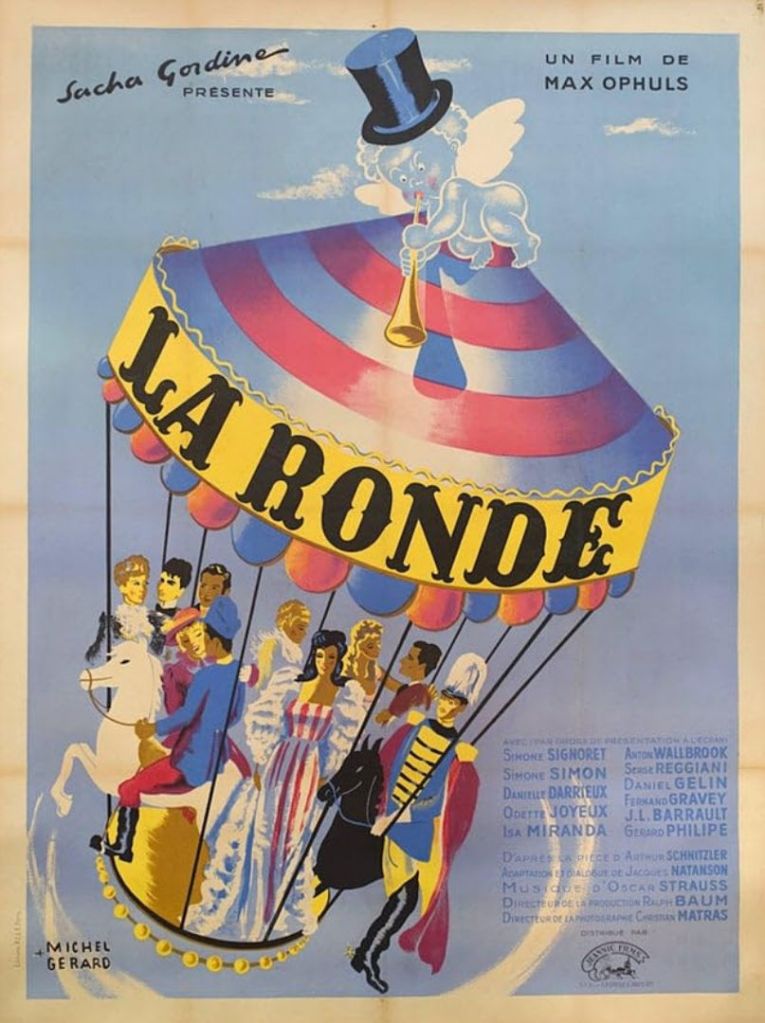
Bond has no sooner entered Tiffany’s room than the next song begins, “La Ronde,” which I believe is really “La ronde de l’amour” (“The Circle of Love”). Music by Oscar Straus (1870 – 1954), lyrics by Louis Ducreux (1911 – 1992), and recorded for the 1950 film La Ronde, which was so risque it was banned in New York City. The film’s producers pursued the matter with the U.S. Supreme Court, and La Ronde was approved for viewing in NYC in 1954.
Tiffany Case:
We finally meet Tiffany Case, and her rough exterior doesn’t hide what her taste in music tells us about her poignantly romantic nature.
J’attendrai:
The next song on Tiffany’s record player begins, which is “J’attendrai,” or “I Will Wait.” Lyrics by Louis Poterat (1901 – 1982), “J’attendrai” is a French-language version of the 1936 Italian song “Tornerai” (“You Will Return”), with music by Dino Olivieri (1905 – 1963) and lyrics by Nino Rastelli. “J’attendrai” was first recorded in 1938 and became very popular during World War II.
George Feyer:

The album Tiffany listens to is a recording by George Feyer (1908 – 2001), a Hungarian pianist. According to Feyer, his mother forced him to study piano as a child by tying his legs to the piano stool. Feyer recorded a series of albums for Vox Records in the 1950s. The catalog number of Tiffany’s record is Vox 500, which was Feyer’s 1953 release Echoes of Paris.
Avril au Portugal:
Playing the flip side of the George Feyer album, at Tiffany’s suggestion, Bond skips “La Vie en Rose” “because it had memories for him.” It has memories for us readers, as well, because the 1945 Edith Piaf song was performed at the restaurant right before Vesper was abducted in Casino Royale. Instead, Bond selects “Avril au Portugal,” or “April in Portugal,” music by Raul Ferrão and original Portuguese lyrics by José Galhardo. The song was originally “Coimbra,” named for the city in Portugal. Lyrics in English and French came later.
Pan-American Airways:
Bond notices a Pan-American airways label on Tiffany’s record player. Pan Am was established in 1927 and was the preeminent airline of both the U.S. and the world by mid-century. Increasing competition after World War II and industry deregulation in 1978 contributed to Pan Am’s decline, and the airline declared bankruptcy in 1991. Air travel has been in decline ever since.
Je n’en connais pas la fin:
We hear one more wistful love song from Tiffany’s collection, “Je n’en connais pas la fin,” or “I Don’t Know the End,” written by Margueritte Monnot (1903 – 1961) and recorded by Edith Piaf (1915 – 1963) in 1939.
Dunlop 65:
Bond, as Peter Franks, tells Tiffany he uses Dunlop 65 golf balls. Dunlop began as a rubber goods manufacturer in 1889 and started manufacturing golf balls in 1910. The company sponsored the Dunlop Masters golf tournament from 1946 until 1982, when it became the British Masters. The 65 was inspired by golfer Henry Cotton (1907 – 1987), who played a round of 65 strokes at the British Open Championship in 1934, which was apparently considered a “perfect” game.
John Doe:
Ian Fleming intended the name “James Bond” to be boring, completely ordinary. He reminds us of that when Tiffany dismisses Peter Franks’ “real” name – James Bond – by asking, “Why not John Doe?”
Q Branch:
We still haven’t formally met Q, but Bond expects Q Branch will provide him the visa and vaccination certificate (because we didn’t have irrational fears of vaccines back then) he will need to enter the U.S.
Astor:
Bond is to meet Michael “Shady” Tree in the U.S. and will stay at “the Astor in New York.” The Hotel Astor opened in 1910 in Times Square in Midtown Manhattan. The Astor had restaurants, ballrooms, a rooftop garden, and other attractions. Frank Sinatra (1915 – 1998) performed there in the early 1940s. Sheraton Hotels purchased the Astor in 1954 and renamed it the Sheraton-Astor. The hotel was eventually closed and demolished in 1967.
Ritz:
While preparing to leave London, Tiffany tells Bond to stay at the Ritz. The Ritz is in Piccadilly (see Chapter 2) and opened in 1906. The hotel was named after its founder, the Swiss hotel operator César Ritz (1850 – 1918). Billionaire J. Paul Getty (1892 – 1976) lived there for a time after World War II.
BOAC Monarch:
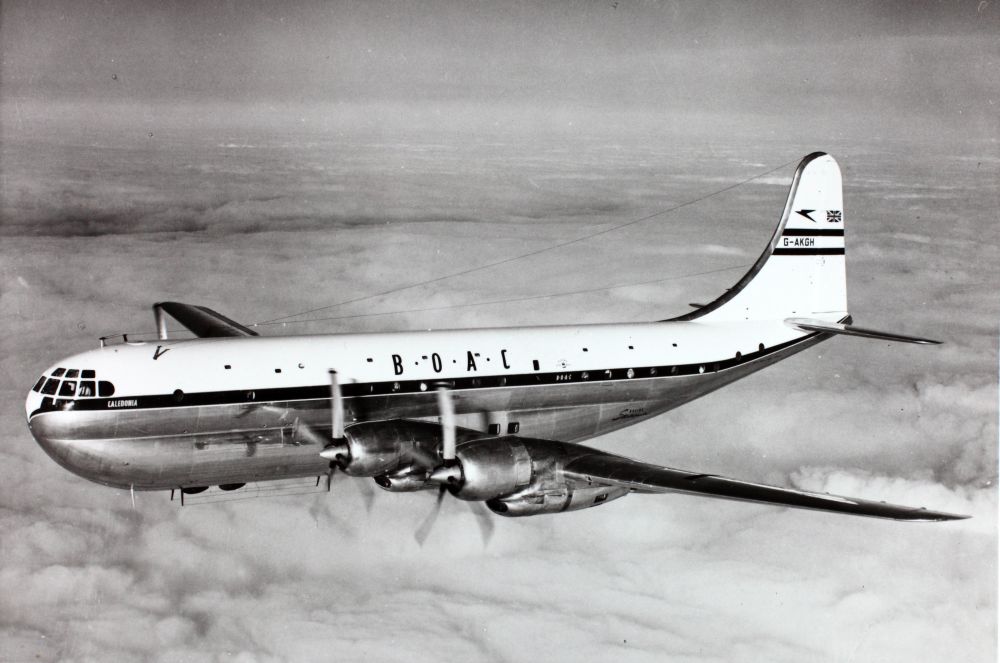
Tiffany tells Bond he will go to New York on a BOAC Monarch flight. British Overseas Airways Corporation (BOAC) was a British government-owned airline that operated from 1939 to 1974. The airline performed a crucial function of maintaining air routes between Britain and its colonies and allied countries during World War II. It was the first airline to use aircraft powered by jet engines instead of propellers, in 1952. BOAC used Boeing Stratocruisers for Monarch flights in trans-Atlantic first-class travel. The Stratocruiser was a commercial design that can be traced back to the B-29 Superfortress and it generally seated either 63 or 84 passengers.
21:
Tiffany and Bond arrange to meet at the 21 Club on West 52nd Street after they’ve arrived in New York City. The name came from the restaurant’s street number and it opened in 1930. It operated as a speakeasy during the early years, as Prohibition was in effect, and the staff managed to outwit authorities during multiple raids. The restaurant has a “secret” wine cellar, which came in handy during the Prohibition years, and at various times was used to store the wine collections of John F. Kennedy, Elizabeth Taylor, Joan Crawford, and Ernest Hemingway, among others.
6: In Transit
Saxone:
Preparing to go to the U.S., Bond packs his Saxone golf shoes. The Saxone Shoe Company was formed in Scotland in 1908 by the merger of two existing businesses, Clark & Sons and F&G Abbott. They were a large manufacturer and retailer during Bond’s time, and during World War II the company switched much of their production to army boots and officer’s footwear.
Sea Island Cotton:
Bond also packs his Sea Island cotton shirts. Sea Island is not a clothing brand but a long-fiber variety of cotton that was grown on barrier islands off the Atlantic coasts of South Carolina, Georgia, and Florida beginning in the 1700s. Bond also wore one of these shirts in Moonraker.
Tommy Armour:

Bond clearly expects to play golf while in New York. He also brings a copy of How to Play Your Best Golf All the Time by Tommy Armour (1896 – 1968), co-written with Herb Graffis (1893 – 1989) and published in 1953. Armour was a pro golfer, born in Scotland, who over the years won the U.S. Open, the PGA, and the British Open Championship, making him one of only three UK golfers to win three different professional major tournaments. He also taught golf in Florida from 1926 to 1955.
Universal Export:
Bond receives a hand-delivered letter from M under the guise of Universal Export. This was the cover he used for an emergency call to M in Live and Let Die, and the name of one of the fictional businesses disguising MI6 headquarters in Moonraker.
Spangled Mob:
M’s message to Bond explains that Rufus B. Saye is also known as Jack Spang, one of the heads of the Spangled Mob which, among other things, operates the Tiara Hotel in Las Vegas. We already got a hint of this in Chapter 3 with the mention of Bugsy Siegel, but this pretty well confirms that we’ll be headed for Las Vegas before the story is over.
Purple Gang:
The Spangled Mob ranks up there with the “Cleveland outfit” and the “Detroit ‘Purple’ Gang.” This reference is a bit out of date, as the Purple Gang operated in Detroit primarily during the 1920s and 1930s. The gang was mostly made up of “problem children” from poor areas of Detroit’s lower east side, including the Bernstein brothers – Abe, Joe Raymond, and Izzy. One theory about the gang’s name was the claim that a neighborhood business operator called the young gang members “purple like the color of bad meat.” Believed responsible for 500 murders in Detroit and involvement in the 1929 St. Valentine’s Day Massacre in Chicago, the gang collapsed in the 1930s due to carelessness and infighting. The “Cleveland outfit” was the Cleveland Mafia, formed during the early 1900s and becoming more organized during Prohibition. John T. Scalish (1912 – 1976) ran the family from 1944 to 1976 and expanded the gang’s reach beyond Cleveland. During the 1970s, the crime family began a period of decline, caused in part by the rise of Irish gangster Danny Greene (1933 – 1977), subject of the 2011 film Kill the Irishman. Aggressive law enforcement largely finished off the crime family in the 1980s, but they supposedly began rebuilding their operation in the early 2000s.
FBI:
M instructs Bond to give the case to the FBI if he comes “into dangerous contact with these criminals.” The vague wording of the order gives Bond considerably leeway in a potential jurisdictional conflict. Bond assumes M would be unhappy to actually consent to letting the FBI take over, reflecting, as he often does, Fleming’s own desire that Britain remain a global power without compromising too much on the “special relationship” with the U.S.
Green Park:
Bond’s hotel room overlooks Green Park, first used by King Charles II (1630 – 1685) in the 1800s and located between Hyde Park and St. James’s Park. The park consists mostly of trees with very few flowers; legend has it that after Charles’ wife, Catherine of Braganza (1638 – 1705), learned that Charles had picked flowers from the park for another woman, she ordered the park cleared of flowers.
Beretta:
Finally, 007 packs his .25 Beretta automatic, one of two guns he received as a gift from M at the end of Moonraker. According to the James Bond Wiki, this is a Beretta 418, first manufactured around 1920 and designed to be easily concealed.
Armstrong Siddeley Sapphire:
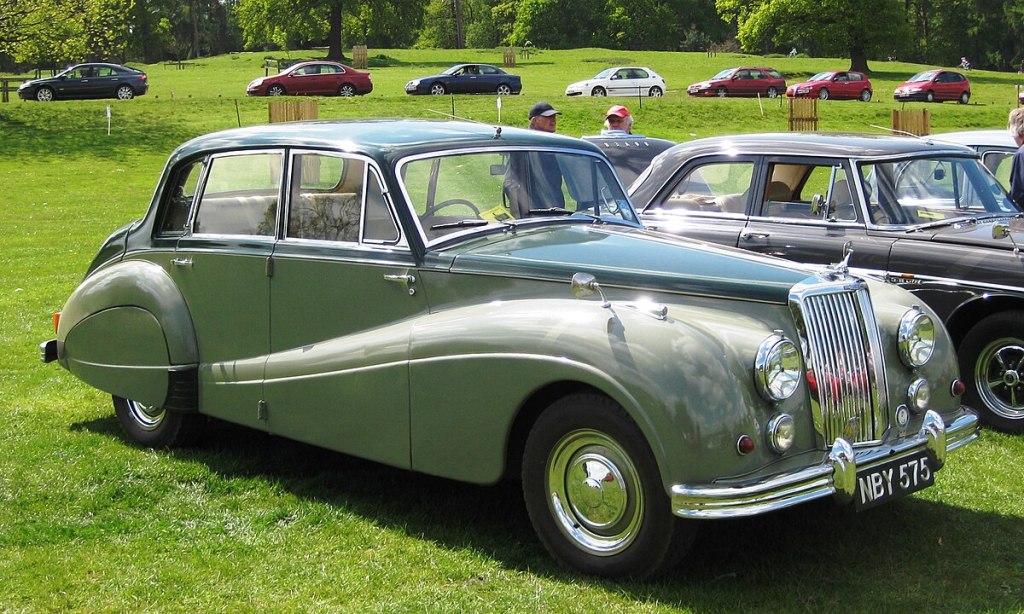
Bond is taken to the airport in a Sapphire, made by Armstrong Siddeley, a British manufacturer of aircraft engines and luxury cars. Armstrong Siddeley was formed by the 1919 merger of the Siddeley-Deasy Motor Car Company and Armstrong Whitworth Development Company. In 1960 the company merged with Bristol Aero Engines to become Bristol Siddeley, and became part of Rolls-Royce in 1966. Armstrong Siddeley produced various Sapphire models from 1952 to 1960.
Great West Road:
Bond’s route to the airport includes the Great West Road, a section of the A4 road that crosses southern England from London in the east to Avonmouth, in Bristol, in the west. It connects with the airport west of London.
London Airport:
Bond departs from London Airport, opened in 1946 and the main international airport serving the London area. In 1966 it was renamed London Heathrow, after the hamlet of Heathrow in which the airport was built.
Evening Standard:
After arriving at the airport, Bond purchases a copy of the Evening Standard, a daily (Monday – Friday) newspaper published as The Standard from 1827 to 1904. In 1963, the Evening Standard began publishing the Modesty Blaise comic strip, created by writer Peter O’Donnell (1920 – 2010) and illustrator Jim Holdaway (1927 – 1970). The newspaper came under new ownership in 2009 and has been distributed free ever since.
Lourdes:
Bond’s fellow trans-Atlantic passengers include some nuns who Bond assumes to be from Lourdes. Lourdes is a town in the Pyrenees in the deep south of France that has been inhabited by humans since prehistoric times. A castle was built there during the Roman era. In 1858 and 1859, 14-year-old Bernadette Soubirous (1844 – 1879) claimed to have received multiple visits from the Virgin Mary. Lourdes became one of the world’s most popular pilgrimage sites and the Catholic church canonized Bernadette as a saint in 1933.
Stetson:

In a bit of foreshadowing, Bond notices two passengers with Stetson hats who will cause him problems later in the story. John B. Stetson (1830 – 1906) was born in New Jersey, the son of a hatter. He created his first Western-style hat from beaver pelt while panning for gold in Colorado in the mid-1800s. When he formed his own hat company in Philadelphia in the 1860s, his “Boss of the Plains” hat was based on that first design from Colorado. The hats were popular with cowboys and celebrities like Calamity Jane, Buffalo Bill, and Will Rogers. The uniform of the Royal Canadian Mounted Police includes a Stetson.
Dramamine:
One of the suspicious passengers takes something Bond assumes to be Dramamine, a brand name for dimenhydrinate, an over-the-counter antihistamine commonly used to treat nausea and motion sickness. It was first sold by the pharmaceutical company G.D. Searle in 1949.
Shannon:
The first stop on Bond’s BOAC flight is Shannon, in County Clare in western Ireland, and home to the international Shannon Airport, built in the late 1930s.
Blood Group F:
One of the suspicious passengers carries a briefcase with a tag that identifies him as W. Winter, with blood group F. Today we generally think of the ABO blood group system, with A, B, AB, and O blood types that are either Rh positive or negative. But there are other blood group systems defined by the presence or absence of specific antibodies, which can be critical factors in determining compatible blood types for transfusions. Blood group F probably refers to the Duffy system, relating to a protein that is the receptor for human malarial parasites.
Bond’s Dinner:
The flight lands in Shannon for dinner, steak and champagne, followed by coffee with Irish whiskey and thick cream.
Jig and Charlie:
Fleming describes the BOAC flight making radio contact with weather ships Jig and Charlie in the mid-Atlantic. Europe, Canada, and the U.S. created the International Civil Aviation Organization (ICAO) in 1948 to establish a network of stationary weather-reporting ships in the Atlantic and Pacific Oceans. The ships were gradually replaced by unmanned weather buoys. Of the original ships, J (Jig) was discontinued in 1949 (so Fleming’s information seems out of date), and C (Charlie) was discontinued in 1973.
Nova Scotia:
Bond sleeps on the remainder of the flight until they approach North America over Nova Scotia, the island province of eastern Canada. While the island was inhabited by indigenous people long before Europeans arrived, it was the Europeans who named it Nova Scotia, Latin for “New Scotland.”
6063:
After an “English countryhouse breakfast” on the flight, which is not specified beyond an “inappropriate assortment of foods,” 007 completes a Treasury Department customs form 6063. I can’t find any information on this form so I assume it has long since been discontinued.
New Jersey Turnpike:
Approaching New York by air, Bond recognizes the New Jersey Turnpike. The main section of the New Jersey Turnpike opened in 1951 and runs from Fort Lee near New York City to Pennsville Township in southern New Jersey.
7: “Shady” Tree
Mike Hammer:
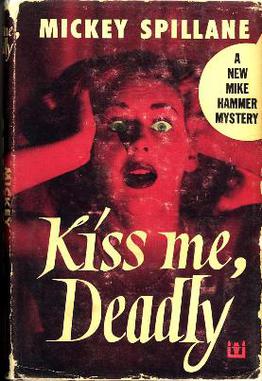
Bond is met at the airport by a man carrying a gun in his hip pocket, which Bond considers a “Mike Hammer routine.” Mike Hammer is the fictional private investigator created by Mickey Spillane (1918 – 2006) for the 1947 novel I, the Jury. Spillane published thirteen Mike Hammer novels, the last one Black Alley in 1996. Writer Max Allan Collins began writing Mike Hammer novels in the 21st century, with the most recent published in 2022. It’s easy to imagine that Fleming might not have thought highly of Spillane or his fictional gumshoe.
Oldsmobile:
The “American gangsters” collect Bond in an Oldsmobile sedan. Founded as the Olds Motor Vehicle Company by Ransom E. Olds (1864 – 1950) in 1897, the company was acquired by General Motors in 1908. Oldsmobiles were some of the fastest consumer cars available in the 1950s (perfect for gangsters) thanks to the Rocket V8 engine introduced in 1949. A gradual decline in sales and profitability led to GM terminating the Oldsmobile line in 2004.
46th Street:
Bond is taken to West 46th Street between 5th and 6th Avenues, what Fleming describes as New York’s equivalent to Hatton Garden, London’s diamond and jewelry district described in Chapter 2. In fact, New York’s Diamond District is a block north, on West 47th Street. Like Hatton Garden, the Diamond District grew somewhat as a result of diamond dealers fleeing the Netherlands and Belgium after those countries were invaded by the Nazis. A look at Google Maps confirms that this block is still a prime location for the diamond industry.
Daily News:
Entering the House of Diamonds’ New York office, we encounter a man (a guard, I presume) reading the sports section of the News, which I imagine is the Daily News. Founded in 1919 as the first tabloid-format newspaper in the U.S., the Daily News peaked in circulation in 1947 and is still published today, though since 1993 it has been printed in New Jersey.
Shady Tree:
We finally meet Shady Tree in the flesh, and, oh look, he has red hair, because Ian Fleming’s villains often have red hair (except Mr. Big in Live and Let Die, who had no hair). Tree is also a hunchback, because Fleming’s villains also have physical imperfections that distinguish them from Bond. And when we meet him, he’s drinking milk, because Fleming’s villains are also disconnected from the essential pleasures of life in which Bond partakes.
Saratoga:
As part of the complex ruse to pay Bond the money he is owed, Shady Tree advised Bond to bet on a horse at Saratoga. Saratoga Race Course opened in 1863 in Saratoga Springs, New York, making it the fourth oldest horse racing track in the U.S. The town of Saratoga Springs is about 36 miles north of Albany, in east-central New York State.
8: The Eye That Never Sleeps
Avenue of the Americas:
Leaving his meeting with Shady Tree, 007 realizes he is being followed and walks up the Avenue of the Americas. Sixth Avenue, sometimes referred to as Avenue of the Americas, runs north-south from lower Manhattan to Central Park, passing, among other sites, Rockefeller Center and Herald Square. While the street was formally named Avenue of the Americas in 1945 in an attempt to entice nations of Central and South America to locate consulates on the the avenue, most New Yorkers refer to it as Sixth Avenue, and that’s how it appears on Google Maps.
Felix Leiter:
Bond isn’t being followed by anyone nefarious, but by his good friend Felix Leiter from Casino Royale and Live and Let Die. Seeing Leiter again is a relief to us and Bond, because his future was not guaranteed the last time we saw him in Live and Let Die.
Sardi’s:
Leiter takes 007 to Sardi’s for lunch of vodka martinis (Bond drinks those more commonly in this book than the previous ones), smoked salmon, and Brizzola. They’ll finish the meal later with avocado with French dressing and espresso. I can’t find much on Brizzola, but Leiter describes it as beef that is “straight cut across the bone. Roasted and then broiled.” According to the James Bond Food site, Brizzola was popular at New York’s 21 Club (see Chapter 5), where it was a favorite of Richard Nixon, among others. Sardi’s current location opened in 1927 on West 44th Street in Manhattan’s Theater District. The restaurant was opened by Vincent Sardi Sr. (1885 – 1969) and his wife Eugenia Pallera Sardi (1889 – 1978) and was long popular with the theater crowd and members of the press. The restaurant is decorated with framed caricatures of celebrities to attract diners.
Pinkertons:
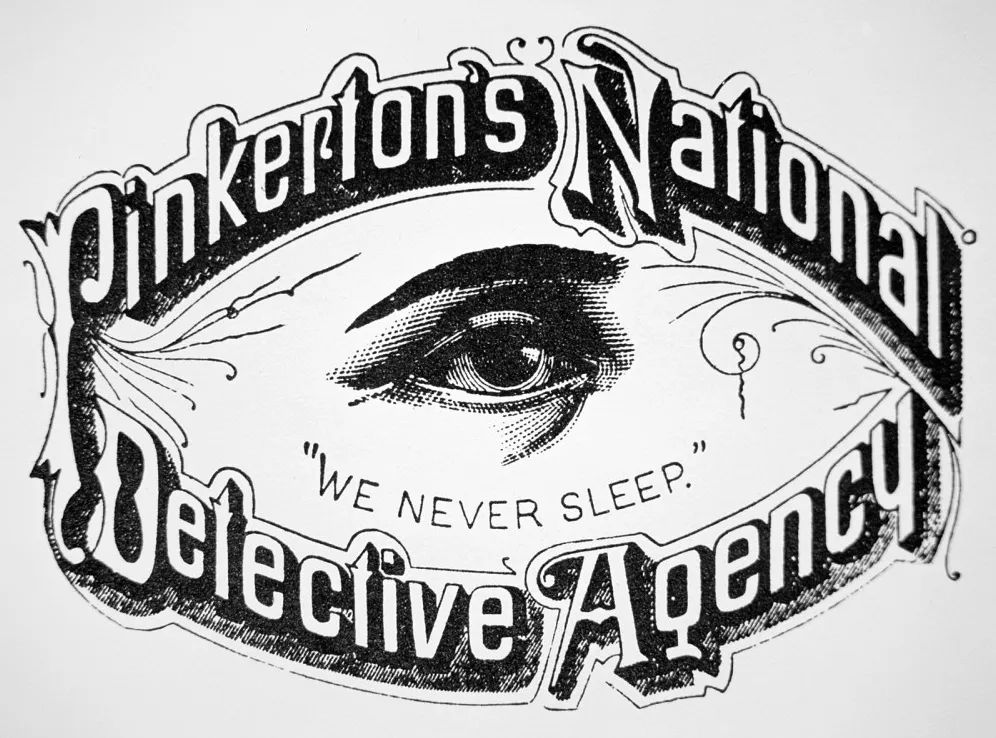
Unable to work for the CIA due to injuries he sustained in Live and Let Die, Leiter now works for Pinkertons. Pinkerton, the private security and investigative agency, was founded in 1850. The business was formed by Allan Pinkerton (1819 – 1884), a cooper who became Chicago’s first police detective in 1849, and Chicago attorney Edward Rucker (who seems to have had little to do with the business). Pinkerton was hired in 1861 to escort President-elect Abraham Lincoln, already threatened with assassination, from Illinois to Washington, DC. Lincoln was accompanied by Pinkerton detective Kate Warne (1833 – 1868) during an overnight train journey from Philadelphia to DC. Warne remained awake the entire time, giving rise to Pinkerton’s early slogan, “We never sleep,” which later became the motto referenced by Felix and the chapter title, “The eye that never sleeps.” And from that we get the term “private eye.”
Britain rules:
It’s significant that Bond is on top of an international diamond smuggling ring while Leiter is only investigating a rigged horse race. “You’re certainly in a bigger league than I am,” Leiter says. Britain sure is important!
Night Eyes:
Bond and Leiter discuss methods of identifying race horses. A tattoo on the lips is one common method, which Leiter says can be foiled with skin grafts. He instead monitors horses’ night eyes, or chestnuts, which are neither eyes nor chestnuts, but callouses on the inner leg above the knee. These formations are unique, roughly equivalent to fingerprints with humans, and another means of identifying individual horses. These do change over time, however, so it’s not a perfect method.
9: Bitter Champagne
Hock:
On the town with Tiffany, Bond suggests “shellfish and hock” for dinner. Merriam Webster defines hock as “a small cut of meat from a front or hind leg just above the foot,” as in ham hocks.
Crabmeat Ravigote:
Tiffany turns up her nose at the thought of “crabmeat Ravigote.” This crab dish is often served as an appetizer and would typically include mayonnaise, Dijon mustard, tomatoes, and other seasonings.
Shaken Not Stirred:
I tend to associate the famous “shaken, not stirred,” line with the movies and had forgotten that Bond’s preferred martini in the books is also shaken, as specified in Chapter 7 of Casino Royale. So of course he specifies that the martinis he shares with Tiffany are “shaken and not stirred.”
Clicquot Rosé:
Bond orders caviar and Clicquot Ros Rosé. The champagne house Veuve Clicquot Ponsardin was established in Reims, France, about 90 miles east of Paris, in 1772, by Philippe Clicquot. The company is still headquartered in Reims. Through inheritance and death, the business was taken over by Madame Clicquot (1777 – 1866), the widow of Philippe’s son François Clicquot. Madame Clicquot is considered to have developed the first vintage champagne, and to have created the first blended rosé, a blend of red and white wines. The company still operates today as part of the LVMH conglomerate.
Twentieth Century and Superchief:
Tiffany plans to take the Twentieth Century train from New York to Chicago, then the Superchief from Chicago to Los Angeles. The 20th Century Limited provided passenger service from New York’s Grand Central Terminal to Chicago’s LaSalle Street Station from 1902 to 1967. Today, Amtrak’s Lake Shore Limited operates on a similar route between Penn Station in New York and Union Station in Chicago. The Super Chief operated between Chicago and Los Angeles from 1937 to 1974. It was the first cross-country diesel-electric passenger train in the U.S. Today Amtrak offers the Southwest Chief along a similar route.
All the Time in the World:
Enjoying his evening out with Tiffany, “Bond suddenly felt they had all the time in the world.” The same phrase was spoken by Le Chiffre in Casino Royale and by Bond himself in Live and Let Die. Of course, we know the romantic couple really doesn’t have all the time in the world, as danger lurks around every corner.
ABC:
Tiffany describes receiving her diamond smuggling orders from the mysterious ABC.
Bond/Tiffany Dinner:
After the appetizers of caviar and champagne, Bond and Tiffany have dinner of cutlets and asparagus with mousseline sauce, similar to hollandaise sauce, with eggs, lemon juice, and cream butter, though I’ve found conflicting information about whether the sauce is made with egg yolks or egg whites.
Kriendler:
Bond and Tiffany are greeted by “one of the famous Kriendler brothers who have owned 21 ever since it was the best speakeasy in New York.” Jack Kriendler and Charles Berns opened the Red Head speakeasy in Greenwich Village in 1922 and went through a series of moves and name changes before becoming the classic 21 Club at West 52nd Street. The Kriendler and Berns families maintained interests in 21 until 1985. I can’t find much on Jack Kriendler, but he appears to have died in 1950, so it would be a member of the later generation who greets Tiffany and 007.
Vin Triste:
Bond sees Tiffany entering a state of “vin triste,” literally “wine sadness,” as a result of too much drink, just as Vesper experienced in Casino Royale.
Use of the Heart:
Bond reflects that “there was one way he would never ‘use’ this particular girl: through the heart.” Bond’s feelings for Tiffany appear to be genuine, though that could be the result of the two needing to rely on each other through a life-and-death situation.
10: Studillac to Saratoga
Western Union:
Bond sends a carefully worded telegram to London via Western Union. Formed in Rochester, New York, in 1851 as the New York and Mississippi Valley Printing Telegraph Company, the company was renamed Western Union in 1856. Western Union was a key player in the U.S. telegraphy industry, not only relaying telegrams, but later developing wire money transfers (1871), telex (1958), and the Candygram (1959). The telegram business was already in dramatic decline by the time of Diamonds Are Forever. Today, funds transfers make up most of Western Union’s business.
Voisin:
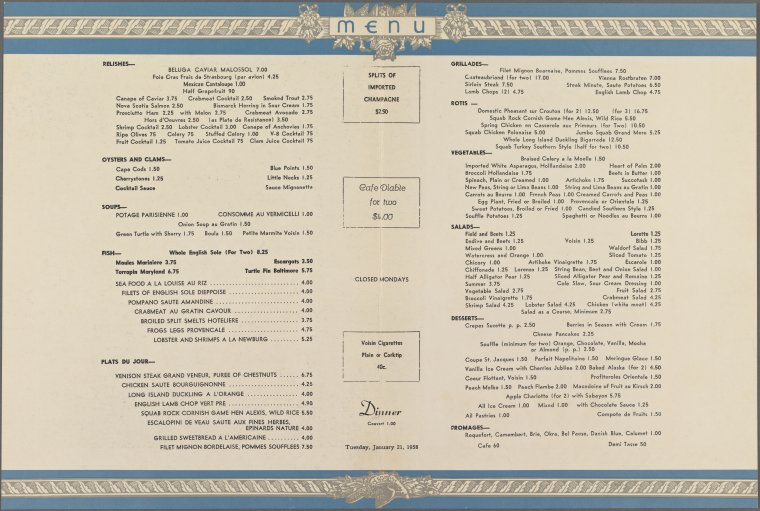
Killing some time waiting for the action to begin, Bond takes his 4th (?!?) shower of the day, then has dinner of two martinis, eggs Benedict, and strawberries at Voisin, a real French restaurant in Midtown Manhattan. Voisin was founded in 1913 by brothers Alfons and Otto Baumgarten from Austria, and was named after a Paris restaurant. New York’s Voisin changed locations a couple of times over the years, but remained in Midtown, until it closed in 1969.
Whitney and Woodward:
Reading up on the local horse racing scene, Bond notes the prominence of C.V. Whitney and William Woodward. C.V. was Cornelius Vanderbilt Whitney (1899 – 1992) who, among numerous other rich guy super-achievements, owned a stable of Thoroughbred racehorses, a past-time he learned from his father, Harry Payne Whitney (1872 – 1930). C.V.’s mother, Gertrude Vanderbilt (1875 – 1942), founded the Whitney Museum of American Art. In the year of Diamonds Are Forever‘s publication, C.V.’s horse Career Boy won the United Nations Handicap race in Oceanport, New Jersey. Whitney also took part in the film industry, producing John Ford‘s The Searchers in 1956. William Woodward Jr. (1920 – 1955) was also a horse breeder, made easier after he inherited a bank fortune and horse farm from his father. Woodward Jr. was killed by his wife Ann Woodward (1915 – 1975) in 1955, after she mistakenly thought he was an intruder and shot him. The marriage was said to be an unhappy one, and some speculated that the shooting might not be accidental. Truman Capote‘s unfinished novel Answered Prayers, published posthumously in 1986, features a character supposedly based on Ann Woodward; Mrs. Woodward took her own life after learning about the book, though she was said to have suffered from depression prior to that.
Central Park:
Felix Leiter drives Bond to Saratoga and they pass through Central Park along the way. Considered the first landscaped park in the U.S., Central Park was designed by Frederick Law Olmsted (1822 – 1903) and Calvert Vaux (1824 – 1895) and opened in 1858. The park was declared a National Historic Landmark in 1963. The site for the park required the demolition of existing villages inhabited by poor residents, including Seneca Village, a settlement of primarily Black citizens, and tiny Pigtown, a settlement of mostly Irish residents.
Henry Hudson Parkway:
The driving route also includes the Henry Hudson Parkway, a nearly 11-mile road from 72nd Street in Manhattan, where it becomes the West Side Highway, to the north border of Van Cortlandt Park in the Bronx, where it becomes the Saw Mill River Parkway. Construction of the Parkway was completed in 1937.
Taconic State Parkway:
Finally, Leiter’s route goes along the Taconic State Parkway, a 104-mile parkway from Kensico Dam (near White Plains, a few miles north of NYC) north to Chatham. It is the longest parkway in New York State. Franklin D. Roosevelt (1882 – 1945) had a lot to do with the parkway’s creation as a means of connecting residents with state parks – FDR was appointed chairman of the Taconic State Park Commission in 1925. The first section of the parkway opened in the late 1920s, but the last section was not completed until 1963.
Indians:
Leiter controls his driving speed to avoid a speeding ticket, to which Bond responds, “But I thought those Indians could do well over ninety.” I take this to mean the state police are riding Indian motorcycles, first manufactured in 1901 and currently owned by Polaris Inc. In the 1960s, New Zealander Burt Munro (1899 – 1978) set a series of land speed records on an Indian, events depicted in The World’s Fastest Indian (2005).
Daytona:
Leiter claims to have put his Studillac (more on that shortly) through the “measured mile at Daytona.” He’s not referring to the Daytona International Speedway, which wasn’t built until 1959, or even its predecessor, the Daytona Beach and Road Course. The Measured Mile was a section of Daytona Beach, on the Atlantic coast of central Florida. It was established by Sir Malcolm Campbell (1885 – 1948), a former Lloyd’s of London underwriter, World War I veteran, and race driver who set a series of land speed records in the 1920s and 1930s. Leiter’s car reached 127 MPH, which is certainly fast, but in 1931 Campbell set a record on the same course of nearly 246 MPH.
Studillac:
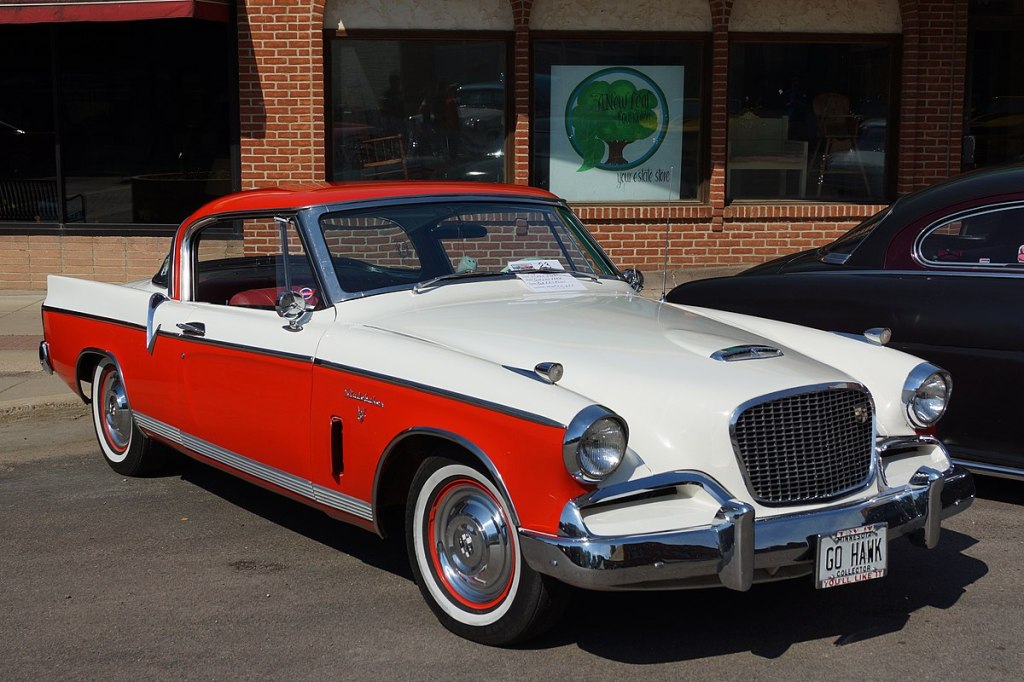
Leiter drives Bond to the races in his custom Studillac, a Studebaker with a Cadillac engine. Founded in 1852 as a wagon and carriage maker, Studebaker began producing motor vehicles in 1902. The company never fully recovered from a failed 1954 merger with Packard and produced its final cars in 1966. Cadillac was founded in 1902 and acquired by General Motors in 1909. Cadillac had a reputation for powerful engines – its V8 powered cars produced in 1915 traveled up to 65 MPH, faster than some existing roads could handle. The company’s 1949 V8 engine with overhead valves led to a Car of the Year award from Motor Trend magazine.
Corvettes and Thunderbirds:
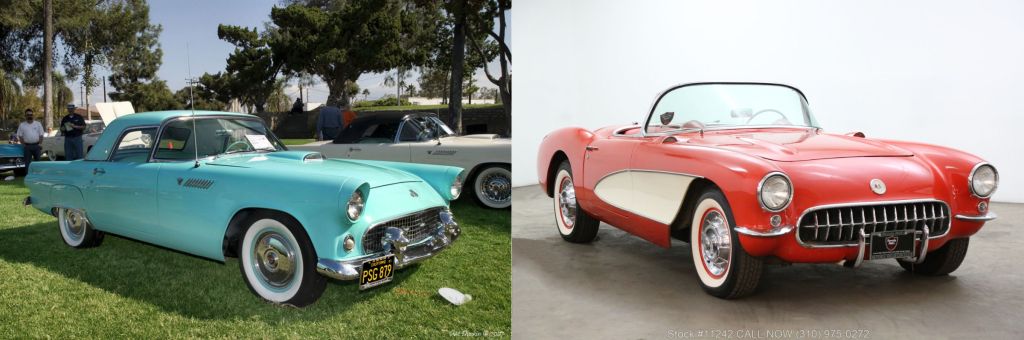
Leiter claims his Studillac is a better sports car than Corvettes and Thunderbirds. The Chevrolet Corvette and Ford Thunderbird were fairly new cars in 1956, first manufactured in 1953 and 1955, respectively. The Corvette was unusual in having a largely fiberglass body. A revised Corvette body was introduced in 1956. The Thunderbird was not intended as a sports car and had a lot to do with creating a new luxury car market segment. Thunderbirds were phased out in 1997, and they were briefly revived from 2002 to 2005.
Raymond Loewy:
Leiter correctly credits the design of his car’s Studebaker body to Raymond Loewy (1893 – 1986). Born in Paris, Loewy became an industrial engineer who did considerable work for the Pennsylvania Railroad, among others, before beginning a series of projects for Studebaker. It was really Robert Bourke, head of a design team at Raymond Loewy Associates, who designed the Studebaker Hawk, newly launched in 1956 and perhaps the very car body Leiter is driving.
Chicken in the Basket:
Bond and Leiter have lunch at a “frontier-style roadhouse” called Chicken in the Basket. While plenty of restaurants serve “chicken in a basket,” fried chicken with French fries, the only Chicken in the Basket restaurant I can find is in North Carolina. Still, it wouldn’t surprise me if this was a real restaurant at the time Fleming wrote the novel. The two agents have scrambled eggs, sausage, rye toast with butter, and iced coffee.
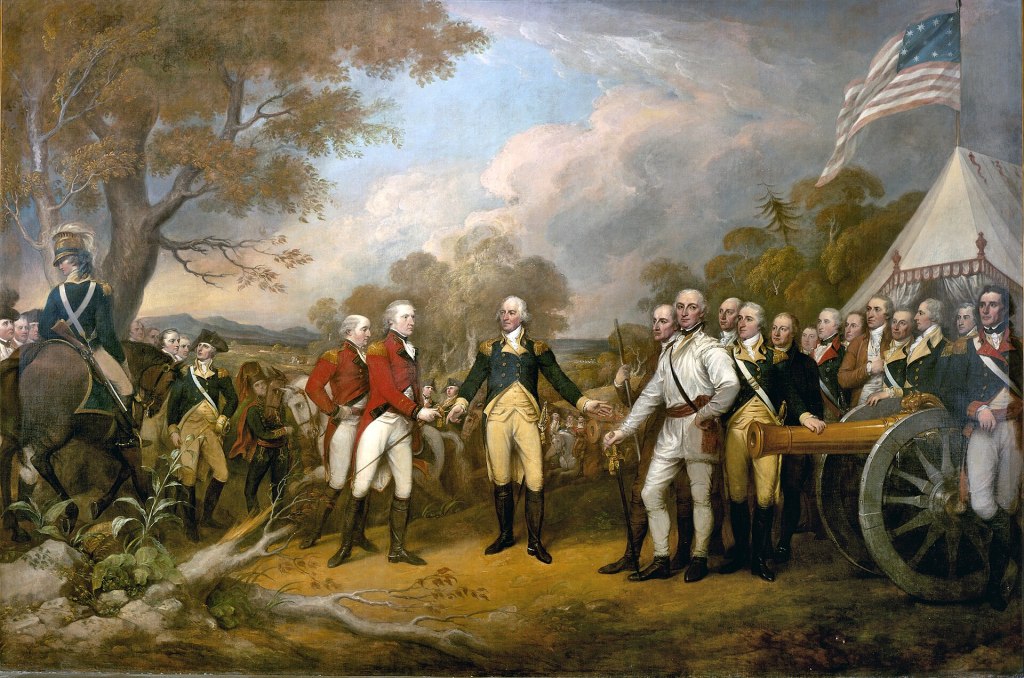
Burgoyne at Schuylerville:
Leiter describes the off-season quiet of Saratoga with the example of old men arguing about “the surrender of Burgoyne at Schuylerville.” British General John Burgoyne (1722 – 1792) moved his army south from Canada too slowly during the American Revolutionary War and allowed colonists to gather strength. Burgoyne masterminded a plan in 1777 to capture the Hudson River Valley. Poor communication from Britain left Burgoyne without the support of additional British forces under other generals. Despite an initial success in the conflict, Burgoyne’s army was defeated by revolutionary forces commanded by Major General Horatio Gates (1727 – 1806) at Saratoga. It was a turning point in the Revolutionary War. The British crossed the Hudson River just north of Saratoga, at a place now named Schuylerville, after American General Philip Schuyler (1733 – 1804) and the whole Schuyler family, who were prominent in business, military, and politics in the 18th and 19th centuries.
Union Hotel:
Leiter also mentions “the old Union Hotel.” Really the Grand Union Hotel, this former boarding house opened in Saratoga Springs in 1802 and in the 1870s was considered the largest hotel in the world. Business began to decline during the Great Depression and World War II, and the building was demolished in 1852 – 1853.
Lily Langtry:
Leiter says Saratoga used to be a popular place for the “belted” English like Lily Langtry (1853 – 1929). Born on the British island of Jersey, Langtry embarked on an acting career in the early 1880s and toured the U.S. in 1882. During the same decade, she had a relationship with wealthy New York real estate investor and horse owner Frederick Gebhard (1860 – 1910), leading to her involvement in U.S. horse racing. English artist Sir John Everatt Millais (1829 – 1896) painted Langtry’s portrait and titled it A Jersey Lily.
Hopeful Stakes:
Leiter also mentions the Hopeful Stakes, an annual Thoroughbred horse race held in Saratoga Springs since 1903. Leiter specifically refers to “the time Novelty beat Iron Mask,” which would have been the 1910 race.
Mauve Decade:
Leiter says Saratoga Springs has “changed a bit since the Mauve Decade.” This was the 1890s or the Gay Nineties. Chemist William Henry Perkin (1838 – 1907), attempting to synthesize quinine to treat malaria, accidentally developed a mauve-colored synthetic dye. This led to development of additional colors of dye, and by the late 1800s fashion trends reflected this wide variety of colors.
Jimmy Cannon:
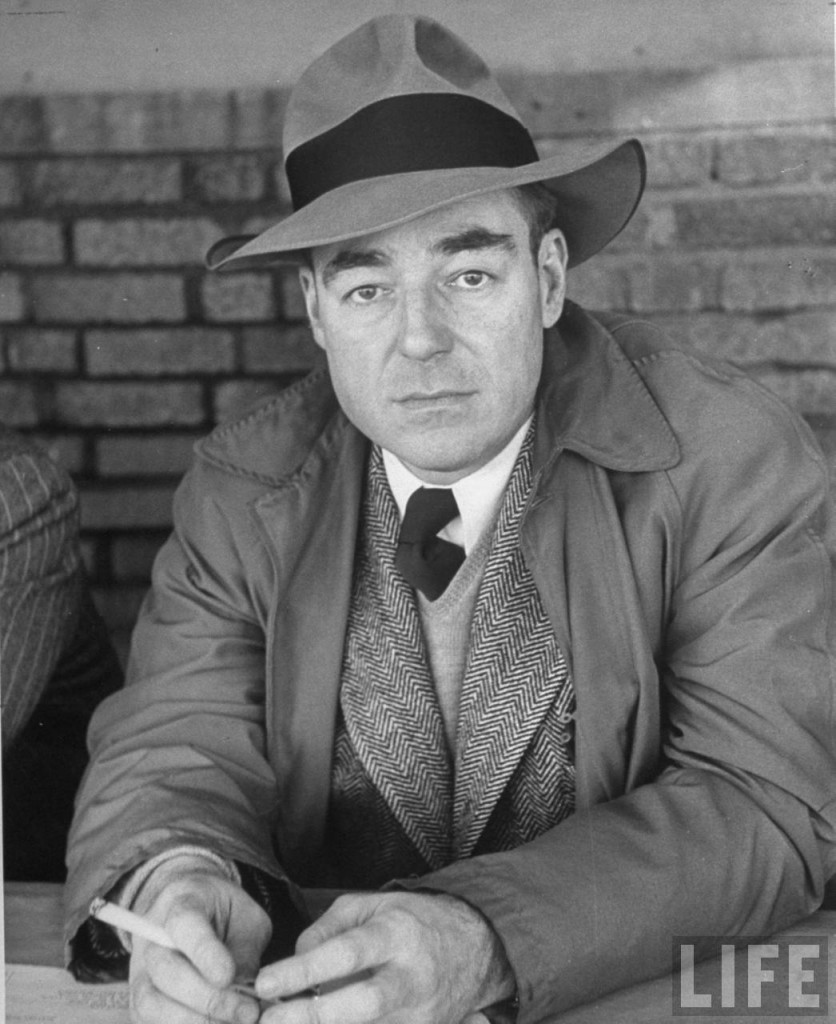
Leiter uses an article by Jimmy Cannon (1909 – 1973) from the New York Post. Cannon wrote a daily sports column, and to fill space on slow sports days, he offered his opinion on any number of non-sports topics. Fleming was clearly a fan, describing Cannon’s “muscular, craftsmanlike prose.” Over the years, Cannon also wrote for the New York Daily News, the New York Journal-American, and King Features Syndicate, but the column cited in Diamonds Are Forever is from the New York Post, founded in 1801 by Alexander Hamilton (1757 – 1804), and only later becoming the tabloid rag owned by seditious fanatics.
Newport and Steubenville:
Jimmy Cannon’s column talks about a gambling circuit that includes, among other places, Newport, Kentucky, and Steubenville, Ohio. Newport became a hub of criminal activity during Prohibition and was sometimes referred to as Sin City because of the number of casinos in town. I can find less on Steubenville, except that it was once a hub of gambling, prostitution, and human trafficking, earning it the nickname Little Chicago. It is also the hometown of Dean Martin (1917 – 1995).
Colonel Bradley:
Cannon’s article compares contemporary gamblers unfavorably with “the tradition of old Col. E.R. Bradley…” Edward R. Bradley (1859 – 1946) was, among other things, a gambler, bookmaker, and Thoroughbred horse breeder. His breeding operation in Lexington, Kentucky, contributed to the significance of the Kentucky Derby. Bradley’s horses won the Saratoga Special Stakes in 1934 and 1939, and numerous other New York races throughout the 1930s and 1940s.
Bill Winfrey:
Cannon’s article also praises trainer Bill Winfrey (1916 – 1994) as one of the few good ones working in Saratoga Springs. Winfrey started as a jockey but became a Thoroughbred trainer of 38 stakes winners. One of them, as identified in the novel, was Native Dancer, twice declared American Horse of the Year.
Lucky and Kid Tatters:
Finally, Jimmy Cannon references Lucky Luciano and a bookmaker named Kid Tatters. Charles “Lucky” Luciano (1897 – 1962) was born in Italy and was so successful as a gangster that in 1931 he established the Commission that governed the American Mafia. I can’t any information about Kid Tatters, who I assume is a fictional character.
Slumberlite:
Leiter and Bond arrive at the Sagamore, which Leiter describes as a motel. The Sagamore resort opened in 1893 in Bolton Landing, but that’s over 35 miles from Saratoga Springs and the Sagamore of the story is later specified to be just outside of town. If there was a Sagamore in Saratoga Springs, it’s apparently no longer in business. The motel advertises Slumberlite beds. I also can’t find much on Slumberlite, except a line of memory foam mattresses made by a New Zealand company and primarily intended for camping. Leiter does mention that the beds are easily stolen, so perhaps this is the same brand.
11: Shy Smile
Elm Trees:

Bond quickly notes the prevalence of elm trees in Saratoga Springs. American elms were some of the most common landscape trees in the United States until beetles carrying Dutch elm disease were introduced in 1928. Elms throughout the country died off in the decades that followed. While many elms in New York City’s Central Park, some planted in the 1860s, were largely preserved because they were isolated from other stands of the trees, elms in many other areas were not so fortunate. Clearly, the elms in Saratoga Springs were still thriving in the 1950s, at least enough so for Fleming to notice them. I’m unable to find more information about the elm’s history in that specific location.
Newmarket and Vichy:
Bond thinks of Saratoga Springs as “a mixture of Newmarket and Vichy…” Newmarket is near Cambridge in east-central England and is considered the birthplace of Thoroughbred horse racing, with horse racing events held there as far back as the 1100s. Vichy, near central France, has been an upscale spa town since the 1800s and today is a UNESCO World Heritage Site.
Tether:
Leiter tells Bond of a Saratoga restaurant called the Tether, a place popular with gangsters at certain times of the year. I can’t find any information about this, and it’s possible Fleming made up a restaurant name based on a common term for the area – horses, of course, sometimes need to be tethered.
Currier and Ives:
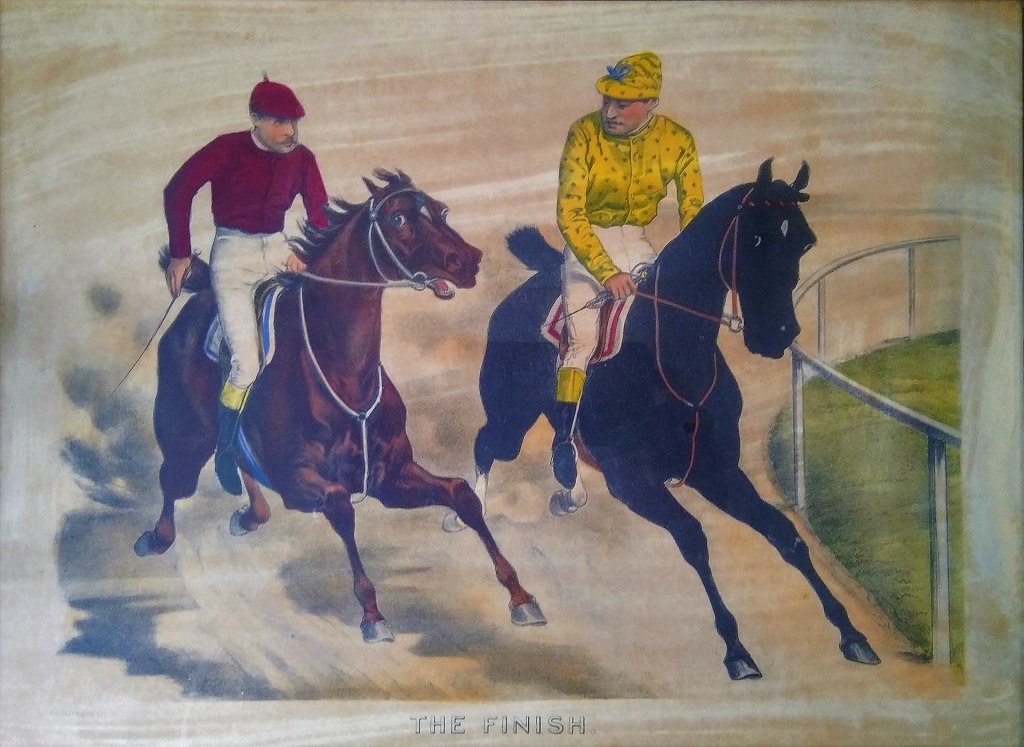
Bond’s room at the Sagamore is decorated with a Currier and Ives print. Nathanial Currier (1813 – 1888) launched a print-making business in New York City in 1835, initially emphasizing disasters-of-the-week, with prints portraying such events as a New York business district fire or the 1840 fire that destroyed the steamship Lexington along with nearly 140 people on board. James Merritt Ives (1824 – 1895) became Currier’s partner in 1857, focusing on business operations and expanding the firm’s work to include political satire and the kind of peaceful imagery for which they are often remembered, such as sleigh rides and country homes.
Chicken Dinner:
Bond has dinner of chicken and two Bourbon old-fashioned cocktails (that should be good for the reflexes!) at an unnamed restaurant
The Saratogian:
Bond relaxes by reading The Saratogian, a daily newspaper covering news in Saratoga County, New York, and published since 1855. At the time of this writing, it is owned by 21st Century Media.
Furlongs:
Leiter reports that the horse they are investigating, Shy Smile, will be timed over four furlongs. A furlong is one-eighth of a mile, 660 feet, or approximately 201 meters. It was first used by the Anglo-Saxons (Early Middle Ages) as the distance a team of oxen could plow a furrow without resting. Turning a team of oxen with a plow was not easy, so longer furrows made for simpler work. The term is rarely used today except in horse racing and agriculture.
San Quentin:
Shy Smile’s registered owner is someone named Pissaro, who now works for Spang and who served prison time in San Quentin. San Quentin Rehabilitation Center, known at the time as San Quentin State Prison, was opened in 1854 in Marin County in northern California. The prison had a reputation for torture and civil rights violations until a new warden, Clinton Duffy (1898 – 1982), took over from 1948 to 1952. Duffy introduced a librarian, psychiatrists, and surgeons to the prison. Black Panther Eldridge Cleaver (1935 – 1998) and country singer Merle Haggard (1937 – 2016) both arrived as inmates at San Quentin in 1958, shortly after Bond’s visit to the States. The prison’s most famous inmate, Charles Manson (1934 – 2017) arrived in 1971.
Sunny Jim:
At the race track, Leiter points out “Sunny” Jim Fitzsimmons (1874 – 1966), a Thoroughbred horse trainer from Brooklyn. Fitzsimmons’ achievements include training three Kentucky Derby winners and two U.S. Triple Crown winners, with 2,275 wins overall.
Chicago O’Brien:
Bond conducts some wagers based on a system developed by Chicago O’Brien. I can find no information on O’Brien, other than a summary of his horse race gambling methodology. O’Brien’s slogan was “Pick ’em to win, play ’em to place.” As I understand it, he picked the horse he expected to win the race, but rather than betting on the horse to win, he bet on it to place – finishing first, second, or third. While the individual payoff might have been less, he won his bets a lot more frequently.
Swinebroad:
Bond and Leiter briefly observe a horse auction conducted by “the redoubtable Swinebroad from Tennessee.” George Swinebroad (??? – 1975) auctioned horses for almost forty years at a combined total value of over one billion dollars. He was described as being “rough and gruff” and possessing a “sometimes-antagonistic marketing style.”
12: The Perpetuities
Pissaro and Budd:
They were mentioned earlier, but now we meet Shy Smile’s owner, Pissaro, and trainer, Rosy Budd. Even after his experience in Live and Let Die, Bond underestimates U.S. gangsters. Comparing Pissaro and Budd to his previous experiences with Russians, Germans, or his own colleagues, he considers Mafia types to be “teen-age pillow-fantasies.”
Seersucker:
Budd wears a seersucker suit. Seersucker is “a thin, puckered, usually cotton fabric,” often with a striped or checkered pattern, well-suited to hot-weather clothing. First developed in the 1800s for use by the Spanish Army in places like Morocco and the Philippines, it was used by the British in warm-weather colonies such as India. The name “seersucker” is derived from Persian words for milk and sugar because of the gritty texture in an otherwise smooth fabric.
Morning Line:
Bond consults the morning line, a daily prediction of the odds for horse races. This is not specifically an estimate of which horse will win, but the odds of each horse winning the race.
Mud and Sulphur Baths:
Bond is to deliver money to Tingaling Bell at Acme Mud and Sulphur Baths. Mud baths are what they sound like, soaking in warm mud made with mineral-rich clay. While there are numerous claims to miracle health benefits, the truth is that mud baths can help to relieve pain or muscle stiffness. Sulfur (sulphur) water is water with hydrogen sulfide gas. Sulfur baths are also alleged to have numerous health benefits, but they come with risks of dehydration and excess sodium or magnesium sulfate.
13: Acme Mud and Sulphur
Belsen-like Chimney:
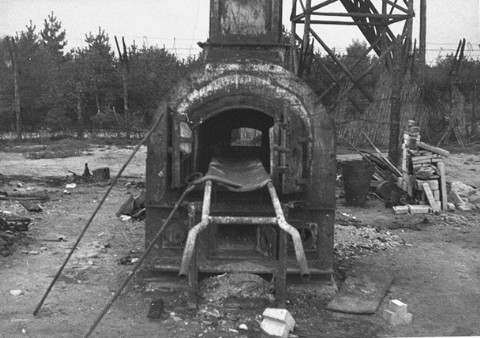
Bond’s reluctance to enter Acme Mud and Sulphur Baths stems partly from the “tall grim Belsen-like chimney.” This seems to refer to the crematorium chimney at the Bergen-Belsen concentration camp, operated 1941 – 1945 near the town of Bergen in northern Germany. Seventy thousand people were killed there by the Nazis.
True Love Stories:
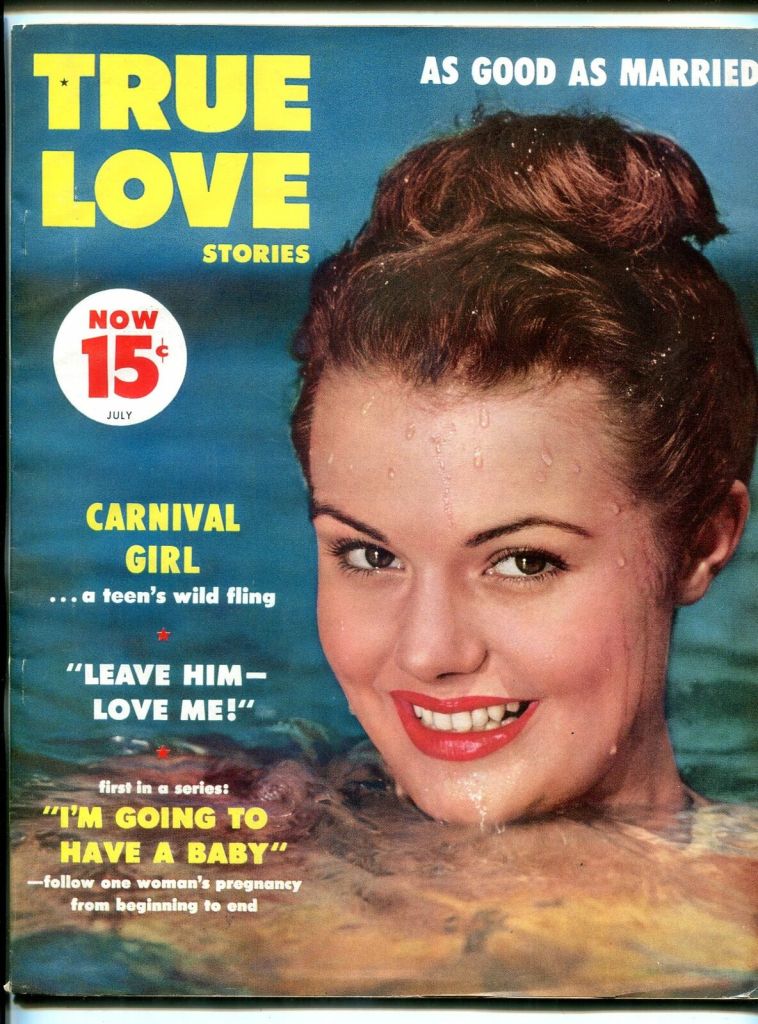
The receptionist at Acme Mud and Sulphur Baths reads True Love Stories magazine. I’m unable to find specifics about publication dates, but there was a True Love Stories periodical, with such confessional-style headlines as “Jealousy Made Him a Brute” and “A Holy Mask Hid My Skin.” You can buy copies on eBay and various collectible sites.
Coffins:
A recurring motif in the Bond novels is a reminder of Bond’s high-risk occupation by subjecting him to a symbolic death. Here, the containers for the mud baths resemble coffins. The process even involves being wrapped in a sheet like a burial shroud. From there, Bond helplessly observes the attack on Tingaling Bell, as though he is a disembodied spirit from the Underworld.
14: ‘We Don’t Make Mistakes’
Doré:
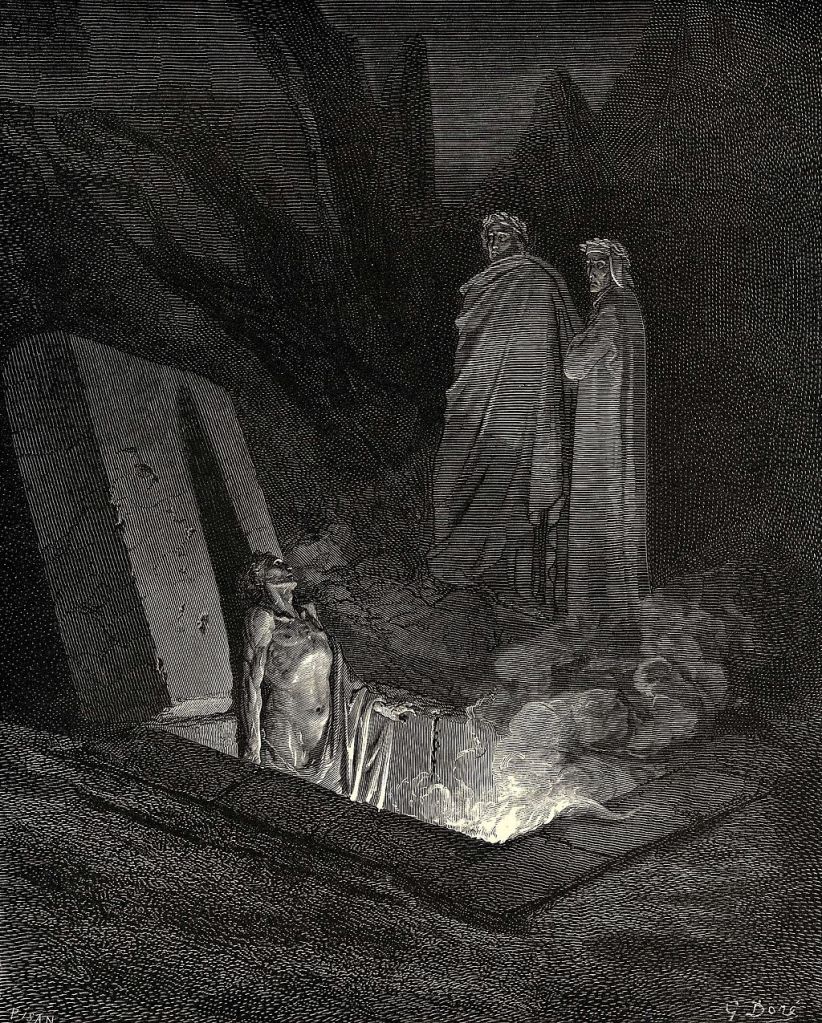
In the aftermath of Tingaling Bell’s assault, Bond observes “the naked men from the showers teetering about like extras out of Doré.” I believe he refers to the French printmaker and illustrator Gustave Doré (1832 – 1883). Doré is known to have created over 10,000 illustrations in his life, including images for editions of the Bible, Cervantes‘ Don Quixote, and Poe‘s “The Raven.” His sometimes haunting illustrations for such works as Milton‘s Paradise Lost and Dante‘s The Divine Comedy may be specifically what Bond/Fleming has in mind here.
Colt .45:
Bond speculates that one of Tingaling Bell’s assailants carried a Colt .45. Is this similar to the long-barreled .45 Colt Army Special Bond wields in Casino Royale and Moonraker? The Colt .45 was introduced by Colt in 1872 and was the official U.S. military handgun from 1873 until 1892.
.38 Police Positive:
The other attacker in the mud baths carried a .38 Police Positive, meaning this gun has made an appearance in all four Bond novels so far. Bond carried one in Casino Royale and Moonraker. Mr. Big’s flunky Tee Hee Johnson uses a modified Police Positive in Live and Let Die. The Police Positive was introduced by Colt in 1905 and was intended primarily for use by law enforcement, although Al Capone (1899 – 1947) used one. Colt claimed better accuracy than the equivalent Smith & Wesson weapon because Colt’s cylinder rotated clockwise, as opposed to S&W’s counterclockwise rotation.
Wint and Kidd:
Leiter identifies the henchmen as Wint and Kidd, more sinister here than they were portrayed in the film adaptation. Like all of Fleming’s villains, Wint and Kidd are “abnormal” and essentially anti-Bonds. Wint frequently sucks at a pronounced wart on one of his thumbs, the opposite of Bond’s fastidiousness about his appearance. The two men are suspected of being gay lovers, unlike the womanizer Bond. And Wint gets carsick, whereas Bond loves aggressive driving.
Blackjack:
As part of his money-laundering process, Shady Tree wires funds to Bond which he is to multiply by playing blackjack. We know Bond is already an experienced card-player and particularly has experience playing baccarat, which has some similarities to blackjack. Blackjack, with the objective of obtaining cards with a face value as close as possible to 21 without going over, is considered the world’s most widely played casino banking game. The game was an English variation of the Castilian veintiuno (twenty-one), which dates back to at least the 1600s.
Pavilion:
Bond and Leiter stop for drinks at a restaurant called the Pavilion. There was a Pavilion Hotel that operated in the 1800s, and a short-lived Pavilion Grand Hotel in the 21st century. If there was a Pavilion restaurant in Saratoga Springs in the 1950s, I’m unable to find any information on it.
Greek syndicate:
Bond still looks down on American casinos and gangsters, comparing them unfavorably to “the Greek syndicate.” It’s an odd choice, because at that time Greece does not seem to have had as developed an organized crime effort when compared to Italy or the U.S.
Desert Inn:
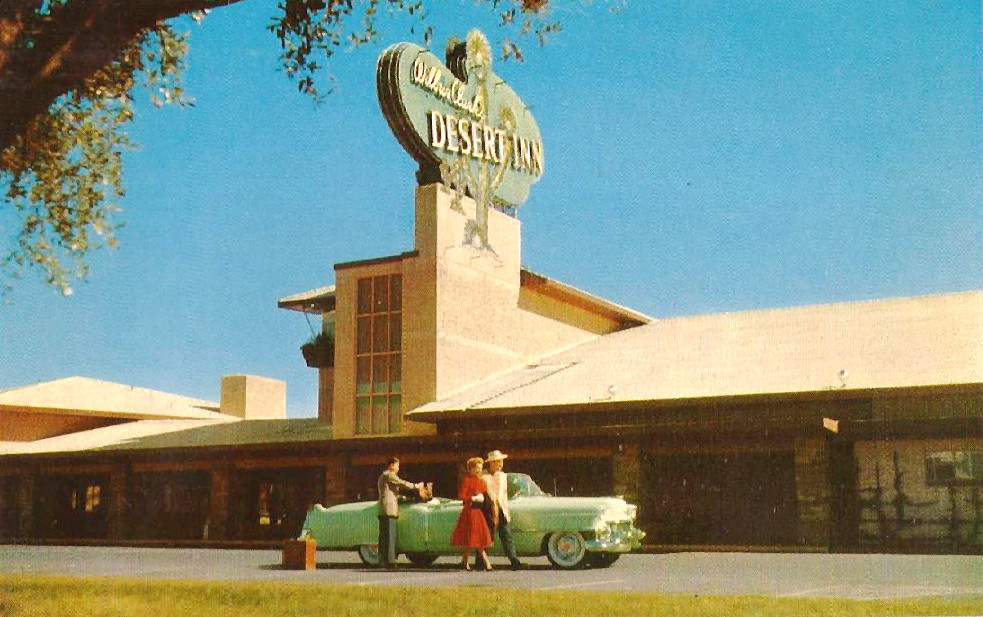
Preparing to disembark for Las Vegas, Leiter tells Bond a tale of “a young G.I.” who had a remarkable string of luck at a craps table at the Desert Inn. As far as I can tell, the young G.I. is fictional, but the Desert Inn hotel/casino operated in Las Vegas from 1950 to 2000. Frank Sinatra’s first Vegas performance was at the Desert Inn’s Painted Desert Room in 1951. The casino also had an 18-hole golf course and considerable financing from organized crime. Some of the hotel’s guests in the 1950s included Winston Churchill, John F. Kennedy (U.S. Senator, 1953 – 1960), and talent agent Lew Wasserman. Howard Hughes (1905 – 1976) lived at the Desert Inn from 1966 to 1970, actually buying the place in 1967.
15: Rue de la Pay
Cajon Pass:
En route to Las Vegas, Bond’s flight passes over the Cajon Pass in southern California. The pass is in the Mojave Desert and came to exist because of the movement of the San Andreas Fault. It’s a major link between San Bernardino and surrounding areas toward the Las Vegas region. It is a freight rail route and interstate I-15 (replacing part of U.S. Route 66) also passes through.
Barstow:
Bond also flies over Barstow, “from which the single track of the Santa Fe strikes off into the desert…” The Santa Fe, formally the Atchison, Topeka and Santa Fe Railway, was a freight rail operator that began in Kansas and New Mexico in 1859, and later operated lines in Illinois, California, Colorado, Texas, and other states. The line originating in Barstow ended in Richmond, in the San Francisco Bay Area. The Santa Fe merged with the Burlington Northern Railroad in 1996. The city of Barstow, in the Mojave Desert, began to form in the 1840s in a region inhabited by indigenous people 3,000 years ago. The city has a history in mining and as a stop for travelers to and from the Los Angeles area.
Oxygen Bar:
Bond makes use of an oxygen bar on his commercial flight to Vegas. Recreational use of concentrated oxygen was first speculated on by surgeon Thomas Henry (1734 – 1816) in 1776, and Jules Verne (1828 – 1905) proposed it in his 1870 novel Around the Moon. Despite numerous snake oil claims, there is no credible evidence to support alleged benefits claimed for inhaling high concentrations of oxygen, and partaking for too long can have serious health consequences.
Chevrolet:
Disembarking in Las Vegas, Bond is picked up by someone driving a “smart-looking Chevrolet.” Presumably not a Corvette as mentioned in Chapter 10. The Chevrolet Motor Car Company was established by, among others, brothers Louis (1878 – 1941) and Arthur (1884 – 1946) Chevrolet in 1911. Another founder was William C. Durant (1861 – 1947), who had previously co-founded General Motors. Later, Durant re-purchased a controlling interest in GM, and Chevrolet was merged with GM in 1918. In addition to the Corvette in 1953, Chevy introduced the compact Corvair in 1960. By 1963, one in ten cars sold in the U.S. was a Chevrolet.
Ernesto Cureo:
Arriving in Las Vegas, Bond meets Ernesto Cureo, driver, friend of Felix Leiter, and Bond’s guide to the Vegas underworld. Supposedly the name is derived from a friend of Ian Fleming’s, a New York-based lawyer named Ernie Cuneo.
Vegas Strip:
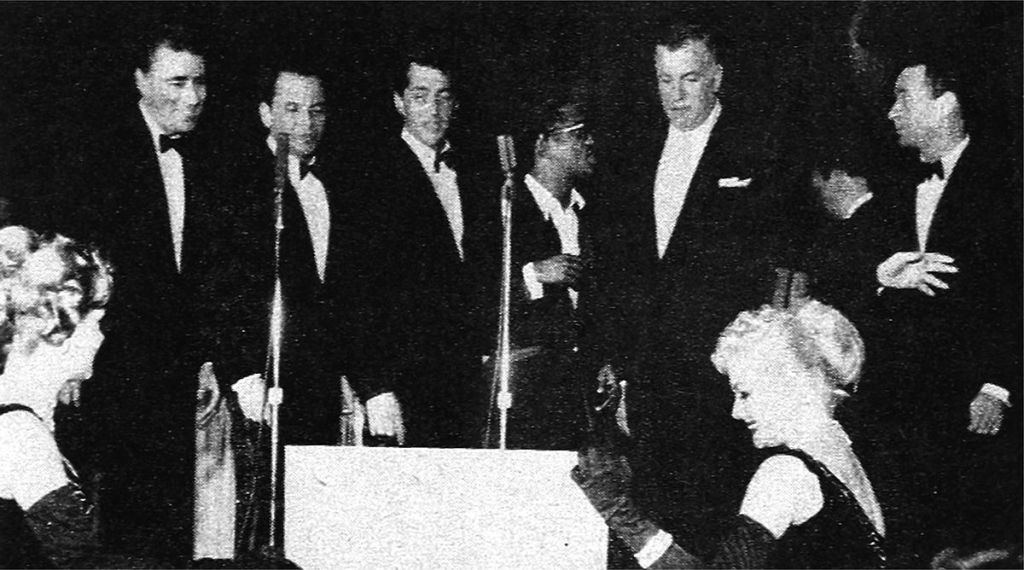
Cureo drives Bond through the Vegas Strip, the 4.2-mile section of Las Vegas Boulevard known for a collection of hotels and casinos. While widely considered part of Las Vegas, it is technically outside the incorporated city limits. Along the way, Cureo name-drops several casino/hotels and their founders, including The Flamingo, originally proposed by developer Billy Wilkerson (1890 – 1962), but largely overseen by Benjamin “Bugsy” Siegel (from Chapter 3) until he was murdered by unknown assailants. We also see the Sands Hotel and Casino, opened in 1952 by Mack Kufferman with financing by some of his crime world associates. At this time, the Sands was run by Jack Entratter (1914 – 1971), who expanded the Sands’ live entertainment business based on his previous experience running the Copacabana in New York City. Frank Sinatra was a regular performer at the Sands for many years beginning in 1953. Next, the Desert Inn, already mentioned in Chapter 14. It was originally called Wilbur Clark’s Desert Inn, named after the founder, developer Wilbur Clark (1908 – 1965). Cureo also mentions the Thunderbird (later the El Rancho), the Last Frontier (the second hotel/casino opened on the Strip), and the fictional Tiara.
Silence Towers:

Cureo compares gambling losses to “those Silence Towers they have in India.” A dakhma, or Tower of Silence, is a raised circular structure used for excarnation, the removal of flesh and organs (usually by vultures) prior to burial. It was developed by Zoroastrians in the 5th century to avoid contaminating soil and water with dead human bodies. After excarnation, the remaining skeleton could be safely buried.
16: The Tiara
Guilded Mousetrap:
Bond thinks of Las Vegas hotel/casino design as the Guilded Mousetrap School, “its main purpose being to channel the customer-mouse into the central gambling trap whether he wanted the cheese or not.” The positioning of entrances and exits forces every individual to walk past slot machines and card tables, attracting anyone with even the faintest inclination toward gambling to donate money to the casino. In reality, casino design is very deliberate, with the intent of keeping visitors in the casino as long as possible and encouraging them to enjoy the experience of losing money.
Bond’s Dinner:
After getting oriented in the casino, Bond has dinner of cherrystone clams with steak and his second vodka martini of the evening. Unlike the little neck clams Bond had in Live and Let Die, cherrystones are the second largest variety of hard-shell clam. Somewhat chewier than smaller clams, they are often used in chowders and sauces.
17: Thanks for the Ride
Half-Wellingtons:
Tiffany Case shows up and wears, along with her sombrero (?), a pair of half-Wellingtons. Wellingtons were leather boots inspired by Hessian military riding boots, first made popular by Arthur Wellesley (1769 – 1852), 1st Duke of Wellington. Over the years the term “Wellingtons” came to be applied to rubber boots that today are more commonly used in farming and other outdoor activities. The British Army made heavy use of Wellingtons in World Wars I and II. Wellingtons typically rise to about mid-calf; half-Wellingtons, as one might imagine, are simply shorter versions of the same boots.
Scarne Shuffle:
Tiffany deals to Bond at the blackjack table using what appears to be a Scarne shuffle. Bond turned to John Scarne‘s (1903 – 1985) Scarne on Cards in Moonraker. Born in Ohio but raised in New Jersey, Scarne set out to be a professional gambler but his Roman Catholic mother convinced him to pursue magic instead. Scarne could shuffle a deck of cards in such a way that would allow him to cut to all four aces, but here I believe the story refers to the now-common riffle shuffle that Scarne used to mix the deck.
Annulment:
Tiffany also manipulates the card deck with a “single-handed Annulment, one of the most difficult gambits in card-sharping.” A single-handed Annulment is a way of cutting a deck of cards with only one hand, and it definitely looks difficult, as demonstrated in this Howcast video.
Boulder Dam:
Bond has bourbon with water from “over by Boulder Dam.” Fleming was a little behind the times in using this name. Congress authorized construction of a dam in the Black Canyon area of the Colorado River in 1928. Later funding bills referred to the Hoover Dam, after President Herbert Hoover (1874 – 1964). But the dam was dedicated in 1935 by President Roosevelt, and FDR’s administration referred to it as Boulder Dam. Congress formally restored the name Hoover Dam in 1947, long before Diamonds Are Forever was published. Sitting on the border between Nevada and Arizona and creating the reservoir Lake Mead, power generated by the dam’s hydroelectric turbines has been declining in recent years as over-consumption has caused Lake Mead’s water level to decline.
18: Night Falls in the Passion Pit
Highway 95:
Spang has an Old West-themed ghost town “way out on Highway 95.” U.S. Route 95 runs north-south from the Canadian border at Eastport, Idaho, to the Mexico border at San Luis, Arizona. The road runs right through Las Vegas. Spang’s ghost town, called Spectreville (uh oh!), is 50 miles from Rhyolite, which is about 123 miles northwest of Las Vegas.
Rhyolite:
Cureo describes a rail line taking silver from Spectreville to Rhyolite. Rhyolite is a ghost town in Nye County, Nevada, very close to the California border. It was established in 1905 and was one of a number of similar mining towns formed at the time. While the novel refers to silver mining, it seems that gold was the primary precious metal to come out of the area. By 1920, the town was abandoned for mining and became a tourist attraction and a filming site for movies. The Rhyolite train depot became the Rhyolite Ghost Casino in 1937, later being converted to a museum gift shop until it was abandoned in the 1970s.
Jaguar:
Bond and Cureo are tailed by an “old sports-model Jag with a rumble seat.” The motorcycle sidecar manufacturer Swallow Sidecar Company was founded in 1922. The company began manufacturing Jaguar sports cars and changed its name to Jaguar in 1945. Jaguar became especially popular through the 1950s and 1960s, with models like the XK120, XK140, and the E-Type. I’m unable to identify a particular Jaguar model that had a rumble seat, an exterior seat that sometimes folded into the body of the car. The Jaguar in question is either an older model or a custom job, as according to Wikipedia the last cars manufactured with rumble seats were in 1939 in the U.S. and 1949 in Britain.
Frasso and McGonigle:
We meet two of Spang’s henchmen, Frasso and McGonigle, though they are not named until Chapter 19.
19: Spectreville
Wells Fargo:
Arriving in Spectreville, Bond sees buildings with signs advertising, among other things, Wells Fargo. Wells Fargo & Company was founded in 1852 by Henry Wells (1805 – 1878) and William G. Fargo (1818 – 1881) to serve the growing demand for banking services in the west due to the California Gold Rush. In the early days the company also transported gold, mail, and supplies. Wells Fargo spun off its express operations in 1905 and over the years went through various acquisitions, mergers, and name changes. In 1954, Wells Fargo & Union Trust became Wells Fargo Bank. In addition to numerous regulatory investigations and fines, Wells Fargo is currently one of the largest lenders to the fossil fuel industry.
Stutz:
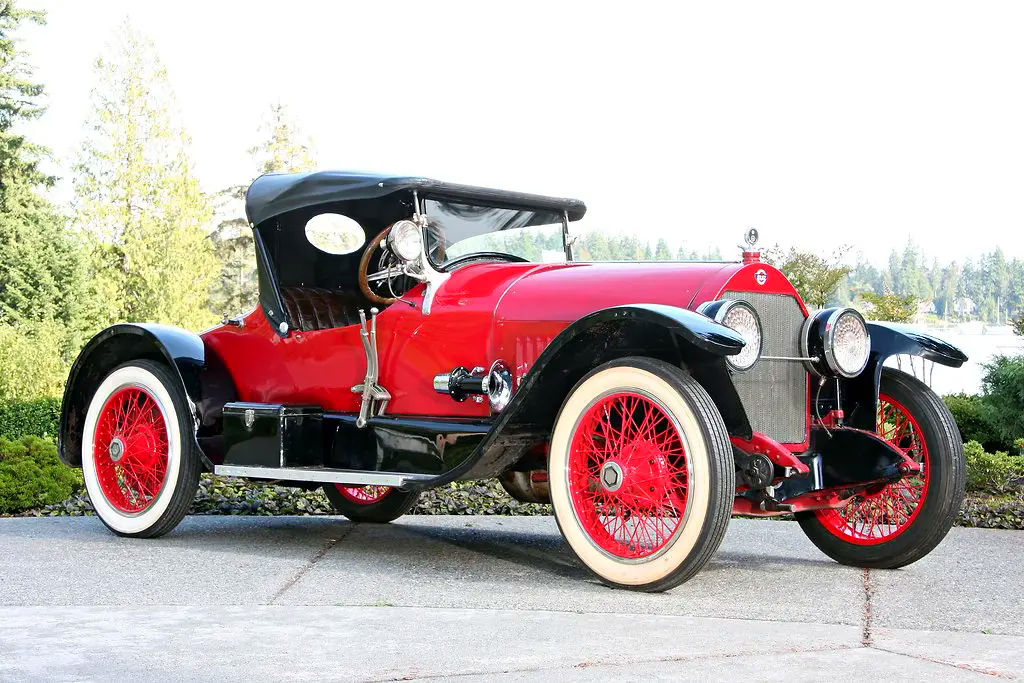
Spang’s auto inventory includes a 1920 Stutz Bearcat. The Stutz Motor Car Company was founded in Indianapolis, Indiana, in 1911 by Harry C. Stutz (1876 – 1930) and Henry F. Campbell (1882 – 1936), and went out of business in 1938. The business name was revived in 1968 but factory production of vehicles ended in 1995. The Stutz Bearcat was first produced in 1912 with racing car features aimed at mainstream auto drivers, though its price made it a luxury vehicle. The Bearcat was produced on and off through 1934. An entirely redesigned Bearcat was produced by the revived Stutz Motor Car in the years 1979 – 1992.
I Wonder Who’s Kissing Her Now:
Spang’s clubhouse also features a “honky-tonk piano” playing the song “I Wonder Who’s Kissing Her Now.” The song was published in 1909 with music by Harold Orlob (1883 – 1982) and lyrics by Will M. Hough (1882 – 1962) and Frank R. Adams (1883 – 1963). The song was introduced to the public in the 1909 musical The Prince of To-Night. The song has been re-recorded numerous times by the likes of Bing Crosby, Ray Charles, Bobby Darin, and Anne Murray (as “I Wonder Who’s Kissing Him Now”).
Annie Get Your Gun:

Tiffany Case reappears in a western-style dress that “looked like something out of Annie Get Your Gun.” The musical premiered on Broadway in 1946 with lyrics and music by Irving Berlin (1888 – 1989) and book by Dorothy Fields (1904 – 1974) and Herbert Fields (1897 – 1958). The first production featured Ethel Merman (1908 – 1984) in a fictional version of the life of the sharpshooter Annie Oakley (1860 – 1926) and included such classic songs as “There’s No Business Like Show Business” and “Anything You Can Do (I Can Do Better).” The play premiered in London’s West End in 1947 with Annie Oakley played by Dolores Gray (1924 – 2002), only nine years before Diamonds Are Forever was published. The show’s first Broadway revival was staged in 1958, with Betty Jane Watson (1921 – 2016) as Annie Oakley.
Highland Railway:
After capturing 007, Spang takes his hostage onto a restored steam locomotive of the “‘Highland Light’ 4-4-0 class.” I think Fleming is referring to Highland Railway, formed in 1865 by the merger of the Inverness & Aberdeen Junction and Inverness & Perth Railway. The railway primarily served Scotland and northern Britain. It operated some light railways (not to be confused with “light rail”), railways built to lower standards than classic heavy rail, with lighter-weight track and operating at a slower speed. A 4-4-0 locomotive has four leading wheels on two axles, four powered/coupled driving wheels on two axles, and zero trailing wheels. This configuration was commonly used in the U.S. in the early 19th century.
Pullman:
Spang’s locomotive includes a Pullman car. The Pullman Company was founded by George Pullman (1831 – 1897) in 1862 to build luxury sleeper cars after he spent an uncomfortable night trying to sleep on a New York train. Pullman was the primary manufacturer of U.S. passenger rail cars for many years, but it ended production in 1982. The company was so influential that it built the town of Pullman, Illinois, now a neighborhood of Chicago, in the 1880s.
20: Flames Coming Out of the Top
Strangways:
Having been roughed up by Wint and Kidd, Bond dreams of Strangways and diving. This refers to Live and Let Die, where Strangways, introduced in Chapter 16 of that book, provided such important support to Bond’s mission.
Buster Keaton:
As Bond and Tiffany escape on a handcar – a small railcar generally powered by a seesaw-like handle pushed up and down by passengers – Bond ignites some gas cans to blow up Spang’s hideout, “Like something out of an old Buster Keaton movie.” Buster Keaton (1895 – 1966) was best known for writing, directing, and starring in a series of silent films involving outlandish stunts without CGI. One of Keaton’s best known films is The General (1926), featuring live-action train stunts and chases that are hard to imagine even today – Keaton himself was knocked unconscious during the filming.
Specter Range:
Escaping on their handcar, Bond and Tiffany observe “the dark mass of the Spectre Mountains.” It’s just a coincidence that we have both Spectreville and the Spectre Mountains, since Bond’s nemesis SPECTRE won’t be introduced until 1961. In this case, however, Fleming is really referring to the Specter Range, a small mountain range in Nye County, Nevada, bordered by, among other things, the Nevada Test Site. Formerly known as the Nevada Proving Grounds, 928 atmospheric and underground nuclear tests were conducted there between 1951 and 1994. In other words, Bond is in truly dangerous territory.
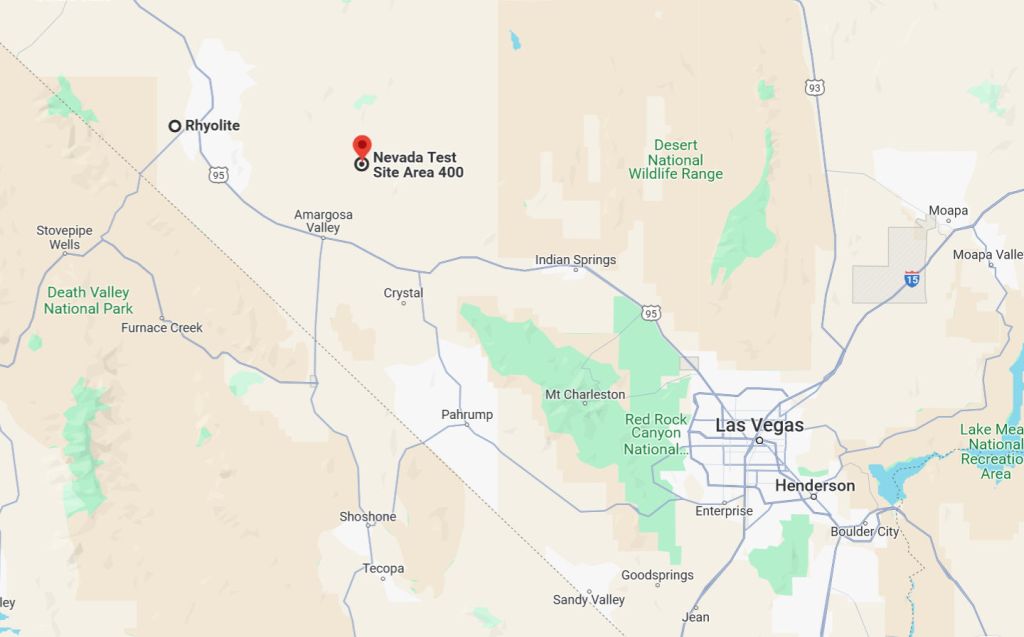
Casey Jones:
Tiffany claims that the handcar won’t go any faster “even if my name was Casey Jones…” John Luther “Casey” Jones (1863 – 1900) was a locomotive engineer for the Illinois Central Railroad. Jones had a reputation for running his trains on schedule, even if he had to compromise a bit on safety: During his career, Jones received nine citations for rules infractions, resulting in suspensions totaling 145 days. However, in 1895 he reportedly ran to the front (cowcatcher) of a train as it approached a station to pull a frightened child off the tracks.
21: “Nothing Propinks Like Propinquity”
Beatty, Death Valley, Olancha:
Felix Leiter rescues Bond and Tiffany, taking them on a drive through Beatty, an unincorporated town in Nye County, Nevada, and formerly home to Western Shoshone peoples. The town was named after Montillus Murray Beatty, owner of a nearby ranch and the town’s first postmaster. Beatty’s population in 1950 was 485. Next, Death Valley, a desert valley in eastern California and in the northern part of the Mojave Desert. (See map in Chapter 20 above.) The Badwater Basin in Death Valley is 282 feet below sea level, the lowest elevation in North America. Finally, Leiter cites Olancha, a small settlement in Inyo County, California. In 1969, two members of the Manson Family hid out in Olancha after participating in the murders of Sharon Tate, Jay Sebring, Wojciech Frykowski, Abigail Folger, and Steven Parent. In 1960, the total population of Inyo County was a little less than 11,700.
Merthiolate:
Leiter gets Bond to a physician who treats some of his woulds with merthiolate, something also needed in Live and Let Die. Thiomersal was a mercury-based antiseptic marketed under the trade name merthiolate.
Sunset Boulevard:
Soon enough, the trio is cruising down Sunset Boulevard in the upscale Los Angeles suburb of Beverly Hills. Sunset Boulevard is 23.5 miles along the route of a 1700s cattle trail. Now the road runs from the Pacific Coast Highway to Figueroa Street in downtown Los Angeles. The year Diamonds Are Forever was published, developer Paul Trousdale (1915 – 1990) purchased 410 acres of land that would be annexed by Beverly Hills as Trousdale Estates, a neighborhood that was later home to such celebrities as Frank Sinatra, Dean Martin, Ray Charles, and Richard Nixon.
Beverly Hills Hotel:
Our protagonists aren’t being subtle. Before returning east, they relax in the bar at the Beverly Hills Hotel, opened on Sunset Boulevard in 1912. Howard Hughes bought a collection of bungalows at the hotel and lived there off and on over the years. Guests in the 1950s included Henry Fonda, Elizabeth Taylor, King Albert of Belgium, and Grace Kelly. The Eagles‘ song “Hotel California” was inspired partly by the hotel.
Good Friend:
Leiter delivers Tiffany and Bond to the airport for their flight to New York; he may be in private service now but he has pulled some strings with the CIA to arrange safe transit for Bond and Tiffany. Bond and Leiter have an emotional farewell and Tiffany tells 007, “You’ve got yourself a good friend there.” The statement perhaps also represents Fleming declaring the U.S. a good friend to England.
TWA:
Bond and Tiffany fly to New York on a Super G Constellation jet operated by Trans World Airlines (TWA). TWA was a U.S. airline formed in 1930 by the merger of about half a dozen smaller airlines. Howard Hughes (again!) obtained majority control of TWA in 1944. The airline began offering nonstop cross-country service in 1953. The Super G Constellation is the Lockheed L-1049G, first operated by TWA in 1955 with a maximum capacity of 99 passengers. The plane was powered by turbo-compound engines, a reciprocating engine with a turbine to recover energy from exhaust gases, increasing the engine’s total power. TWA’s delay in entering the jet age had a lot to do with Hughes eventually losing control of the airline. In 1958, TWA was the first major airline to hire a Black flight attendant. Thanks partly to a money-losing ticket scheme arranged by corporate raider Carl Icahn, TWA declared bankruptcy in 1995 and was eventually acquired by American Airlines in 2001.
Bond in Love?:
On the flight east, Bond reflects on Tiffany Case. “Bond knew that he was very near to being in love with this girl.” And, soon after, “Once he committed himself to her it would be forever.” I understood Bond’s infatuation with Gala Brand in Moonraker, but I confess I’m a bit stumped as to what he sees in Tiffany Case. Presumably this, as in Bond’s previous adventures, is a case of Bond temporarily losing control of his emotions after the stress of a life-or-death situation. And Bond considers Tiffany a damaged woman, so he may be in something of a saviour complex. (“His would be the role of the healer, the analyst…”)
Floris:
Bond plans to cable his housekeeper May to prepare his flat for Tiffany’s expected arrival, including “bath essence from Floris.” Floris of London, founded in the 1730s by Juan Famenias Floris, was granted its first Royal Warrant (a contract to serve the royal family) in 1820. Floris was perfumer to Queen Elizabeth II and is still owned by the Floris family. Floris also provided soaps and lotions for the members of Blades in Moonraker.
LaGuardia:
Bond and Tiffany arrive in New York via LaGuardia Airport in Queens. Beginning as a private seaplane port in 1929, the airport was expanded to commercial service thanks to Fiorello La Guardia (1882 – 1947), who was mayor of New York City from 1934 to 1945 and was frustrated by the lack of commercial air service into the city. Thanks to the Works Progress Administration (WPA), which did much of the expansion work, New York Municipal Airport was dedicated in 1939. It was formally renamed in honor of the former mayor in 1947. In April, 1957, close to the time of Bond’s visit, there were 283 weekday fixed-wing departures from LaGuardia.
Pontiac:
Bond and Tiffany are met in New York by representatives from Pinkerton and the State Department, and driven off in a “smart maroon Pontiac…” Pontiac was a division of General Motors. GM purchased the Oakland Motor Car Company in 1909 and introduced the first Pontiac model in 1926 as a less expensive companion model to the Oakland. The cars were initially manufactured in Pontiac, Michigan, which was named after the Odawa chief Pontiac, or Obwaandi’eyaag (approx. 1714 – 1769). Bond was there at a key time in the company’s history; numerous changes to Pontiac bodies and chassis were made for the 1955 and 1956 models. GM discontinued the Pontiac line in 2010.
Queen Elizabeth:
In New York, Tiffany and Bond board the RMS Queen Elizabeth bound for England. Named after Queen Elizabeth (1900 – 2002), who was queen of the UK from 1936 to 1952, the cruise ship was operated by the Cunard Line providing weekly service between NYC and Southampton in the UK. The QE was launched in 1938 and was the largest passenger liner in the world at that time. The ship actually began service transporting troops in World War II and did not enter true commercial service until 1946. The ship was retired from commercial service in 1968 and replaced by the Queen Elizabeth 2. The original QE was 1,031 feet long and had 13 decks. The QE was sold to a Hong Kong businessman and caught fire and capsized under mysterious circumstances in Hong Kong Harbour in 1972. The wreck appeared as a remote MI6 office in the film version of The Man with the Golden Gun (1974).
22: Love and Sauce Béarnaise
Ambrose Light:
Leaving New York, the RMS Queen Elizabeth (QE) passes Ambrose Light, really the Lightship Ambrose, a lightship in Ambrose Channel, the main passage for ships going to and from the Port of New York and New Jersey. Various ships served this function beginning in 1823. The specific ship in service during Diamonds Are Forever would have been the U.S. Lightship WLV-613, which went into service in 1952 and maintained its vigil until being replaced by a fixed light station (Ambrose Light) in 1967.
U-Boats:
Bond recalls the QE playing “hide-and-seek with the U-boat wolfpacks” during the war. He’s referring to the QE’s troop transport operations, including transporting U.S. troops to Asia and Europe. U-boats were the term for German submarines, from the German Unterseeboot (under-sea boat). The QE was fast enough to generally avoid the U-boats, but she was fired on (unsuccessfully) by U-704 in 1942. What strikes me about this passage is that Bond recollects the events almost as if he was there.
Portishead:
Wint and Kidd have followed Bond and Tiffany, and during the cruise Wint sends a cable that will be received by “the listening ear of Portishead.” Portishead is a town in the county of Somerset in southwestern England. The town sits on the Severn Estuary, which leads into the Bristol Channel. But the cable is almost certainly being received by Portishead Radio, a radio station that provided maritime communications beginning in 1928. Portishead Radio provided vital communications during World War II and became even busier in the post-war years, communicating with an average of 1,000 ships per day by 1965. Much of the station’s work was gradually replaced by communications satellites, and the station was closed in 2000.
Miss Rheingold:
Complaining about Bond’s choice of seating in the QE’s cocktail bar, Tiffany says she feels like “Miss Rheingold of 1914.” Rheingold Beer was sold from 1883 to 1987 by Rheingold Brewery, which was a U.S. company founded by German immigrant Samuel Liebmann (1799 – 1872) and his sons. The Liebmann family controlled the company until selling it to Pepsi-Cola in 1964. Rheingold was very popular, especially in New York State, where it was the leading brand for much of the 1940s and 1950s. There was no Miss Rheingold of 1914, but Philip Liebmann, great-grandson of Samuel, started the Miss Rheingold marketing scheme in 1940. Every year from 1940 until 1965, the company solicited applications for the title of Miss Rheingold; they selected six finalists, and consumers voted at supermarkets for their favorite. Two of the winners, Emily Banks (1960) and Celeste Yarnall (1964), would go on to play yeomen in the original Star Trek TV series. The contest was revived in 2003 but did not generate much interest and only lasted two years.
Shantung:
Tiffany wears a Shantung silk shirt. Shantung is a type of silk from the eastern Chinese province of Shandong. Shantung has a ribbed surface and is sometimes used for bridal gowns, which ties in nicely with Bond’s illusions of eternal love.
Cartier:
Tiffany also wears a Cartier watch. The French jeweler was founded by Louis-François Cartier (1819 – 1904) in 1847 and was controlled by the Cartier family until 1964.
Iwo Jima:
We learn that when Tiffany Case was born, her father was so upset at not having a son that he left his family, joined the Marines, and was killed at Iwo Jima. Iwo Jima is a Japanese volcanic island that is part of the Ogasawara Archipelago and located in the Pacific Ocean about 750 miles south of Tokyo. Only about 11.5 square miles in size, Japanes airfields were placed on the island during World War II. The airfields were considered important enough that the U.S. Navy and Marine Corps assaulted the island in February – March 1945, with combined U.S. / Japanese casualties over 20,000. The Marine Corps Iwo Jima Memorial was dedicated at Arlington Ridge Park near Arlington National Cemetery in 1954. The Japanese government is still searching for remains of soldiers killed in the battle.
Sauce Béarnaise:
Describing the kind of woman he wants, Bond says he wants “Somebody who can make Sauce Béarnaise as well as love.” Bond and Vesper shared a dinner of Sauce Béarnaise in Casino Royale. It’s similar to Hollandaise sauce but with different seasonings.
M:
Bond may serve England but his true loyalty is to the ever-present M. 007 tells Tiffany, “Matter of fact, I’m almost married already. To a man. Name begins with M. I’d have to divorce him before I tried marrying a woman. And I’m not sure I’d want to do that.” Bond’s dedication to M has been the defining relationship of the novels. Bond has engaged in this internal debate before, a stable and boring life of the heart versus the danger of a life of duty, and he has always returned to M. Bond even discloses to Tiffany that he would like to have children, “But only when I retire.” Following that up with, “My job’s not all that secure,” we get the sense that Bond expects to die in the line of duty, a sentiment expressed more explicitly in Moonraker.
The Virgin Tiffany:
Tiffany tells Bond, “I’ve never what you’d call ‘slept with a man’ in my life.” Bond will be the man to deflower her. This seems hard to believe given how streetwise Tiffany comes across and how long she has been involved with gangsters and the Vegas milieu. However, it’s not surprising as the kind of male fantasy that Fleming might have passed along to his secret agent.
Bollinger:
After they part company for the night, Tiffany sends a bottle of Bollinger to Bond’s room. The champagne maker was founded in 1829 – in the Champagne region of northeastern France, of course – by Jacques Bollinger along with members of other families who had wine-making history as far back as the 1500s.
23: The Job Comes Second
All the Time in the World:
There’s that phrase again. As Tiffany and Bond finish their dinner on the QE and take each other’s hands, we get that powerful foreshadowing: “But now there was all the time in the world…” A variation of words used previously by Le Chiffre in Casino Royale and by Bond himself in Live and Let Die.
Midlands:
The QE passengers take part in an auction involving a wager on the precise number of miles the cruise ship will travel the following day. The auction is conducted by a “jovial Midlands businessman…” Midlands is essentially central England and the region played a significant role in the Industrial Revolution during the 18th and 19th centuries, particularly Birmingham, which today is England’s second largest city. In the post-War years, Birmingham experienced significant immigration from British territories, and the city saw its highest population during that period in 1951, at 1.1 million.
Esquire:
One of the auction bidders is a man identified as “a caricature of an Esquire sugar-daddy.” Esquire magazine was launched in 1933 and was immensely popular right from the start. The magazine covered men’s fashion but also featured the writings of Ernest Hemingway, F. Scott Fitzgerald, and other respected writers of the time.
Up to Forty:
Commenting on the Esquire sugar-daddy, Bond says, “He must be sixty. Up to forty, girls cost nothing. After that you have to pay money, or tell a story. Of the two it’s the story that hurts most.” Is this misogyny on Fleming’s part, or is he describing the stress of producing entertaining stories? Fleming is said to have written Casino Royale to generate income because of anxiety over his pending marriage to Ann Charteris (1913 – 1981) in 1952. Diamonds Are Forever was his fourth Bond novel in four years. Fleming only turned 48 the year Diamonds Are Forever was published, but he suffered his first heart attack only five years later.
Cunard:
Bond mentiones Cunard; as described earlier, the QE was operated by the Cunard Line, the British shipping line initially founded by Samuel Cunard (1787 – 1865) in 1839 as a steamship mail company. Cunard’s ship the Lusitania was sunk by the Germans in World War I. Cunard was the largest Atlantic passenger line after World War II, operating twelve ships to North America. Cunard was acquired by Carnival in 1998.
Dutch Schultz:
Tiffany compares Bond to an underworld accountant nicknamed “Abadaba,” who died in “the Dutch Shultz killing.” The accountant, Otto Biederman (1891 – 1935) was referred to as “Abbadabba” and supposedly came up with the saying, “Nothing personal, it’s just business.” Dutch Schultz, or Arthur Flegenheimer (1901 – 1935) was a New York gangster involved in bootlegging and the numbers racket. Schultz, along with his accountant and two others, were assassinated in a Newark restaurant in October, 1935, as a result of Schultz attempting to assassinate prosecutor Thomas Dewey (1902 – 1971), in violation of orders from the Mafia’s ruling Commission.
24: Death is So Permanent
Left-side Sleeping:
Tiffany advises Bond that sleeping on one’s left side is bad for the heart. According to Healthline, research indicates that sleeping on the left side may increase pressure on the heart, as indicated by changes in cardiac electrical activity measured by ECG. There is no indication that this will actually lead to heart disease. However, some congestive heart failure patients experienced discomfort and breathing difficulty if sleeping on their left side.
Dakar:
Bond receives a cable from M’s chief of staff indicating that Rufus B. Saye, aka Jack Spang, is the brains behind the whole diamond smuggling operation. Saye has been tracked to Dakar via Paris. This is taken as evidence that the diamond pipeline begins in Sierra Leone. Dakar is the capital of Senegal in western Africa and the westernmost city on the African mainland. (See map under Chapter 1.) The city was an active port in the Atlantic slave trade in the 1600s and was later a significant city among French colonies. Senegal merged with French Sudan to form the Mali Federation in 1959, but the two regions split in 1960 and Senegal became an independent republic. Sierra Leone’s capital of Freetown is roughly 900 miles from Dakar.
Canberra:

The Chief of Staff’s cable also specifies, “RAF Canberra awaits you Boscombe Down for immediate onward flight tomorrow night to Sierra Leone.” In this case, Canberra is not a city but a jet-powered bomber manufactured by English Electric and first put in to service for the Royal Air Force in 1951. The Canberra could fly higher than most other aircraft in the 1950s, and in 1957 set a world altitude record of 70,310 feet. The RAF’s final Canberras were retired in 2006. (More on Boscombe Down in Chapter 25.)
Emerson:
In addition, the Chief of Staff’s cable alerts Bond that a member of the Spangled Mob has followed them on to the QE, causing Bond to recall “that most sinister line in all poetry.” This is from Ralph Waldo Emerson‘s (1803 – 1882) 1856 poem Brahma: “They reckon ill who will leave me out; When me they fly, I am the wings…” Transcendentalist Emerson wrote the poem from the perspective of the omnipotent Hindu god Brahma. Brahma appears to be one of the first poems to describe subject matter from Asia in Western poetic verse. The specific line, in this context, is a reminder to Bond of the arrogance that he had sole control over his destiny. While Bond is certainly not Hindu, we’ve seen clear evidence in the past that he tends toward superstition, and is certainly aware that evil, and death, can lurk around every corner.
Blood Knot:
Learning that the enemy’s cabin is, conveniently, directly below his, 007 climbs out his cabin porthole by tying bed sheets together using a blood knot. A blood knot is a type of bend knot, which is used to connect two lines of rope (or sheets, in this case). The knot is frequently used in fly fishing because there is less loss of strength compared to other knots. It’s not an easy knot to tie, just the challenge for Bond.

Southampton:
After Bond dispatches the villains, he stages their cabin with an eye to how it will be interpreted by “the detectives who would come on board at Southampton.” As mentioned earlier, Southampton is on the English end of the QE’s Atlantic route. Southampton, is, naturally, a port city, at the northern point of Southampton Water, a large tidal estuary where the River Test and the River Itchen meet. The Mayflower and the Speedwell departed Southampton in 1620 before returning to land at Plymouth due to structural problems with the Speedwell. The RMS Titanic departed Southampton in 1912 on its first and final voyage. The city’s commercial and military importance made it a target for heavy bombing during World War II; 630 people were killed and thousands of buildings were damaged. And Benny Hill was born in Southampton in 1924.
25: The Pipe Line Closes
No Scorpion:
We return to the scene of the first chapter, where the smuggler killed the scorpion. There is no more scorpion; the smuggler is now the one who will be vanquished by Bond and his assault force.
Telebadou:
The smuggler looks in the direction of Telebadou (Télébodou), a town in the West African nation of Guinea. So far I am unable to find any information on Télébodou beyond the fact that it exists.
Bofors:
The mini-assult force that accompanies Bond to close down the pipeline brings a Bofors. AB Bofors was a Swedish arms manufacturer founded as a hammer mill – a pre-industrial manufacturer of tools and weapons – in 1646. Alfred Nobel (1833 – 1896) briefly owned the company in the late 1800s. Bofors was acquired by various companies over the years and was most recently acquired by the British firm BAE Systems in 2005. There’s a good chance Bond’s cohorts are using a Bofors 40 mm L/60 gun, an anti-aircraft gun used by both Allied and Axis powers in World War II and commonly referred to as the “Bofors gun.”
Boscombe Down:
In a brief flashback, M calls Bond at Boscombe Down, a military aircraft testing site in the town of Amesbury, England. It’s about 30 miles northwest of Southampton, where the QE docked. (Bond was directed to the site in Chapter 24.) The site originated as an aerodrome under a different name in 1917. During the Cold War, Boscombe Down was used for the testing of numerous aircraft for the British Armed Forces.
Daimler:
In an awkward conversation with M, Bond explains that he has sent Tiffany to his flat in a Daimler hire. I’m guessing the Daimler in question isn’t from the German Daimler-Benz, but the British Daimler Company. The British firm, founded in 1896 by H.J. Lawson (1852 – 1925) had to buy the rights to use the Daimler name from the already established German company. From 1902 to 1950, Daimler held a Royal Warrant to provide automobiles to the British monarch. Poor business choices caused Daimler to decline after World War II, and losing the Royal Warrant to Rolls Royce didn’t help. In 1960 the company was purchased by Jaguar.
Final Thoughts:
Another 007 adventure ends with Bond grimly victorious, as always. Fleming’s research for Diamonds Are Forever contributed to his 1957 non-fiction book The Diamond Smugglers. I’m a little surprised that the novel ends with Tiffany Case apparently taking up residence in Bond’s flat. Doesn’t this imply that marriage is being contemplated? Diamonds were popular in wedding and engagement rings by 1956, thanks to a late-1940s advertising campaign by De Beers. But the book equates diamonds with death, implying that, for Bond at least, marriage would also be a kind of death. Either way, co-habitation seems like a significant step for 007; he did say in Chapter 22 that he is symbolically married to M. (Again connecting marriage with dying, as it’s M who sends Bond on missions that nearly always end in someone’s death.) I look forward to learning how this is resolved in Ian Fleming’s next Bond novel.
 The Creative Life Adventure