“There may be no such thing as the sweet life. But it is necessary to find that out for yourself.”
Roger Ebert, in an essay on La Dolce Vita (1960)

I read Jonathan Lee’s novel The Great Mistake this week. The book is a fictional imagining of historic events, both the life and death of Andrew Haswell Green (1820-1903). Green was sometimes referred to as the Father of Greater New York because, among other things, in the late 1800s he led the movement to unite the City of New York (Manhattan), Brooklyn, and surrounding areas into the New York City that we know today, an act opponents at the time called The Great Mistake. Green was also one of the leaders in establishing Central Park, the Metropolitan Museum of Art, the New York Public Library, and numerous other urban upgrades. (It wasn’t all good, of course. The building of Central Park, for example, led to the destruction of Seneca Village, a majority-Black settlement with 3 churches, 2 schools, and 3 cemeteries.) Green was assassinated by Cornelius Williams in 1903 in an extreme case of mistaken identity. Lee includes considerable historic details in The Great Mistake, with alternating chapters exploring Green’s life and the investigation of his death. The book doesn’t focus on the logistics of Green’s achievements but on how individuals perceive each other and connect, or fail to connect, with each other. It’s a beautifully-written novel but I felt considerable sadness reading it. Maybe that’s not surprising for a book that begins with an assassination.
- P. 7: “At the age of eighty-three he had the self-awareness necessary to be patient with other people, but not always the facility to disguise the effort.”
- P. 18: “Strangers shaped out their own idea of him and called this creation by his name. They made him an outcast of his own universe and a bit player in theirs.”
- P. 53: “New York didn’t set out to charm you. It was like God that way. You had to bring a lot of the enthusiasm yourself.”
- P. 80: “How do we picture the past? Does it become clearer as it drifts into the distance? Can it be seen from more angles, a better vantage, with finer instruments for optics, and more supporting documentation to draw from? Or has its essence already vanished, leaving space for lies to multiply and thrive, spreading across paperwork that is good for nothing…”
- P. 227: “Each passing year it seemed there would be time. But the final realization of life is that there isn’t time. There isn’t time. It is slipping away from us with every smile.”
- P. 255: “Encouraging the rich to donate something to our new museum, a painting or two from their private collection, in return for having their name on display. Mentioning their name would be on display, it transpired, was much more effective than pointing out that, without a first-class art museum, a city could never be great.”

I also revisited The Dark Knight Returns by Frank Miller, Klaus Janson, and Lynn Varley. It’s hard to recall how disruptive this title felt when it was released in 1986. I was more of a Marvel fan at the time, but even I understood TDKR was a game-changer. Some people were turned off by the story’s rapid shifts in perspective, but that gave it a cinematic style that I hadn’t seen in comic books previously. By now, TDKR is thoroughly embedded in comic superhero culture, not just in all of the Batman movies from 1989 forward, but in how the character was portrayed in his point of origin, comic books. Without TDKR, would we have had the “A Death in the Family” storyline in 1988, or Legends of the Dark Knight, the one Batman title I kept up with religiously during my collecting years? I haven’t read any of Miller’s Dark Knight sequels, they don’t look interesting to me, but The Dark Knight Returns holds up brilliantly nearly 40 years later.
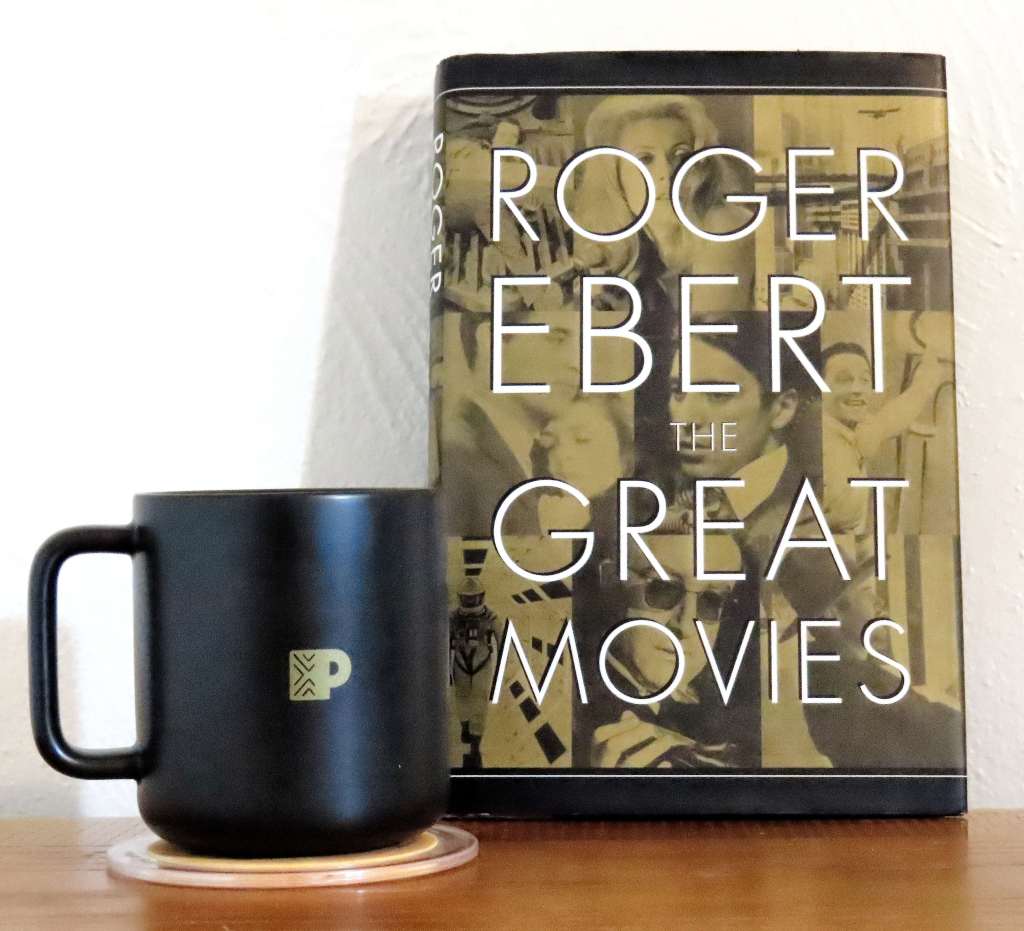
And I’ve started reading The Great Movies by Roger Ebert, a book I miraculously picked up at a library book sale for only $2. As I’ve written before, I remain a big fan of Ebert and often find myself wondering what he would think of some of the movies released after his death. The Great Movies is a collection of reviews/essays on 100 films that Ebert considered important. Sometimes I agree with him 100%, as with Casablanca (1942) – “Seeing the film over and over again, year after year, I find it never grows overfamiliar.” – and other times I disagree, as with Bride of Frankenstein (1935) – “[I]t’s satirical, exciting, funny, and an influential masterpiece of art direction.” Either way, I always appreciate his insights. Like a good book review, a good movie review should stand on its own, and Ebert’s work qualifies. This is a book you can read all at once or revisit from time to time for specific essays. Reading The Great Movies is as close as you can get to reading a book and watching movies at the same time.
- P. xvi: “The ability of an audience to enter into the narrative arc of a movie is being lost; do today’s audiences have the patience to wait for Harry Lime in The Third Man?”
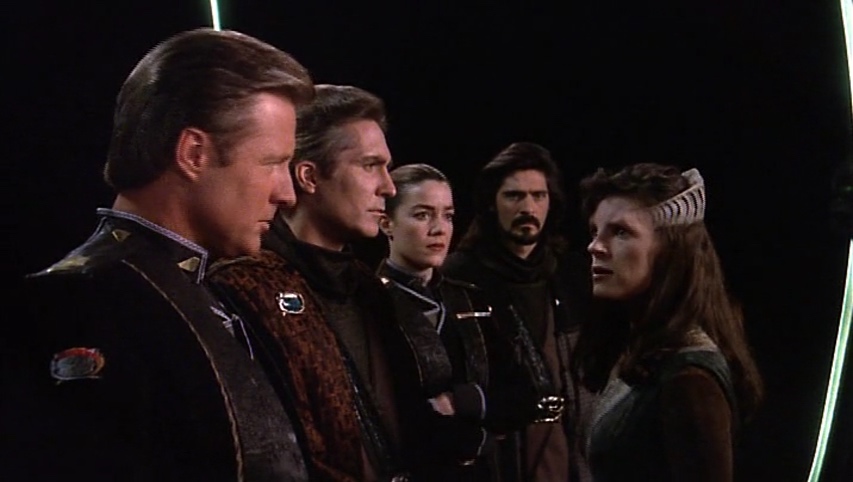
Back in March I wrote about watching Babylon 5 (1993-1998) for the first time (see March 3 and March 10). Between summer travel and pausing to watch the final season of Miami Vice (I’m working on a third essay to complete the analysis I started with Seasons 1 & 2, and Seasons 3 & 4), I’m now nearing the end of Season 3 of B5. While I’ve found the series interesting, I admit I became a little neutral on the show once Michael O’Hare left at the end of Season 1. Bruce Boxleitner is a wonderful actor, but O’Hare brought a gentle quality to the character of Jeffery Sinclair that I really miss. O’Hare’s personal struggles and final outcome are heartbreaking but I respect his reasons for leaving the series. However, Season 3 has really revived my interest, especially the 2-part mind-bending time travel episode “War Without End,” which I watched this week. So many elements from previous episodes are brought together in that episode, including the return of Sinclair and a resolution to his character arc. The episode is so complex, at some point I forgot what the ultimate purpose was, but it didn’t matter because it was so cleverly written and well acted. Supposedly an animated B5 film is in the works for later this year.

 The Creative Life Adventure
Leave a comment