The Gods Have Always Been Crazy
“Perhaps all of us are crazy, Ona says. Of course we’re all crazy, says Mejal. How can we not be?”
—Women Talking by Miriam Toews–
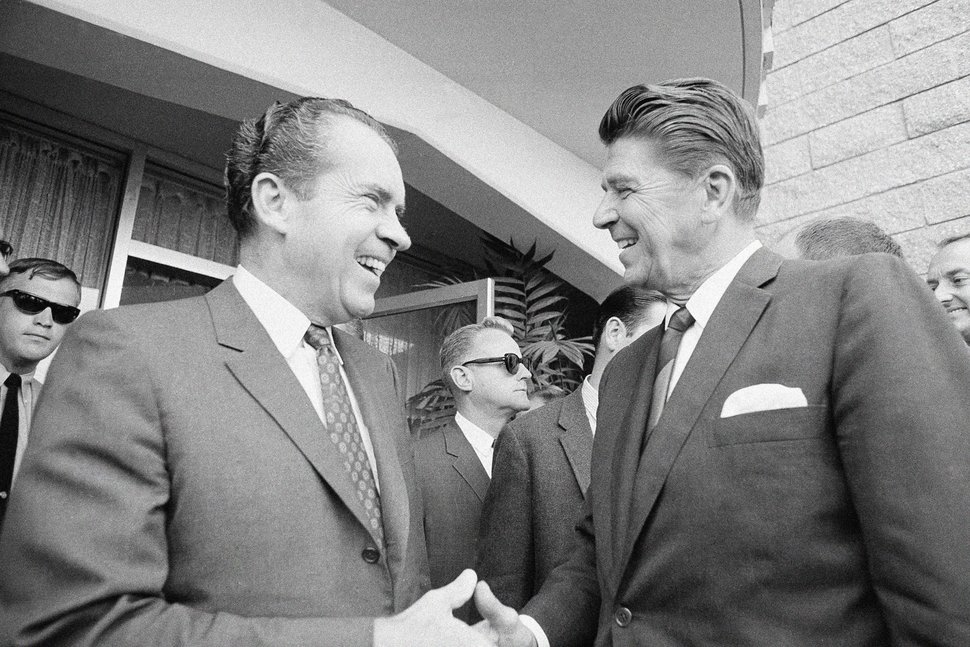
Like so many others, I was devastated by the results of the U.S. presidential and congressional election on November 5. Devastated, but not terribly surprised. Only a lost nation accepts a healthcare system that values profits over people, abandons collective safety to reward the insecurity of the unhinged, or declares a scorched earth “good for the economy.” This inhuman “pro-life” mindset is hardly new in the land of the free oligarchs. So many of our current troubles go back to the days of Reagan. We signed the national death warrant when we forgave Reagan and company for trafficking with terrorists, pandering to bigots and homophobes, and turning human suffering into the stuff of grandfatherly jokes. Having lived through these events, I knew they were terrible when they were happening, but I didn’t understand how obsessively the country would cling to its delusional path. And we shouldn’t forget that the Gipper mastered his corrupt ways while informing on his film industry peers to the FBI during the McCarthy era. Human history is not discrete events, but a continuum that tends toward failure. This recent election is not an outlier.

During the chaotic days following the 2020 election – the launching point of the Big Lie – I found surprising comfort in Miriam Toews‘ brilliant novel Women Talking. Toews’ book describes a group of women confronting the reality that the men in their Mennonite community have repeatedly assaulted them; the women’s thoughtful and compassionate, though sometimes heated, decision-making process is an inspiration. If this small group, that has suffered such cruelty – cruelty justified by others’ worship of a sadistic god – can sort through their diverse opinions and find a hopeful way forward, certainly the rest of us can if we want to. I didn’t have such a comforting book on hand for this latest election, so instead I turned to movies, and re-watched the controversial 1980 film The Gods Must Be Crazy.
The Myth of Civilization
“They believe that the gods put only good and useful things on the earth for them to use.”
—Paddy O’Byrne as the Narrator, The Gods Must Be Crazy—
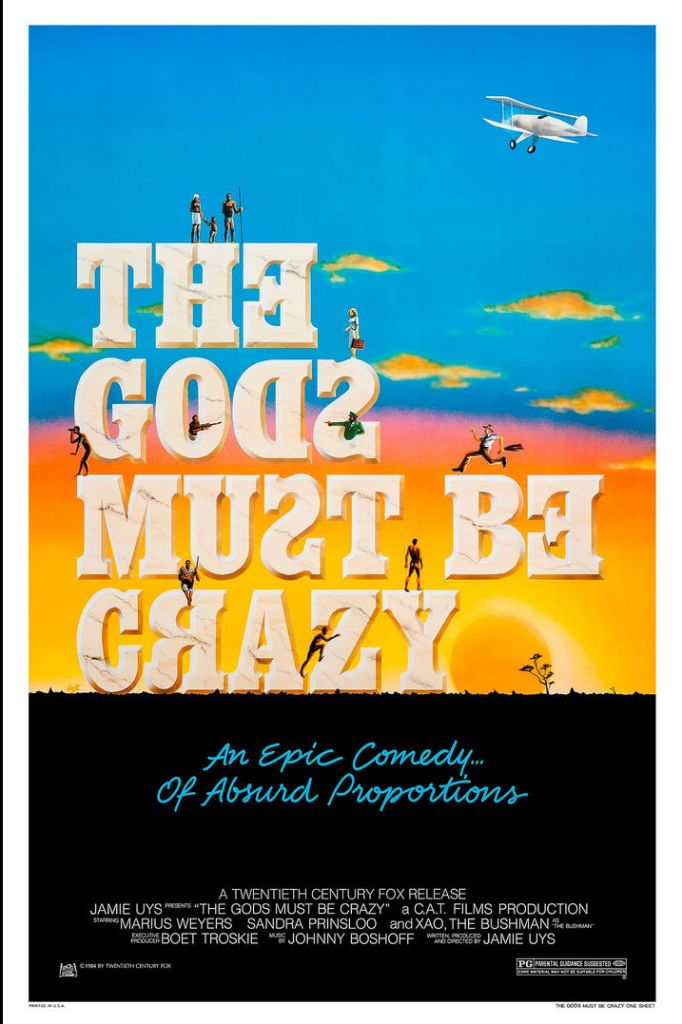
A simple plot description of The Gods Must Be Crazy doesn’t give a sense of the movie’s strangeness. Still, it’s the only plausible place to begin: An airplane pilot throws an empty Coke bottle out of his window. The bottle is found by a San (Bushmen) community in the Kalahari Desert of southern Africa. The San, according to the film, believe everything to be a gift from the gods. At first finding the bottle to be a surprisingly useful tool, the group soon erupts in conflict over the extremely limited resource. There is only one bottle and suddenly they all need it. What were the gods thinking? Xi (Nǃxau ǂToma) resolves to take the Coke bottle to the ends of the earth and return it to the gods. Along the way, he comes in contact with a socially awkward biologist, a journalist beginning a new career as a teacher, and a band of guerrillas bent on overthrowing their government.

As I indicated, there’s more to the movie. The first ten minutes offers about as concise a takedown of “civilization” as I’ve ever seen. First we have the San hunter-gatherer group compared to the hard-working capitalists in bustling Johannesburg. Then the Coca-Cola bottle is a clever tool to expose the clash of values as “civilization” expands into the San’s homelands. In addition, we have slapstick humor, a love story, respect for the harsh Kalahari ecosystem, and occasional intermingling of violence and humor. Imagine if Benny Hill, Quentin Tarantino, and Marlin Perkins made a movie together. It’s worth noting that a couple of violent scenes are shocking in a movie that is otherwise so genial. Assassination and torture are clearly not funny, but it’s hard not to laugh at the bumbling guerrillas as they storm into a cabinet meeting, only to have the door slammed in their faces.
We All Must Be Crazy
“When you get to know me better, you’ll see that I’m not always stumbling. It’s really just an interesting psychological phenomenon.”
—Marius Weyers as Andrew Steyn, The Gods Must Be Crazy—

Part of the movie’s genius is its balance of macro- and micro-level conflict. The opening scenes have a documentary quality. The San coexist with animals and plant life, not separately from it. They have no clocks or calendars and are better off for it. They live relatively carefree and their children are well-adjusted. In contrast, the city folk – both white and Black – are reduced nearly to schizophrenia, driving back and forth between their separate zones of living and working, enslaving themselves to the clock and their employers. Gradually, we focus on the ensemble cast of individuals. Xi negotiates with a baboon that tries to steal the Coke bottle. Andrew, the biologist, struggles to operate his failing Land Rover so he can transport the teacher Kate (Sandra Prinsloo) to her new assignment. M’pudi (Michael Thys) assists Xi on his journey while cursing the Land Rover he’s assigned to repair. (Motor vehicles seem very useful at first, but they’re soon as haywire as the wayward Coke bottle.) The characters are not really crazy, but appear fully eccentric to us viewers sitting in comfort.

It’s easy to script movie characters so that they fit within a desired region of the mythical bell curve. Xi is clearly intended as a representative of his people. Andrew and Kate, on the other hand, are interesting specifically for their eccentricity; they are not typical of the “civilized” world they came from. M’Pudi is essential for his ability to interface between the two cultures. They’re all smart enough to realize that their complementary differences make for a perfect collaboration. If only real life could be that easy. Consider the subjects of “person-on-the-street” interviews conducted by the media, the individual representatives of a group or community intended to prop up macro-level reporting. These interviews sometimes seem cherry-picked for eccentricity. Elections are a popular time to trot out this method. “These white folks sure are angry! Let’s meet one!” Remember Joe the Plumber? If not, count yourself lucky – he was a Republican “ordinary guy” role model who turned out to be a lying gun-nut. Imagine sitting in a room with similar crackpots and trying to iron out a consensus the way the characters in Women Talking did. Those people have left eccentric in the rear-view mirror. And yet…a stroll through social media gives me the impression that most of us are off our rockers. Maybe all of us. We must be – just look at the election results. We’re about as far from civilized as we can get.
Art vs. the Oppressor
“And civilized man, who refused to adapt himself to his natural surroundings, now finds that he has to adapt and re-adapt himself every day and every hour of the day to his self-created environment.”
–Paddy O’Byrne as the Narrator, The Gods Must Be Crazy—

Speaking of uncivilized, The Gods Must Be Crazy was filmed during the time of apartheid, and some criticized the film for presenting a false image of San life. In 1986, Canadian anthropologist Richard Borshay Lee wrote, “…the notion that some San in the 1980s remain untouched by ‘civilization’ is a cruel joke. The San have been the subject of a century of rapid social change and especially in the last twenty years have been forced to endure all the ‘benefits’ of South Africa’s apartheid policies in Namibia.” The Gods Must Be Crazy was released only a few years after the Soweto uprising, when South African police killed hundreds of individuals, many of them children, who were demonstrating against forced instruction of Afrikaans, “the language of the oppressor.” I remember anti-apartheid demonstrations on my college campus in the late 1980s, but I was too ignorant at the time to understand the significance. The Reagan administration, of course, chose “constructive engagement” with the South African government, increasing U.S. trade with South Africa in the 1980s. Someone has to profit off all that suffering! And if you think South African apartheid has no bearing on current U.S. events, the phrase “ignorance is bliss” comes to mind.
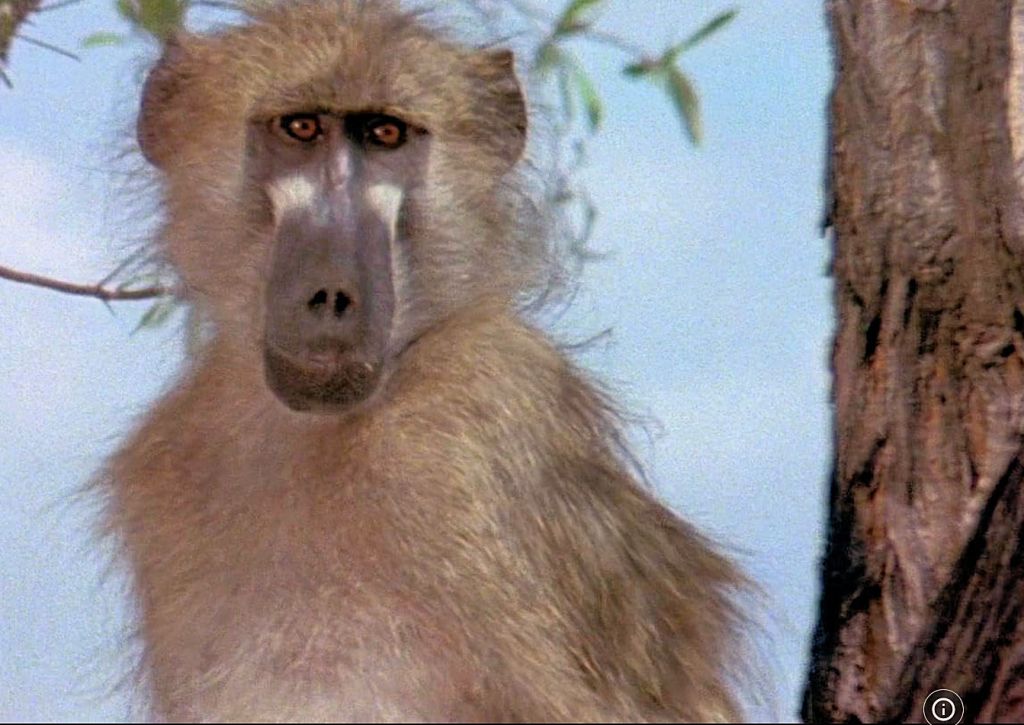
The movie was also criticized as condescending or patronizing to the San. I understand this point of view, but I don’t share it. For example, Xi thinks of cars as “strange animals with round legs,” but Xi isn’t the joke. The joke is on the “civilization” that made itself dependent on these four-wheeled animals. Another example is Xi reasoning with the baboon that tries to make off with the Coke bottle. The scene might seem condescending at first, but Xi’s patience pays off – the baboon cooperates and hands back the bottle.

I find these criticisms far outweighed by the movie’s upbeat message. Late in the movie, we learn that the San have no word for “guilty.” How wonderful, to live in a community that doesn’t need such a word. More importantly, the film’s humor – the fire-fighting rhinoceros never gets old – makes for smoother delivery of a cautionary tale. The San have no interest in the kinds of weapons used by the guerillas in the movie, though one can imagine their attitude changing under more extreme circumstances. And the San aren’t the only ones affected by the march of civilization – in his haste, Andrew nearly strikes an elephant in his Land Rover. So while The Gods Must Be Crazy might suggest an idealized version of San life, it doesn’t present a sugar-coated false equivalence – the civilized world, with its gods of power and material goods, is clearly the true source of the craziness. Just look at a typical Walmart on a typical “Black Friday” morning. Since the Cold War, much of the world has embraced hypercapitalism, taking as a role model the zombie-like cravings of the American consumer.
The Ouroboros
“In fact, he began to doubt if they really were gods.”
–Paddy O’Byrne as the Narrator, The Gods Must Be Crazy—

The truth is, we’re killing ourselves on all this civilization. Some are affected by it more urgently than others, but even the oligarchs are fooling themselves. Just as in Women Talking and The Gods Must Be Crazy, whatever god or gods we choose to worship – be it gun-toting Jesus, free Amazon shipping, or a spacious corner office – all of this civilization is literally destroying the world. In the grand scheme of human existence, I have an easier life than many, and I still feel alone and anxious about the future most of the time. I worry that my wife and I won’t receive the Social Security and Medicare benefits that we have paid into for decades. (Anyone who tells you those are “entitlement” programs is either a fool or a liar. Probably both.) I worry about violence against everyone the GOP has put their sights on – sexual assault victims, people of color, trans people, immigrants, you name it – making the world more dangerous for all of us. I worry about what will happen to the skyrocketing number of climate change refugees. I worry about the mass species extinctions we’re causing. I worry about seniors without the funds to appease an extortionary healthcare system. I could go on. And on.

This was the message of The Gods Must Be Crazy, and that was forty-four years ago. We’ve known for decades, longer even, that we were going in the wrong direction. We just lacked the will to reorient ourselves. The robber barons who sponsored Reagan knew the harm their trickle-down phoniness would cause, just like the current generation of oligarchs is happy to let us choke on iPhones, sedate ourselves with streaming binges, and blast each other with Second Amendment righteousness. We’re like the Ouroboros, the ancient symbol of a serpent consuming itself. We hardly need a mythical serpent to drive us from Eden – we’re perfectly capable of destroying ourselves.
The Edge of the World
“Even a poisonous snake is not bad. You just have to keep away from the sharp end. Actually, a snake is very good. In fact, it’s delicious. And the skin makes a fine pouch.”
–Paddy O’Byrne as the Narrator, The Gods Must Be Crazy—

Except, the Ouroboros is much more than an image of self-destruction. It represents a cycle of life, death, and rebirth. The earliest known representations of the Ouroboros come from ancient Egypt, including the tomb of Tutankhamun, and symbolize both the end and beginning of time, the cyclical pattern of the seasons, and an attempt to find order and meaning in a sometimes chaotic world. It is a beginning as much as an end. In reality, our own beginnings have often been false starts – the elections of Barack Obama and Joe Biden, which gave hope to so many of us, ended up being the real outliers, the rare moments when we managed to defy the dishonesty of the electoral college. Add that to the long list of failures: the Founders weren’t crazy at all; they knew exactly what they were doing when they inflicted the rigged electoral college on us. It’s preposterous to empower a small handful of “swing states” to decide the fate of an entire nation, let alone unleash a serpent onto the world. This chaos is no accident – we chose it.

One of the best lessons of The Gods Must Be Crazy comes from the scene with Xi and the cobra, and tells us the perfect response to a snake in the grass. Grab it by the tail, slam it against the ground until it’s dead, skin it, and cook it for dinner. Maybe that’s the problem – we should have skinned more snakes over the years. But the film’s ultimate meaning is in the title: blind faith is a losing proposition. Xi and his people demonstrate wisdom by accepting the imperfection of their gods. Xi’s mission is to find the edge of the world so he can return the Coke bottle to the gods and restore peace to his community. In the same way, we should have rejected the Second Amendment, the toxic myth of “economic growth,” the bald-faced lie of “pro-life,” the cult brainwashing of school prayer, and all the other fundamentalist sacred cows that cause more harm than good.

Instead, we’ve approached a different edge of the world, the precipice of fascism wedded to climate change. While I appreciate the many who shared hopeful messages on November 6, I can’t personally find much basis for hope. And to all the hypocrites who claimed “both-sides” neutrality, you’re not fooling anyone. Neutrality equals complicity. The rest of us can do little more than follow the advice of Thomas Henry Huxley: “We live in a world which is full of misery and ignorance, and the plain duty of each and all of us is to try to make the little corner he can influence somewhat less miserable and somewhat less ignorant than it was before he entered.” Maybe, if the cancer of humanity finally self-destructs, the real rebirth will occur, and the earth will carry on in peace. Humans created god in their own image, and that has always been the problem. Our self-created end times, and the outcome of November 5, are only a reflection of ourselves, and the dark frailty of the human heart.
“In every stage of these Oppressions We have Petitioned for Redress in the most humble terms: Our repeated Petitions have been answered only by repeated injury. A Prince whose character is thus marked by every act which may define a Tyrant, is unfit to be the ruler of a free people.”
–U.S. Declaration of Independence–



 The Creative Life Adventure
Leave a reply to docbravard Cancel reply