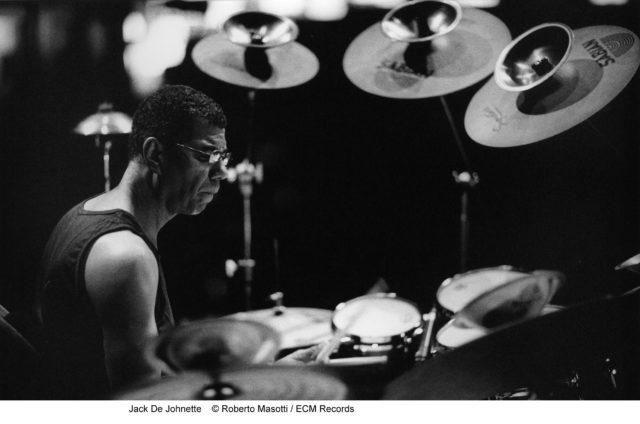
Drummers are often thought of as timekeepers, marking the time signature for a band or ensemble. Of course, the good ones do much more than that. Gene Krupa made the first commercially recorded drum solos in 1937 as a member of Benny Goodman‘s band, and brought the drums forward as an equal member of the band. Roy Haynes was a timeless giant, performing with just about everyone on the planet during a career that lasted nearly eighty years. Max Roach was one of the first bebop drummers in the 1940s. Keith Moon was the wild man of the Who, propelled by so much energy that he literally self-destructed. And Jack DeJohnette, who passed away October 26 at age 83, was present at the creation of the Miles Davis Bitches Brew album, going on to work as a sideman and bandleader right up until his death, collaborating with time to create beauty where none existed before.
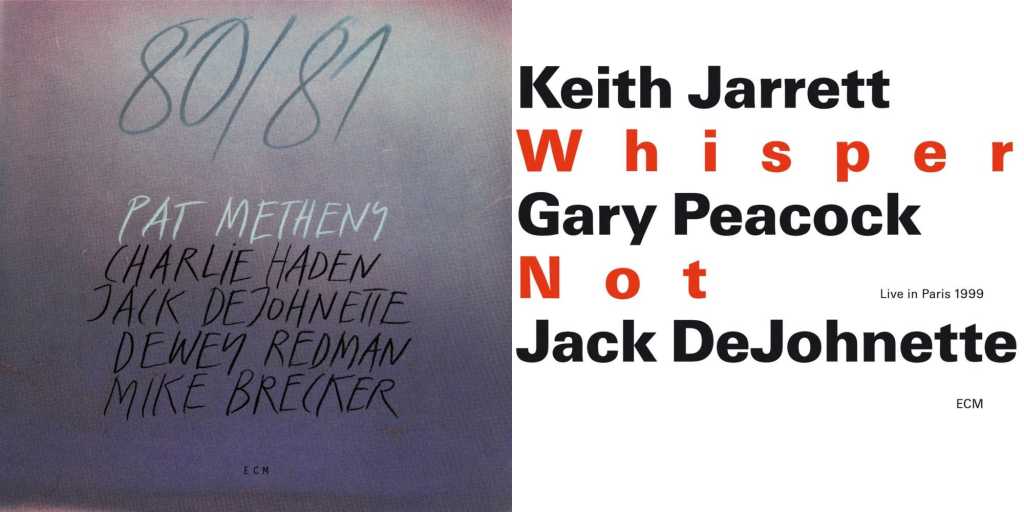
Like many fans, I was primarily familiar with DeJohnette’s work with the Standards Trio that also featured Keith Jarrett and Gary Peacock. Of the many jazz recordings I listen to, DeJohnette’s solos on the Trio albums grab my attention more than any other drummer. I had the good fortune to see/hear the Standards Trio perform in Boston in the early 2000s, and it was one of those rare occasions when real life wildly exceeded my expectations. While I knew DeJohnette had a diverse resume, I didn’t fully understand the vast array of artists he collaborated with: Pat Metheny, Herbie Hancock, Bill Evans, Bobby McFerrin, and John Scofield are only an introductory list of his numerous collaborators. It’s also worth noting that in addition to his extraordinary achievements as a drummer, he was also a highly-respected pianist, with several piano recordings and tours to his credit.
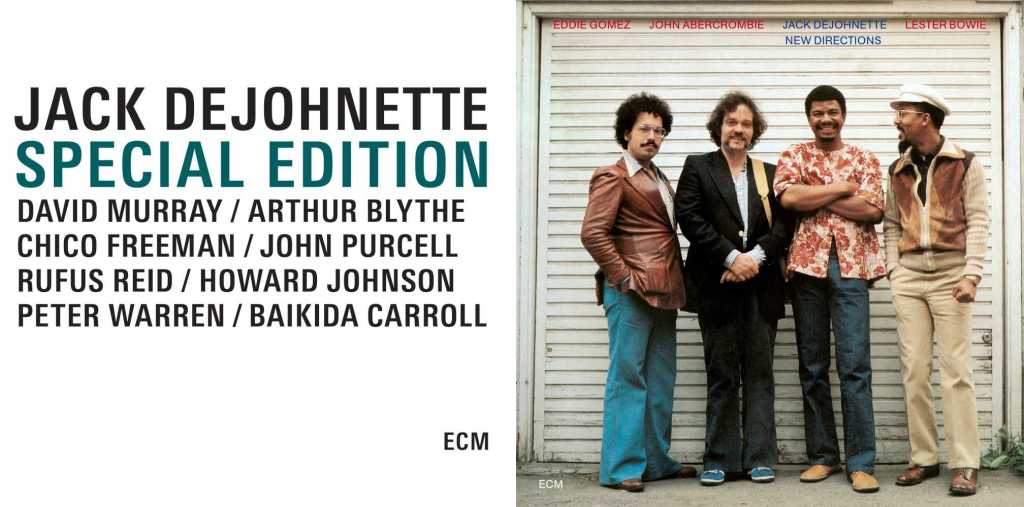
I’m not generally one to rely on social media for news or information, but widespread sentiments of affection and mourning indicate how beloved DeJohnette was:
- John Medeski: “One of the grand masters in human history.”
- Anouar Brahem: “A visionary musician and a singular presence in the history of jazz.”
- ECM Records: “He was always at the heart of the musical action and the soul of things.”
- Jean Luc Ponty: “He was such an original…musician in modern jazz and a great man.”
- Bill Bruford: “Jack’s voice rang clear as a bell to me and so many others.”
- Marcus Strickland: “The light he brought to this world is forever forged in my memory.”
- Herbie Hancock: “Jack responded to whatever I played with a depth of understanding and sensitivity that was completely his own.”
- Jason Moran: “Jack reflects the view that the world shows more curves than straight lines.”
- Bruce Hornsby: “…a true original, a beautiful soul, and inspiring musical role model…”
We humans created hours and minutes to mark the passage of time, but clearly time passes whether we measure it or not. The change from night to day, the cycle of the seasons, the performance of a song – a static universe would be no universe at all. Like a drummer, we can settle for counting measures, or we can add our distinctive voice to the song. When we recall Jack DeJohnette’s music, we should also recall his creativity and attitude that made the music a reality: “The possibilities are only limited by your imagination.”



 The Creative Life Adventure
Leave a comment