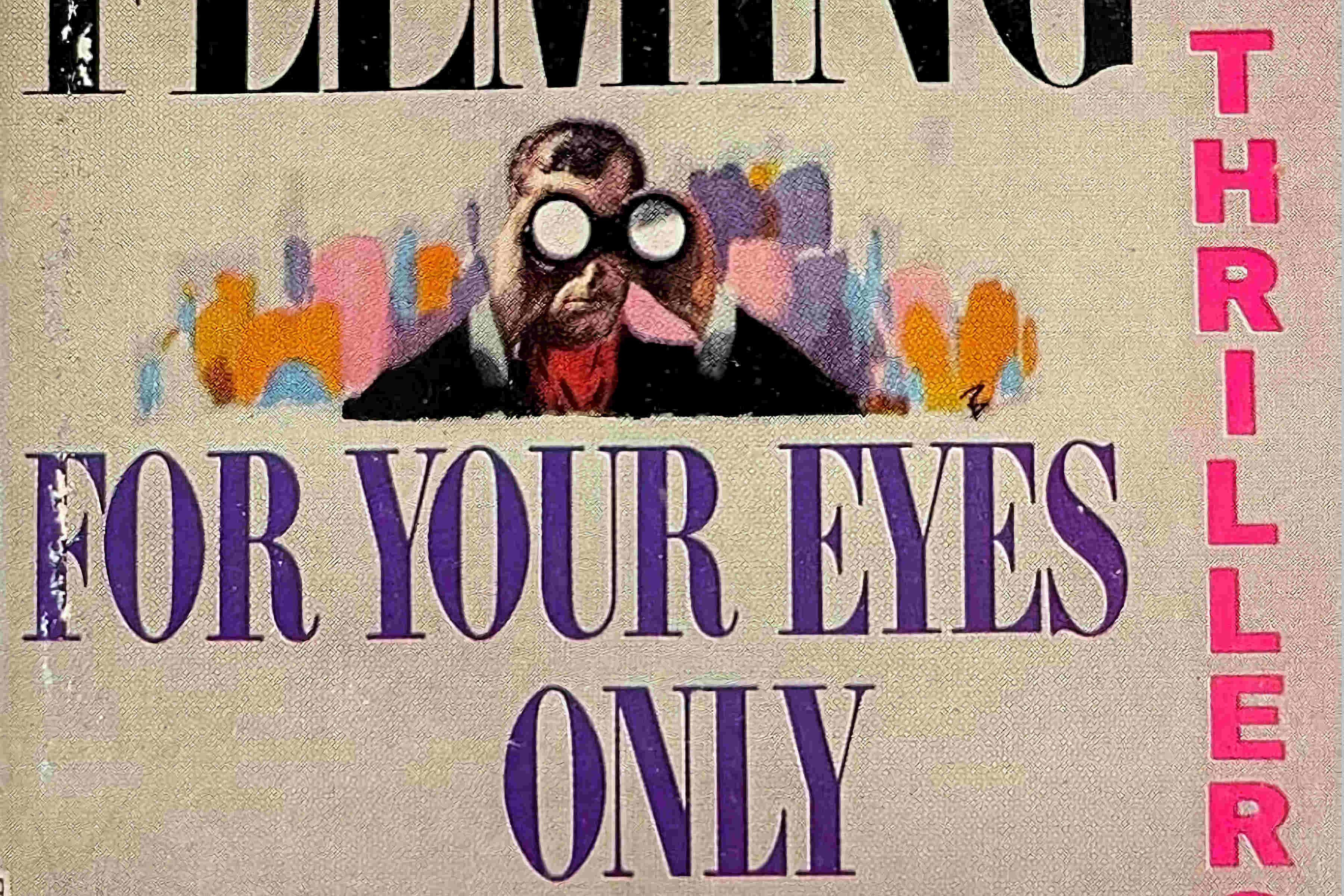

For Your Eyes Only (1960) was Ian Fleming‘s eighth James Bond book.
After completing Goldfinger, published in 1959 but written in early 1958, Fleming predicted that it would be his last novel-length Bond story, and for a brief time he was correct. For Your Eyes Only is a collection of five short stories, three of which were based on story ideas for a Bond TV series planned by CBS. It’s probably for the best that CBS scrapped the series idea, but Fleming adapted three episodes into short stories at his Goldeneye estate in early 1959. As he had done in the past, Fleming also borrowed from his own experiences. There’s no clear film adaptation of For Your Eyes Only, though the story “For Your Eyes Only” provided the basis for the 1981 film of the same title. Otherwise, some of the story titles and various plot elements have been incorporated into several of the movies.
I haven’t included page numbers, as this will vary by edition. I’m reading the Signet Books mass market paperback. The stories are short enough that references should be easy to find in the text. The best approach, if you can manage it, is to keep this handy while you read the book. I’m only human, so if I’ve made any factual errors, please feel free to reach out to me via the Contact Me page.
Last revised: 27 September 2026
From a View to a Kill
Originally written as an episode for the TV series, Fleming had previously intended “From a View to a Kill” to fill in the backstory for Hugo Drax from Moonraker. Instead, the villains became nameless in the literary version. The story originally appeared in serialized form in the Daily Express with the title “Murder Before Breakfast.” It’s believed that the story was inspired by the exploits of Fleming’s older brother Peter (1907 – 1971), who had quite an impressive career as both a writer and a military officer. In 1940, Peter Fleming was assigned to an Auxiliary Unit that developed a network of tunnels to support a British resistance movement, in anticipation of a possible German invasion.
The title comes from “D’ye ken John Peel?” (“Do you know John Peel?”), a hunting song in Cumbrian, the dialect historically spoken in Cumberland and surrounding areas of northwest England. A verse in the song, depending on the translation, says either, “From the drag to the chase, from the chase to the view / From a view to the death in the morning,” or, “From a find to a check, from a check to a view / From a view to a kill in the morning.”
The Literary 007 site has a very nice essay on Bond in Paris.
BSA M20:

Fleming uses BSA and BSAM interchangeably in my edition, but the assassin and the courier are each riding a BSA M20 motorcycle. BSA Motorcycles was a company spun off from BSA Cycles, which was itself derived from the Birmingham Small Arms Company Limited, established in 1919 for the manufacture of firearms, bicycles, hand and power tools, and various other products. The M20 was produced from 1937 to 1955. The M20 was highly popular with the British military. At one point during World War II, there were 126,000 M20s in service, making it the most common motorcycle produced for the war effort. Civilian versions of the M20 became popular after the war.
Inhuman Villains:
The motorcycle rider introduced on the first page is easily identifiable as a villain, as Fleming employs his usual animalistic or otherwise non-human descriptions. The rider has “tombstone teeth” and the “paws of a big animal.”
Royal Corps of Signals:
The assassin is dressed as a courier for the Royal Corps of Signals, sometimes known simply as Royal Signals. Despite the benign sounding name, Royal Signals performs a combat function within the British Army and is often among the first to go into battle. During the Cold War period, Royal Signals served in Palestine, Korea, the Malay Peninsula, and other locations.
Silencer Baffles:

The assassin’s motorcycle has had some of the “silencer baffles” removed to increase speed. These baffles are just a type of muffler that reduces the exhaust noise.
Luger:
The assassin carries a Luger firearm. Lugers were manufactured in multiple countries and used for military service by a number of nations, beginning with Switzerland in 1900 and including Germany during World Wars I and II.
May:
The action takes place in May, spring in northern France, where the story is set.
Versailles and Saint-Germain:
We know we are somewhere in the area of Versailles and Saint-Germain. Versailles lies among the western suburbs of Paris and was capital of the Kingdom of France from 1682 to 1789. The city is best known as the site of the signing of the Treaty of Paris in 1783 to end the American Revolution and the Treaty of Versailles in 1919 to end World War I hostilities between Germany and the Allies. Saint-Germain-en-Laye is an upscale area also in the western suburbs of Paris. In 1962 Saint-Germain’s population was around 34,600. Composer Claude Debussy (1862 – 1918) and future king Louis XIV (1638 – 1715) were among the notable people born there.

D98:
The motorcycle is headed north toward Saint-Germain on D98, “a secondary road serving local traffic.” If I’m reading the map correctly, D98 runs from Saint-Germain in the north to the area north of Les Clayes-sous-Bois in the south, a few miles west of Versailles. The driver has just passed the “Paris-Mantes Autoroute,” which appears to be the A13, which opened in 1946.
NATO:
The actual courier, spying the disguised assassin approaching from behind, might be “anyone from the eight NATO nations that made up the staff of SHAPE.” (I’ll get to SHAPE next.) NATO is the North Atlantic Treaty Organization, formed in 1949, a western defense alliance of which the UK and the USA are founding members. In 1960, NATO had 15 member countries. We will later learn that the dispatch-riders’s name is Bates, a “good solid man.”
SHAPE:
The Supreme Headquarters Allied Powers Europe (SHAPE) is the military headquarters for NATO’s Allied Command Operations (called Allied Command Europe in 1960), which commands NATO military operations. In 1960, SHAPE was headquartered in Rocquencourt (today part of Le Chesnay-Rocquencourt), just north of Versailles. See the map earlier in the story.
Slav Lines:
Fleming’s bigotry soon shows itself, as the assassin has “perhaps Slav lines,” meaning he would most likely have come from Central or Eastern Europe or northern Asia.
Magpie:

One magpie flies in front of the legitimate dispatch-rider, and this is significant. Magpies are part of the avian family Corvidae, which also includes crows and ravens. Magpies are some of the most intelligent animals in the world. A 16th century English nursery rhyme foretells future events based on the number of magpies observed: “One for sorrow, Two for joy…”
Michelin:

The magpie flies behind a Michelin distance sign, one of many road signs installed throughout France by Michelin beginning in the early 1900s. A French-based car tire manufacturer, Michelin went to great lengths to increase its potential market share by promoting automobile use among the public. One result was the Michelin Guide, first published as a directory of French roadside services (maps, mechanics, hotels, etc.) in 1900. Michelin’s maps were so good, they were used by Allied Forces in World War II. Michelin also took the liberty of installing directional road markers, like the one the motorcyclist observes, throughout France to identify road numbers, town names, etc.
James Bond:
After the tragic death of the dispatch-rider, we change setting to catch up with James Bond, who, by a happy coincidence, happens to be in Paris.
Fouquet’s:

Bond is having pre-dinner drinks at Fouquet’s on the Champs-Élysées. Brasserie Fouquet’s is a restaurant/bar that opened in 1899 and is based in the hotel Fouquet’s Paris.
Drink Options:
Bond ponders his drink options, including: fine à l’eau (a cognac cocktail, typically of just cognac and water), quart de champagne (a quarter bottle of champagne), champagne à l’orange (champagne with orange juice or orange bitters in its simplest form, but sometimes includes liqueur or other liquor).
Pernod:
Bond also considers, and rejects, Pernod. Pernod Ricard, formally established in 1975 but dating back to distilleries from the 1700s, is best known for producing anise-flavored alcoholic drinks, which creates the licorice flavor that Bond dislikes.
Americano:
Bond’s drink of choice in Paris cafes is an Americano, which is not the coffee version. The Americano cocktail is made with Campari, vermouth, soda water, and a lemon slice. Campari is an Italian bitter aperitif. Bond’s chosen variety of vermouth is Cinzano, an Italian brand introduced in the mid-1700s.
Perrier:
Only Perrier sparkling water is suitable for 007’s Americano. Perrier is a French brand founded in 1898, bottling water from a natural spring in Vergèze in the deep south of France. Today the Perrier brand is owned by Nestle.
Terminus Nord:

Bond stays at the Terminus Nord because he likes “station hotels.” Today it’s owned by the 25hours Hotel brand but is still located across the street from Gare du Nord and a short distance from Gare de l’Est. Even the company’s web site has no real information on the hotel’s history.
Paris Restaurants:
For lunch while in Paris, Bond sticks with a few preferred restaurants: Café de la Paix opened in 1862 and is located near the Palais Garnier opera house; La Rotonde, located near the Luxembourg Garden, was established in 1911; Le Dôme opened in 1897 and is located across the street from La Rotonde. As of early 2026, all of these restaurants are still in business.
Harry’s Bar:
Bond considers Harry’s Bar a good place for a drink. Harry’s was established in Paris in 1911 by U.S. jockey Tod Sloan (1874 – 1933). Sloan hoped to attract U.S. tourists and expatriates in Paris. Financial difficulties forced Sloan to sell the bar to head bartender Harry MacElhone (1890 – 1958) of Scotland, leading to the name change to Harry’s. Harry’s is found at “sank roo doe noo,” or 5 rue Daunou, which, like Café de la Paix, is near the opera house. Since 1924, Harry’s has been conducting straw polls among U.S. customers to predict U.S. presidential elections, and they have only been wrong three times. This 2026 YouTube video provides interesting historic and contemporary information abouto Harry’s.
Continental Daily Mail:
Bond recalls his first visit to Harry’s Bar, prompted by an ad in the Continental Daily Mail. The Daily Mail was established in Britain as a daily broadsheet in 1896, switching to a tabloid format in the 1970s. The wingnut-leaning publication launched a new edition, the Continental Daily Mail, in 1905 to cover Europe and northern Africa.
Bond’s Losses:
What is most notable about the brief mention of Harry’s Bar is the insight we get in to Bond’s youth and his first visit to Paris at the age of sixteen: “That had started one of the memorable evenings of his life, culminating in the loss, almost simultaneous, of his virginity and his notecase.” The loss of his notecase means that his wallet was either stolen or emptied, probably directly connected to the loss of his virginity. No doubt it was an important lesson for the young Bond. We have no indication of what brought teenage Bond to Paris in the first place.
Great Restaurants:
Bond’s restaurant preferences for dinner in Paris are Véfour, Caneton, Lucas-Carton, or Cochon d’Or. Le Grand Véfour was a bistro opened in the 1700s and renamed when it was purchased by Jean Véfour in 1820; located near the former Royal Palace and is still in operation. I can’t find anything on Caneton, but the French word “caneton” translates to “duckling.” Cochon d’Or translates to “roasted pig;” the restaurant no longer exists, but according to the James Bond Food site it was located near the large La Villette park in northeastern Paris. Maison Lucas-Carton was established in 1900 and still operates today near the famous Tuileries Garden.
Not Great Restaurants:
Bond cites Tour d’Argent and Maxim’s as restaurants that have succumbed to “the tarnish of the expense account and the dollar.” La Tour d’Argent (the Silver Tower) is located near the Sorbonne and claims to have been founded in 1582, though operations at its current location seem more likely to have begun in the 1800s. Maxim’s, like Lucas-Carton, is near the Tuileries Garden and was founded in 1893. The “tarnish of the expense account and the dollar” probably refers to post-war reconstruction, which was certainly big business through much of the 1950s, as well as NATO’s position in the military-industrial complex and the general influence of the U.S. as the dominant Western political and economic power during the Cold War.
Place Pigalle:
After dinner, Bond likes to visit Place Pigalle “to see what would happen to him.” Place Pigalle is a public square near Sacré-Cœur and a hub of activity in the Pigalle district, popular with tourists and a wilder night-time crowd, and home to numerous night clubs including the Moulin Rouge.
Hungary and Station V:
Bond is in Paris following a failed mission to smuggle an unidentified individual out of Hungary, who died as a result of “willful” misunderstandings on the part of Station V, the Secret Service office in Vienna, Austria. Hungary at the time was part of the Soviet Union. The Soviet-chosen Mátyás Rákosi (1892 – 1971) led Hungary from 1949 to 1956, imposing harsh repression that led to the imprisonment or execution of an estimated 350,000 government officials and civilians. The Hungarian Revolution of 1956 was crushed by the Soviet Union, leading to thousands of deaths and arrests. About 200,000 Hungarians fled, mostly to Austria, to avoid persecution. Vienna’s proximity to the Hungarian border made it a logical escape route.
Bois/Armenonville:

Bond fancies the idea of meeting a “real girl” while in Paris so he can “take her to dinner at some make-believe place in the Bois like the Armenonville.” The Bois de Boulogne is a massive park, over 2,000 acres, in western Paris on land donated by Emperor Napoleon III (1808 – 1873) in 1852 specifically for that purpose. See the map earlier in the story for the location relative to central Paris. Pavillon d’Armenonville was built as a hunting lodge in the 1700s. Specifics are vague, but apparently the hunting lodge fell out of use and was destroyed, but a new building was constructed for use as a restaurant, which operates today as an events venue.
Saint-Tropez:
As he did in Goldfinger, Bond conjures up an elaborate fantasy surrounding his dream girl, including a long-ago meeting in Saint-Tropez. Saint-Tropez is a southern coastal town, about halfway between Marseille and Cannes, part of the French Riviera. Except for an interruption during World War II, the area was closely associated with modernist art and culture, attracting the likes of Coco Chanel (1883 – 1971) and Henri Matisse (1869 – 1954), and providing the setting for the film And God Created Woman (1956).
Pawned Paris:
Bond has disliked Paris since the war, primarily because he feels the city has “pawned” its heart to tourists, Russians, Romanians, Bulgars, and “of course,” Germans. Fleming has clearly not forgotten that Paris was occupied by the Nazis in June, 1940, leading to rationing, curfews, and broadcasting of German propaganda. The Allies freed the city in August, 1944, but after the war hundreds of Nazi collaborators were executed. Others, like the aforementioned Coco Chanel, who had been living with a German officer, left France. West Germany joined NATO in 1955, and France returned the Saarland, a region in west-central Germany which France had occupied after the war, to West Germany.
Champs-Élysées:
Bond is offended by the amount of motor vehicle traffic in Paris, particularly along the Champs-Élysées, the historic 1.2-mile avenue connecting Place de la Concorde in the east with Place Charles de Gaulle, and the Arc de Triomphe, in the west. Construction of the Arc was completed in 1836, and the Champs-Élysées, already an established thoroughfare, was enhanced as part of an overall redesign of Paris by Napoleon III to modernize the city (and to make it less inviting to revolution).
Laurens Jaune:
Bond smokes a “Laurens jaune.” The French “jaune” translates as “yellow;” not being a smoker, I’m not sure how this applies to cigarettes. I can’t find much on the Laurens brand, but it appears to have been a high-end cigarette maker established in Alexandria, Egypt, by Edouard Laurens in 1887.
Lille:
Bond imagines that his fantasy woman is from Lille, in northern France near the Belgian border. Lille was occupied by Germany during both world wars and suffered extreme poverty during the Great Depression, so perhaps Bond yearns for a troubled woman who needs to be saved.
La Ronde:
Imagining that the fantasy woman or her “maquereau,” or pimp, will take his notecase (wallet), Bond reflects, “La ronde!” “The round” refers to the circular nature of a life that brings Bond back to Paris after so many years only to again (in his fantasy life, at least) have his wallet stolen by a prostitute or her pimp.
Peugeot 403:

Bond is collected by a driver in a Peugeot 403. The French company Peugeot was founded in the 1800s, initially manufacturing kitchen implements and hand tools, and began production of internal-combustion automobiles in 1890. The mid-sized, four-door 403 was manufactured during 1955 – 1966.
Crash Dive:
Bond is greeted with the phrase, “crash dive,” an expression “borrowed from the Submarine Service. It meant bad news – the worst.” A crash dive is an evasive maneuver by submarines, diving from the surface as quickly as possible to avoid attack or collision. The action is generally not necessary with modern nuclear submarines as they operate submerged for long periods of time.
Mary Ann Russell:
We meet Mary Ann Russell, agent 765, a “grade two assistant,” sent to locate Bond based on an urgent signal from M to Head of Station F (France). Russell conveniently resembles Bond’s imaginary prostitute, and as Russell is employed by the Secret Service, perhaps some greater metaphor is intended.
Deuxième:
Russell’s orders include working with the Deuxième if necessary to locate Bond. The Deuxième Bureau de l’État-major général is the “Second Bureau of the General Staff.” The French Premier Bureau obtained intelligence on French/allied/friendly forces (along the lines of the NSA), and the Second Bureau monitored enemy forces (similar to the CIA); the Deuxième was dissolved in an intelligence reorganization in 1940, but the term remained in common use.
Bond’s Routine:
Russell locates 007 with little difficulty because Head of Station F knows Bond’s regular haunts in Paris. Imagine how easy it would be for an enemy to track down Bond; this is an argument for spies to not maintain a consistent routine.
Poor Paris:
It turns out that, like Bond, Russell also dislikes Paris, though for different reasons. Apparently French men can’t keep their hands to themselves, particularly on the Paris Metro, the Paris urban transit system operating since 1900, consisting primarily of underground trains.
Rond Point:
Russell drives Bond through Rond Point, a large traffic circle on the Champs-Élysées, a little less than one mile from the Arc de Triomphe.
Avenue Gabriel:
Russell exits Rond Point onto Avenue Matignon, to Avenue Gabriel. The Secret Service Paris headquarters seems to be located near the intersection of Gabriel and Matignon. The streets intersect just northeast of Rond Point. Today this area is primarily commercial, with hotels, restaurants, art galleries, shops, and the large market/park Marigny Square.
Commander Rattray:
Bond meets with Commander Rattray, Head of Station F and something of a poor man’s M, as M doesn’t appear directly in this story. Rattray is clearly a stand-in for bureaucracy, perhaps reflecting Fleming’s opinion of Britain’s sluggishness in the post-war world: “He made a good-living, wine-and-food-society impression…”
Gauloises:

Rattray smokes Gauloises cigarettes, as Le Chiffre did in Casino Royale. Established in 1910 by SEITA, a French-government-owned monopoly on tobacco products, Gauloises initially were unfiltered and made with a Syrian/Turkish tobacco blend. A filtered variety was introduced in 1950. Picasso, Sartre, Jim Morrison, and John Lennon were among celebrity Gauloises smokers.
Multinational SHAPE:
Rattray reports that M is mistrustful of NATO and SHAPE, in particular. The multinational aspect of the organization seems to be his primary concern, as the security staff includes French (some of whom might have collaborated with Germany during the war), Italians (ruled by the fascist Mussolini dictatorship during the war), and even a German.
Fourqueux:
Rattray identifies Fourqueux as the daily destination of the dispatch-rider who was killed. Fourqueux was a small town with a 1962 population of 840. It was incorporated into Saint-Germain in 2019.
Saint-Nom:
Rather than drive through the “built-up area” of the Paris suburbs, the dispatch-rider’s daily route sends him through Saint-Nom, which would take him to the west rather than on a direct route. Saint-Nom-la-Bretèche is roughly halfway between Versailles and Saint-Germain.
Invisible Man:
One strong element of “From a View to a Kill” (and, really, the rest of the stories in this collection) is how down-to-earth the stakes are compared to the novels. While the villains in the novels – Le Chiffre, Drax, Goldfinger, etc. – were all fairly transparent in their villainy, here M has advised Rattray that they are looking for “an invisible man, a man everyone takes so much for granted that he just isn’t noticed…”
Suchard Chocolate:
Returning to Russell’s Peugeot, Suchard milk chocolate is among the car’s contents. Chocolat Suchard was a Swiss chocolate factory founded by Philippe Suchard (1797 – 1884) that operated from 1826 to 1996. The brand still exists, however, and today is owned by French confectioner Carambar & Co.
John O’Hara:

Russell also has a John O’Hara paperback in her car. John O’Hara (1905 – 1970) was an American writer who wrote numerous short stories for The New Yorker magazine. His first novel Appointment in Samarra (1934) was inspired by a Babylonian myth referenced in From Russia with Love. His other novels included BUtterfield 8 (1935) and Pal Joey (1940), both of which were adapted as films. O’Hara is less well known today compared to some other 20th century writers because he did not allow his work to be anthologized. A few timely possibilities for Russell’s specific book are Ten North Frederick (1955), recipient of the National Book Award for Fiction, A Family Party (1956), or From the Terrace (1958).
Etoile:
Still distracted by thoughts of Russell, Bond “thought about her as far as the Etoile and then closed his mind to her…” The capitalization implies a specific location, but I can’t find anything relevant in that area of Paris. The French word “etoile” is “star,” so it may simply refer to the shape of the Rond Point traffic circle.
Porte de Saint-Cloud:
Bond drives past the Porte de Saint-Cloud in Paris. The Porte de Saint-Cloud is a gate that still stands in western Paris, just south of the Bois de Boulogne. The gate was part of the Thiers Wall, a defensive wall built around Paris in the early 1840s. By the time of World War I, the wall was outdated as a defensive feature and was limiting urban expansion. The wall was largely destroyed before World War II, but the Boulevards of the Marshals, a series of roads around Paris, generally indicate the wall’s path.
Colonel Schreiber:
Bond meets Colonel G. A. Schreiber, head of SHAPE security. The American Schreiber (with a distinctly German-sounding name) clearly does not appreciate Bond interfering on his turf.
Commander:
Schreiber addresses Bond as “Commander,” reminding us of Bond’s rank.
Einstein:
Schreiber claims that his security staff is so thorough that it would take Einstein to out-think them. Albert Einstein (1879 – 1955) is, of course, best known for the theory of relativity, for which he was awarded the Nobel Prize in Physics in 1921. After becoming a U.S. resident, so many people approached Einstein in public that he sometimes pretended to be someone else who only resembled the famous physicist.
Proctor:
We briefly meet Proctor, the aide who escorts 007 to his quarters while assigned to SHAPE.
Hopeless:
Bond believes that locating the courier’s assassin “was probably the most hopeless assignment that he had ever been on.” It’s certainly not the most dangerous mission, but if we’re evaluating this solely on the likelihood of success, it’s understandable why Bond would not be optimistic.
Camouflage:
Bond wears camouflage while staking out the road where the dispatch-rider was killed. Considering how fussy Bond can be with his clothing, it’s a refreshing change to see him dressed for actual surveillance work.
Landes:
Bond works briefly with the Frenchman Landes, the search dog handler.
Alsatians:
The dog search team works with Alsatians, which is the UK term for German Shepherds. As the name implies, the dogs were first bred in Germany by actual shepherds, but dogs in different regions had different traits. Dog breeder Max von Stephanitz (1864 – 1936) developed the breed we know today as German Shepherds. German Shepherds are both strong and intelligent, and can become overprotective of their people if not socialized carefully. Like the dogs, Bond is here to sniff out and find the villains.
Carrefour Royal:
Landes reports that the dogs became excited in an area near the Carrefour Royal. I can’t find a precise location for this, but the French word “carrefour” translates as “crossroad.” Today Carrefour is probably better known among consumers as a French-based grocery and convenience store chain.
Tumulus:
Inspecting the site of the former gypsy encampment (more on that shortly) Bond notices “a low mound, perhaps a tumulus…” A tumulus is a burial mound sometimes covering some sort of internal structure. This was a frequent practice throughout the world in ancient times.
Gypsies:
The clearing Bond explores was previously occupied by a group of gypsies, often more properly known as Romani, or Roma, a largely nomadic ethnic group of Indi-Aryan people descended from inhabitants of central Asia and northern India. Romani today are more concentrated in Bulgaria, Hungary, Romania, Serbia, and Slovakia. However, they exist throughout the world, including up to one million in the U.S. They have been widely persecuted due to their ethnicity and their sometimes itinerant lifestyle. As is so often the case with persecuted groups, when they are not experiencing direct discrimination, they are overlooked. Bond has found “the invisible man”: “You could be a foreigner, and yet not a foreigner, because you were only a gypsy.”
Private Wars:
Bond reflects on the pointless conflict between the British Secret Service and SHAPE security forces. Interdepartmental turf wars throughout governments and the private sector often do more harm than the threats they are allegedly defending against. For example, better information sharing between the CIA, the NSA, and the FBI might have prevented the 9/11 terrorist attacks. John le Carre‘s 1965 novel The Looking Glass War depicts a spy mission sabotaged by conflict between government agencies. This may also be another attempt by Fleming to disparage the multinational NATO/SHAPE effort, which he clearly considers the weak link in Bond’s current world. “Private armies, private wars,” Bond thinks. “How much energy they siphoned off from the common cause, how much fire they directed away from the common enemy!”
Glucose Tablets:
Bond ingests two glucose tablets to keep his energy level stable while hiding out in the tree overlooking the clearing. Glucose tablets are typically used by patients with hypoglycemia, or low blood sugar. While this form of self-medication isn’t ideal, at least Bond is foregoing the Benzedrine he has used on previous missions.
Fairy Tale:
Fleming contrasts the earnestness of Bond’s mission, and the violence launched by the assassin who departed from this clearing, with the resident natural beauty. Varieties of birds and flowers tempt Bond’s attention from the job at hand. This perhaps also underscores the often otherworldly quality of human interactions. “It was a scene from a fairy tale…” This is a sharp contrast to the human-caused chaos of the city, where Bond started out. It reminds me of Casino Royale, where the staleness of a casino in the opening scenes contrasted with outdoor peacefulness in Chapter 5.
Ardennes:
Bond considers the gypies’ “left-behind spy unit” superior to similar works by the British (which might have been constructed by an Auxiliary Unit, one of which Peter Fleming was a member), as well as “what the Germans had left behind in the Ardennes.” The Ardennes is a heavily forested area that stretches through Belgium, Luxembourg, Germany, and France. During World War II, the region was the setting for the Battle of the Bulge, sometimes known as the Ardennes Offensive, which began with a German surprise attack on Allied forces in Belgium in December, 1944, and included a V-2 rocket destroying a movie theater in Antwerp, killing 567 people.
High-Stepping:
Observing the spies emerging from their secret base, 007 sees “something extraordinarily sinister about the way they softly high-stepped along through the shadows…” The spies walk this way because they are wearing snow shoes, but it could be a subtle reference to the goose-stepping style of marching by soldiers. This is most often associated with the Nazis, but the style was adopted by countries throughout the world, including the Soviet Union.
GRU:
Bond assumes that the spies are members of the GRU. Formed in 1918 as the Registration Directorate, the Soviet foreign military intelligence organization became the GRU in 1942. The agency’s functions were taken over by the Russian GRU in 1992, following the breakup of the Soviet Union. The GRU functioned independently of other Soviet security and intelligence agencies, such as KGB, NKVD, etc. Ivan Serov (1905 – 1990) ran the GRU uring 1958 – 1963; Serov’s photo was on the SMERSH conference room wall in From Russia with Love.
Red Indians:
Russell criticizes the Secret Service when Bond discloses his plan to her: “You’re just a lot of children playing at red Indians.” While “Red Indian” can be a highly offensive term for American indigenous people, in this case it’s a euphemism for spy work, derived from the nickname for No. 30 Commando, the intelligence gathering unit formed in 1942 on the recommendation of Ian Fleming, who at the time was an officer in British naval intelligence. The unit’s mission was to advance into enemy territory ahead of Allied forces to gather codes, secret documents, equipment, etc. No. 30 Commando reportedly tried (and failed) to capture a German Enigma machine, which was the inspiration for the Spektor cipher machine in From Russia with Love. The unit took part in the Normandy landings and was instrumental in retaking Paris from the Nazis in 1944.
Austin A40:
The Signal Corps corporal who outfits Bond with the appropriate equipment and attire, comments that he prefers an Austin A40 over the BSA motorcycle used by the SHAPE dispatch-riders. It seems like an odd comparison because the A40 was a series of vehicles produced by British automaker Austin Motor Company, established in 1905. Austin merged with Morris Motors Limited in 1952 to form British Motor Corporation (BMC) but maintained the Austin brand. The Austin trademark is currently owned by China’s SAIC Motor. The A40 was a series of car models produced from 1947 to 1967, called A40 because the engine output was about 40 horsepower. The A40 line included 2-doors, 4-doors, convertibles, even pickups and vans, so its hard to guess which variety the corporal prefers.
Bailly / Noisy-le-Roi:
Before Saint-Nom, Bond passes through Bailly and Noisy-le-Roi, both of which are small communes in the Paris suburbs and situated only a couple of miles east of Saint-Nom. See the map earlier in the story.
Colt:
Bond carries a long barrel .45 Colt, not the Walther PPK assigned to him by Boothroyd and M in Doctor No. The Colt .45 was introduced by Colt in 1872 and was the official U.S. military handgun from 1873 until 1892. This may be the same long-barrel Colt Bond has carried since Casino Royale.
Russians:
The villains speak “what sounded like Russian,” presumably confirming Bond’s expectations from earlier in the story.
Russell Saves Bond:
It’s a bit of a letdown that Bond needs to be saved by Russell in his own story. While it’s impressive that Fleming gives Russell that honor (and ability), it’s still a Bond story and it would seem more heroic if he had saved himself.
For Your Eyes Only
“For Your Eyes Only” is another adaptation of an episode of the planned TV series. For insight on the use of bows and arrows which prove important in the story, Fleming consulted firearms expert Geoffrey Boothroyd, whose advice Fleming had previously incorporated into Doctor No.
Jamaica:
The story opens in the Caribbean island nation of Jamaica, the setting of previous Bond stories and a place dear to Fleming’s heart. At this time Jamaica was still a British colony; the country achieved full independence in 1962 but remains a member of the Commonwealth of Nations.
Doctor Bird:

We observe a Trochilus polytmus hummingbird, more commonly known as the streamer-tail, scissor-tail, or doctor bird. It is native to Jamaica and the country’s national bird. Only the males have the long streamer tails described in the story. This is also a reminder of our hero’s namesake, the ornithologist James Bond (1900 – 1989), author of Birds of the West Indies.
Mrs. Havelock:
The wealthy British land owner, Mrs. Havelock, provides our eyes at the beginning of the story. Her patient observation of successive generations of doctor birds may reflect Fleming’s own appreciation of Jamaica’s natural beauty.
Content:
The name of the Havelock estate is Content. Does the name have a particular significance? The word has diverse applications, referring to someone who is pleased or satisfied. It can also refer to substance, as in the contents of a story or building. Or it can describe significance, for example if something is lacking in content. Three ships in the British Royal Navy were named HMS Content, all in the 1600s and 1700s. “Content” is also a French word for happy. Or perhaps Fleming took the name from Jamaica itself: Sherwood Content is a small town in north central Jamaica, composed of the two villages Sherwood and Content.
Bird Names:
Mrs. Havelock has named the doctor birds, including two couples named, respectively, Pyramus and Thisbe, and Daphnis and Chloe. All four names come from Greek literature. Pyramus and Thisbe appeared in the 8th century narrative poem Metamorphoses by Ovid (43 BC – 17/18 AD). The young couple’s love is opposed by their parents; Pyramus and Thisbe each take their own life when they believe the other one to be dead. The tale provided inspiration for Shakespeare‘s Romeo and Juliet. Daphnis and Chloe is a 2nd century novel by the Greek writer Longus (2nd century AD), and it appears to be his only surviving work. In the story, Daphnis and Chloe are abandoned as infants and eventually, after a troubled life and romance, become married and live happily ever after.
Hat and Monkeyfiddle:

The Havelock landscaping includes “Japanese hat” and monkeyfiddle. I believe the Japanese hat is really Holmskioldia, sometimes referred to as Chinese hat plant. Part of the mint family, the plant is native to parts of the Himalayas, but can be grown in the West Indies and other regions. Monkey fiddle appears to be a common name for Euphorbia tithymaloides, a flowering perennial with a variety of nicknames and grown in numerous regions throughout the world.
Patum Peperium:
Mrs. Havelock is lunching on a Patum Peperium sandwich. Also named Gentleman’s Relish, Patum Peperium is an anchovy paste developed by John Osborn in 1828. The British brand was so protected that the manufacturer, Elsenham Quality Foods in Elsenham, in southeastern England, only shared the recipe with one employee. Sadly (?), the product was discontinued in 2026.
Colonel Havelock:
We now meet Colonel Timothy Havelock, completing the staid, old-school British expatriate couple.
Daily Gleaner:
Colonel Havelock reads the Daily Gleaner, a daily Jamaican newspaper established in 1834. The paper was renamed The Gleaner in 1992 and is still published as of 2026, making it the oldest continuously published newspaper in the Western Hemisphere.
Batista and Castro:

Colonel Havelock seems disconcerted over how affairs in nearby Cuba are affecting Jamaica. “It looks as if Batista will be on the run soon. Castro’s keeping up the pressure pretty well.” Fulgencio Batista y Zaldivar (1901 – 1973) was president of Cuba during 1940 – 1944 and 1952 – 1959. Batista was a dictator supported by the U.S., which explains how the U.S. was able to control the Cuban sugar industry and why so much Cuban land was owned by foreigners. This also permitted the U.S. Mafia to engage actively in drugs, gambling, and prostitution in Cuba. Fidel Castro (1926 – 2016), along with Che Guevara (1928 – 1967), led a guerrilla warfare revolution during 1956 – 1958, taking over Cuba and driving Batista from the country on 1 January 1959. This would seem to set the story in 1957 – 1958.
Barclays:
Colonel Havelock has a contact at Barclays who tells him of “a lot of funk money coming over here already.” Barclays is a full-service multinational bank. It was founded in London in 1690 but took on the name Barclays when James Barclay, son-in-law of co-founder John Freame (1669 – 1745), became a partner in the bank. In 1958 Barclays became the first UK bank to appoint a female bank manager.
Belair:
The colonel reports that an estate called Belair has recently been sold. This appears to be entirely fictional; there is a Belair hotel in western Jamaica, but it does not appear to have been in operation when Fleming wrote the story. We learn shortly that Belair is owned by an unseen character named Aschenheim. (Maybe a play on the title of W. Somerset Maugham’s spy novel, Ashenden: Or the British Agent?)
Blue Harbour:
Havelock also says, “Somebody’s suddenly gone and bought that ghastly Blue Harbour hotel…” This is an in joke, as one of Fleming’s neighbors in Jamaica (and a witness at the wedding of Ann Charteris and Fleming in 1952) was playwright Noel Coward (1899 – 1973), who called his house Blue Harbour.
Farquharson:
Havelock also talks about a fellow land-owner, Jimmy Farquharson, selling property. As far as I can tell, this is an entirely fictitious name.
Leaf-Spot and Panama Disease:
Havelock disparages the Farquharson property as being contaminated with leaf-spot and Panama disease. Leaf-spot can be fungal, bacterial, or viral and, as the name implies, results in dead and discolored spots on plant leaves. A subspecies of the fungus Fusarium oxysporum causes Panama disease, a wilting disease specific to banana plant leaves. An outbreak of Panama disease throughout Central and South America had a lot to do with a post-war shift from Gros Michel bananas to Cavendish bananas as the primary export banana variety.
Old Families:
The colonel despairs, “That’s one more of the old families gone.” The British Empire has been in a slow retreat for years, something Fleming has expressed disappointment over throughout the Bond stories.
Agatha and Fayprince:
We meet the Havelocks’ housekeepers and…yikes. The two women are Agatha, described as “a huge blue-black Negro woman,” and Fayprince, described as “a pretty young quadroon.” A “quadroon” was a colonial term for a person with one-quarter African or Aboriginal ancestry and three-quarters European ancestry; in other words, someone with one African/Aboriginal grandparent and three white grandparents. Laws and civil rights were sometimes based on the extent of an individual’s white ancestry.
Port Maria:
The young Fayprince is from Port Maria, a small town in northeastern Jamaica. Bond claimed residency in Port Maria as part of his cover identity in Casino Royale.
Henriques:
Mrs. Havelock has previously purchased canning jars at Henriques, which appears to be a fictional business.
Frangipani:
Mrs. Havelock observes a mockingbird on a frangipani. The flowering plant genus Plumeria is sometimes referred to as frangipani. It often grows as a shrub or small tree and it native to Central America, the Caribbean, and small areas of North and South America.
Blue Mountains:
Content is situated on Candlefly Peak in the Blue Mountains, the longest mountain range in Jamaica and running to the northeast of Kingston. Jamaica’s highest point, Blue Mountain Peak, is just over 7,400 feet in altitude and offers a view of Cuba when the skies are especially clear. Candle Fly Peak is in eastern Jamaica, rough 25 miles east of Kingston.
Cromwell / King Charles:

The Havelock family obtained the land for Content as a gift from “Oliver Cromwell as a reward for having been one of the signatories to King Charles’s death warrant.” Oliver Cromwell (1599 – 1658) was a Member of Parliament and served in the British military. In 1655 he led the campaign that took Jamaica from Spain. Charles I (1600 – 1649) was King of England, Scotland, and Ireland during 1625 – 1649. Charles I advocated the “divine right of kings” and his taxation policies made him unpopular with the English Parliament. His marriage to Roman Catholic Henrietta Maria of France (1609 – 1669) angered powerful Protestant forces. Charles I was defeated in the English Civil War during the 1640s, ultimately leading to his execution and a temporary end to the English monarchy during the Commonwealth of England. Cromwell played a significant role as a military officer during the civil war and was among those who supported Charles I’s execution.
Port Antonio:
When unexpected visitors arrive, Mrs. Havelock frets that it might be “those ghastly Feddens from Port Antonio.” Port Antonio is Jamaica’s third largest city, located on the northeastern coast, and is a popular port town. Supposedly the Jamaican folk song “Day-O (The Banana Boat Song)” originated from dockworkers in Port Antonio loading bananas for export.
Kingston:
The strange visitor has arrived from Kingston, Jamaica’s capital and largest city, located on the southeastern coast. The modern city of Jamaica was founded in 1692. Iris King (1910 – 2000) was Kingston’s first woman mayor, in 1958 – 1959.
Panama Hat:

The visitor wears a Panama hat, a brimmed hat typically made from the leaves of the jipijapa plant that, despite its name, originated in Ecuador. Increased exports from Ecuador to the U.S., with cargo ships often stopping at Panama, increased the hat’s popularity in the U.S., as did President Theodore Roosevelt‘s (1858 – 1919) use of a Panama hat when visiting the in-progress Panama Canal in 1906.
Gonzales:
The mystery visitor is Major Gonzales of Havana, Cuba’s capital and located on the northeastern coast. It’s interesting that Fleming makes his villain – actually a henchman for the story’s true villain – a member of Cuba’s existing, and American-sponsored, power structure.
Pan American:
Gonzales’ helpers carry overnight bags from Pan American. Pan American Airways (Pan Am) was established in 1927 and was the preeminent airline of both the U.S. and the world by mid-century. Increasing competition after World War II and U.S. airline industry deregulation in 1978 contributed to Pan Am’s decline, and the airline declared bankruptcy in 1991. Air travel quality has been in decline ever since. This video from the Mentour Now! channel is a very interesting discussion of Pan Am and its role in aviation history.
Government House:
Colonel Havelock advises that Gonzales should have asked around regarding property purchases, including at Government House. As in Doctor No, Government House is more commonly referred to as King’s House, home to “the Governor and Commander-in-Chief of Jamaica.” Today, King’s House is home to Jamaica’s Governor-General. The current King’s House was constructed in 1907, after the previous house was destroyed by an earthquake. Sir Kenneth Blackburne (1907 – 1980) occupied King’s House as the Governor-General of Jamaica during 1957 – 1962.
U.S. Dollars:
The Havelocks are not impressed that Gonzales brings U.S. dollars and not British pounds or Cuban pesos. The Cuban peso, established in 1914, had the same value of the U.S. dollar until 1959; after the revolution, it was tied to the Soviet ruble. Pounds were the currency in Jamaica until the Jamaican dollar was established in 1969.
Animal Tendencies:
Fleming again describes villains, as well as people of color, in animalistic terms. Gonzales comes across as reptilian: his “tongue came out and slowly licked along his lips.” Gonzales’ assistants have “sharp animal eyes” and “brown monkey hands.”
Ford Consul:

The assassins drive a Ford Consul, a model manufactured by Ford of Britain during 1951 – 1962, and again during 1972 – 1975. I’m guessing this is a Consul Mark II, produced during 1956 – 1962.
Most Beautiful Harbor:
Gonzales and his helpers depart Jamaica from the Port Antonio area, “what an American poetess has called the most beautiful harbor in the world.” Poet Ella Wheeler Wilcox (1850 – 1919) actually described Port Antonio as “the most exquisite port on earth.” Wheeler is best known for the poem “Solitude,” which includes the famous lines: “Laugh, and the world laughs with you; weep, and you weep alone.”
Chris-Craft:
The villains depart Jamaica in a Christ-Craft boat. Brothers Chris and Henry Smith began manufacturing boats full-time in the 1880s and named their business Chris-Craft in 1924. Before and after World War II – when the company manufactured thousands of small boats for the U.S. military – Christ-Craft specialized in high-end wood boats; William Randolph Hearst, Dean Martin, and Katharine Hepburn were among the company’s customers. Chris-Craft began producing fiberglass boats in 1955. Chris-Craft Corporation today is owned by Winnebago Industries.
Stars and Stripes:
Gonzales’ Chris-Craft flies the “Stars and Stripes,” the U.S. flag, again emphasizing Cuba’s ties to the U.S. at the time of the story.
Montego Bay:
Casual observers of the escape boat might think the occupants were tourists from Kingston or Montego Bay. Montego Bay is on Jamaica’s northwestern coast. Portions of the 1973 screen adaptation of Live and Let Die were filmed in Montego Bay.
Titchfield Hotel:
The assassins escape via “the deep channel below the Titchfield Hotel.” There is a Titchfield Guesthouse currently operating in Port Antonio, but the text refers to the hotel built in the 1890s; the original building was replaced with a larger hotel in the early 1900s, and again in the 1930s. That hotel burned in the 1960s and was not rebuilt.
October:
We pick up the story in London in October, a month after the death of the Havelocks.
Regents Park:
We are in the familiar Secret Service office overlooking Regent’s Park. The park is 410 acres and a convenient location for the Secret Service, home to Winfield House, which was occupied by the Royal Air Force during World War II and in 1955 became residence for the U.S. ambassador to the UK. Bedford College was also located there in the 1950s, and five London Underground stations are located in or very near the park. I can find no evidence that the Secret Service was actually headquartered there, though it appears that the Special Operations Branch once occupied a building nearby.
M and Bond:
Again, a familiar scene, with M briefing James Bond about a mission.
Lawnmowers:

Listening to gas-powered lawnmowers in the park, old-fashioned Bond misses “the drowsy iron song of the old machines.” I’m with Bond on this one. Reel mowers, pushed from behind, were themselves an 1800s advance over scythes. This simple technology allowed simplified maintenance of large playing fields for football, lawn bowling, lawn tennis, etc., paving the way for much of modern-day sports. The first gas-powered lawnmowers were devised to assault our ears in the early 1900s.
Pandora’s Box:
Bond awaits his new assignment as a type of Pandora’s Box. In Greek mythology, Prometheus defied the gods of Olympus and gave humanity fire, endowing us with technology (which turns out to not be such a godsend after all). This offended Zeus, who instructed Hephaestus, the god of blacksmiths, carpenters, and a number of other skilled trades, to create Pandora with the intent of unleashing evil on the world. According to Works and Days, a poem by Hesiod (active sometime between 750 – 650 BCE), Pandora carried a jar (later mistranslated as “box”) which, when she opened it, released “countless plagues.” This made women at fault for all the world’s evils, an idea Christians would hijack when they placed the same burden on Eve. (Yes, the Garden of Eden story comes from the Jewish Torah, but Judaism generally interprets the story as more of a shared blame situation.)
Toughness:
M is more reflective than he has been in previous stories. “Someone’s got to be tough,” M says. “Some people are religious – pass the decision on to God. I used to try that sometimes in the Service, but He always passed the buck back again…” This implies past hardships that may have turned M from organized religion. Whatever the moral status of the universe, M is in the decision-making hot seat, and some days that will be unpleasant.
Bond’s Status:
M also reflects on the number of people who don’t “keep tough” after the age of forty. Bond seems to consider himself rather fortunate: “He had not got a wife or children – had never suffered the tragedy of a personal loss. He had not had to stand up to blindness or a mortal disease.” Instead of general emotional coldness, maybe fear of loss is what drives Bond’s lack of a personal life.
M’s Burden:
For the first time, we see how M is affected by his leadership role in the Secret Service. “You rely on me. You won’t take any damned responsibility yourself. I’m the one who has to do that. I’m the one who has to decide if a thing is right or not. Oh, well, I suppose it’s what I’m paid for. Somebody’s got to drive the bloody train.” Am I the only one who hears the author describing himself here? Fleming biographer Andrew Lycett wrote of this time period that Fleming’s “mood of weariness and self-doubt was beginning to affect his writing.” While Fleming most likely preferred to identify with Bond, at least in the earlier books, he seems to be speaking through M as he expresses the pressure of trying to produce more Bond exploits.
Fifth Sea Lord:
M’s career path gave him the choice of becoming a Fifth Sea Lord or leading the Secret Service. The Fifth Sea Lord was a member of the Board of Admiralty responsible for the British Royal Navy. From 1938, when naval aviation was separated from the Air Council, the Fifth Sea Lord was the Chief of Naval Air Services. During 1957 – 1965, the Fifth Sea Lord was also the Deputy Chief of the Naval Staff. The position was abolished in 1965. The actual Fifth Sea Lord during 1957 – 1959 was Vice Admiral Sir Manley Power (1904 – 1981).
Malta:
M was the best man at the Havelocks’ wedding in Malta in 1925. Malta is an island nation in the Mediterranean between Sicily and North Africa. Malta became a British colony in the early 1800s and its location made it strategically important during World War II. Malta became independent in 1964 but retained close ties to Britain until the 1970s. During the time of the Havelocks’ wedding, there was considerable debate in Malta over the choice between English or Italian as the country’s predominant language.
Station C:
M refers to Station C, or the Secret Service office in Cuba. I can only imagine how the British Secret Service might have viewed the social and political dynamics in Cuba at that time. M does, however, say, “We’ve got a good man on the other side – with this chap Castro.”
Gestapo:
The Secret Service has determined that a former Gestapo officer named von Hammerstein ordered the Havelocks killed if they didn’t surrender their land. The Gestapo, formally known as the Geheime Staatspolizei, or “Secret State Police,” was Nazi Germany’s secret police force that operated during 1933 – 1945. The Gestapo’s primary function was to terrorize or incarcerate Jews, the handicapped, homosexual persons, and anyone who disagreed with the Nazis. The Gestapo’s primary tool was the willingness of German citizens to sacrifice their fellow Germans. Some Gestapo leaders were imprisoned and even executed after the war, while others managed to escape to South America or other destinations. The text implies that Batista’s government was welcoming to ex-Nazis, while a Castro government would not have been so tolerant.
Vermont:
Von Hammerstein has fled Cuba for Echo Lake, Vermont, in the U.S. (look who else is welcoming to former Nazis!) and very close to the Canadian border. Vermont was the 14th U.S. state, admitted in 1791. Echo Lake is near the town of Charleston, which had a population of 668 in 1960. The name comes from the way sounds echo around the area of the lake, a condition not conducive to espionage.
Hoover and the Attorney General:
M briefs “Edgar Hoover” in the U.S. and Britain’s Attorney General regarding von Hammerstein’s status and the possibility of extradition from the U.S. J. Edgar Hoover (1895 – 1972) was a racist and general back-stabber, and he was director of the FBI during 1935 – 1972. Despite Fleming’s claim that Hoover was focused on gun-running between Cuba and Miami, during much of the 1950s he was so busy obsessing over mythical Communists that he tried to deny the existence of organized crime and their activities in drugs, prostitution, etc. At the time For Your Eyes Only was published, Hoover was well into COINTELPRO, the 1956 – 1971 program designed to discredit and destroy organizations involved in civil rights, the anti-war movement, and other issues. The Attorney General, formally the Attorney General for England and Wales, during 1954 – 1962 was Sir Reginald Manningham-Buller (1905 – 1980). In 1957, Manningham-Buller was reprimanded for his unethical handling of the trial of suspected serial killer Dr. John Bodkin Adams (1899 – 1983). In 1960, Manningham-Buller brought Penguin Books to trial for publishing the D.H. Lawrence novel Lady Chatterley’s Lover. Charged under Britain’s Obscene Publications Act 1959, Penguin was acquitted and UK publishers were given more freedom in publishing explicit material.
Mounties:
M has received surveillance help from the Canadian Mounties. The Royal Canadian Mounted Police (RCMP) is Canada’s national police service, established in 1920. The RCMP Security Service was a special national security and intelligence branch of the RCMP during 1950 – 1984. One of my favorite cartoon characters, Dudley Do-Right, was a humorous look at the RCMP that premiered with The Adventures of Rocky and Bullwinkle in 1959.
The Law of the Jungle:
This is perhaps one of Bond’s most ethically thorny tales. “Hammerstein had operated the law of the jungle on two defenseless old people. Since no other law was available, the law of the jungle should be visited on Hammerstein.” M wants von Hammerstein killed but is too personally close to the matter to make that decision. While he subtly suggests that he wants Bond to assassinate von Hammerstein, he leaves it to Bond to make that decision.
Comet:
Bond takes “the Friday Comet to Montreal.” Several aircraft models have been named Comet over the years, but I suspect this is the de Havilland DH.106 Comet, the first commercial jet airliner. De Havilland was a British aircraft manufacturer founded in 1920. The Comet entered commercial service in 1952 but was temporarily withdrawn from service in 1954 after three of them crashed as a result of structural failure. A redesigned Comet entered service in 1958.
Stratocruiser:

Bond considers the Comet too fast and too crowded compared to the Stratocruiser operated by BOAC. Bond has made multiple trans-Atlantic trips on Boeing Stratocruisers, used by BOAC (British Overseas Airways Corporation) for trans-Atlantic first class travel. The Stratocruiser was a commercial design that can be traced back to the B-29 Superfortress and it generally seated 63 or 84 passengers.
Hertz Plymouth:
Bond drives a Hertz Plymouth from Montreal to Ottowa. Plymouth was a lower-priced brand introduced by Chrysler in 1928. The name comes from Plymouth, Massachusetts, where the ship Mayflower landed at Plymouth Rock in 1620 (though the Pilgrims themselves never claimed this). The Plymouth line was discontinued in 2001. The Hertz car rental business was established as Hertz Drive-Ur-Self System in 1923 by John D. Hertz (1879 – 1961) when he purchased Rent-a-Car, Inc., which itself was founded by Walter L. Jacobs in 1918. Hertz sold the business to General Motors in 1927 but reacquired it in 1953. Today Hertz is a global company that also owns the Dollar, Firefly, and Thrifty car rental brands.
Montreal / Ottawa:
Bond drives his Plymouth from Montreal to Ottawa. The cities are only about 124 miles apart and both are near the U.S. border, specifically the border with Vermont and New York State. Montreal is where Goldfinger’s crew was intended to regroup after escaping the U.S. in Goldfinger.
Dick Tracy:

Reading a RCMP recruiting pamphlet, Bond is reminded of Dick Tracy. The police detective Dick Tracy was born in a comic strip created by Chester Gould (1900 – 1985), first printed in the Detroit Mirror in October, 1931. Dick Tracy was soon syndicated nationwide and the character showed up on all sorts of merchandising, including comic books, games, toys, and in a 1934 – 1948 radio show. The comic strip was influenced by Gould’s views, which included opposing any rights for the accused and a willingness to overlook police brutality. In 1959, he introduced a villain called The Fifth, expressing opposition to an accused’s right to remain silent, derived from the Fifth Amendment to the U.S. Constitution. Beginning in 1942, Al Capp (1909 – 1979) poked fun of Dick Tracy in his Li’l Abner comic strip, with the recurring character Fearless Fosdick.
Rose Marie:
In addition to Dick Tracy, the RCMP recruiting brochure reminds 007 of Rose Marie. The operetta Rose-Marie was first performed on Broadway in 1924, with music by Rudolf Friml (1879 – 1972) and Herbert Stothart (1885 – 1949), and book/lyrics by Otto Harbach (1873 – 1963) and Oscar Hammerstein II (1895 – 1960). The musical tells the troubled love story of Canadians Rose-Marie La Flemme and Jim Kenyon; the story involves a murder investigated by RCMP Sergeant Malone, performed by Arthur Deagon (1871 – 1927) in the initial Broadway production. So far there have been three film adaptations of the musical.
Colonel Johns:
Bond is briefed by Colonel Johns (not his real name), who appears to be the RCMP’s approximate equivalent to M’s Chief of Staff.
Commander:
As in “From a View to a Kill,” we’re reminded of Bond’s rank of commander, something that doesn’t happen frequently in the book series.
Sing Sing:
Bond accepts that this mission is unofficial and that he can’t expect official support if he ends up “in Sing Sing.” The Sing Sing Correctional Facility opened in 1826 as the Ossining Correctional Facility because of its location in Ossining, about thirty miles north of New York City. Sing Sing is a maximum security facility. Julius and Ethel Rosenberg were executed at Sing Sing in 1953. The expression “up the river” as describing someone being sent to prison comes from Sing Sing’s location up the Hudson River from New York City.
Houndstooth:

Bond wears a black-and-white hound’s-tooth (or houndstooth) suit. Houndstooth fabric uses an alternating light and dark pattern. Uses of a similar pattern have been found in textiles as far back as 1500 – 1200 BCE.
Walnut Stain:
Johns advises Bond to “give yourself a bath in” walnut stain. I can’t find other references, so this appears to be actual stain. Presumably this is a non-toxic stain, because prolonged skin exposure to traditional wood stain is not exactly healthy. For that matter, the hulls of black walnuts can also cause skin irritation. However, Johns refers Bond to a chemist, a term sometimes applied to pharmacists, so he may be thinking of an entirely different type of product.
Savage 99:
Bond will undertake his mission armed with a Savage 99 rifle. Savage Arms was founded in Utica, New York, in 1894 by British businessman Arthur Savage (1857 – 1938). Savage manufactured Thompson submachine guns (“Tommy guns”) for use by the Allies in World War II. The Savage Model 99 had a long history of production during 1899 – 1997. Today Savage is headquartered in Massachusetts.
Weatherby:
Bond’s rifle is equipped with a Weatherby scope. Weatherby was founded in 1945 and manufactures rifles, shotguns, and ammunition. It produced several models of rifle scopes until 1994.
Vermin License:
To provide a cover if he encounters local law enforcement, Bond will be issued a small game hunting license for vermin only. Based on my limited knowledge of state hunting licenses in the U.S., vermin are generally considered fair game without a license, but the license might be necessary to justify Bond carrying a firearm on public land.
Walther PPK:
007 also carries the Walther PPK forced on him by M in Doctor No. There have been several models of the Walther PP, a semi-automatic pistol developed by German firm Carl Walther GmbH Sportwaffen, founded in 1886. The initial PP was introduced in 1929; PP = polizeipistole, or police pistol. The PPK was introduced in 1931, designed for increased concealability with shorter grip, barrel, and frame. PPK = polizeipistole kriminal, or police pistol criminal, though “kriminalamt” refers to a crime investigation unit. Hitler used a PPK when he took his own life in 1945.
Berns Martin Holster:
Bond carries the PPK in a Berns Martin holster (oddly spelled “Burns Martin” in my edition). Based on the description in Doctor No, this is the Berns-Martin Lightnin’ holster, widely used by U.S. law enforcement during the 1950s – 1970s. The original Berns-Martin holster was developed in the 1930s by two members of the U.S. Navy rifle team, J.E. Berns and Jack Martin.
Esso Map:
Johns also provides Bond with an Esso map. During much of the twentieth century, travelers in the U.S. could collect free road maps distributed by oil companies through local gas stations. Esso was one of many such offerings. Esso was a name used by Standard Oil Company of New Jersey, a company formed by the breakup of Standard Oil in the 1911 Supreme Court case Standard Oil Co. of New Jersey v. United States. Esso is simply “S O” from Standard Oil. Today the Esso name is used by ExxonMobil.
Ottawa to Frelighsburg:
Bond is to travel from Ottawa, back to Montreal, and on to Frelighsburg, a small town less than 2.5 miles from the border with Vermont, before entering the U.S. The map below depicts Bond’s approximate route.

Prohibition:
Johns advises Bond on a route from Frelighsburg into Vermont previously used by bootleggers during Prohibition. The U.S. banned the production, import, transport, and sale of alcoholic beverages with passage of the Eighteenth Amendment to the Constitution in 1919. The Twenty-first Amendment, ratified in 1933, repealed the Eighteenth Amendment. Prohibition was brought about by religious fundamentalists who believed alcohol was to blame for many of the nation’s problems. While they may have had a good point – rates of liver cirrhosis and infant mortality declined during the 1920s – Prohibition itself encouraged the rise of organized crime to traffic in illegal alcoholic beverages. Partly because Britain opposed Prohibition, Canada and the Caribbean – which were still partly under British control in the 1920s – were notorious sources for illegal importation of alcohol.
Viscount:
Johns says that in the post-Prohibition era, the “rough customers” associated with organized crime generally travel to and from Canada by Viscount. Viscount turboprop aircraft were manufactured by the British engineering firm Vickers-Armstrongs during 1948 – 1963. Early versions could carry up to 53 passengers depending on the configuration.
Green Mountains:
Approaching Vermont, 007 will enter the Green Mountains. The mountain range begins in southern Quebec province and extends through Vermont and Connecticut into Massachusetts. In Connecticut and Massachusetts, the range is typically referred to as the Berkshires, and in Quebec it is known as the Sutton Mountains. The Green Mountains in Vermont are popular with skiers and hikers, and include the highest point in Vermont, Mount Mansfield, with an elevation just under 4,400 feet.
Enosburg Falls:
Bond will pass near Enosburg Falls, Vermont, a village about 56 miles west of Lake Echo.
Monty:

Bond’s mission causes Johns to recall “one or two sniping jobs at the end of the war. … We were under Monty in Eighth Corps.” “Monty” refers to Field Marshal Bernard Montgomery (1887 – 1976), a British Army officer with experience in World War I, the Irish War of Independence, and World War II. Montgomery commanded the British Eighth Army during 1942 – 1943.
Ardennes:
Johns, referring to the missions with “Monty,” recalls that they were, “On the left of the line in the Ardennes.” This region was previously mentioned in “From a View to a Kill.” Johns might be referring to the Battle of the Bulge, which took place during December 1944 – January 1945. However, by that time Field Marshal Montgomery commanded the 21st Army Group, which included the British Second Army and the First Canadian Army.
Ko-Zee Motor Court:
Bond spends the night at the Ko-Zee Motor Court “outside Montreal.” As far as I can tell this is a fictional business.
Glucose:
As he did in “From a View to a Kill,” Bond brings glucose tablets to maintain his energy level during a long vigil.
Bourbon:
Bond also brings along a thermos filled with coffee-flavored bourbon, something that will definitely help with hand-eye coordination during a long-distance assassination.
Red Indian:
After Bond covers himself with walnut stain, “He came out looking like a red Indian with blue-gray eyes.” Sadly, this is not a reference to No. 30 Commando, as in “From a View to a Kill,” but a fairly crude reference to indigenous Americans.
Laconic Grunts:
Wishing to cover his British accent, Bond reflects, “You can get far in North America with laconic grunts.” It’s an interesting insight into U.S.-Canadian culture (Fleming presumably didn’t consider Mexico part of North America), though I’m not entirely sure I agree with the sentiment.
U.S. Highways 108 and 120:
Bond enters northern Vermont on foot and crosses U.S. Highways 108 and 120. These are really Vermont state roads: 108 extends about 45 miles from the U.S./Canada border south to the town of Stowe; 120 runs about 10.5 miles from Berkshire west and then south to the town of Sheldon.
Ethan Allen:
Bond considers the irony of furniture stores named after Ethan Allen (1738 – 1789), U.S. politician and military officer, considered a founder of the state of Vermont, who led the capture of Fort Ticonderoga from the British during the U.S. Revolution. There is much speculation about Allen’s participation in slavery or assault on indigenous Americans, but there appears to be very little credible evidence. Allen led the Green Mountain Boys militia, which was largely focused on resisting efforts by New York to control the land that eventually became Vermont. In these troubled times, it’s hard not to be cynical about a militia. The present-day Vermont Army National Guard and Vermont Air National Guard display the flag of the Green Mountain Boys. As for the furniture store, it was established by Theodore Baumritter and Nathan S. Ancell in 1932 in Vermont; they named it Ethan Allen because of their emphasis on early American furniture. Today the company is headquartered in Connecticut.
Identity Crisis:
Visualizing the death of his target, Bond suffers a brief crisis of conscience. “Who was this man he was going to do this to? What had he ever done to Bond?” It’s an intriguing dilemma, as Bond finds himself in the gray area between professional duty and a personal vendetta for M.
Hurricanes:
Among the forest Bond observes “much dead wood from old hurricanes.” Fleming is probably referring to the natural debris found in any forest, resulting from age, wind, storms, etc. It’s very rare for named hurricanes to have a significant impact on Vermont, but it does happen. An unnamed 1938 hurricane struck Vermont as a Category 1 storm and caused widespread damage. Hurricane Cindy was blamed for five deaths and heavy rainfall in the New England states in July, 1959.
Bambi:

Bond also observes “a large doe, with two Bambi-like young…” We tend to associate Bambi with the 1942 Walt Disney animated film, but the character originated with the 1923 novel Bambi, a Life in the Woods by Austrian writer Felix Salten (1869 – 1945). A victim of antisemitism throughout his life, Salten’s novel was partly a commentary on persecution of Jews. It was also a coming-of-age story and a reminder of the evils of sport hunting. The book depicts the life of young Bambi as he loses his mother to hunters and learns the ways of the forest. It is probably no surprise that the book is much darker than the Disney movie, though the movie does depict genuine tragedy.
Nature:
Hearing a twig snap, Bond reflects on humankind’s clumsiness in the natural world: “Animals and birds do not break twigs.” For someone who spends most of his time in cities or luxury accommodations, Bond seems fairly savvy about navigating the forest; perhaps a skill he developed during his war service. Just after this, Bond demonstrates his discipline and focus as he patiently maneuvers his way through the landscape.
Robin Hood:

When Bond encounters the woman with the bow-and-arrow, he addresses her as Robina, a reference to Robin Hood. Tales of the notorious English outlaw date back to at least the 1300s. By the 1600s, the classic legend of Robin’s service to the poor, his skills as an archer, his conflict with the Sheriff of Nottingham, and his merry band of Little John, Will Scarlett, etc., was already in place. That legend has been expanded, altered, and mythologized in numerous written works, songs, and movies.
Maids:
At the target house on Echo Lake, Bond notices two “colored maids” serving breakfast. Affluent whites have long relied on Black service workers (as the Havelocks did in Jamaica), but it seems an odd choice for Cuban political exiles. Perhaps the staff came with the house?
Biltong:
Bond offers his new acquaintance some biltong, which is meat cured by air-drying. (Jerky, on the other hand, is heat-dried.) Biltong is sometimes credited to 1600s Dutch colonizers in southern Africa, and it is sometimes credited to the indigenous people the Dutch were colonizing. Air drying the meat with spices provided a sustainable food in a time and place without refrigeration; coriander, which has some antimicrobial properties, is commonly used in the curing process.
Judy Havelock:
We now learn that the mystery woman is Judy Havelock, daughter of the dearly departed Havelocks from the opening pages, here to avenge her parents’ deaths.
Burlington and Montpelier:
Havelock has a hunting license to cover her real motive. The license was issued in Burlington by the state Fish and Game Service in Montpelier. Burlington is in northwestern Vermont on Lake Champlain. Montpelier, in north-central Vermont, is the state capital.
Revenge:
Learning Havelock’s true motive, Bond tells her: “You know what they say in China: ‘Before you set out on revenge, first dig two graves.’” Roger Moore as Bond will speak a similar line in the 1982 movie For Your Eyes Only. The saying, expressing the danger to life and spirit from being consumed by revenge, is often credited to the Chinese philosopher Confucius (551 – 479 BCE), though there seems to be no real evidence of this. Quote Investigator reports that the first known similar sentiment in print is by (Westerner) William Elliot Griffis (1843 – 1928) in a book of Japanese proverbs: “If you call down a curse on any one, look out for two graves.” It certainly proved true for Tilly Masterton when she sought revenge for her sister’s death in Goldfinger. On the other hand, Bond’s mission is also largely motivated by revenge.
Scotland Yard:
Bond claims to have been sent by Scotland Yard. Scotland Yard is the headquarters for London’s Metropolitan Police, given its name from the street (Great Scotland Yard) on which the original headquarters was located.
Palomino:

Havelock says that her palomino horse was poisoned by von Hammerstein’s men. Palomino refers to a color of horse, with a gold coat and a lighter or white mane and tail. Roy Rogers‘ loyal companion Trigger, and famous television star Mister Ed, of the 1959 – 1961 CBS series, were palominos.
Alsatians:
Havelock also reports that her beloved Alsatian was shot by von Hammerstein’s henchmen. As we know from “From a View to a Kill,” Alsatian is a common UK term for German Shepherd dogs.
Pinkertons:

Havelock tracked down von Hammerstein with the help of Pinkerton, the private security and investigative agency founded in 1850. The business was formed by Allan Pinkerton (1819 – 1884), a cooper who became Chicago’s first police detective in 1849, and Chicago attorney Edward Rucker (who seems to have had little to do with the business). Pinkerton was hired in 1861 to escort President-elect Abraham Lincoln, already threatened with assassination, from Illinois to Washington, DC. Lincoln was accompanied by Pinkerton detective Kate Warne (1833 – 1868) during an overnight train journey from Philadelphia to DC. Warne remained awake the entire time, giving rise to Pinkerton’s early slogan, “We never sleep.”
Pretty Monkeys:
Fleming’s bigotry is revealed again when Bond observes the female companions of Gonzales and his colleagues. Bond thinks of the women as “cheap Cuban whores” and “pretty monkeys.”
Von Hammerstein:
We only see von Hammerstein from a distance, but Fleming again makes his villain easier to hate with animal-like descriptions. Von Hammerstein has “a stomach that was going to fat,” a simian “mat of black hair,” “piggish” eyes, and “hideous lips.”
Man’s Work:
Despite Havelock’s obvious competence, Bond insists that assassination is “man’s work” and believes her to be in a state of “controlled hysteria.”
Public Executioner:
Bond seems to have nearly resolved his mental confusion over his intended role: “He was the public executioner appointed by M to represent the community.” Bond may be pulling the trigger, but he has the moral support of what remains of the British Empire.
SMERSH:
Bond justifies his “public executioner” role by thinking, “these men were as much enemies of his country as were the agents of SMERSH or of other enemy Secret Services.” It makes sense that Bond would often think in terms of his long-term arch-nemesis. Smert’ shpiónam, or “Death to Spies,” was a real Soviet agency. The name was created by Joseph Stalin (1878 – 1953), who became the dictator of the Soviet Union from 1924 until his death. SMERSH was only active from 1943 to 1946, when its activities were absorbed by MGB. Officially, SMERSH was charged with operations in the Red Army: counter-intelligence, counter-terrorism, and investigation of suspected traitors or deserters. The agency’s primary objective was to identify and eliminate alleged German spies operating within the Red Army during World War II. At one time, SMERSH was estimated to have recruited anywhere from 1.5 to 3.4 million informants within the Red Army (giving a sense of how large the army was). About 30,000 Germany “spies,” some actual spies but others perhaps not, are believed to have been killed as a result of SMERSH operations. Fleming’s portrayals of SMERSH were generally discredited in later years, particularly as it didn’t even exist after 1946. In the late 1960s, famous wingnut L. Ron Hubbard claimed that SMERSH had taken over governments throughout the world, and you can bet he had a complicated plan to defeat them.
Ethics Resolved:
Bond’s ethical dilemma about killing von Hammerstein is essentially taken out of his hands, as it is Havelock who carries out the actual assassination. Whether or not Havelock’s action is justified, is left for us readers to consider.
Tommy Guns:
Upon seeing von Hammerstein killed, his henchmen retaliate with Tommy guns. The Thompson submachine gun was designed by small arms specialist Brigadier General John T. Thompson (1860 – 1940) in 1918. The gun was used by the U.S. Marine Corps in military intervention in Central American and Caribbean nations, the U.S. Postal Inspection Service, and the FBI, among others. Tommy guns were also popular with gangsters during Prohibition. Thompsons were also used by both Batista and Castro forces during the Cuban Revolution.
Obedience:
Despite the competence and strength of will Havelock has displayed, she has suddenly become “soft and obedient,” ready to let a man take over.
Bread Bandage:
To temporarily patch Havelock’s wounds, Bond applies a slice of bread as a field bandage. Perhaps this is another field technique 007 learned during the war? The idea isn’t entirely far-fetched. Bread was sometimes the base material for poultices used to treat wounds in the Middle Ages and Renaissance periods. The bread would often include herbs or other plant materials intended to promote healing. Research indicates that some bread molds can also contribute to wound healing.
Quantum of Solace
The story-within-the-story in “Quantum of Solace,” about the ill-fated Phillip Masters and Rhoda Llewellyn, supposedly originated in a similar story told to Fleming by Blanche Blackwell (1912 – 2017), one of Fleming’s neighbors in Jamaica and with whom he had an affair. The writing style of the story is said to be similar to that of W. Somerset Maugham (1874 – 1965), whose work influenced Fleming. I can’t comment on this, as I’ve not yet ready any of Maugham’s work. The story was first published in Cosmopolitan magazine in 1959; Cosmo did publish fiction by prominent authors in its early years, but was reducing its fiction content in the 1950s.
Bond and the Air Hostess:
It seems rare for a Bond story to open immediately with dialogue from James Bond himself, but here we are with 007 speculating that if he were to marry it would likely be to an “air hostess.” Today, of course, they are move commonly referred to as flight attendants. Bond reduces the profession to “a pretty girl always tucking you up and bringing you drinks and hot meals and asking if you had everything you wanted,” yet it’s a profession with a more interesting history than one might expect. The first known flight attendant was Heinrich Kubis (1888 – 1979) aboard the German Zeppelin LZ 10 Schwaben in 1912. Kubis was on board the Schwaben when it was destroyed in a windstorm, and he also miraculously survived the Hindenburg disaster in 1937. The flight attendant profession was dominated by men in the early years; the first female flight attendant was a registered nurse, Ellen Church (1904 – 1965), in 1930, and the profession gradually became dominated by women, as airlines felt attractive female flight attendants would appeal to male travelers. Many airlines imposed strict physical requirements on female flight attendants, and often required them to remain single as a condition of employment. Flight attendants were among the first complainants to the U.S. Equal Employment Opportunity Commission when it was established in 1964, concerning age discrimination, weight requirements, and marriage bans. Flight attendants also experience higher than average incidence rates of numerous types of cancer, perhaps partly explained by their lengthy exposure to recirculated cabin air and increased radiation at higher altitudes.
ADC / Governor:
Bond has dined with two as yet unspecified guests, the ADC and the Governor. ADC = aide-de-camp, a personal assistant or secretary to a senior military or government officer, so in this case he is a senior assistant to the Governor. As we’ll soon learn that we are in the Bahamas (more on that shortly), the Governor is the representative of the British Crown and the colonial head of state. We don’t know what time period the story is set in, but at the time For Your Eyes Only was published, the actual Governor of the Bahamas was Sir Oswald Raynor Arthur (1905 – 1973), who held the title from 1957 until June 1960.
Office of Works:
Bond and the Governor sit in the “Office of Works furnished drawing room.” The Office of Works within the British government is, according to Wikipedia, “responsible for structures and exterior spaces.” It would primarily have been responsible for government-operated buildings and public spaces.
Chintz Sofa:

Bond is uncomfortable sitting on the plush rose chintz sofa. Chintz is a heavy cotton textile with colored floral patterns on a (usually) light background. The fabric was first produced in the 1500s in Hyderabad (formerly Golconda), India. This ties in directly with Bond’s later reflections on the Governor – in Fleming’s mind, the British Empire needed more action-oriented individuals like Bond and fewer civil servants.
Nassau:
Bond is in Nassau, which is both a city and an island, and is the capital of the Bahamas. The Bahamas was still a British colony until it was granted “internal autonomy” in 1964 and became fully independent in 1973.
Winter Crowd:
Bond dislikes Nassau, and in particular the “winter crowd,” presumably tourists and snowbirds who, in this context, are probably British citizens who come to the Bahamas to escape Britain’s cold winters. This feels a bit hypocritical, as Fleming himself was part of the “winter crowd” in that other Caribbean nation, Jamaica.
The Millers:
The dinner guests included Mr. and Mrs. Harvey Miller, whom Bond initially considers “rather dull.”
Savoy Grill:
The chatty Mrs. Miller considers the Savoy Grill “the nicest place for supper.” The Savoy Grill is a restaurant in the Savoy Hotel in London. The Savoy is a luxury hotel in central London that opened in 1889. It was home to Rufus B. Saye in Diamonds Are Forever. Charles de Gaulle was a regular diner at the grill during World War II.
Vienna:
Trying to find common conversational ground with Mrs. Miller, Bond’s only visit to a theater in two years was while on a mission in Vienna. Vienna is the capital of Austria, situated in the northeastern region of that country. Following World War II, modern-day Austria was not established as a sovereign state until 1955, the same year that Vienna’s historic State Opera and Burgtheater reopened to the public after reconstruction. As discussed in “From a View to a Kill,” many refugees from Hungary fled to Vienna in 1956. It sounds like an ideal city for a 007 mission.
Miami, Cuba, and Big Sugar:
Bond is preparing to go to Miami after recently completing a mission involving weapons shipments to Castro’s rebels in Cuba first from Miami, and then from Jamaica and the Bahamas. As we saw in “For Your Eyes Only,” this would appear to place the story in 1957 – 1958. Bond’s “sympathies were with the rebels,” presumably because of the Batista regime’s connections to organized crime, but a sugar contract between Britain and Cuba prohibited UK support of any anti-governmental forces in Cuba; again, the Bahamas was a British colony at this time, making the weapons shipments a British problem. Sugar became a powerful industry in Europe by the 1700s and sugar cane farming was a driving force in the slave trade during this time. To this day, the global sugar industry is involved in political corruption, brutal working conditions, and economic manipulation.
Colonial Civil Servant:
Bond is fairly dismissive of the Governor, “the best type of colonial civil servant” who would “have filled the minor posts for thirty years while the Empire crumbled around him.” No doubt Bond considers the Governor to be riding out his career in stress-free positions, lacking Bond’s desire to be where Theodore Roosevelt called “in the arena.” But does Bond consider the Governor a cause of the “crumbling” Empire, or a symptom?
GCB:
Bond expects that in a year or two the Governor will retire with a GCB. GCB = Knight Grand Cross or Dame Grand Cross, a class of the Order of the Bath, an order of chivalry established by King George I in 1725. GCB and the corresponding classes (Knight/Dame Commander and Companion) are typically awarded to senior level military officers or civil servants. The term “Order of the Bath” was inspired by a bathing ritual undertaken by medieval candidates for knighthood, who were thereby known as knights of the Bath.
Goldalming / Cheltenham / Tunbridge Wells:
Bond also expects that the Governor will retire to someplace like Godalming, Cheltenham, or Tunbridge Wells, where “no one at the local golf club would have heard of or would care about” the Governor’s memories of the places where he had been posted. All three are small towns, positioned roughly 37 miles southwest of London (Godalming), 95 miles northwest of London (Cheltenham), and 45 miles southeast of London (Tunbridge Wells).
Trucial Oman / Leeward Islands / British Guiana:
The sources of the memories mentioned above, the memories the government servant will recall in retirement, might include Trucial Oman, the Leeward Islands, or British Guiana. Trucial Oman, also known as the Trucial States or the Trucial Sheikhdoms, was a confederation of sheikhdoms in southeastern Arabia that was a British protectorate based on various treaties signed throughout the 1800s until 1971, when six of the sheikhdoms joined together as the United Arab Emirates. The Leeward Islands are part of the Lesser Antilles in the Caribbean Sea, from the Virgin Islands in the northwest and curving southeast to Guadeloupe. They were more formally known as the British Leeward Islands during 1671 – 1816, and again during 1833 – 1958. Some of the islands are still part of the British Commonwealth. British Guiana, just east of Venezuela in South America, was a British colony until 1966, when it became the nation of Guyana.
BOAC:
The Governor observes that BOAC is getting a lot of traffic on the U.S./Nassau route because of superior service. BOAC (British Overseas Airways Corporation) was a British government-owned airline that operated from 1919 to 1974. The airline performed a crucial function of maintaining air routes between Britain and its colonies and allied countries during World War II. It was the first airline to use aircraft powered by jet engines (i.e. not propellers) in passenger service.
Japanese:
Bond makes a borderline derogatory remark about Japan, claiming that, lacking the appropriate air hostess, he would marry a Japanese woman: “They seem to have the right ideas, too.” That is some unfortunate foreshadowing for Bond’s future travels in You Only Live Twice.
Philip Masters:
We’re indirectly introduced to Philip Masters as the Governor describes past events. The Governor indicates that, for the sake of privacy, this was not the character’s true name.
Fettes / Oxford:
Masters had a first-class education, attending Fettes and Oxford. Fettes College opened in Edinburgh, Scotland, in 1870 as a boys’ school and did not start admitting girls until 1970; despite the name, Fettes is roughly equivalent to a junior high and high school in the U.S. The University of Oxford, which Masters attended on scholarship, had been around so long that its exact origin date is uncertain, but it may go back as far as 1096. Oxford is a collection of colleges which function somewhat independently, and is located in the city of Oxford, about 56 miles northwest of London.
Nigeria:
Masters’ first colonial posting was to Nigeria, in West Africa, just east of Benin and northwest of Cameroon. While the area has been inhabited by humans since at least 1500 BCE, modern-day Nigeria began as a British colony in the 1800s. The country began lobbying for independence after World War II and established full independence in 1960.
Victorian Grandfathers:
The Governor describes Masters’ emotional life as “frustrated and unhealthy,” an inheritance from “our Victorian grandfathers.” The British Victorian era corresponds approximately to the reign of Queen Victoria (1819 – 1901), from 1837 to 1901. It was a time of relative prosperity for many but also great inequality, when Britain was the world’s first dominant country. An evangelical movement led to more attention on moral and cultural behavior. While the Victorian era was probably not as prudish as Fleming would have us believe, male sexuality was granted much more permissiveness than female sexuality. During the 1860s to 1880s, for example, women even suspected of prostitution might be forced to undergo exams for sexually transmitted diseases, more for the protection of men than women.
Birth Control:
Bond makes the regrettable claim that “Negro women” (specifically, the Nigerians) are ignorant on the subject of birth control. Yikes. The subject of birth control has a long history and involves the intersection of feminism, eugenics, racism, economics, medical science, and other subject areas. Britain was home to the first permanent birth control clinic, opened in 1912 by palaeobotanist/feminist/eugenicist Marie Stopes (1880 – 1958). Methods at the time of the story would have been limited, as formally approved birth control pills were not available in the UK until the 1960s.
The British and Sex:
The Governor claims that young Masters “was sadly ignorant of sexual matters. Not a rare thing even today among young people in England…” This gets way beyond my limited knowledge of British culture in the 1950s, but it strikes me as related more to Fleming’s own opinions than a true reflection of Britain’s younger generation of the time, particularly considering that the “Swinging Sixties” was just around the corner.
Labour Government:
The Governor reports that Masters’ posting to Nigeria “coincided with the first Labour Government.” Based on Wikipedia’s UK election results summary, the UK’s first majority Labour government would have been 1945, when Clement Attlee (1883 – 1967) became Prime Minister. Attlee was also leader of the Labour Party during 1935 – 1955. The Governor describes a “reform of the foreign service,” and this is consistent with Attlee’s support of decolonization. However, British colonies in Africa were considered important for strategic purposes, and the Attlee government attempted to modernize the economies of the African colonies while still maintaining tight control. As described earlier, this time period coincided with a push for independence by Nigeria.
Bermuda:
Masters was promoted from his post in Nigeria to the role of Assistant Secretary to Government in Bermuda. Bermuda is a collection of 181 islands in the Atlantic Ocean about 640 miles east of the U.S. mainland. Bermuda appears to have had no indigenous population prior to European settlement. Bermuda was settled by British colonists accidentally in 1609 when a British ship en route to Jamestown was thrown against Bermuda’s coral reef during a storm. Today Bermuda remains a British Overseas Territory.
Train to Nairobi:
Before setting off to Bermuda, Masters travels by train to Nairobi for a flight to London. His alternative is the slower route of a cruise ship departing from Freetown in Sierra Leone. This indicates how much international travel has changed over the years. The Nnamdi Azikiwe International Airport, in Nigeria’s capital of Abuja, did not open until 2002, though I’m unable to find anything on what kind of air service existed prior to that. The map below gives a sense of the distances involved – from Freetown to Nairobi is over 4,500 miles.

Imperial Airways:
Masters’ flight to London was with Imperial Airways, “the forerunner of BOAC.” Imperial Airways operated during 1924 – 1939 (conflicting with the timing of service during the first Labour Government, as described above), that primarily connected Britain with colonies in South Africa, India, Australia, and the Far East. BOAC was formed in 1939 by the merger of Imperial Airways and British Airways Ltd.
Rhoda Llewellyn:
The flight from Nairobi to London is when Masters meets air hostess Rhoda Llewellyn, thus beginning his slow downfall. This also puts Bond in his place for his opening comments about air hostesses, as young Rhoda Llewellyn was clearly not the kind of woman he had in mind.
Aden:
Contemplating asking Rhoda on a date, Masters worries about “being turned off the plane at Aden.” The primary reference for Aden is a port city in Yemen, on the southern Arabian peninsula. It was the site of a British colony at the time of For Your Eyes Only. That’s considerably off a direct Nairobi-London route, so perhaps the flight is making the rounds of several colonial areas before returning to London.
Brilliantine:
The Governor describes Masters, among other things, applying “dreadful brilliantine” to his hair as part of his efforts to dress himself up for his new wife. Brilliantine is a hair-styling cream introduced early in the 20th century by French perfume/cosmetics business operator Edouard Pinaud (1810 – 1868). It is a type of product and not a brand name. As it was initially a French product, it was initially called Brillantine, from the French word brillant for brilliant. When the movie Grease (1978) was released in French-speaking Quebec, it was titled Brillantine.
Mid Ocean Club:
Trying to occupy his impatient wife, Masters sets her up with membership at the Mid Ocean Club, a real life private golf course in Tucker’s Town, on the eastern end of Bermuda’s main island. The club opened in 1921 as part of a re-orientation of Bermuda’s tourism industry to attract wealthy snowbirds, particularly U.S. citizens looking to escape Prohibition. The likes of Dwight Eisenhower, the Duke of Windsor Edward VIII, and Winston Churchill played at the Mid Ocean Club, and it is still a highly rated golf course.
Tattersall of Hamilton:
One of Rhoda Masters’ golf partners is “the oldest Tattersall boy – they’re the leading Hamilton merchants…” Hamilton is the capital and commercial hub of Bermuda, established as a city in 1790.
MG:
Tattersall drives an MG. The British carmaker was established in the 1920s from Morris Garages, a car dealership founded by William Morris (1877 – 1963). MG has gone through various name and ownership changes and currently the MG brand is owned by SAIC Motor of China. Tattersall also owns a Chris-Craft boat; see “For Your Eyes Only.”
Lady Burford:
We never actually meet Lady Burford, the wife of Bermuda’s Governor, but she plays a key role in trying to talk sense to the meandering Rhoda Masters.
Whitehall:
The patient Bermuda Governor resists reporting Masters’ failure to Whitehall. Whitehall is an area in the City of Westminster in Central London and home to a number of British government departments, including the Ministry of Defence and the Foreign Office.
Dutch Uncle:
The Governor of Bermuda, sending Masters to Washington, DC, for a breather, “spoke to him like a Dutch uncle.” A “Dutch uncle” is not a literal uncle, but an elder who gives one direct and sometimes blunt advice that may be difficult to receive but is intended for long-term benefit. The origin of the phrase is hazy, some claiming it originated in Britain and others in the U.S.
Death of Common Humanity:
The Governor describes for Bond his belief that a marriage can survive any challenge except “the death of common humanity in one of the partners.” Beyond providing the story’s title – the Governor’s Law of the Quantum of Solace – it is a fair description of the 21st century’s death of manners and decent human relations. Regarding those one disagrees with as less than human creates a tolerance for all manner of cruelty.
Radiogramophone:

Masters had previously purchased his wayward wife a radiogramophone. Also sometimes referred to as a radio gramophone or a radiogram, this is a piece of furniture that combines a radio, a record player, and speaker(s). These could become quite large and really did function as a piece of furniture.
Blue Hills Hotel:
Rhoda Masters is shipped off to work as a receptionist at the Blue Hills Hotel in Kingston, Jamaica. Kingston and Jamaica were already mentioned in “For Your Eyes Only,” but as far as I can tell the Blue Hills Hotel is fictional.
Rhodesia:
The Governor missed the tail end of Rhoda Masters’ drama because he had been assigned to Rhodesia by that time. Southern Rhodesia was a British colony in southern Africa, in what today is part of Zimbabwe. The British colonized the area in the late 1800s and named it after British politician and mining big shot Cecil Rhodes (1853 – 1902). During 1953 – 1963, Southern Rhodesia, Northern Rhodesia, and Nyasaland joined together in the Federation of Rhodesia and Nyasaland.
Human Passions:
Bond – who, oddly, has been strictly an observer in his own story – contemplates the “comédie humaine where human passions are raw and real, where Fate plays a more authentic game than any Secret Service conspiracy devised by governments.” Even 007 seems to put more stock in human relationships than the contrived pursuits of power and territory played out by Cold War governments. And who can blame him?
Risico
Another of the proposed TV series episodes, “Risico” was first published as “The Double-Take” in the Daily Express newspaper in 1960, probably only days or weeks before the book was published.
James Bond:
Like “Quantum of Solace,” we open immediately with James Bond, this time taking part in a secretive meeting.
Albergo Colomba d’Oro:
The story opens with a rendezvous in a restaurant in the Albergo Colomba d’Oro, which roughly translates from Italian as Inn of the Golden Dove. The restaurant is later established to be in Rome, but there is a real Hotel Colomba d’Oro in Verona, Italy, that opened in 1837.
Excelsior Bar:
Jumping around to different timeframes, we quickly flash back two hours to the Excelsior Bar. This is probably not the bar in the luxury Westin Excelsior hotel, opened in Rome in 1906. While 007 might appreciate the hotel’s style, I get the sense that his meeting with Kristatos is in a lower-end establishment.
Alexander:
Bond will identify his contact as a man drinking an Alexander, a cocktail which Bond considers a “creamy, feminine drink.” An Alexander is traditionally made with cream, crème de cacao, and either cognac or gin. According to Wikipedia, Alexanders were made with gin earlier in the 20th century, but is more often made with brandy or cognac in modern times; no indication, however, of when that transition occurred. I’m guessing this one is with gin, as the more modern varieties tend to be called Brandy Alexanders.
Kristatos:
Bond meets with the shadowy Kristatos, who we will later learn is a drug dealer / double agent.
Negroni with Gordon’s:
Bond drinks a Negroni, a cocktail that originated in Italy, traditionally made with gin, vermouth rosso (a red, semi-sweet Italian wine generally flavored with flowers, herbs, spices or other botanicals), and Campari (an Italian liqueur produced by the Campari Group, an Italian beverage maker established in 1860). Bond specifies Gordon’s gin, a London-based brand established in 1769 and owned today by the multinational Diageo.
Alfredo:
Bond and Kristatos discuss someone named Alfredo. All we seem to know about Alfredo is that he has a son living with the consequences of polio. While a polio vaccine was developed as early as the 1930s, the first vaccine considered truly effective was developed by Jonas Salk (1914 – 1995) in 1952. Widespread vaccination campaigns in the 1950s led to a dramatic decrease in polio cases. Is Alfredo a real person, or is this just a coded introduction to help Bond and Kristatos confirm their respective identities?
Piazza di Spagna:
Bond meets Kristatos again in a restaurant along Piazza di Spagna in central Rome. The historic plaza is the location of a Rome Metro station and the Column of the Immaculate Conception, a statue of the Virgin Mary dedicated in 1857. The plaza also connects to the Spanish Steps, featured in numerous books and movies, including Tender is the Night by F. Scott Fitzgerald and Roman Holiday (1953).

M:
As is customary, a flashback describes M briefing 007 on his mission.
Home Office:
M offers a file that includes documents from the Home Office and the Ministry of Health. The Home Office, sometimes referred to as the Home Department, is the UK interior ministry, responsible for public safety, immigration and border security, passports, etc.
International Opium Control:
M refers to reports from “the International Opium Control people in Geneva.” I believe he refers to the Permament Central Opium Board, established in 1925 by the Second International Opium Convention to create an international control system for opium, morphine, cocaine, and cannabis. As the 1925 conference was a function of the League of Nations, after World War II the Opium Board’s duties fell under the United Nations and the World Health Organization. In 1961, the Opium Board and other similar responsibilities were assigned to the International Narcotics Control Board, founded in Geneva but headquartered today in Vienna.
Rome:
Earlier descriptions already clued us in to the city, but M confirms that he is sending Bond to Rome, the capital of Italy. Italy joined NATO in 1949 and post-war reconstruction, aided by the Marshall Plan, led to prosperity during the 1950s and 1960s known as la dolce vita (the sweet life). Rome’s Cinecittà film studio (founded in 1937) released such historic films as Ben-Hur (1959) and La Dolce Vita (1960) during the story’s approximate timeframe.
Churchill and Montgomery:
Contemplating M’s “idiosyncrasies,” Bond compares M to Churchill and Montgomery. Winston Churchill (1874 – 1965), of course, was Britain’s Prime Minister during 1940 – 1945 and 1951 – 1955. Bernard Montgomery (1887 – 1976, and also mentioned in “For Your Eyes Only”), after direct combat experience during World War I, eventually rose to the rank of Field Marshall during World War II, with numerous commands that included Allied ground forces during the 1944 Normandy campaign. He ended his career in the 1950s as Deputy Supreme Allied Commander Europe under NATO.
Station I:
Bond inquires about possible leads toward the “big people” in the narcotics trade from Station I, meaning the Secret Service station in Italy.
October:
Bond’s meeting with M takes place in October, which means temperatures are cooling and winter is not far off. Given Fleming’s (and Bond’s) dislike of cold weather, this seems like a good time to head south for Rome’s warmer climate.
Mexico:
M refers to a mission “earlier this year” when Bond went after a Mexican grower. This strikes me as a reference to the mission from which Bond was emotionally recovering at the start of Goldfinger.
Prime Minister:
The drug trafficking situation has reached the level of the Prime Minister, who was Harold Macmillan (1894 – 1986) at the time of For Your Eyes Only‘s publication.
Ronnie Vallance:
M credits Ronnie Vallance of Special Branch with the idea that drug trafficking in the west might be a tool of Cold War sabotage and not just pursuit of a quick profit. We previously met Vallance in Moonraker and Diamonds Are Forever. Special Branch is a London police unit established in 1883 to conduct counter-terrorism operations.
Ghost Squad:
M implies that Vallance is now heading the Ghost Squad, presumably the same Ghost Squad that put Bond on the trail of the drug producers in the backstory of Goldfinger. Ghost Squad was established after World War II, partly in response to hoarding and criminal trafficking of commodities that were rationed during and after the war. Ghost Squad was to recruit and manage street-level informants, which clearly raises complicated ethical matters. The squad was disbanded in 1949, but they lived on in the ITC Entertainment TV series Ghost Squad that aired from 1961 – 1964.
Interpol:
Vallance has coordinated with Interpol in his pursuit of the drug producers. Interpol is the International Criminal Police Organization, established in 1923 in Vienna with sixteen member nations. The UK joined in 1928 and the U.S. joined in 1938. The organization was essentially hijacked by the Nazis during World War II but was reformed by the Allies in 1946 with a headquarters in Paris, which was later moved to Lyon, France. Interpol provides investigative support and training to member nations throughout the world.
Montesi:

Bond suggests that the drug traffickers might be protected by politicans or law enforcement, saying, “That Montesi business didn’t look so good.” I believe this refers to the death of Wilma Montesi (1932 – 1953), whose body was found on the beach at Torvaianica (or Torvajanica), just south of Rome. Montesi was only twenty-one years old and engaged to a police officer at the time of her death. The police initially ruled Montesi’s death an accidental drowning, but she was later connected to Piero Piccioni (1921 – 2004), a musician and film score composer and son of Deputy Prime Minister Attilio Piccioni (1892 – 1976). The journalist who reported this claim, however, later retracted his story after being subjected to government interrogation and family pressure.
Narcotics Bureau:
M finds it odd that the U.S. Secret Service and “Narcotics Bureau” fall under the U.S. Department of the Treasury. In fact, the U.S. Secret Service, formed in 1865 by Abraham Lincoln in response to currency counterfeiting during the Civil War, was contained within the Treasury Department until it was moved to the Department of Homeland Security in 2003. The Federal Bureau of Narcotics (FBN) was founded in 1930 to enforce drug trafficking laws; primarily targeting opium and heroin, the Bureau had a lot to do with early criminalization of marijuana. The FBN also operated under the Department of the Treasury until it joined with the FDA’s Bureau of Drug Abuse Control in 1968 to create the Bureau of Narcotics and Dangerous Drugs, which eventually became the Drug Enforcement Administration (DEA) under the U.S. Department of Justice.
Allen Dulles:

M credits Allen Dulles (1893 – 1969) himself with providing Kristatos’ name as a contact in Rome. Dulles was Director of Central Intelligence during 1953 – 1961, the first civilian to head the CIA. Dulles had a lot to do with the CIA’s policy of clandestine and covert operations devised during the Eisenhower administration, orchestrating coups in Iran (1953) and Guatemala (1954). Dulles also helped mastermind the failed 1961 Bay of Pigs operation, one of the events that led President Kennedy to insist on Dulles’ resignation in late 1961. President Johnson appointed Dulles to the Warren Commission that investigated President Kennedy’s assassination. Johnson’s motive was to conceal from the public JFK’s plans to assassinate Cuban president Fidel Castro, but Dulles’ potential bias as a Commission member was later cited as “evidence” by conspiracy believers.
The Special Relationship:
Dulles tells M “he couldn’t involve his people in any way,” leaving the mission open to Britain’s Secret Service. Is this a case of the CIA obligating Britain to do an unpleasant job? Or is Britain demonstrating covert superiority to youthful U.S. intelligence services? This is some sort of commentary on the U.S./Britain relationship, but I’m not certain which interpretation Fleming intended. I would guess the latter, as Fleming has previously depicted the U.S. as dependent on Bond’s (and, by extension, Britain’s) expertise.
Chianti:
Kristatos recommends a local chianti. Chianti is a red wine specifically from the Chianti region in Tuscany, in north-central Italy.
Tagliatelle Verdi with Genovese Sauce:
Bond dines on tagliatelle (“tagliatelli”) verdi with a Genovese (“Genoese”) sauce. Tagliatelle is a long, flat pasta, similar in shape to fettuccine, that comes from the regions of Emilia-Romagna and Marche, in northern and central Italy. Green tagliatelle would be made with spinach. Genovese sauce is “in the style of Genoa” (a city in northwestern Italy), the sauce is more commonly associated with Naples, much further south. It is a meat sauce with onions and often topped with grated cheese. (Kristatos reports that this restaurant’s sauce also includes basil, garlic, and fir cones.)
Party Papers:
Bond notices a man on a bicycle selling “Party papers” with a pennant reading, “Progresso? Si! Avventuri? No!” (Progress? Yes! Adventures? No!) This presumably refers to the Italian Communist Party (PCI), which controlled 22.7% of the Italian parliament after the 1959 national election. While the PCI was relatively strong compared to communist parties in other western nations, the 1950s was a divisive time for the PCI as it struggled to respond to revelations of Joseph Stalin’s atrocities and the Soviet invasion of Hungary in 1956.
Mein Täubchen:
Bond and Kristatos are watched by a mysterious man who we will meet later. He sits near the caisse (cash register), and addresses his female companion as “mein Täubchen,” which is German for “my little dove.”
Alfa Romeo:
Alfa Romeo is one of the topics of casual conversation between 007 and Kristatos. The Italian automaker was founded in 1910 and specialized in sports cars. The company’s new models at the time would have been the 2000 (1958 – 1962) and the Dauphine (1950 – 1964), which was produced under license for Renault.
Karachi:
While Bond faces off against a man we will later learn is Enrico Colombo, Kristatos will conveniently leave town for Karachi. Much of that region was a British colony until the separate and independent nations of India and Pakistan were established in 1947. Today, Karachi is the capital of Pakistan’s Sindh province, located in the country’s southern coastal region.
Deported U.S. Gangsters:
Kristatos informs Bond of a unique situation regarding crime in southern Italy: “There were two thousand American gangsters in the country – Italian-Americans who had been convicted and expelled from the United States.” Members of the U.S. Mafia were certainly deported; New York City crime leader Joe Adonis (1902 – 1971), for example, was deported to Italy in 1946. So far I’m unable to find data to support the claim of two thousand, but it does seem plausible.
Great Smuggling Centers:
Kristatos claims that some of the deported U.S. gangsters dispersed to Beirut, Istanbul, Tangier, and Macao, “the great smuggling centers of the world,” to establish smuggling operations routed through Milan. Istanbul (Turkey), Tangier (Morocco), and Macao/Macau (China) have been mentioned in previous Bond adventures as hubs of illicit activity, and all four cities/regions are prominently located as transit/commerce hubs within or between Europe and Asia. Macau would be included in Fleming’s 1963 book of travel writing, Thrilling Cities.
Orient Express:
Kristatos identifies the Orient Express out of Istanbul as one of the transit modes used by the opium smugglers. The Orient Express, of course, played a significant role in From Russia with Love. The historic rail began service from Paris to Vienna in 1883 and in later years extended the line to Istanbul. In From Russia with Love we were reminded that “the great trains are going out all over Europe…” and this was true in the post-war years as air travel became increasingly common. The Orient Express began shortening its route in 1977, stopping eastward service at Bucharest. The route continued to shorten until the train’s final voyage in 2009. France-based Accor S.A. plans to launch a luxury version of the Orient Express some time in the future. The Venice Simplon-Orient-Express service operates occasional high-end rail service between Paris and Istanbul, and on other routes.
Pharmacia Colombo S.A.:
Kristatos describes a pharmaceutical company created by Colombo as a front for opium smuggling. While clearly a fictional company, this article on the East India Company and this article about the Netherlands pharmaceutical industry, and their respective roles in drug trafficking, indicate the factual basis of the premise. The more recent example of Purdue Pharma and the U.S. opioid pain medicine crisis (in fact, it is a global problem) indicates that pharmaceutical companies continue to engage in illicit conduct.
Enrico Colombo:
We finally learn that the man who has been observing Bond and Kristatos is, in fact, Kristatos’ (and, by default, Bond’s) target, Enrico Colombo.
Lisl Baum:
Bond, typically, focuses on Colombo’s female companion, who Kristatos identifies as Lisl Baum, a prostitute from Vienna, and her presence somehow improves Bond’s estimation of Colombo, thereby simplifying the changing dynamic of their relationship later in the story.
Grundig:

We learn that Colombo has been eavesdropping on Bond’s and Kristatos’ conversation with a Grundig tape recorder. The consumer electronics manufacturer Grundig was founded in 1945 in Fürth, in south-central Germany, by Max Grundig (1908 – 1989). Grundig was among the first European companies to market FM radios and televisions, giving it a significant role in West Germany’s post-war economic recovery. Audio tape recorders were among the many products the company introduced during the 1950s. Today Grundig is a division of the Turkish multinational conglomerate Koç Holding.
Hotel Ambassadori:
As Bond and Baum attempt to seduce each other for contradictory objectives, Baum claims to be staying at the Hotel Ambassadori. I believe this is the InterContinental Rome Abasciatori Palace, operated today by IHG. I can’t find much on the hotel’s history, but the site was established in 1900 as a host property for visiting ambassadors before becoming the library for the American Embassy in 1946.
Writer:
Rather than using his traditional cover as an agent for Universal Export, Bond describes himself as a writer of “adventure stories” gathering research for a story about drug smuggling. The subject matter must have been an important one to Fleming, as he would later develop the story for the 1966 UN-backed production of The Poppy is Also a Flower, about UN narcotics agents on the trail of heroin distributors.
Van Cleef:
Bond promises Baum a diamond clip from Van Cleef in exchange for her help with his “research.” The French jeweler Van Cleef & Arpels was founded in 1896 by Dutch diamond-cutter Alfred Van Cleef and his father-in-law Salomon Arpels. A few of their past clients included Elizabeth Taylor, Grace Kelly, and Eva Perón. The company has been owned by the Swiss luxury goods conglomerate Richemont since 1999.
Bagni Alberoni:
Baum makes plans to meet Bond the following day at Bagni Alberoni in Venice. While “bagni” is the Italian word for “bath,” Bagni Alberoni is a luxury beach resort on an island facing the Adriatic. A horse-riding school was established there in 1904, and Baum even refers to “the English poet Byron,” Lord Byron (1788 – 1824), riding his horse there; Byron spent 1816 – 1823 in Italy, living part of that time in Venice, where horse-riding on the beach was one of his favorite activities.
Vaporetto:
Baum informs Bond that he can reach Bagni Alberoni via vaporetto. The vaporetto is a water shuttle service in Venice that covers the Grand Canal and the Lido, or beach area. The network of canals in Venice makes water transport the most effective means of public transit.
Hotel Nazionale:
Bond spends the night in Rome at the Nazionale. I believe this is the Hotel Nazionale, located in Rome’s historic central district, in a building constructed in 1733 at the direction of Pope Clemente XII (1652 – 1740). I can’t find much on the hotel’s history, but they claim to have opened “at the end of the 19th century.”
Laguna Express:
Bond considers the daily Laguna Express to be the best train between Rome and Venice. I imagine this rail service existed at the time, but I’m unable to find any specifics.

Ferrovie dello Stato Italiane:
Bond, unhappy with the rail service, “cursed” the Ferrovie dello Stato Italiane, the state-owned Italian rail operator. The organization was established in 1905 with the takeover of many of Italy’s then privately-owned train routes. The 1950s were a time of rebuilding and improvement in Italy’s rail network, which had been heavily damaged during World War II.
Mestre:
Bond is relieved to reach Mestre and, soon after, Venice. Mestre is a borough of Venice, situated on the mainland rather than the islands that make up most of Venice. It experienced rapid growth following World War II.
Grand Canal / Gritti Palace:
Bond soon forgets the bumpy journey at the sight of the Grand Canal and the Gritti Palace. The Grand Canal is one of the major water traffic routes through Venice. One end of the canal is near the Santa Lucia rail station, opened in 1861 and presumably where 007 disembarks. The Grand Canal is approximately 2.4 miles in length but with an average depth of only 16 feet. Palazzo Pisani Gritti was built in the 14th century for the uber-wealthy Pisani family. The building (no longer the original) became a hotel in 1895 and today is owned by Marriott.
Vallombrosa:
Bond tries to quickly establish himself as a writer conducting research by “scattering thousand-lire notes like leaves in Vallombrosa.” Vallombrosa refers to both an Italian village and a forest where the village is located, roughly halfway between Rome and Venice, east of Florence in the map above. The Benedictine Vallombrosa Abbey was established in the area in the 11th century. The area became popular with tourists in the late 1800s, but declined during the 20th century until a ski resort attracted new tourists beginning around 1960. The Vallombrosa forest today is a protected natural area.
Harry’s, Florian’s, and Quadri:
007 spends his thousand-lire notes at Harry’s Bar, Florian’s, and Quadri. Harry’s (not to be confused with Harry’s Bar in Paris, mentioned in “From a View to a Kill”) was founded in 1931 by chef Giuseppe Cipriani (1900 – 1980) and rich American man-about-town Harry Pickering. Caffè Florian in Venice was opened in 1720, making it Italy’s longest continuously operating coffee house. In its early years, Caffè Florian was the only coffee house in Italy to allow women patrons, making it popular with Casanova (1725 – 1798). Caffè Quadri opened in Venice in 1775 as a coffee house and was expanded to include a restaurant in 1830.
Americano:
Bond enjoys an Americano (described in “From a View to a Kill”) at Florian’s.
St. Mark’s Square:
Bond overhears “culture-snobs” debating the facade at St. Mark’s Square. Piazza San Marco has long been the main public square in Venice, and Caffè Quadri faces the square. The square is named for the Biblical apostle St. Mark.
Georgian Group:
Bond sends a postcard to his secretary (presumably still Loelia Ponsonby, last seen in Goldfinger) as she had previously traveled to Italy with the Georgian Group. The nonprofit Georgian Group serves as a national authority in England and Wales on Georgian architecture built between 1700 and 1837. The Georgian architectural style is named after the monarchs King George I through IV, who ruled during 1714 – 1830. The Group monitors alterations and destruction of buildings fitting the specified period.
Bardot at the Scala:
Bond reports fictitious plans to visit the Municipal Waterworks, which is a reference I’m unable to interpret. He also claims to be seeing a Brigitte Bardot film at the Scala Cinema. I can’t find information on a Scala Cinema in Venice, only the famous Teatro alla Scala opera house in Milan. Brigitte Bardot (1934 – 2025) was the French actress and model who became internationally famous after appearing in the 1956 movie And God Created Woman. Bond describes seeing an “old” film, but it couldn’t have been that old, as Bardot’s first film appearance was in Crazy for Love (1952).
O Sole Mio:
Bond ends the postcard by describing Venice as romantic, like the song “O sole mio,” a title which translates approximately as “my sun” or “my sunshine.” The original Neapolitan version of the song was written in 1898, with lyrics by Giovanni Capurro (1859 – 1920) and music by Eduardo di Capua (1865 – 1917) and Alfredo Mazzucchi (1878 – 1972). The 1960 Elvis Presley (1935 – 1977) song “It’s Now or Never” uses the music of “O sole mio” with English-language lyrics written specifically for Elvis by Aaron Schroeder (1926 – 2009) and Wally Gold (1928 – 1998).
Walther PPK:
007 checks the condition of his Walther PPK, described in “For Your Eyes Only.”
Golf du Lido:
The author describes Golf du Lido on Alberoni, only maintained for its “snob appeal.” The golf course on Alberoni today is called Circolo Golf Venezia, established in 1928.
Adriatic:
Walking the Alberoni beach, Bond faces the Adriatic Sea, north of the Mediterranean. The Adriatic marked the southern region of the so-called Iron Curtain of Soviet domination during the Cold War, after Winston Churchill declared in 1946, “From Stettin in the Baltic to Trieste in the Adriatic, an iron curtain has descended across the Continent.”

Land Mines:
We’re presented with the eerie image of the golf course surrounded by land that has not yet been cleared of landmines from the war. Allied and Axis powers deployed antitank mines and antipersonnel mines during World War II and many of them were left undetonated at war’s end. I’m unable to find data specific to Italy, but the estimate of global undetonated mines from all conflicts is 80 to 110 milion. Currently the problem is greatest in Africa due to mines deployed during wars of independence and wars between African nations; an estimated 12,000 people per year are killed by landmines.
Acacia Trees:
Bond pauses briefly under the shade of some acacia trees. Acacia is actually a genus that includes over 1,000 species of shrubs and trees. That many species creates a wide variety of uses, including harvesting the seeds for high-protein food, cultivation for ornamental flowers, and lumber.
Neapolitan Music:
Bond hears a radio playing “Neapolitan music.” Naples has a long history of classical and popular music, including the aforementioned “O sole mio,” and this branch of popular music is possibly what Bond considers “Neapolitan music.” Or the term could refer to folk music featuring such instruments as the mandolin or the friction drum instrument the putipù.
Coca-Cola:
The music comes from a stand selling, among other things, Coca-Cola, Honey Rider’s beverage of choice in Doctor No. Coca-Cola is a carbonated beverage produced by the Coca-Cola Company. The original soft drink was devised by Confederate morphine addict John Pemberton (1831 – 1888) in 1885. It was based on French coca wine, a beverage that combined wine and cocaine, with the addition of a kola nut for caffeine. Pemberton removed the alcohol in 1886 and named the drink Coca-Cola. Fresh coca leaves were removed in 1903, but the beverage still contained trace amounts of cocaine from the use of spent coca leaves. Eventually the company switched to a cocaine-free coca leaf extract. The Coca-Cola Company only manufactures a syrup concentrate, which is distributed internationally through franchise bottlers.
Greta Garbo:

“I am like Greta Garbo,” Baum says when Bond finds her on the beach. “I like to be alone.” Swedish actress Greta Garbo (1905 – 1990) began acting in silent films in 1924 and made her first talkie in 1930. Her 1941 film Two-Faced Woman was a critical flop and she never appeared in another movie. Garbo was reclusive by nature and members of the media sometimes referred to her as the “Swedish Sphinx.” She claimed in a 1928 interview that, “As early as I can remember, I have wanted to be alone.” Her real-life persona was closely identified with dialogue from the 1932 film Grand Hotel, in which Garbo’s character allegedly says, “I want to be alone,” though Garbo later claimed the actual line was, “I want to be let alone.” I’ve seen the movie, and to me the line sounds like, “I want to be alone,” and IMDB agrees.
Bond Aerobics:
Bond is often subjected to physical stress, but rarely of the aerobic kind, as here he is forced to run “perhaps a mile” on a hot beach as he attempts to escape Colombo’s henchmen. A reminder that in between all that eating, drinking, and card playing, he must be getting some calisthenics to stay in shape.
Carabinieri:
Approaching a group that Bond expects to be innocent fisherman, Bond says, “Mi inglese. Prego, dove il carabinieri?” which translates as, “I am English. Excuse me, where are the Carabinieri?” The Carabinieri is a national Italian police force that functions both domestically and internationally. As they are technically a branch of the Italian military, Bond probably intends to ask for any available law enforcement officer.
Mr. Toad:

One of the men approaching Bond, who will turn out to be Colombo, resembles “Mr. Toad of Toad Hall in Technicolor.” Mr. Toad is a character in The Wind in the Willows, the novel for children published in 1908 by Kenneth Grahame (1859 – 1932). In the book, Mr. Toad was an English squire who referred to his country estate home as Toad Hall. The story originated with bedtime stories Grahame told to his young son Alistair. Prior to writing his novel, Grahame took early retirement from his position as Secretary of the Bank of England – most likely due to a toxic work culture – the national bank which featured prominently in Goldfinger. Technicolor refers to a series of color motion picture film processes, first employed in 1916.
CO2 Harpoon Guns:
Colombo and his men carry CO2 harpoon guns, more commonly referred to as spearguns. Spearguns are typically band-powered, powered with a large elastic band, or pneumatic, powered with compressed air. I’m unable to find much on what type of gas goes into the “compressed air,” though many contemporary models seem to rely on a hand-pump using ambient air.
Mantegna’s Saint Sebastian:

Colombo warns 007 to cooperate, “Unless you wish to make a copy of Mantegna’s ‘Saint Sebastian.’” Andrea Mantegna (1431 – 1506) was an Italian Renaissance painter whose work was influenced by experimentation with perspective and sculpture-like figures. Pope Innocent VIII recruited Mantegna to paint frescoes in a Vatican chapel in the late 1400s, which were destroyed by Pope Pius VI in the late 1700s. Mantegna created three paintings of Saint Sebastian during the years 1470 – 1506; Sebastian (255 – 288 AD) allegedly survived being tied to a tree and shot with numerous arrows during a period of Roman persecution of Christians. Sebastian is the patron saint of plagues, amont other things. Plague epidemics were a recurring problem during Mantegna’s lifetime.
Luger:
At least one of Colombo’s henchmen carries a Luger, described earlier in “From a View to a Kill.”
Subito:
When Bond awakes, he is tended briefly by one of the fishermen, who offers a few phrases in Italian. He is basically telling 007 that he will dine with Colombo at 9PM, and he should sleep until then:
“Subito okay.” = “Right away (immediately) okay.”
“Mangiare con padrone, si?” = “Dining with the boss, yes?”
“Dormire” = “Sleep”
Bologna:
To dine, Colombo offers Bond, among other rhings, “the finest sausage in the whole of Bologna.” Bologna is a large city in northern Italy. It’s position on the Italian peninsula has long made the city a center of culture, commerce, and transportation. The surrounding Emilia-Romagna region is also one of Italy’s most important agricultural areas and is known for pork-based products, among other things.
Resistance:
Colombo claims knowledge of English culture after working with them in the Resistance during World War II. Though resistance to Italy’s fascist government existed before the war, the Italian Resistance was primarily active during 1943 – 1945 in opposition to the Nazis and the puppet Nazi government established in Italy at the time. Resistance leaders were influential in forming the postware Italian Republic.
King’s Medal:

Colombo even claims to have received the King’s Medal for his resistance work. There are several honors referred to as the “King’s Medal,” but he probably refers to the King’s Medal for Courage in the Cause of Freedom, created in 1945 with the express purpose of honoring foreign nationals, both military and civilians, who served the Allied effort during World War II. Members of resistance groups were common recipients.
Tangier:
Colombo claims to smuggle U.S.-made cigarettes into Italy from Tangier. The city in northern Morocco was already mentioned as a smuggling hub earlier in the story. Tangier had a reputation for smuggling due in part to political neutrality. Britain, Spain, and France cooperated to create the Tangier International Zone, a multicultural area specifically designed to be favorable to international trade; illicit trade has a tendency to follow the hubs of legal trade. The area was incorporated back into Morocco when that country became independent in 1956.
Beirut and Sierra Leone:
Colombo claims to smuggle diamonds through Beirut from Sierra Leone and South Africa. Beirut is the capital of Lebanon, which was a de facto French colony after World War I until becoming independent in 1943. Sierra Leone, which was prominent in Diamonds Are Forever, was a British colony until it began assuming local control in the 1950s, becoming fully independent in 1961. South Africa became independent from British rule in 1931. Already a highly segregated country, the National Party was elected to control of South Africa’s government in 1948 and began implementing the white supremacist apartheid system.
Antibiotics:
Colombo also used bribery to obtain antibiotics from U.S. hospitals during a period of war-time shortage, primarily aureomycin and penicillin. Aureomycin is Lederle Laboratories‘ trade name for chlortetracycline, the first tetracycline antibiotic, discovered by Lederle researchers in 1945. Penicillin was one of the first widely effective antibiotics, first identified as such by Scottish physician Alexander Fleming (1881 – 1955) while working at a London hospital in the late 1920s. Trafficking in diluted penicillin was one of Goldfinger’s many crimes.
Syria / Persia:
Perhaps Colombo’s most significant crime is the importing of women (whether willingly or enslaved is not clarified) from Syria and Persia. Syria was placed under a French mandate in 1920 but achieved independence militarily in 1936, though the independence treaty was not ratified and the French did not vacate until 1946. Persia was a common name in the western world for Iran. At the time, Iran was ruled by Shah Mohammad Reza Pahlavi (1919 – 1980) following a coup, heavily aided by the CIA and MI6, which deposed lawfully elected president Mohammad Mosaddegh (1882 – 1967).
Albania:
Colombo describes dueling with a gunboat from Albania, which perhaps relates to an Albanian he spoke of killing earlier in the story. Albania is a Balkan nation in southeastern Europe. It was part of the Ottoman Empire until declaring independence in 1912. It remained a tumultuous and volatile country through most of the subsequent decades. Albania stabilized and became a NATO member in 2009, and as of 2026 is a candidate for EU membership.
Tirana:
We learn that Kristatos is the one surviving crew member of the aforementioned Albanian gunboat, after Colombo released him “on the coast north of Tirana.” Tirana is the capital of Albania, and judging from its relative location within the country, I’m guessing Kristatos was released somewhere around the coastal inlet west of Lezhë, an area that today is largely protected as nature reserves.

Ancona, Santa Maria:
Colombo takes his crew, and Bond, to “a small fishing port just north of Ancona, Santa Maria.” Ancona sits on a small peninsula on the Adriatic, in west-central Italy. It’s no surprise that Santa Maria is a common name in Italy, but I can find no port town north of Ancona with that name.
Treasure Island:
Bond compares the atmosphere on Colombo’s ship with that of Treasure Island, the novel by Scottish writer Robert Louis Stevenson (1850 – 1894). Treasure Island was first published in serial form during 1881 – 1882, then published as a novel in 1883. Stevenson’s tale of pirate adventure and intrigue contains considerable death and violence for what was intended as a children’s tale. In fact, similar to The Wind in the Willows mentioned earlier, Stevenson originally devised the story as entertainment for his stepson.
Flick-Knives:
Colombo’s men carry “flick-knives.” A flick-knife is another term for a switchblade, a knife with a spring-loaded blade that can be quickly deployed. Switchblades are prohibited weapons in many countries, or allowed only by permit, including Italy, the UK, and the U.S. However, the UK law and the U.S. federal law were both passed in 1958, with varying U.S. state laws enacted at different times. I’m unable to determine when switchblades were banned in Italy.
Catherine Wheel:

Bond shoots the opposing crew’s machine gun operator, and the gun makes “a brief Catherine wheel of flashes” as it falls. A Catherine wheel, sometimes calleld a pinwheel, is a type of firework that emits circular flashes, usually by spinning around a fixed position. The name is inspired by St. Catherine of Alexandria, who lived in the 4th century and was reportedly imprisoned by Roman Emperor Maxentius, who ordered her executed on a spiked breaking wheel. Having been visited by Christ during her imprisonment, the wheel shattered at Catherine’s touch.
Treacle / Opium:
During the climactic battle, Bond spots “black treacle” on the ship’s deck, which turns out to be raw opium, the smuggling of which instigated Bond’s mission. Treacle is a liquid substance more commonly derived from sugar production, when black treacle is similar to molasses.
Lancia Granturismo:
At the warehouse, 007 finds Kristatos in a convertible Lancia Granturismo. The Italian carmaker Lancia was established in 1906 by Vincenzo Lancia (1881 – 1937) and Claudio Fogolin (1872 – 1945). Lancia was acquired by Fiat in 1969, and as of 2026 is a subsidiary of Stellantis Europe. Generically, Granturismo refers to a grand touring car, a luxury car specifically designed for high-speed driving over long distances. One of the first was the Lancia Aurelia B20 GT; the Aurelia was produced during 1951 – 1958, and the B20 GT was a two-door coupe version of the Aurelia.
Autostrada:
Colombo imagines the now deceased Kristatos driving to hell and signaling to turn onto the Autostrada. The Autostrade is just Italy’s national highway system, putting Kristatos on the highway to hell.
Bond’s Breakfast:
Bond shares a celebratory breakfast with Colombo: fried eggs, bacon, toast, and coffee with rum.
Cascara:
Colombo claims to have a chemical factory which produces “nothing more deadly than cascara and aspirin.” Cascara probably refers to the plant Frangula purshiana, or cascara, which can be used in laxative supplements. It has a bitter taste and is therefore sometimes applied to fingernails to stop nail-biting.
Caucasus:
Colombo claims that Kristatos was channeling heroin into the UK made from poppies grown in the Caucasus. The Caucasus region, between the Black Sea to the west and the Caspian Sea to the east, forms something of a geographic barrier between western Asia and eastern Europe. Numerous other cultures with different languages have historically existed throughout the region. Colombo implies that the heroin is intended as a weapon – he likens it to a projectile – aimed by Russia at the Western allies. In other words, Italy is only a conduit, and is not responsible for the drug supply. This is in keeping with what Ronnie Vallance proposed, as M described early in the story.
American Intelligence:
Colombo expects that 007 will need to explain “the facts of life to your colleagues in American Intelligence.” Here we have another situation where England is ahead of the curve and in a superior intelligence position compared ot the U.S. It’s perhaps worth noting that in 1958, though it seems unlikely Fleming would have known this, MI6 had three covert agents positioned in the Polish national security service; according to Wikipedia, the CIA considered these agents to have provided “some of the most valuable intelligence ever collected.” Meanwhile, the Cambridge Five spy ring had been partly exposed, with the 1951 defection of Guy Burgess (1911 – 1963) and Donald Maclean (1913 – 1983) to the Soviet Union; the same year, Kim Philby (1912 – 1988) had been evicted from the U.S. and forced to resign from MI6. U.S. intelligence agencies were reluctant to trust their British peers for years afterward.
Albergo Danieli:
The story ends with Colombo giving Bond the key to a room in Albergo Danieli, where Lisl Baum awaits him. Hotel Danieli in Venice was originally built as a palazzo in the 14th century. In the early 1800s, Giuseppe Dal Niel, nicknamed Danieli, began operating the property as an inn. Danieli has attracted many creative types throughout its history, including Goethe, Charles Dickens, Peggy Guggenheim, and Steven Spielberg. Today Danieli is a Four Seasons hotel.
The Hildebrand Rarity
“The Hildebrand Rarity” was first published in the March 1960 issue of Playboy magazine. Fleming went on an alleged treasure hunt in the Seychelles as part of his travel writing for The Sunday Times, an experience he incorporated into the story.
Stingray:
The story opens on a stingray ten feet long by six feet wide. There are numerous varieties of rays. This particular one might be an eagle ray, which inhabits the Seychelles (more on our location shortly) and grows up to 16.7 feet long and a massive 23 feet wide. The ray is regarded in the story as a predator, but rays generally only sting humans if provoked or stepped on while the rays are settled on the sea floor. Even when rays do sting humans, it is rarely fatal.
James Bond:
We meet James Bond as he snorkels and hunts the stingray. He does this strictly “because it looked so extraordinarily evil,” which, honestly, seems pretty cowardly. Rays are quite beautiful as they “fly” through the water, and hardly come across as evil.
April:
The story takes place in April, when it is often still chilly and rainy in London, so a good time for Bond to be in the tropics.
Seychelles:
Our location is revealed to be the Seychelles, a nation of 115 islands in the Indian Ocean about 800 miles east of Africa. It appears that the islands were not inhabited by humans until European colonists arrived. France occupied the Seychelles in the 1700s, bringing enslaved people from Africa with them. Britain took over the islands in the early 1800s, and while Britain officially abolished slavery during this time, that didn’t stop them from bringing indentured laborers from India, which would ultimately create a unique culture in the island nation. The Seychelles was a British colony until 1976, explaining why Bond is sent there. He is, specifically, on Mahé, the largest Seychelles island with an area just under sixty square miles. Bond’s specific location, Belle Anse, a lagoon on the island’s southern tip, appears to be fictional, but there are numerous “anse,” or beaches, on the island.

Sea Life:
Bond encounters a variety of sea life while snorkeling, including parrotfish (fish with beak-like mouths with approximately 95 different species), chub (ray-finned fish in numerous families and species), squid (which really can change color for camouflage as described), spined sea eggs (I believe these are sea urchins), langoustes (spiny lobsters) leopard cowrie (sea snails inhabiting shells), and Venus harp (I’m stumped on this one).
N–rhead:
As in Doctor No, the text refers to coral rock outcrops emerging from the water by a slang term that I see no need to spell out here.
Champion Harpoon Gun:
Bond wields a Champion harpoon gun (or speargun, as clafiried in “Risico”), the same brand he used in Live and Let Die. So far I’m unable to find specifics about this brand.
Ulysses:
Bond recalls that Ulysses was killed by the barb of a stingray. Odysseus, or Ulysses in Latin, is best known as the mythical figure of Homer‘s Odyssey and Iliad. However, in the Telegony, of uncertain authorship, Odysseus was killed by Telegonus, his son with Circe, by use of a spear with a stingray barb on the end. According to myth, the death was accidental, as Telegonus did not recognize Odysseus until it was too late.
Pliny:
Bond recalls that Pliny believed stingray poison capable of killing a tree. In fact, Pliny the Elder (23/24 – 79 AD), the Roman author, naturalist, and military officer, did claim this, in his work Naturalis Historia (Natural History), considered by some to be the world’s first encyclopedia.
Provençal:
Bond reflects on the use of barbed stingray tails as whips by ruthless sea captains against disobedient crewmembers or cruel husbands against their wives. This nefarious practice actually existed, and it is generally banned, as described in the text. The phrase Fleming cites, “a eu la crapule,” is supposedly a Provençal term for stingray, but my translator app translates the phrase as “got the scoundrel,” which presumably refers to the scoundrel wielding the whip. This will be important later, not only as a plot device but in an attempt to better justify Bond killing the stingray.
The Old Man and the Sea:
Bond is greeted by a friend who references The Old Man and the Sea. This, of course, is the legendary novella by Ernest Hemingway (1899 – 1961), published in 1952 and the last of Hemingway’s major works published during his lifetime. The old man in question is Santiago, an elderly fisherman looking to end his long fish-less streak. Santiago encounters a huge marlin, and I’ll stop there to avoid spoilers. The origins of the tale are vague, but it seems to have been a popular legend in Cuba originated by the writer Ramón Meza y Suárez Inclán (1861 – 1911) and told to Hemingway by a Cuban guide named Carlos Gutiérrez. While Barbey is joking, Bond used to be compared to Hoagy Carmichael, so there’s an implication that Bond is showing his years if The Old Man and the Sea is an easier comparison.
Fidéle Barbey:
We learn that Bond’s friend is Fidéle Barbey, a member of a wealthy Seychelles family. As far as I can tell, the name is entirely fictional, though it would fit the French influence in the Seychelles, as Barbey is the name of a commune in northern France, and Jules Barbey d’Aurevilly (1808 – 1889) was a French writer who specialized in mystery stories.
Raie au Beurre Noir:
Bond suggests “raie au beurre noir” for dinner. This is skate (a stingray-like fish) with black butter and other seasonings.
Victoria:
Barbey is scheduled to return Bond to Victoria, which is not a person, but the capital city of the Seychelles, located on the northeast of Mahé. (See map above for relative location.)
Wifeless Bond:
When Barbey asks if he wants the stingray’s tail, 007 replies, “I haven’t got a wife.” I initially took this to mean Bond was exercising misogynistic feelings in killing the stingray, frustration at the women who, surprisingly, have ditched him as often as he has ditched them. In the end, however, we will understand that Bond’s psychology is deeper than this.
Chagrin:
Barbey has a diversionary trip planned to an island called Chagrin, which is in or near the African Banks. The African Banks are part of the Seychelles, about 140 miles west of Victoria. As far as I can tell, Chagrin is a fictional island, and appropriately named given the direction the story takes. There is a Chagos Archipelago, a group of islands in the Indian Ocean, about 1,170 miles east of the Seychelles, but this is the wrong direction and too great a distance for the Wavekrest to cover in only a few days.
Boobies Eggs:
Barbey claims that boobies’ eggs are the only thing useful his family has found on Chagrin Island. (And given his family’s financial prominence, he is probably only considering economic value.) A booby is a collection of seabird species. The name is thought to originate with a Spanish slang word for stupid, “bobo”; the birds had a reputation for being easily caught and killed on sailing ships. The booby has facial air sacs that allow it to dive under water to catch fish.
Catholic Swimming:
Barbey says that the majority of Seychelles residents can’t swim because the Roman Catholic Church “doesn’t like them taking their clothes off.” This is, presumably, just sarcasm. I can find no evidence that this is a widespread belief among Catholics.
Stonefish:
Barbey also claims that fear of stonefish is another reason for the absence of swimmers in the Seychelles. Stonefish frequently inhabit coral reefs and they do indeed have poisonous dorsal fin spines. The sting is very painful and the venom can be fatal to humans.
Sell Seashells From the Seychelles:
Bond recommends that Seychelles inhabitants generate income by selling cowrie shells, reminiscent of Honey Rider’s primary business in Doctor No.
LegCo:
Barbey promises to recommend Bond for governor at the next LegCo meeting, which I assume is one of his family’s businesses.
Patchouli:
Barbey references a postwar patchouli boom. Patchouli is a flowering perennial herb, the dried leaves and stems of which produce patchouli oil after steam distillation. The oil is used in perfume, incense, insect repellent, tea, and herbal medecines. I can find no history of a postwat boom in demand for the plant, though patchouli incense did increase in popularity in the 1960s.
Sir James:
Barbey tells Bond, “You’ll be Sir James in no time!” There have been a number of “historic” figures named Sir James, but this might be a sly reference to the New Testament apostle James, who Felix Leiter invoked in Goldfinger. Or perhaps it’s an inside joke; Bond can never formally be “Sir James,” as his perpetually undercover status prohibits him from receiving a knighthood or any other such public honor.
Vanilla:
Bond considers his shell idea more productive than “trying to grow vanilla at a loss.” Vanilla has long been one of the Seychelles’ primary crops. A 1965 report indicated that one-third of the Seychelles labor force worked at plantations, of which vanilla was one of the most common.
M:
We abruptly flash back to London a month earlier (March), when M assigned 007 to his most recent mission.
Maldives/Ceylon:
Bond’s mission was triggered by “communists” based in Ceylon sabotaging elements of the British fleet stationed in the Maldives. The Republic of Maldives is an archipelagic South Asia country in the Indian Ocean, about 470 miles southwest of India. The Maldives have been visited or occupied by humans since at least the 5th century BCE, and perhaps much earlier. The islands were colonized by the Portuguese and Dutch before becoming a British protectorate in 1796. The Maldives remained a British protectorate until 1953, but the British military maintained a strong presence until the early 1970s. Sri Lanka (formerly British Ceylon) is an island country, also in the Indian Ocean, just east of the southern tip of India. The area has been inhabited by humans for at least 125,000 years. Like the Maldives, Sri Lanka was colonized by the Portuguese and Dutch until it became British Ceylon, a British colony, from 1796 until 1948, when the island became independent as the Dominion of Ceylon. Ceylon became a non-aligned country when British military bases were removed in 1957. As a non-aligned state, Ceylon formalized relations with the USSR in 1957, and the Soviet Union did provide aid in the areas of infrastructure, education, and the military. I can’t find any historic incidents that might have inspired the story’s Maldives/Ceylon dynamic, but one can imagine how the West might have regarded Ceylon’s diplomatic and economic links with the Soviet Union.

Colonial Office:
As the British consider moving their Maldives fleet to the Seychelles, according to M, the Colonial Office has declared the region safe. Great Britain’s Colonial Office was established in 1768, primarily for administration of the Thirteen Colonies and the Canadian territories. The office went through a few name changes and department mergers over the years but was re-formed in 1854. It joined with the Commonwealth Office in 1966, which later became the Foreign, Commonwealth and Development Office.
Makarios:
M references a dicey situation when someone named Makarios was “locked up” in the Seychelles. Makarios III (1913 – 1977) was Archibishop of the Church of Cyprus (part of the Eastern Orthodox Church) during 1950 – 1977. Makarios was an advocate of independence for Cyprus, which was a British colony at the time. Considered to be engaging in seditious behavior, Makarios was abducted by Special Branch and exiled to the Maldives in March, 1956. He was released in 1957, but was forbidden to return to Cyprus until 1959.
March in London:
M’s office looks out on “driving March sleet,” and M seems a bit envious when he tells Bond, “Don’t get sunstroke.” Fleming often timed Bond’s missions according to the weather, as the author himself didn’t care for British winters, choosing instead to spend that time in Jamaica. However, this is the first time I recall Bond not appreciating being sent to a tropical location.
Mombasa:
With his security review complete, Bond awaits sea transport to Mombasa, formerly capital of British East Africa. The capital was later moved to Nairobi, but today the nation is Kenya. Mombasa is a coastal city almost due west of the Seychelles. See Seychelles map above for Mombasa’s relative location.
Copra:
Weather aside, Bond seems quite ready to leave the Seychelles, being tired of “interminable conversations about copra.” Copra is dried coconut flesh. Oil extracted from the copra is used in soaps, fatty acids, and cosmetics, and the residue from oil production is used in animal feeds.
Pirogue:
Bond and Barbey take a pirogue from a pier to the Wavekrest for their diversionary voyage. Pirogue is a French word that translates to canoe or dugout, and the term is generally applied to any small boat in regions previously colonized by France or Spain. Before the advent of outboard motors (which Barbey uses), pirogues were typically operated with paddles and/or small sails.
Florida Keys:
Bond has a favorable first impression of the Wavekrest, “built to cruise the world and not just the Florida Keys.” The Keys are a coral archipelago extending from the southern tip of the Florida mainland and make up the southernmost point in the continental U.S. From a boating standpoint, one of the most consistent dangers seems to be running aground in shallow water. However, tropical storms, the Gulf Stream, and rapidly changing weather conditions can make boating in the Keys more than a casual experience.
Renoir:

Boarding the Wavekrest, Bond spots what appears to be an original Renoir painting. Pierre-Auguste Renoir (1841 – 1919) was a French artist best known for his impressionist paintings. Renoir was part of the famous April 1874 First Impressionist Exhibition of artists who had been rejected by the influential Paris Salon. Fleming’s description of the painting is “the head and shoulders of a pretty dark-haired girl in a black and white striped blouse.” This may be an entirely fictional work; for now, the closest I can find in Renoir’s catalog is La Loge (The Theatre Box) of 1874. La Loge was part of the 1874 exhibition and today is held by the Courtauld Institute of Art in London.
Milton Krest:
He was mentioned earlier, but we now meet the bullying Milton Krest, owner of the Wavekrest and someone to whom Bond takes an immediate dislike. Krest is not just a stereotypical dumb American, but representative of a post-war American arrogance that caused some in power to practice “cowboy diplomacy” while diminishing the importance of England, and Europe in general, in the new world order. “You English make the best…butlers and valets in the world.” The character’s name was reportedly a combination of Milton, the name of a Greek ship captain who was awarded a Distinguished Service Order and MBE (Member of the Order of the British Empire) for transporting British soldiers past German patrols, and Krest, the name of a drink Fleming enjoyed in the Seychelles; this may have been Krest Bitter Lemon Soda, a (current or former?) Coca-Cola product sold in parts of Africa.
Humphrey Bogart:
Krest’s most redeeming feature might be his voice, which according to Bond is just like that of Humphrey Bogart (1899 – 1957). Bogart had an influential film career before his early death at the age of 57. One of Bogart’s many film roles was that of Philip Marlowe, the fictional detective created by Raymond Chandler (1888 – 1959). We know (from Goldfinger) that both Bond and Fleming were fans of Chandler, and would certainly have been familiar with Bogart’s interpretation of Marlowe.
Liz Krest:
We meet Liz Krest, Milton’s troubled wife. Unlke her blustery American husband, Mrs. Krest is a refined Brit and forms an immediate connection with 007. Is it carrying the analogy too far to picture Mrs. Krest as England herself, even the British Monarchy, disrespected by America’s burgeoning Cold War attitudes?
Old Faithful:
Krest crudely converts Fidéle Barbey’s first name into Old Faithful (“fidelity”). The geyser in Yellowstone National Park in Wyoming was named Old Faithful in 1870, before Yellowstone was established as a national park in 1872. Old Faithful emits boiling water over 100 feet in the air in somewhat regular eruptions. The time between eruptions has gradually increased, from an average of 66.5 minutes in 1939 to an average of 90 minutes in 2000. From Yankee Krest, a comparison to the geyser seems more likely than the obscure 1935 British film Old Faithful, about generational change among horse-drawn taxi drivers.
Germans:
It initially seems odd that Krest’s crew is all German. Though this is never really developed as a plot point, we will later learn that Krest’s father was German. In Bond’s mind, this puts Krest’s behavior in an entirely new context, and perhaps lets us Americans off the hook for the man’s poor manners.
Piccadilly Circus:
Krest suggests Bond and Mrs. Krest “swap yarns about Piccadilly Circus and the Dooks you both knew.” Piccadilly Circus is a public space in London’s West End. Like Times Square in Manhattan, Piccadilly Circus is noted for numerous large signs, including one for the bottler Schweppes (a company that also produces a bitter lemon soda) that would have been present in Bond’s time. Dook is clearly intended to be derogatory, but I can’t find a slang meaning that fits in the context of the conversation.

North Point:
The Wavekrest passes North Point, presumably the northern point of Mahé, though I can’t find a specific place name in the Seychelles.
Demimonde:
Learning that Mrs. Krest was briefly a hotel receptionist, he considers it “that respectable female calling that yet has a whiff of the high demimonde about it.” Demimonde is a French word that translates literally as “half world.” Demimonde was more commonly used in the 1800s to refer to women who were not entirely respectable, especially the courtesans of wealthy patrons. The description came from the Alexandre Dumas (1824 – 1895) play Le Demi-Monde, about prostitution’s impact on marriage. The term generally fell out of favor in the early 1900s as women gained more equivalent rights and increasingly established themselves professionally.
Sihouette Island:
The Wavekrest passes Silhouette Island, one of the Seychelles islands and about 12 miles northwest of Mahé. The island was privately owned until it was sold to the Seychelles government in 1983.
Eating Crow:
Bond determines to hold his temper regarding Krest, invoking the U.S. expression “eating crow.” The expression may originate in the fact of some crows being carrion eaters, meaning that by eating a crow you are also, in a way, eating what the crow has consumed. Or, as some crows are referred to as ravens, it may derive from dietary restrictions against eating certain animals, including ravens, imposed in the Old Testament Book of Leviticus. A short story printed in 1850, author unknown, described a humble farmer challenged to eat a crow by some cruel city-folk. The British have a similar phrase, eating humble pie.
Bronson Shipbuilding:
Krest claims that the Wavekrest was built by Bronson Shipbuilding Corporation, clearly a fictional business as Krest himself owns 90% of the company’s stock.
Rosenblatt:
The Wavekrest was designed by Rosenblatt’s, “the top naval architect.” M. Rosenblatt & Son was founded in 1947 by Mandell Rosenblatt as a naval architectural and marine engineering firm. The business is still family-owned today, operating as Bruce S. Rosenblatt & Associates.
Superior Diesels:
Krest reports that his boat’s engines come from Superior Diesels. There appear to be a number of engine providers and resellers called Superior Diesel(s), but none that seem to fit this context.
Carrier Corporation:
The Wavekrest is air-conditioned by Carrier units. Carrier Global is a U.S.-based HVAC company established in 1908 by Willis Carrier (1876 – 1950), a mechanical engineer generally considered the inventor of modern-day air conditioning systems.
Vermont Birch:
The Wavekrest stateroom is paneled with Vermont birch. Birch can be used in a variety of construction and furniture applications, but it has limitations, as it splits easily and is prone to water and insect damage. Birch trees are common in Vermont, but I can find nothing distinctive about birch trees from Vermont, except that Vermont is where the action took us in “For Your Eyes Only.”
Corning Glass:
The stateroom also has Corning Glass lamps. U.S.-based Corning Glass Works, originally Bay State Glass Company, was established in 1851 by Amory Houghton Sr. (1812 – 1882), patriarch of the prominent New England Houghton family. Corning developed the heat-resistent Pyrex and was later a pioneer in LCD glass and fiber optics. Today Corning Inc. is a multinational company that manufactures, among other things, Gorilla Glass for iPhones.
Montague Dawson:

The stateroom also features a painting by Montague Dawson (1890 – 1973), a British artist best known for his paintings of sailing ships. We’re given no details to identify a specific painting.
Bahrain:
Krest says he obtained his “Corrector,” the whip made from a stingray tail that was conveniently foreshadowed in the opening, in “Bahrein,” claiming, “The Arabs use them on their wives.” Bahrain is another island country, this one located in the Persian Gulf, very near Qatar and Saudi Arabia. Bahrain became a British protectorate in the 1800s after a series of power struggles within the country. The country declared itself independent in 1971. What’s most notable to me about this conversation is Krest’s reminder that the Wavekrest is registered in the U.S. when Bond calls him out for possession of the “Corrector,” implying that he believes (hopefully incorrectly) the object and its associated cruelty should be perfectly acceptable in the U.S. I can find no U.S. legislation prohibiting owning such a device, but some stingray varieties are legally protected as endangered species.
Creoles:
In discussing the stingray whip, Bond says, “In the Seychelles, where the Creoles are pretty tough, it’s illegal to even own one of those, let alone use it.” Creole is simply a term applied to people of a distinct identity as a result of mixed ethnicities, often relating to population movements – voluntary or not – brought about by European colonialism. We’ve already established the unique character of Seychelles inhabitants from the mixing of white Europeans, enslaved Africans, and indentured Indians.
Foundations:
Krest tells Bond, “In the States we have this foundation system for the lucky guys that got plenty dough and don’t happen to want to pay it into Uncle Sam’s Treasury.” I’m impressed that by 1960 Fleming was calling out the U.S. foundation scam, though a similar system is practiced in other countries. The obscenely wealthy (for their era) John D. Rockefeller (1839 – 1937) and Andrew Carnegie (1835 – 1919) pioneered the use of foundations in the U.S. as a way of directing large sums of money toward philanthropic purposes. After World War II, foundations became more commonly used as tax shelters. Krest does a pretty good job of explaining how foundations can be used to cheat the public, but this article from ProPublica gives more contemporary details.
Smithsonian:
Krest invokes the Smithsonian as an organization that collaborates with him in collecting rare animal species, specifically referencing the “natural history institution.” The Smithsonian Institution is a collection of museums and research organizations created by the U.S. federal government in 1846. Yet the name comes from British chemist/mineralogist James Smithson (1765 – 1829), who never visited the Colonies yet specified in his will that his estate should fund an institution “for the increase and diffusion of knowledge.” The Smithsonian covers a vast array of disciplines, but the National Museum of Natural History (NMNH) was established in 1910, both as a museum and research facility. One feature of the museum’s collection is a massive assortment of preserved animals, many of which were collected and killed for the specific purpose of public display; one of the museum’s early missions was the display of thousands of wild animals killed by “conservation president” Theodore Roosevelt (1858 – 1919). In addition, the NMNH holds the remains of thousands of indigenous Americans. So Krest’s claim to be partly sponsored by the Smithsonian is entirely plausible.

Fatty Arbuckle:

Krest boasts, “For three months of every year I have a fine holiday that costs me just sweet Fatty Arbuckle!” Roscoe Arbuckle (1887 – 1933) was an actor/writer/director of silent films, nicknamed “Fatty” in his youth due to his lifelong large size – he weighed over thirteen pounds at birth. At his peak, Arbuckle was one of the highest paid actors in Hollywood, and he helped launch the careers of Charlie Chaplin, Buster Keaton, and Bob Hope, among others. The public soured on Arbuckle when actress Virginia Rappe (1891 – 1921) died after becoming fatally ill during a private party she attended with Arbuckle and others. Arbuckle was accused of raping Rappe, though the sole accuser later admitted a plan to extort money from Arbuckle. The press fabricated hedonistic behavior by Arbuckle during the course of three rape trials orchestrated by an overzealous public attorney. Arbuckle later did some directing under a false name, and had just signed a contract to resume acting under his own name when he died of a heart attack. John Belushi, John Candy, and Chris Farley all considered playing Arbuckle in a biopic, but all three died young.
Panda / Parrot / Tortoise:

Krest lists a panda, a black parrot, and a giant tortoise as examples of species he might collect. The panda is presumably a giant panda, the black-and-white bear indigenous to China; they have been revered in China since ancient times. Habitat destruction has driven them to near extinction. Perhaps the most famous pandas were Ling-Ling and Hsing-Hsing, given to the Smithsonian in honor of Richard Nixon’s diplomatic visit to China in 1972. The Seychelles black parrot is the nation’s national bird and occurs naturally only on the island of Praslin (which Krest mentions); in modern times the black parrot population is estimated at 520 – 900. There are several species of large tortoises found primarily in the Galapagos Islands or islands in the western Indian Ocean (including the Seychelles’ Aldabra Atoll, which Krest also mentions). Overhunting and human invasion of habitat has also endangered these animals.
Isabella and Mappa:

Krest is on the lookout for isabella cowries (Luria isabella) and mappa cowries (Leporicypraea mappa). Isabellas are roughly one inch in length and beige or light brown in color. Mappas are roughly 3.5 inches long, named because of their brown/beige pattern that was considered reminiscent of the coloring of early maps. Mappas are collected both for shell trading and food.
Squirrelfish:
Krest describes his current target, the Hildebrand Rarity of the title, a fictitious rare variety of squirrelfish. There are about forty species of the fish subfamily Holocentrinae, nocturnal fish found in the Atlantic, Pacific, and Indian Oceans.
University of Witwatersrand:
The Hildebrand Rarity was first documented by a researcher from the University of the Witwatersrand in Johannesburg, South Africa. The university started as the South African School of Mines in 1896. The school resisted the restrictions of apartheid in the 1950s but was forced to severely restrict the admission of Black students beginning in 1959, before again desegregating in 1990.
Doldrums:
The Wavekrest motors through a period of doldrums in which sailing ships would have been at a considerable disadvantage. The Intertropical Convergence Zone, which exists along the earth’s thermal equator (where the highest mean temperatures occur at each longitude), marks a convergence of southeast and northeast trade winds resulting in heat and humidity with little or no wind. Conversely, it can also result in erratic storms dangerous to both seagoing vessels and aircraft.

Winter Dreams:
Barbey tells Bond, “These little islands are bloody awful places. Nothing but crabs and bird dung surrounded by too damn much sea. It’s only the poor bloody frozen Europeans that dream of coral islands.” In other words, the grass is always greener, and cold London winters (and even more brutal winters in Canada and the northern U.S.) inspire dreams of tropical vacations. I can attest to this mindset, having spent time in Florida as both a tourist and a resident.
The Times:
In response to Barbey’s preference for a flat in London or Paris, Bond suggests he place an ad in The Times. The London-based newspaper was founded in 1785 as The Daily Universal Register, then changed its name to The Times in 1788. Since 1981 The Times has been a subsidiary of the sinister News Corp. Kim Philby was a correspondent for The Times in the 1930s. Fleming himself did some writing for the sister paper, The Sunday Times, after World War II.
Rotenone:
Krest uses a sadistic substance called Rotenone to indiscriminately kill fish in order to catch the specific fish he wants. Fleming, along with Blanche Blackwell, observed this procedure first-hand while snorkeling in Jamaica. Rotenone is an organic compound found in the roots and stems of plants in the Lonchocarpus and Derris genera, just as Krest claims. In fact, Rotenone is mildly toxic to humans and other mammals, but not enough to cause real harm. It is primarily toxic to gilled animals. As such, it is used as a nonselective piscicide (an insecticide for fish), sometimes by governments trying to eradicate invasive fish species. Rotenone is sometimes used as an insecticide in combination with other insecticides, and that can be highly toxic to mammals. Derris includes over 65 species found in eastern Africa, India, southeast Asia, and other tropical areas. They are a food source for a variety of butterflies and moths.
Predators:
Coerced into helping Krest administer the toxic Rotenone, Bond grows angry and reflects, “Now, a big, a fully grown predator, a man called Krest, was standing in the wings, waiting. And this one wasn’t even hungry. He was just going to kill – almost for fun.” I sympathize with Bond’s sentiments, but it exposes his hypocrisy in killing the stingray in the story’s beginning.
Nagasaki:
Bond expresses his anger by saying, “I feel like the bomb-aimer at Nagasaki.” Nagasaki, as a city, was established by Portuguese colonizers in the 1500s as a trading port. During the Meiji period, covering the late 1800s and early 1900s, Nagasaki developed as an important ship-building hub and was a key industrial area for military supplies during World War II. We in the West primarily know Nagasaki as the second Japanese city, after Hiroshima, attacked with an atomic bomb by the U.S. on 9 August 1945 to end World War II. With a city population at the time of 250,000 – 270,000, initial casualties exceeded 39,000, with 60,000 – 80,000 total deceased by the end of 1945. The city was rebuilt after the war, and today it remains a significant port and shipbuilding area.
St. Vitus’ Dance:
When the fish are exposed to Rotenone, “It was as if they had all been seized with St. Vitus’s dance.” The Sicilian Christian martyr Vitus (approx. 290 – 303 AD) was celebrated with feasts in Germany that involved enthusiastic dancing. The dancing came to be referred to as St. Vitus’ Dance, and the term was later applied to an autoimmune neurological condition called Sydenham’s chorea, or rheumatic chorea, which involves rapid, uncontrollable jerking movements primarily in the hands, feet, and face. The severity of movement varies by patient and can include anxiety, mood swings, and other symptoms.
Hammacher Schlemmer:
To celebrate, Krest suggests serving caviar bought from Hammacher Schlemmer. Hammacher Schlemmer was a U.S. retailer founded as a hardware store in New York City in 1848. One of the first national hardware chains, the company expanded its product offerings that were sold through retail stores and catalogs. The business went through a series of name changes before settling on Hammacher (after an early investor, Albert Hammacher) Schlemmer (after William Schlemmer, nephew by marriage to one of the company’s founders).
Formalin:
Krest preserves his animal specimens with formalin, just as Honey Rider did with her shells in Doctor No. Formalin is an aqueous solution of formaldehyde, and may also contain methanol to prevent or minimize oxidation.
Senility:
Making drunken comments about the state of global politics, which are, in fairness, mostly accurate, Krest insults England and several other European countries, failing to anticipate the possible future development of a European Union. Bond’s response, however, is quite insightful, that “America had progressed from infancy to senility without having passed through a period of maturity.”
Orion and the Southern Cross:
Mrs. Krest talks with Bond about the numerous stars visible at sea, and Orion and the Southern Cross are her favorite constellations. Orion is named after the Greek mythological hunter; it is primarily visible during the winter months in the northern hemisphere and the summer months in the southern hemisphere. The Southern Cross is visible year-round in the southern hemisphere and part of the year in the tropical regions of the northern hemisphere. Both constellations are highly useful in aiding navigation.
Ringwood / New Forest:
Mrs. Krest comes from “Ringwood in the New Forest.” Ringwood is a market town in southern England, near the English Channel coast. It is located in the New Forest political district and near the actual New Forest, a protected area of pasture, heath, and forest established by William the Conqueror (1028 – 1087) in 1079. An estate in the New Forest was used as a finishing school for Special Operations Executive (SOE) agents during World War II. A series of New Forest Acts between 1697 and 1970 attempted to better protect the area.
Baboon:
Krest catches his wife and Bond holding hands and “he had the silhouette of a baboon,” continuing Fleming’s pattern of ascribing animal characteristics to his villains.
Habsburg Lip:

When confronted by Bond, Krest makes “a contemptuous Hapsburg-like grimace.” Prognathism is a condition involving protrusion of either the upper jaw (maxillary prognathism) or lower jaw (mandibular prognathism). Mandibular prognathism is sometimes the outcome of genetic inbreeding and can be seen in modern-day versions of some flat-faced dogs like shih tzus. It was a common trait among members of the House of Habsburg (sometimes spelled Hapsburg in English), a powerful dynasty that controlled regions of Europe and the Americas from the 11th through the 18th centuries. As such, the condition is sometimes referred to as Habsburg Lip or Habsburg Jaw.
Germans:
Krest reveals that he has an all-German crew because they will willingly throw a passenger overboard at Krest’s command. It’s not clear if this is out of loyalty to Krest or an implication that Krest considers Germans cruel by nature.
Dunlopillo:
Bond makes a bed for himself on the Wavekrest deck with Dunlopillo cushions. I can’t find much on Dunlopillo, a manufacturer of latex bedding materials, beyond the company’s web site, which reports the development of Dunlopillo latex foam by Dr. E. A. Murphy in 1929. Dunlopillo is responsible for a number of additional developments in latex-related products. It may just be a coincidence, but the name is strikingly similar to Dunlop, the British-based rubber goods manufacturer co-founded by John Boyd Dunlop (1840 – 1921) in 1889.
Sir Galahad:
Debating whether to interfere in the Krest marriage, our hero believes “it was no good Bond’s playing Sir Galahad,” the second reference to linking Bond with a mythical hero. Galahad became a knight of King Arthur’s Round Table and led a search for the Holy Grail. Galahad was considered the finest Round Table knight, being the only person to defeat Lancelot in a duel, with a reputation for virtue and gallantry. He was also, however, a virgin, which would seem to rule out 007.
Damn Fish:
Bond imagines his friend Barbey saying, “Je lui ai foutu son sacré poisson dans la gueule.” This translates roughly as, “I shoved that damn fish in his mouth.” A reminder that Bond is fluent in French, as we learned in Casino Royale.
Fritz:
We briefly meet first mate and ship’s engineer Fritz.
Cannon Point:
The Wavekrest passes Cannon Point, which is presumably on Chagrin Island, the Wavekrest‘s destination.
Koh-i-Noor:

Believing that the Americans will harass Bond and Mrs. Krest over the elusive Hildebrand Rarity fish, Barbey tells them that that “you are now both trustees of a scientific Koh-i-noor.” The Koh-i-noor diamond may have come from the Kollur Mine that operated in India from the 1600s to the 1800s. Believed to have an original weight of 191 carats (38.2g or 1.3 ounces), it was later cut to a weight of 105.6 carats (21.2g or 0.75 ounces). There is a fair amount of mystery surrounding the diamond’s origin and history, but it has changed hands numerous times, sometimes ethically and sometimes not. The diamond was claimed by the British East India Company in 1849 and given to Queen Victoria. Today the Koh-i-noor is in the Crown of Queen Elizabeth the Queen Mother, worn by Queen Elizabeth the Queen Mother (1900 – 2002), called that to distinguish her from her daughter Queen Elizabeth II, at her coronation in 1937. As of 2026 it is displayed with the other Crown Jewels at the Tower of London. Because of the diamond’s questionable chain of custody, India, Pakistan, Iran, and Afghanistan have all claimed ownership of the diamond. The diamond’s hotly-contested status, similar to what might happen with the Hildebrand Rarity, is what Barbey refers to.
British Museum:
Mrs. Krest has decided to gift the rare fish to the British Museum. The British Museum is a public national museum established in London in 1753 according to the will of Sir Hans Sloane (1660 – 1753). Sloane was a doctor and naturalist who had collected thousands of objects in the course of global travel, including books, dried plants, and prints and drawings. Like the Smithsonian, the British Museum has expanded to include massive exhibits in a wide array of disciplines; many of the museum’s holdings were gained through colonial exploits, giving other nations reasonable claims to request those items be returned.
Final Thoughts:
Most importantly, I love these stories, and I feel they are a great format for some of Bond’s adventures. However, I feel the short stories work primarily because we’re already familiar with Bond’s world from the earlier novels. For Your Eyes Only would not be so effective as an introduction to 007. We already know Bond’s status as a 00-agent, his relationship with M, the pattern of warm-weather missions, etc. A few thoughts regarding specific stories:
- “From a View to a Kill” is probably my favorite story of the collection. It shows us Bond in top investigative form and reminds us how much Cold War intrigue was influenced by the resolution of World War II. I’m again struck by Russell’s rescue of Bond – despite the franchise reputation for sexism, it’s interesting how often Bond is saved by women in both the books and movies.
- “For Your Eyes Only” dips its toes in the water of the consequences of colonialism: the Havelocks lose the land that didn’t rightfully belong in their family in the first place. Yet the execution of the Havelock’ killers demonstrates that Britain was not ready to give up on the idea of Empire.
- Despite his oddly misogynist statements at the opening of “Quantum of Solace,” Bond does demonstrate insight into human nature – the “human comedy” – by the story’s end. This drawing room tale has none of the action typically associated with a Bond story, yet it remains entirely compelling.
- Bond’s error in judgment in choosing his ally in “Risico” highlights both the potential danger of 007’s work and his own fallibility. The fact that Bond is initially directed to Kristatos, when he should have been allied with Colombo, also reminds us how difficult it is for both individuals and governments to choose their allies. Worse, the fact that the Kristatos referral originated with Allen Dulles, ends up making Dulles look like a bit of a bumbler.
- I remain angered by Bond’s murder of the stingray in “The Hildebrand Rarity;” the act depicts Bond as weak-willed, which is presumably the opposite of what Fleming intended.
- Finally, Bond ends up with a woman in four of the five stories, considerably more often than he has in the novels so far. This might seem trivial, but it gives Bond’s life a more cheerful quality than some of the novels.
- Fleming has not shied away from reluctant acknowledgement of Britain’s declining status as a global power. The round-the-world nature of this collection, taking Bond to such a variety of locations, perhaps demonstrates this more than any of the previous books. As Ben Macintyre wrote in For Your Eyes Only: Ian Fleming + James Bond: “By the 1960s, the myth of Britain taking on the Soviet menace was becoming impossible to sustain.”
Again, I love this story collection, and I would have been happy if Fleming had written more 007 short stories. However, it’s hard to complain about what would come next; by the time For Your Eyes Only was published, the troubled next Bond novel was already in development.