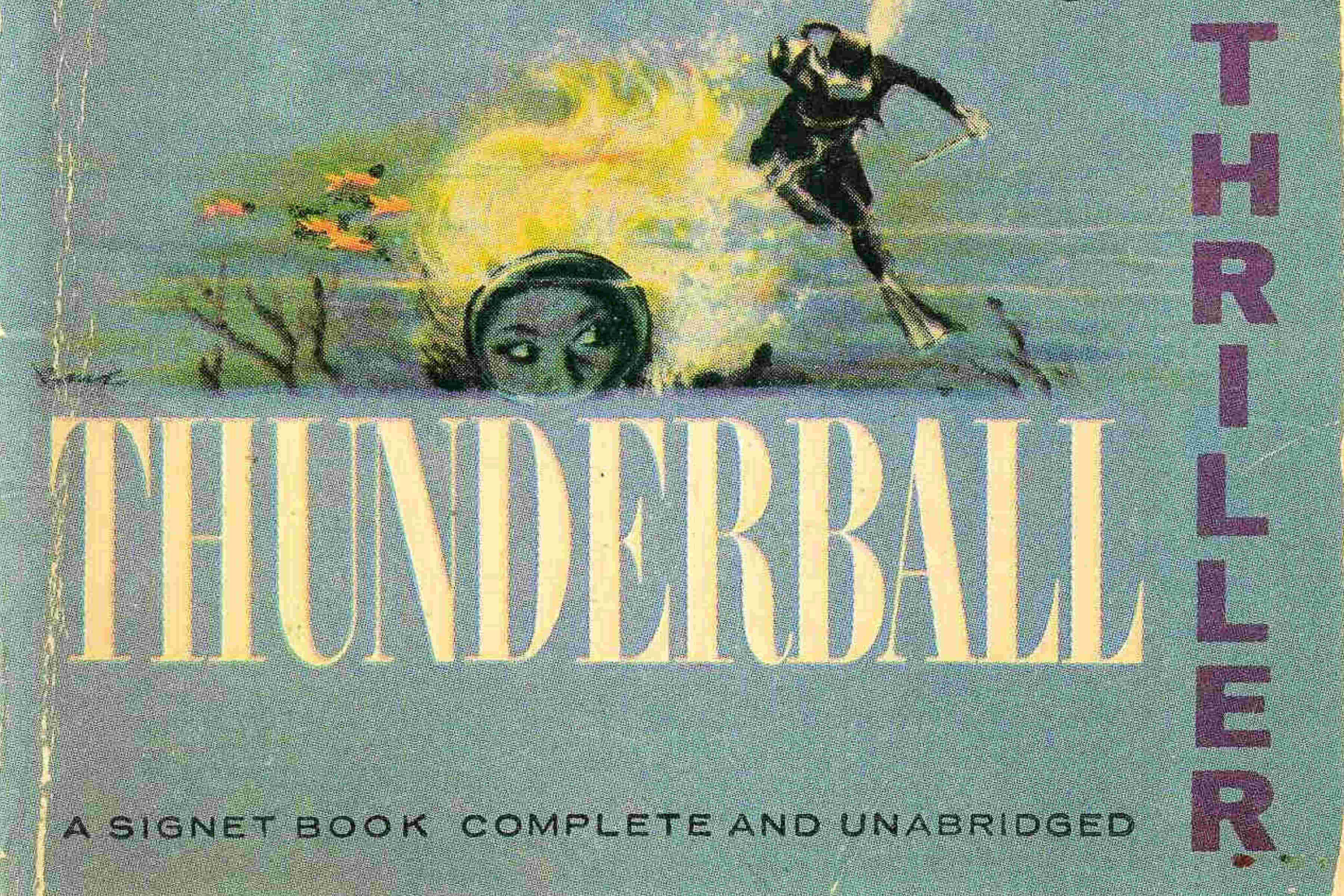

Thunderball (1961) was Ian Fleming‘s ninth James Bond book.
Unlike the previous Bond adventures, Thunderball has a troubled and cloudy history. At least one book (The Battle for Bond by Robert Sellers) has been published about the writing of Thunderball and the aftermath. The underlying issue seems to be that by the time For Your Eyes Only was published in 1960, Fleming was struggling to devise suitable Bond plots. “Now the keys creak as I type and I fear the zest may have gone,” he wrote to his long-time editor William Plomer (1903 – 1973), to whom he had dedicated Goldfinger. At the same time, Fleming had a long-time ambition of seeing Bond in movies or television. A planned TV series had been canceled but provided Fleming with premises for several of the short stories in For Your Eyes Only. In 1958, Fleming had talks with friend and former British intelligence officer Ivar Bryce about developing a screenplay for a Bond film. By 1959 they were meeting with screenwriter/producer Kevin McClory (1924 – 2006) and author/athlete/intelligence liaison Ernest Cuneo (1905 – 1988), and developed what would become the basic story for Thunderball. Later, playwright/screenwriter Jack Whittingham (1910 – 1972) became involved. The movie never panned out, and thank heavens, because instead we got 1962’s Dr. No and the legendary Eon Productions film series. But after Fleming recycled the script into the novel Thunderball, decades of legal wrangling over book and film rights followed.
As I’ve done with the previous Bond books, this is my informal Thunderball reader’s guide regarding brand and place names, historic references, themes, and character development. A few references are repeated from previous books, in which case I’ve generally copied those entries. I haven’t included page numbers, as this will vary by edition. I’m reading the Signet Books mass market paperback. Mr. Fleming was kind enough to divide his books into brief chapters, so references should be easy to find in the text. The best approach, if you can manage it, is to keep this handy while you read the book. I’m only human, so if I’ve made any factual errors, please feel free to reach out to me via the Contact Me page.
Last updated 15 October 2026
Fleming / McClory / Whittingham:
The first edition of Thunderball identified only Ian Fleming as the author, while many later editions (mine included) added a story credit to Fleming, Kevin McClory, and Jack Whittingham.
1 “Take It Easy, Mr. Bond”
James Bond:
We begin in James Bond‘s bedroom when he awakes after a night of over-indulgence. The location is not specified, but Bond presumably still lives in his flat in Chelsea, as described in Casino Royale, Live and Let Die (where a more precise location of King’s Road was first indicated), Moonraker, and From Russia with Love.
A Rare State of Mind:
We experience the unusual circumstance of Bond waking “ashamed of himself – a rare state of mind.” For perhaps the first time, we see Bond internally criticizing himself for over-consumption of alcohol and tobacco the previous night: “…smoking too much goes with drinking too much and doubles the hangover…”
Park Lane:
Bond’s decadent evening took place in “a luxurious flat in Park Lane.” The owner is not identified, but since the late 1700s Park Lane, in Westminster in Central London, has been one of London’s most prominent streets. The luxury hotel The Dorchester on Park Lane was General Dwight D. Eisenhower‘s London headquarters during World War II. Prominent occupants during Bond’s time included Keith Clifford Hall (1910 – 1964), an optician and one of the first contact lens specialists, whose practice was on Park Lane from 1945 until his death.
Bridge:
Bond spent his lavish night playing (and losing at) bridge, a card game he played more successfully in Moonraker. The game is typically played with two 2-player teams, with teammates seated opposite each other. Bridge is derived from whist, a popular 18th/19th century game in England, which itself evolved from Triumph, a card game believed to have originated in Spain or France around the 15th century.
Queen of Spades:
Bond and his partner are defeated when their opponent plays the queen of spades over Bond’s knave, or knight. Bond’s card equates him with knighthood, or the gallantry that knighthood implies, a link made verbally by Felix Leiter in Goldfinger and Fidéle Barbey in For Your Eyes Only. Except the loss, like Bond’s hungover state, is another indicator that Bond’s knighthood is ebbing. The potentially sinister nature of the queen of spades was referenced in From Russia with Love. The significance of the card seems to vary considerably by game or use and also by whom is making the interpretation. Fleming may be referring to Alexander Pushkin‘s story The Queen of Spades, published in 1834. The story involves a German officer who causes the death of an elderly woman who he believes knows a secret about three lucky cards for gambling. The woman appears in a dream and tells the officer to gamble at faro, a French card game, on the three, the seven, and the ace. The officer does this with success, until he accidentally wagers instead on the queen of spades and loses all his money, later becoming insane and ending up in an asylum. Russian composer Pyotr Illyich Tchaikovsky (1840 – 1893) was inspired by Pushkin’s story to write the 1890 opera The Queen of Spades. The queen is a high-ranking card in bridge, but as far as I can tell the queen of spades has no special significance in the game itself. The card has been “marked with South”; bridge players are identified as sitting at the four cardinal directions of the compass, so this simply links the card to Bond’s opponent at the South position.
Mona Lisa Smile:
The opponent’s queen has a “Mona Lisa smile.” Leonardo da Vinci (1452 – 1519) created his iconic Mona Lisa painting during 1503 – 1506 (approximately), and it has long been artistically and culturally influential. The subject is believed to be Lisa del Giocondo (1479 – 1542), of the aristocratic Italian Gherardini family and wife of prominent Italian silk merchant Francesco di Bartolomeo del Giocondo, who was fourteen years older than Lisa. Mona Lisa’s enigmatic smile and the positioning of her eyes have long fueled speculation about her nature and personality.
Important Money:
Bond loses 100£ in the climactic bridge round, which for him is “important money.” We learned in Moonraker that Bond receives a salary of 1,500£/year and a tax-free 1,000£/year from an unidentified source. That makes the loss 4% of Bond’s annual income, which does seem significant for a single round of a card game.
Styptic Pencil:
Bond cuts himself shaving and applies a styptic pencil. Styptic pencils were common in shaving kits prior to the availability of safety razors. The pencil most likely contains anhydrous aluminum sulfate as a coagulant and an astringent to promote vasoconstriction.
Paperwork:
Bond blames his self-destructive behavior on “more than a month” of paperwork with no field action. This feels a bit hypocritical, as Bond smokes and drinks plenty when he’s on a mission, but the point of Bond’s desire for action is well-taken. In Moonraker, Bond pondered the likelihood of being killed in action before the mandatory active-duty retirement age of 45. We can only imagine how damaging retirement would be for 007.
Fruit Stones:
Bond is also aggravated by his secretary (probably still Loelia Ponsonby, introduced in Moonraker) being out with the flu, temporarily replaced by a pool secretary “who spoke to him primly through a mouth full of fruit stones.” Not the pits from stone fruit, I think the secretary is eating Fruit Stones fruit-flavored hard candies. I can’t find details on the candy or manufacturer, except that it originates (at least in contemporary form) in Greece.
May Rain:
It’s May and raining in London. Contemporary data shows London to average about 1.75 inches (44mm) of precipitation in May. Historic data for London Heathrow shows only 1.1 inches (21.9mm) of precipitation in May 1959 and 1.7 inches (42.8mm) in May 1960.

Phensics:
Another callback to Moonraker, when Bond takes two Phensics to help with his hangover, just as he did in that earlier tale. At that time, Phensic contained aspirin, caffeine, and phenacetin (see this 1960s TV ad). Phenacetin was used to relieve pain and reduce fevers, but was banned in the UK in 1980, and many other countries throughout the 1970s and 1980s, because it was linked to kidney disease.
Eno’s:
Bond adds Eno’s to his hangover remedy. Eno’s Fruit Salt was a variety of fruit salts, a fizzy compound that could include some combination of citric or tartaric acid, sodium bicarbonate, sodium carbonate, sodium bitartrate, flavoring, and sugar. Once sold as a tonic for various conditions, the ingredients primarily show up in antacids today. James Crossley Eno (1827 – 1915), a British pharmacist, started selling a fruit salt compound in 1852 in the northern port city of Newcastle upon Tyne, and he gave Eno’s Fruit Salt to seamen coming through the port, giving his product an international reputation. As of 2026, Eno’s Fruit Salt is sold primarily in India by GlaxoSmithKline as an antacid.
Headquarters Phone:
Bond’s morning is disrupted by a phone call, and his bedroom phone is a direct line to headquarters; it’s an indication of the potential urgency of Bond’s work.
M:
Bond is called to M‘s office on the eighth floor (and top floor, as we’ve learned in previous books) of the Secret Service headquarters.
Medical Report:
M is displeased with Bond’s latest medical report, the details of which were reportedly lifted heavily from a report Ian Fleming received from his physician. It’s fairly shocking if the specifics of Bond’s daily routine – sixty cigarettes a day and half a bottle of hard liquor – reflected Fleming’s actual consumption. Bond’s blood pressure of 160/90 is considered “a little raised” at the time of the story, but as of 2024, the European Society of Cardiology defined a blood pressure of 140/90 or higher as hypertensive, depending on where and how the measurement was taken.
Balkan Tobacco:
The tobacco in Bond’s cigarettes is “a Balkan mixture with a higher nicotine content than the cheaper varieties.” We can assume Bond is still buying his cigarettes from Morland’s of Grosvenor Street, though the description of the tobacco has varied a bit, a “Balkan and Turkish” blend in Casino Royale and a “Macedonian blend” in Moonraker.

Occipital Headaches:
Bond “admits to frequent occipital headaches,” a somewhat surprising confession for someone as private and suspicious of bureaucracy as 007. Occipital neuralgia originates in one or both of the greater occipital nerves, one of which appears on either side of the head, running from the spine in the upper neck over the back of the head and onto the scalp. The result can be shooting or tingling pain on one side of the scalp, sometimes radiating toward an eye. The pain can result from a pinched nerve, an injury to the scalp or skull, or long-term tense muscles in the back of the head or upper neck. Migraines and other types of headaches can cause pain in a similar area, so its possible Fleming is referring to a more generic cranial pain.
Fibrositis:
Bond also reports spasms in his trapezius muscles, the trapezoidal muscles from the lower neck and shoulders to the middle back, and the doctor detects “fibrositis nodules.” Historically, fibrositis was an early name for what is today known as fibromyalgia, a term first used in 1976. Fibromyalgia is primarily characterized by widespread chronic pain, but can also include fatigue, troubled sleep, memory issues, and other symptoms. Nodules don’t seem to be a common symptom, but Bond may just have knotted muscles from injuries or stress. Or Fleming may intend this to be fibrosis, the formation of fibrous connective tissue, or scarring; arthrofibrosis in shoulders, knees, or other parts of the anatomy can result from injury or surgery.
Embrocation:
Bond believes that “aspirin and embrocation” will be enough to patch him up. Embrocation is another term for a liniment or heat rub, a preparation, sometimes in the form of a lotion or transdermal patch, applied to the skin to help relieve muscle aches, arthritis, or other similar conditions. Embrocations may contain alcohol or acetone, a counterirritant such as menthol or benzoin resin, or analgesic.
Bread and Sugar:
M makes a short-sighted comment about medication – “Medicine doesn’t get to the root of the trouble” – which is clearly inaccurate when it comes to antibiotics, vaccines, and many other medications. However, he offers some insightful observations about the modern diet for a spy thriller published in 1961, criticizing “white bread with all the roughage removed, refined sugar with all the goodness machined out of it, pasteurized milk which has had most of the vitamins boiled away, everything overcooked and denaturized.” Long before the long history of fad diets that took off in the 1970s, M recommends stone-ground whole wheat, yogurt, uncooked vegetables, nuts, and fresh fruit.
Naturopaths:
M name-drops a series of naturopaths who have apparently influenced his thinking:
- Maximilian Bircher-Brenner (1867 – 1939), a Swiss physician; advocate of eating raw fruits, vegetables, and nuts; operated a sanatorium in Zurich
- Sebastian Kneipp (1821 – 1897), a German Catholic priest; advocate for a holistic healing system of hydrotherapy, phytotherapy, exercise, nutrition, and mind/body balance
- Vincenz Priessnitz (1799 – 1851), Austrian naturopath who advocated for hydrotherapy, applying wet bandages and blankets to cause perspiration followed by a cold bath
- Arnold Rikli (1823 – 1906), Swiss naturopath; opened a health spa in Bled, Yugoslavia (now Slovenia), promoting sunlight, fresh air, clean water, and exercise for health improvement
- Johann Schroth (1798 – 1856), Austrian naturopath; advocated wraps and steam baths to heal injuries; opened a cold water health spa in Bad Lindewiese in the Czech Republic
- Gossman – this is the only name I can’t find, tips are welcome
- Friedrich Eduard Bilz (1842 – 1922), German naturopath; operated a health spa and sanatorium in Radebeul, Germany; developed a mineral water/fruit juice beverage called Sinalco, which grew into a popular German maker of non-alcoholic beverages
Washington / Sussex:
M sends Bond to Shrublands (more on that later) “near Washington in Sussex.” Washington is a village in West Sussex, about 49 miles south-southwest of London and only about 7 miles from the English Channel. See map under Chapter 2 for Washington’s relative location.
009:
M will assign Bond’s duties to 009, and we’re not sure who is getting the better deal. Bond must really dread the thought of a health spa if he would rather stay amid the interminable paperwork. We’ve previously heard of 008 and 0011, but this is the first mention of 009.
Moneypenny:
M’s secretary Miss Moneypenny has been mentioned in previous books, but here she finally gets to have a fairly lengthy conversation with Bond. They refer to M as “the old man,” Bond calls her “Penny,” and we learn that Moneypenny “often dreamed hopelessly about Bond.”
Lumbago:
Moneypenny reveals that a case of lumbago is what inspired M on his latest health craze. Lumbago is simply a term for lower back pain, involving nerves, muscles, or bones, and can be acute or chronic. The pain often goes away on its own and the actual cause may not be known. This implies that either M had a fairly severe case or he may have overreacted a bit.
Blades:
Moneypenny informs us that M learned of Shrublands from a friend at Blades. Once again, we turn to Moonraker, where M took Bond to Blades in order to catch Hugo Drax cheating at cards. In that novel, Blades was described as “probably the most famous private card-club in the world,” but it was certainly more than just a card-playing venue. The private gentlemen’s club, a product of the 18th century British empire, originated in London’s West End. The clubs were a reflection of, and reinforcement of, polite establishment, often associated with veterans of a particular military branch or alumni of a specific university, where “gentlemen” could share interests in sports, politics, literature, etc. Card-playing was often a significant activity at such clubs. A few such clubs still operate, some no longer restricted to men only. Leave it to Americans to sully the tradition and turn “gentlemen’s clubs” into strip clubs. The fictional Blades opened in 1776.
Treacle / Wheat Germ:
M gifted Moneypenny with tins of treacle and wheat germ, among other treats. Treacle is uncrystallized syrup resulting from the refining of sugar. It can range in color from pale to gold to black. Remember M’s earlier criticism of refined sugars, so this would be considered a better alternative as a sweetener. Golden syrup treacle has the look and consistency of honey and is a common sweetener in British cuisine, having first been developed by British chemists and brothers Charles Eastick (1860 – 1947) and John Joseph Eastick (1855 – 1917). As for wheat germ, that is the seed embryo, or the part of the grain that will develop into a plant. The wheat germ contains numerous vitamins and nutrients, and is high in fiber. The germ is removed from flour used in white bread production, explaining M’s criticism of white bread.

Kruschen Salts:
Bond thinks that M, rejuvenated after a stay at Shrublands, looks like “that blasted man in the old Kruschen Salts advertisements.” Kruschen Salts were primarily a laxative sold by the Griffiths Hughes Company of England. I haven’t been able to find much about the company, but the product was apparently promoted as a general cure-all for gout, rheumatism, depression, anxiety, lumbago, and other disorders. They seem to have found high demand among British colonies in the 1920s and 1930s, where settlers feared contamination by the environment and culture of often tropical subjects of the British Empire. Newspaper ads often depicted individuals before (fatigued, depressed) or after (happy, energetic) their use of the product. At least one product that claims to replicate Kruschen Salts is sold in Australia as Nourish Salts.
Dunlopillo:
When Moneypenny teases Bond about having wandering hands, he threatens to “give you such a spanking you’ll have to do your typing off a block of Dunlopillo.” The Wavekrest had Dunlopillo cushions in “The Hildebrand Rarity” from For Your Eyes Only. I can’t find much on Dunlopillo, a manufacturer of latex foam bedding materials, beyond the company’s web site, which reports the development of Dunlopillo latex foam by Dr. E. A. Murphy in 1929. Dunlopillo is responsible for a number of additional developments in latex-related products. It may just be a coincidence, but the name is strikingly similar to Dunlop, the British-based rubber goods manufacturer co-founded by John Boyd Dunlop (1840 – 1921) in 1889.
2 Shrublands
Austin:
Bond climbs into a taxi – why he needs a taxi is not specified, but I have thoughts on that below – and the car is an Austin. Austin Motor Company was established in 1905. Austin merged with Morris Motors Limited in 1952 to form British Motor Corporation (BMC) but maintained the Austin brand. The Austin trademark as of 2026 is owned by China’s SAIC Motor. The car model is not yet specified, and in fact is a bit confusing, as I’ll address shortly.
Brighton City Airport:
Why is Bond taking a taxi instead of driving his own beloved car to Shrublands? We’re not given a reason, but based on the driving time of half an hour to Shrublands, I believe Bond has flown into Brighton City Airport, sometimes called Shoreham Airport because it’s near Shoreham-by-Sea in West Sussex. Brighton City Airport is the oldest airport in the UK, and opened in 1911.

Tommy Steele:
Bond’s initial impression of his taxi driver is that the young man wants to be Tommy Steele. Sir Thomas Hicks, known to the public as Tommy Steele, was a singer and an actor on stage and screen, and in more recent years has taken up sculpting and writing. Steele began performing and recording in the mid-1950s, making him one of Britain’s early teen idols and rock stars, predating the Beatles, the Who, the Rolling Stones, and most of the others. If this story takes place in 1959 (which will be specified later), Tommy Steele’s movie that year was the musical comedy Tommy the Toreador.
Welfare State:
Fleming has turned up his nose at the “welfare state” before, but this is probably the most critical he has been, via Bond, as the taxi driver pauses to comb his duck-tail haircut before driving. “It was typical of the cheap self-assertiveness of young labor since the war. … He was born into the buyers’ market of the Welfare State and into the age of atomic bombs and space flight. For him, life is easy and meaningless.” It’s ironic, perhaps, that Fleming would bring up the atomic age while missing the point, Britain’s postwar austerity and the hopeless feelings provoked by the Cold War nuclear arms race. The UK’s Liberal Party initiated public reforms in the early 1900s in the areas of health coverage, unemployment insurance, and senior pensions; this involved increased taxation of the wealthy and they have been crying about it ever since. Increased state control during World Wars I and II led to increased government support of liberal policies, including development of the National Health Service after World War II. Being among the upper classes, particularly after marrying into the aristocratic family of Ann Charteris (1913 – 1981), perhaps caused Fleming frustration regarding tax policies without considering the societal benefits.
Bluebird:
Bond refers to the driver’s Austin as a Bluebird, which confuses me, because Japan’s Nissan produced the Bluebird from 1955 to 2007. The car was clearly identified as an Austin at the beginning of the chapter. The Bluebird was commonly used as a taxi throughout its history. Nissan did take inspiration from Austin designs, and the two companies had a cooperative engineering agreement beginning in 1952, but the specifics of that relationship are not clear to me.
Volkswagen Minibus:
The taxi driver aspires to buy a Volkswagen Minibus. Volkswagen (VW), of course, is the German automaker founded in 1937 with the intent of producing a car that would be affordable to all Germans. Production shifted heavily to military equipment (using forced labor from concentration camp prisoners) during World War II, and the company was revitalized with help from the British after the war, becoming significant to West Germany’s postwar recovery. The “Minibus” is the Volkswagen Type 2 (Type 1 was the classic VW Beetle), first produced in 1949, sold in numerous variants as a delivery and passenger vehicle. The vehicle’s size and relative affordability made it popular with the 1960s counterculture. A few short years after Thunderball‘s publication, the Type 2 became caught up in the Chicken War, when President Lyndon Johnson (1908 – 1973) imposed a heavy tariff on European light trucks imported into the U.S., as a response to French and West German tariffs on U.S. chicken imported into Europe. As of 2026, the light truck tariff remains, but some companies avoided the matter by simply manufacturing vehicles outside of Europe.
Brighton Races:
The taxi driver wants to “do the Brighton races” with his VW minibus. Since the minibus isn’t exactly a racing vehicle, I assume he intends to expand his taxi service to transporting groups among the racing crowd. Brighton, on the English Channel, has been a popular seaside resort since the 1700s and since 1905 has hosted the Brighton Speed Trials. The races are held on Madeira Drive, a beachside road in Brighton. Other racing events are hosted there, but the Speed Trials are the most notable. The year of Thunderball‘s publication was the first year a dragster appeared at the Speed Trials for competition; a ruptured fuel line prevented the vehicle from setting an anticipated speed record.
Bucket of Blood:
Bond asks about the Bucket of Blood in Brighton, which must have been common knowledge to Brits at the time but is quite an obscure reference today. All I can find about this so far is this discussion on the My Brighton and Hove web site: supposedly a Brighton night spot called the Astor Club had a reputation for violence among its customers and was involved in a police corruption case in the mid-1950s. This is certainly the area’s general reputation indicated in Quadrophenia (1979), the film adaptation, set in the 1960s, of the 1973 album by The Who. Brighton features prominently in both the album and the movie.
Poynings / Fulking / Gatwick:
The driver “drove westward under the Downs through Poynings and Fulking.” This isn’t really consistent with arrival from the Brighton City Airport, as I speculated earlier, so it’s possible that Bond instead arrived via London Gatwick Airport, about 30 miles south of London and about 26 miles northeast of Washington (and Shrublands). Gatwick first opened to commercial flights in 1933, with the airport’s first terminal built in 1935. Poynings and Fulking are both villages in West Sussex. The “Downs” refers to what today is South Downs National Park, though the South Downs area was recognized as an area of significance long before the park was formally designated in 2009. South Downs is a range of chalk hills over 260 square miles (the formal park covers a considerably larger area) running primarily through East Sussex and West Sussex. The South Downs area appears to have been occupied by humans since at least the Neolithic age (10,000 BC – 2,000 BC).

Bentleys:
The taxi driver isn’t happy about the area being overrun by rich folks driving Bentleys. Unless Bond has changed vehicles, he has owned a 1953 Bentley Mark VI since the end of Moonraker (a replacement for his previous Bentley, which was crashed in that novel). Ironically, as of 2026, the Bentley brand is owned by Volkswagen.
Honey Bee Tea Shop:
The taxi driver tells Bond of a “local tart” who worked at a Washington business called the Honey Bee Tea Shop. As far as I can tell, this is a fictional business.
Polly Grace:
The former waitress from the tea shop is identified as Polly Grace. While it seems Fleming must have introduced her name for a reason, we never actually meet Polly.
Austin Metropolitan:
Polly Grace “went mobile” after purchasing an Austin Metropolitan. The Nash Metropolitan was produced during 1953 – 1962 by Austin (BMC) in England but was aimed at the U.S. market, where it was sold by the American Motors Corporation (AMC). The Austin Metropolitan was produced for the UK market, by agreement with AMC, during 1956 – 1961. An Austin dealer in London, Car Mart, presented a Metropolitan in black finish with gold trim to Princess Margaret (1930 – 2002) when she married Anthony Armstrong-Jones in 1960.
Curzon Street:
The driver equates Polly Grace with “the London tarts in Curzon Street they all talk about in the papers.” These must have been a high class of tarts, as Curzon Street in Mayfair in central London has long been an address for elites, including MI5, the UK’s domestic security service, during 1945 – 1976. In 1964, Radio Caroline, the pirate radio service formed to circumvent the radio broadcasting monopoly of the BBC, established its home office in a cul-de-sac off of Curzon Street.
Lewes:
Polly Grace seeks clients in Brighton and Lewes, among other places. Lewes is a county town in East Sussex and about nine miles northeast of Brighton.
Rosemary Clooney:
The driver talks about the oldies “cutting the mustard” with Polly Grace, referencing a song by Rosemary Clooney. Pop/Jazz vocalist Rosemary Clooney (1928 – 2002) was a prolific stage performer and recording artist, releasing her first studio album in 1952. She also made numerous TV appearances before appearing in the beloved movie White Christmas in 1954. Clooney had a troubled personal life, triggered partly by the trauma of being present at the assassination of Robert F. Kennedy in June 1968. Clooney released an EP of duets with Marlene Dietrich (1901 – 1992), Rosie and Marlene, in 1953, which included a single they had recorded in 1952, “Too Old to Cut the Mustard.” The song was written by Bill Carlisle (1908 – 2003) and first recorded by Ernest Tubb (1914 – 1984) and Red Foley (1910 – 1968) in 1951.
Shrublands:
Bond arrives at the much-hyped Shrublands. The health farm is based on Enton Hall, a similar establishment visited by Ann (Charteris) Fleming. Ann tried to persuade Fleming to go to Enton Hall, as he suffered from sciatica, recurring headaches, and chest pains by this time, but his attitude was similar to Bond’s. Enton Hall was established in the 1880s and by Bond’s era specialized in hydrotherapy. Enton Hall was sold to the fundamentalist Seventh Day Adventists in the 1970s and soon closed.
Victorian Lodge:
Shrublands itself is a Victorian lodge. In some of the previous books, Fleming has referred to the Victorian era, approximately the reign of Queen Victoria (1819 – 1901) during 1837 – 1901. Victorian architecture became popular after about 1850 and was really a revival and reimagining of prior styles, including Gothic, Renaissance, Romanesque, and others. A few examples of prominent UK buildings from that era include Royal Albert Hall in London, Selwyn College in Cambridge, and London’s Palace of Westminster.
Alan Moyle:
Bond’s room at Shrublands includes the book Nature Cure Explained by Alan Moyle, MNBA (Member: British Naturopathic Association). This was an actual book, though it appears to be out of print. According to this excellent post from the James Bond Memes blog, M’s lecture about diet in Chapter 1 comes almost verbatim from Nature Cure Explained. Apparently much of Moyle’s advice seems fairly conventional today, with an emphasis on exercise and a diet of whole foods, raw fruits and vegetables, and reduced meat consumption. However, Moyle supposedly also opposed pharmaceutical treatment for illnesses, which is potentially life-threatening. The book is also said to include recipes, like this potassium broth recipe (mentioned in the text) from the James Bond Food site. The British Naturopathic Association was founded in the early 1900s and as of 2026 is still active in supporting Registered Naturopaths in the UK.
Swedish Massage:
Bond reads a chapter in Nature Cure Explained about massage and encounters terms like effleurage, petrissage, tapotement, etc. These are all styles of strokes used in Swedish massage. The term “Swedish massage” is typically only used in English-speaking and Dutch-speaking countries, and, for some reason, Hungary and Israel. Other regions more often use the term “classic massage.” There is evidence that Swedish massage can be a benefit to chronic pain, fatigue, joint stiffness, and osteoarthritis.
Joshua Wain:
Bond meets Joshua Wain, the naturopath who founded Shrublands.

Sacroiliac Strain:
Wain determines that Bond has “some right sacroiliac strain with the right ilium slightly displaced backwards.” The sacroiliac joint lies between the sacrum (a triangular bone at the base of the spine) and the ilium (the upper region of the coxal, or hip, bone).
Arlberg Express:
We get a moment of great insight into Bond’s recent past: the sacroiliac strain was likely caused by a “bad fall,” which Bond suspects was the time he fell from the Arlberg Express. The Arlberg Railway connects the Austrian cities of Innsbruck in the east and Bludenz in the west, a route of approximately 85 miles. The route was put into service in 1884. The Arlberg Railway station in Dalaas, about 10 miles east of Bludenz, was hit by an avalanche in 1954 that killed 10 passengers and station staff.
Hungarian Revolution:
Bond’s fall from the Arlberg Express occurred “after Heinkel and his friends had caught up with him around the time of the Hungarian uprising in 1956.” The Soviet-chosen Mátyás Rákosi (1892 – 1971) led Hungary from 1948 to 1956, imposing harsh repression that led to the imprisonment or execution of an estimated 350,000 government officials and civilians. The Hungarian Revolution of 1956, a populist revolt against the Rákosi government, was crushed by the Soviet Union, leading to thousands of deaths and arrests. About 200,000 Hungarians fled, mostly to Austria, to avoid persecution. In “From a View to a Kill,” from For Your Eyes Only, we find Bond in Paris, recovering from a failed mission to smuggle someone out of Hungary. Is this a reference to the same mission? The Arlberg Railway route is on the opposite side of Austria from Vienna, the primary escape route into Austria from Hungary, but this might have been part of Bond’s escape from the failed mission. I can’t determine whether Heinkel refers to a real or fictitious person; perhaps this is the villain who foiled Bond’s mission?
Sitz Bath:
Wain’s regimen for Bond includes “hot and cold sitz baths.” It seems like an odd choice, given Bond’s symptoms. Sitz baths are sometimes referred to as hip baths, as they involve sitting in water up to about hip level. They can be hot or cold and often involve adding salt, baking soda, or vinegar. They are primarily intended to soothe pain from hemorrhoids, inflammatory bowel disease, yeast infections, constipation, and other similar conditions.
Veronica:
Observing a female Shrublands staff member nearly run over by a reckless driver, Bond saves her with “a passable Veronica” and “picked her body literally off the hood of the car.” A Veronica is a bullfighting move that involves the matador trailing his cloak over the head of the bull when it runs past him. The movement is named after Saint Veronica, the widow – not mentioned in the canonical Gospels – who gave Christ a veil to wipe his forehead when he passed her while carrying the cross to his crucifixion. When Christ returned the veil, it carried an image of his face. She is believed by some to be the woman identified in the Gospel of Luke who is healed after touching the hem of Christ’s garment. Invention of the bullfighting Veronica is credited to Spanish bullfighting pioneer Joaquín Rodríguez Costillares (1743 – 1800).
Patricia Fearing:
We learn that the hapless staff member’s name is Patricia Fearing (her last name is not specified until Chapter 4).

Herringbone Tweed:
The dangerous driver wears herringbone tweed. Tweed is rough woolen fabric and is frequently woven into a herringbone pattern, which is a zigzag v-shaped pattern. Similar patterns have been found in wool clothing dating as far back as 800 – 500 BC.
Anderson & Sheppard:
Bond believes the driver’s herringbone tweed could have come from Anderson & Sheppard (A&S). A&S was established in Savile Row – a central London hub of high-end men’s tailors for many years – in 1906. I can’t find much on the company’s history, except that it seems to have been founded by Swedish tailor Peter Gustav Anderson.
Vicuña:
The driver wears a sweater that Bond equates with vicuña. The vicuña is a camelid native to the Andes of South America. They have coats of fine wool but the coats grow so slowly, the animals can only be shorn every three years, making the material expensive. Incas wore vicuña wool and the vicuña is the national animal of Peru. They are smallish animals, averaging about five feet in length and three feet in height at the shoulder.
Count Lippe:
We learn that the reckless driver’s name is Count Lippe, and he will become important to the story.
Macao:
Patricia claims that Count Lippe operates a business in Macao. Macao (often called Macau) was a Portuguese colony until it was handed over to China in 1999. Macau became a path for refugees from China during and after the Chinese Civil War, fought in two phases from the 1920s through the 1940s.
Tattoo:
In the Shrublands massage room, Bond notices Lippe’s tattoo, “a small zigzag crossed by two vertical strokes.” This, also, will become significant.
3 The Rack
Red Lightning Tong:
Bond calls his London office, which identifies Lippe’s tattoo as belonging to the Red Lightning Tong. We may recall that Dr. No launched his life of crime with tongs in Shanghai. A Chinese tong is a group or social gathering, more common among Chinese immigrants in the U.S. and other English-speaking countries than in China. They were formed partly to offer community to Chinese Americans who were victims of anti-Chinese discrimination. The tongs were not purely criminal undertakings, but some of them were involved with organized crime. The first tongs in China were formed in the 1640s, and some criminal organizations in China still operate as tongs. The Red Lightning Tong of the story appears to be fictitious.
Station H:
Headquarters reports that Station H had some unfortunate dealings with the Red Lightning Tong; Station H is simply the Secret Service office in Hong Kong. Hong Kong was a Chinese territory but became a British colony in the early 1840s after the First Opium War, wherein the British were pro-opium. Japan controlled the island during World War II, but Hong Kong was still a British territory during Bond’s time. Despite disagreement among inhabitants over whether they favored the Republic of China or the Chinese Communist Party, Hong Kong gradually became an important location for finance and shipping. Hong Kong was returned to Chinese control in 1997.
Redland:
The Station H action against the Red Lightning Tong was disrupted because “Redland had some sort of a deal with these people.” I’m not certain about this reference, it might be an obscure reference to the USSR.
Bond’s Dinner:
Bond has perhaps his most disappointing dinner in the series so far, a “thin” vegetable soup.
Brown Sugar:
Bond sweetens his tea with brown sugar, the only kind of sugar allowed at Shrublands. This “brown sugar” could either be raw sugar with a high degree of purity, which has a brown color instead of the white of refined sugar. Or it might be refined white sugar with molasses added to create a brown color. Given Shrublands’ philosophy of avoiding refined sugars, in this case it is probably raw sugar.
Hercules Motorized Traction Table:

Bond is fastened to a Hercules Motorized Traction Table, the rack of the title, to stretch his spine. Hercules seems to be a fictional brand name, but traction tables are real devices used for spinal decompression in physical therapy.
4 Tea and Animosity
Forgetting Pain:
After his torture on the traction table, Bond wakes, relieved that “the body retains no memory of pain.” That may be true, but the brain is another matter, and research indicates that the brain-body retention of pain can be a complicated affair that varies by individual. This article from The Bump reports that “it’s normal and well-documented for moms to remember the pain of childbirth even years later.” An article from Northwestern University’s Feinberg School of Medicine claims that one cause of chronic pain can be “an old memory that essentially gets stuck in the prefrontal cortex, the site of emotion and learning.” And research reported by the Summit Pain Alliance indicates that there may be gender differences in the memory and retention of pain. So it appears that Bond is one of the lucky ones who can forget.
Coramine:
Patricia describes treating Bond with Coramine after finding him on the traction table. Coramine was a trade name for the respiratory stimulant nikethamide. It is not common in clinical applications today but can be used by mountain climbers and other athletes to increase endurance at higher altitudes. It is a banned substance in some sports.
Chain of Command:
Before he fully recovers, Bond imagines complaining about M and it gives a nice summary of the chain of command: the Chiefs of Staff to the Cabinet to the Prime Minister. The UK Chiefs of Staff Committee is staffed by the most senior personnel in each branch of the British Armed Forces: the Royal Navy, the Royal Marines, the British Army, and the Royal Air Force. The Cabinet is the UK’s senior-most decision-making body, appointed by the Prime Minister from Members of Parliament. Bond complaining to the Chiefs of Staff doesn’t entirely make sense, as MI6 answers directly to the Foreign Secretary, a member of the Cabinet.
Dandelion Tea:
Wain recommends dandelion tea as part of Bond’s recovery regimen. A dandelion infusion – sometimes called coffee, sometimes tea – can be made from roasted dandelion root. However, Wain is probably recommending an infusion made directly from dandelion leaves or blossoms. It is reported to act as a diuretic and to contain a number of vitamins, minerals, and other nutrients.
Bond and Tea:
We learned in Goldfinger that Bond considers tea “one of the main reasons for the downfall of the British Empire,” and to Patricia Fearing he calls it a “flat, soft, time-wasting opium of the masses.” I’m mystified as to why Bond is so hostile to such a beloved beverage. Bond’s comment also calls to mind the famous statement attributed to Karl Marx (1818 – 1883) that religion is “the opium of the masses.” Marx’s full statement, part of a much longer posthumously published article, was: “Religion is the sigh of the oppressed creature, the heart of a heartless world, and the soul of soulless conditions. It is the opium of the people.” Marx had sincere complaints against organized religion, but he recognized that religion provided relief from suffering that many people, at the time, struggled to find anywhere else.
Ford Populars:
Bond imagines that customers of one of the local tea shops are Ford Popular drivers. Oddjob drove a Ford Popular in Goldfinger. The Popular was manufactured by Ford UK during 1953 – 1962. The car was appropriately named: because of the temporary halt to car manufacturing during World War II, and post-war quotas and restrictions on purchase and resale of new cars, the Popular sold well. The Popular’s relatively light weight also made it a hit with hot rodders in the late 1950s.

Morris Minor:
An alternative for the tea shop clientele above is the Morris Minor. British firm Morris Motors, originally W. R. M. Motors, was established in 1912 by former bicycle manufacturer William Morris (1877 – 1963). In a 1952 merger Morris became part of the British Motor Corporation (BMC). The Minor was produced during 1948 – 1971. Variants of the Minor included a two-door saloon, a convertible, a panel van, and a pickup truck. The Minor was originally conceived as a practical economy vehicle; Britain’s Autocar magazine called it “a primary way Britain got back on the road after the Second World War.”
Character Vices:
Bond suffers a brief identity crisis over the irony of feeling better as a result of temporarily “losing the vices that were so much part of his ruthless, cruel, fundamentally tough character?” Past stories have sent a similar message, implying that Bond’s strength of character is reflected in the vices that are considered sinful, going so far as to contrast him with villains who sometimes abstain from those same vices. We might extrapolate this to Fleming’s attitude toward Britain and his earlier commentary about the “welfare state”; he presumably believed Britain needed more hard-living toughness and less compassion.
Spaghetti Bolognese:
Bond identifies spaghetti bolognese as one of the “obsessions which belonged to his former life,” so it seems odd that this is the first time he has mentioned it. Bolognese sauce, a variety of ragù, is a meat sauce common in Italian cuisine and was historically adapted from French ragout, a stew that might include meat or any variety of vegetables. The first known recipe of a ragù served with pasta comes from Bologna, in northern Italy, in the late 1700s.
Chianti:
Another of Bond’s former “obsessions” is Chianti, a red wine specifically from the Chianti region of Tuscany, in north-central Italy.
Stockholm / Lisbon:
Bond schemes against Lippe “with the cold intensity he would have employed against an enemy agent, say in a hotel in Stockholm or Lisbon during the war.” Stockholm is the capital of Sweden and Lisbon is the capital of Portugal. Both countries remained officially neutral during World War II. Sweden remained subject to blockades during the war; Sweden also facilitated movement of volunteers and war material to Finland in its World War II conflicts with Russia, the Winter War (1939 – 1940) and the Continuation War (1941 – 1944). Lisbon, as a European port city in a neutral country, attracted spies from multiple countries and provided an escape route for tens of thousands of refugees escaping Germany. Referencing these two non-combatant cities, both significant European ports, implies that Bond was already engaged in espionage work during the war, while previous World War II references have given the impression that Bond was in active combat. It’s an intriguing view of Bond’s past.
Bournemouth:
Lippe mostly remains in his room while at Shrublands except for mysterious business trips to Bournemouth. Bournemouth is a coastal town roughly 80 miles west of Washington. It became a popular beach resort after local railways opened in the late 1800s.
Yale Lock:
Bond inspects Lippe’s room after easily picking the Yale lock on the door. Both Linus Yale Sr (1797 – 1858) and Linus Yale Jr (1821 – 1868) held patents for pin tumbler locks, but the concept was based on lock designs dating back to the 8th century BC. A pin tumbler locking mechanism uses pins of varying lengths to secure a bolt; only the correctly designed key will lift the pins the correct distance to release the bolt. The Yale company was founded in 1868 by Yale Jr and Henry R. Towne (1844 – 1924), and the company had additional patents relating to safe locks, padlocks, and others. Yale was founded in Connecticut and sold primarily in the U.S. until the 1920s, when they became the dominant lock company in Britain by acquiring British firm H&T Vaughan. As of 2026, Yale is a subsidiary of Swedish conglomerate Assa Abloy.
Name Brands:
The primary outcome of Bond searching Lippe’s room is name-dropping a series of brand names to indicate his first-rate attire. This makes Lippe a worthy adversary for 007.
- Charvet shirts: Charvet Place Vendôme produces luxury shirts, ties, and other clothing. It was founded in the 1830s in Paris by Joseph-Christophe Charvet (1809 – 1870), whose father had been wardrobe curator for Napoleon. Charvet also distributes its clothing worldwide through other retailers.
- Tripler ties: I’m unable to find any background on Tripler, except that it was founded by Frederick R. Tripler and formerly had a prime location in New York City. Tripler clothing can be purchased online from resellers, but as far as I can tell the company is no longer in operation.
- Dior ties: The House of Dior was founded in 1946 by French fashion designer Christian Dior (1905 – 1957). Dior got his start selling fashion sketches and was heavily influenced by his friendship with such artists as Pablo Picasso, Salvador Dalí, and Alberto Giacometti.
- Hardy Amies ties: The Hardy Amies label was founded in 1946 on Savile Row by English fashion designer Sir Edwin Amies (1909 – 2003). Amies was an official dressmaker for Queen Elizabeth II (1926 – 2022) during 1955 – 1990. Amies staged the first men’s ready-to-wear clothing catwalk show in London in 1961.
- Peal shoes: It’s spelled “Peel” in my edition but this is certainly Peal and Co., a London shoemaker dating back to the mid-1500s. Brooks Brothers purchased the Peal brand name in 1965.
- Mark Cross suitcase: Bond carried a Mark Cross billfold in Live and Let Die. The company was founded in Boston in 1845 as a manufacturer of equestrian gear before moving into luxury leather goods like billfolds and handbags; the brand name has been passed through multiple corporate owners over the years.
- Wilkinson razor: Bond used a Wilkinson dagger in Live and Let Die, and his Q-branch attache was equipped with a Wilkinson throwing knife in From Russia with Love. Henry Nock (1741 – 1804) founded a weapons manufacturer in 1772, which became James Wilkinson & Son when it was taken over by Henry Wilkinson in 1824. The company took up shaving razors manufacturing, gave up weapons, and still does business today.
Maquereau:
Based on appearances, Bond could have mistaken Lippe for a maquereau. The French word maquereau literally translates to English as mackerel, but it’s also a slang term for pimp.
Imagined Haunts:
Bond imagines the kind of places that would be frequented by the maquereau version of Lippe:
- Ritz Bar in Paris: The Victorian-style Ritz Bar is one of several bars in the Hotel Ritz in Paris. Swiss hotel operator César Ritz (1850 – 1918) and French chef Auguste Escoffier (1846 – 1935) opened the Ritz Paris in 1898. The Ritz Hotel is where Bond tracked down Rosa Klebb in From Russia with Love.
- Palace in St. Moritz: Badrutt’s Palace Hotel opened in 1896 in St. Moritz, in southeastern Switzerland, by Swiss businessman Caspar Badrutt (1848 – 1904).
- Carlton in Cannes: The Carlton Cannes Hotel was founded in 1911 in Cannes on the French Riviera. It is a favorite lodging for celebrities attending the Cannes Film Festival. As of 2026 it is owned by IHG Hotels.
S.I.S. Records / C.I.D.:
Bond plans to “put through a good trace” on Lippe through S.I.S. Records and C.I.D. S.I.S. (SIS) = Special Investigation Section, and C.I.D. (CID) = Criminal Investigation Division. (CID assisted Bond in Goldfinger.) Given the similarities of the names, it’s not clear to me how the functions of SIS and CID would differ; maybe SIS is involved before actual criminal charges are involved?
Blood Pressure:
Bond’s blood pressure after the Shrublands treatment is 132/84. This is clearly an improvement over his earlier result and at the time was probably considered healthy, but, again referring to the European Society of Cardiology 2024 guidelines, it is considered elevated today.
Turkish Bath:

Bond catches Lippe in an “electric Turkish bath” and delivers a response to the traction table incident. This is clearly not a Hammam, what Westerners often refer to as a Turkish bath, a public bathing area of cultural significance in the Muslim world, providing both hygiene and a social gathering place separated by gender. Hammams existed by at least the 7th or 8th century and they were adaptations of Roman and Greek bathhouses. A variation of the Hammam, the Victorian Turkish bath, became popular in the UK, largely introduced there by Scottish diplomat David Urquhart (1805 – 1877), who had served in the Ottoman Empire in the 1830s, and Irish physician Richard Barter (1802 – 1870), who actually built the first known Victorian Turkish bath in 1858 in County Cork, Ireland. Like the Hammams of Islam, the Victorian Turkish baths served both health and social functions. However, what Bond traps Lippe in is a step removed from the Victorian Turkish bath, and is a personal sauna, an enclosed sauna designed for one seated individual. They are rare these days, most contemporary individual saunas are shaped more like large, enclosed showers. But the Thunderball film adaptation depicted the kind of device involved here.
Medikalischer Maschinenbau:
The electric Turkish bath unit is made by Medikalischer Maschinenbau GmbH, 44 Franziskanerstrasse, Ulm, Baden-Württemberg. This is an oddly specific detail, but as far as I can tell, there is no such company, and the address in Ulm, in southern Germany (West Germany at the time), appears to be fictitious.
Gentian Violet:
Bond expects that Lippe’s experience in the electric Turkish bath will be treated with gentian violet. Also known as crystal violet, methyl violet 10B, or hexamethyl pararosaniline chloride, gentian violet is a dye used in histological staining and in the classification of certain bacteria. The dye has antibacterial, antifungal, and antiparasitic properties, and was used as a topical antiseptic until more effective drugs were developed for such purposes; this is the application which Bond has in mind. The substance was also used in inks for pens and inkjet printers.
Tannic Acid Jelly:
Bond also expects that tannic acid jelly will heal Lippe’s wounds, as it was used on Bond himself in Moonraker and Doctor No. Tannic acid was first used to treat severe burns in the 1920s but was eventually replaced by more effective treatments. In excess amounts, tannic acid can cause severe side effects.
5 S.P.E.C.T.R.E.
Boulevard Haussmann:
We change setting to an office on Boulevard Haussmann in Paris and the street is approximately as Fleming describes it, running roughly east-west through Paris from rue du Faubourg Saint-Honoré (and Avenue de Friedland) in the west to Boulevard Montmartre (about half a mile past the Palais Garnier opera house) in the east. Boulevard Haussmann is named for its designer, Georges-Eugène Haussmann (1809 – 1891), who, under the direction of Napoleon III (1808 – 1873), transformed Paris during 1853 – 1870, though a section of Boulevard Haussmann was not built until 1926. Haussmann’s transformation had significant positive impacts, improving sanitation and traffic flow, building and redesigning parks, and expanding the city limits. However, the long project was extraordinarily expensive and was partly intended to inhibit revolution and simplify the movement of soldiers through the city; it also destroyed many historic buildings and neighborhoods.
Avenue d’Iéna:
Fleming calls Avenue d’Iéna the richest street in Paris. Avenue d’Iéna was opened in the late 1850s and replaced an older road (meaning it was probably also part of Haussmann’s Paris renovation), and was named after the Battle of Jena-Auerstedt, fought between France and Prussia in October 1806 as part of the Napoleonic Wars. Sotheby’s International Realty describes the street as an “international corridor” and “one of the most sought-after addresses in Paris.” The nearby Pont d’Iéna, which crosses the Seine, includes a set of steps featured in an early scene from A View to a Kill (1985).
Rich vs. Solid:
After calling Avenue d’Iéna the richest street in Paris, Fleming identifies Boulevard Haussmann as the most “solid,” wisely pointing out that the richest people are often not the most solid. Sadly, he goes too far and claims that the questionable rich people on Avenue d’Iéna are foreigners with names originating primarily in central or eastern Europe. (It’s worth noting that the Sotheby’s web site cited above promotes the street as an ideal destination for foreign investors.)
Liechtenstein / Bahamas / Switzerland:
We’re told that, while Avenue d’Iéna is mostly residential, it is home to some holding companies based in Liechtenstein, the Bahamas, or Canton de Vaud in Switzerland. Liechtenstein was established in 1719 and is located next to Austria and Switzerland. Vaud is currently the third largest of twenty-six cantons that make up Switzerland, with the capital city of Lausanne and located near the French border. We will visit the Bahamas in more detail later in the book. At the time Thunderball was published, all three countries were welcoming tax havens to the uber-wealthy, though Liechtenstein has backed away from this slightly in recent years.
Second Empire:
Boulevard Haussmann is lined with “bastard Second Empire buildings.” The Second Empire style, as one might imagine, originated during the Second French Empire, the government established by Napoleon III in 1852 when he declared himself Emperor of France. The Second Empire ended in 1870 when France was defeated in the Franco-Prussian War. Fleming refers to Second Empire as a “bastard” style because it incorporated elements of previous architectural styles along with newer materials such as iron frameworks and glass skylights. It leaned toward larger structures and a high degree of ornamentation. Fleming may have borrowed his description from French writer Emile Zola (1840 – 1902), who described the style as “the opulent bastard child of all the styles.”
Lombard Street / Wall Street:
Fleming claims that if a few questionable businesses are found on Boulevard Haussmann, such businesses are also found “behind even the solider frontages of Lombard and Wall Streets.” Lombard Street is not the crooked San Francisco street, but a busy financial hub in the heart of London since at least the 1600s. Wall Street, of course, is the hub of the U.S. financial district, located in Lower Manhattan in New York City. The street has been a hub of securities trading since the 1700s.
French Shakespeare Society:
The French Shakespeare Society is one of the “respectable” occupants of Boulevard Haussmann. The only French Shakespeare Society I can find (the Société Française Shakespeare) was established in 1975 to promote “the study of works by Shakespeare and other authors from the Tudor / Stuart period in the literary, political and social context of Renaissance Europe.” I’m unable to find a similar organization that existed at the time of Thunderball.
FIRCO:
Our villains, who we will meet shortly, operate behind a front organization, the Fraternité Internationale de la Résistance Contre l’Oppression (FIRCO). This translates approximately as International Brotherhood of Resistance Against Oppression, which seems about as generic as it gets, though resistance to oppression is a right guaranteed by the French constitution. We’re given 136 bis Boulevard Haussmann as FIRCO’s address – “bis” simply means there are multiple residents at that street number (like 136A and 136B in some U.S. addresses). There doesn’t appear to be a “136 bis” on Boulevard Haussmann, and 136, as of 2026, looks to be a generic office building.
Directoire Doors:
Directoire double doors open to the FIRCO office. Directoire was a fashion and furnishings style during the short-lived Directory, the government established by the French Constitution of 1795 and overthrown by Napoleon (1769 – 1821) in 1799. The style made heavy use of such ornamentation as vases and urns, winged lions, dragons, and sphinxes.
International Refugee Year:
A FIRCO staff member claims that the organization is especially busy because it is International Refugee Year. In fact, the United Nations High Commissioner for Refugees sponsored World Refugee Year from June 1959 to June 1960, giving us a fairly specific time-frame for the story. More than sixty countries participated in an attempt to attract more signatories to the UN-sponsored Convention Relating to the Status of Refugees of 1951. The convention was an attempt to create a global standard for rights of individuals who seek asylum outside their home country to escape persecution. The original intent was to aid World War II refugees in Europe but was later expanded globally. A briefing paper on World Refugee Year can be found at the University of Nottingham web site (select 7: World Refugee Year).
Pas de Quoi:
Hanging up the phone, the FIRCO staff member says, “Pas de quoi,” which translates approximately as “don’t mention it.”
Lucien’s:
We learn that Bond had his longed-for spaghetti Bolognese at Lucien’s in Brighton. As far as I can tell, Lucien’s is fictional, or at least no longer exists.
No Vices:
The secretive meeting prohibits drinking and discourages smoking. This is a sure sign that they are villains, lacking the vices central to Bond’s nature, as established in Chapter 4.
Alpha Male:
Fleming subscribes to the long outdated alpha male theory of tribe hierarchy, suggesting Genghis Khan, Alexander the Great, Napoleon, and even Adolf Hitler as examples. Genghis Khan (1162 – 1227) established the Mongol Empire that ruled much of China and central Asia. Alexander the Great (356 – 323 BC) ruled Macedon and created an empire from Greece to India. Napoleon Bonaparte, identified earlier with the Directory, was Emperor of France during 1804 – 1814. Hitler (1889 – 1945) was chancellor and Führer of Germany, and prime instigator of World War II, during 1933 – 1945. While all of these men may have possessed charisma and intelligence, the argument ignores luck, circumstances of history, and the many, many others who aided these individuals in their quest for power. It also ignores the extraordinary violence enacted by these “rare men” and the occasional unhappy ending, including the possible poisoning of Alexander, Napoleon’s exile from France (twice), and Hitler’s death by suicide.
Blofeld:
At last, we meet the story’s villain, remembered more than anyone as Bond’s arch-nemesis. Ernst Stavro Blofeld was born 28 May 1908; we don’t know the exact current date, but this story began in May, so if Thunderball takes place in 1959, Blofeld may be about to observe his 51st birthday. The character’s name may have come from one of two Fleming acquaintances: Thomas Blofeld (1903 – 1986) attended Eton College with Fleming; John Blofeld (1913 – 1987), a writer on Asian culture and religions, was a member of Boodle’s gentlemen’s club (the inspiration for Blades in Moonraker) with Fleming.
Gdynia:
Blofeld was born in Gdynia, Poland. Gdynia is a city on the Baltic coast in northern Poland. Today Gdynia is part of a substantial metropolitan area, but in Blofeld’s time it was a small fishing town. The estimated population in 1910 was only 895. It was also part of the German Empire at that time, and was not returned to Poland until after World War I. Construction of a harbor and seaport took place during the 1920s to facilitate international commerce. Germany invaded the city in World War II and imprisoned thousands of residents. The city was again returned to Poland after the war, but Poland was run by a communist government until 1989.
University of Warsaw:
Blofeld studied economics and political history at the University of Warsaw, opened in 1816 and Poland’s largest higher learning institution. The university went through a period of modernization and expansion between the world wars, roughly the time Blofeld would have attended, but the nation’s economy limited scholarships and financial aid to students.
Warsaw Technical Institute:
After the University of Warsaw, Blofeld studied engineering and radionics at Warsaw Technical Institute. I believe this is really Warsaw University of Technology, founded in 1826 with an early emphasis on mining and military technology. If we assume that Blofeld attended in the early 1930s, the school would have had roughly 3,000 – 4,000 students. Radionics, also called electromagnetic therapy (EMT), seems an odd choice for such a matter-of-fact individual: this is a field of alternative medicine that uses radio waves or other electromagnetic radiation to treat illness. EMT was generally discounted by serious physicians from the start. The field was largely established by U.S. physician Albert Abrams (1863 – 1924). I imagine Fleming really intended that Blofeld was involved in a field of radio technology.
Ministry of Post and Telegraphs:
After college, Blofeld started his career at the Polish Ministry of Post and Telegraphs. The Ministry functioned under this name during 1919 – 1924 and 1927 – 1939. Blofeld claims to have started there at the age of 25, which would have been 1933. The Ministry oversaw national postal and communications services. The Ministry was later absorbed into the Ministry of Communications.
Communications = Power:
Blofeld wisely understands the connection between information and influence in a world of rapidly evolving technology: “He had decided that fast and accurate communication lay, in a contracting world, at the very heart of power. Knowledge of the truth before the next man, in peace or war, lay, he thought, behind every correct decision in history and was the source of all great reputations.” It’s easy to imagine that in later years Blofeld would have involved himself in television and radio, and later into cellular and Internet services.
Warsaw Bourse:
Blofeld exploits his Ministry position to trade equities on the Warsaw Bourse. Bourse is another term for a stock or securities exchange. The Warsaw Stock Exchange was established in 1817. Blofeld wisely leaves before the outbreak of World War II, as all Polish stock exchanges were closed when Poland was occupied by Germany and the Soviet Union in 1939.
Red Cross:
Blofeld obtains contact names in defense firms by pretending to solicit donations for the Red Cross. The International Red Cross and Red Crescent Movement is a surprisingly complex organization, also including the International Federation of Red Cross and Red Crescent Societies and the International Committee of the Red Cross. The organization has a nebulous mission of providing relief to human suffering, typically in the wake of war or disasters of human or natural origin. It originated with the First Geneva Convention, adopted in 1864, revised considerably in later years, to provide humanitarian standards for the treatment of wounded soldiers and military medical personnel, and providing relief to victims of military conflicts.
TARTAR:
Blofeld’s first organized crime effort, trafficking in military secrets, is dubbed TARTAR. I can’t find any special significance behind the name, though it’s perhaps a reference to Tartary, a term sometimes used in Western Europe during the 13th to 19th centuries to refer to a large region of central Asia, more often referred to as Central Eurasia today. Limited understanding in the West of the people and cultures of this region gave rise to conspiracy theories about a secretive civilization with sophisticated technology, reminiscent of Wakanda in some of the Marvel movies.
Abwehr:
Approaching Germany as a potential buyer of his secret information, Blofeld connects with AMT IV of the Abwehr. AMT simply refers to a department or office. The Abwehr was a German military intelligence agency during 1920 – 1944. It was divided into three functional areas: espionage, sabotage, and counter-intelligence. Given that, I’m not sure what Department IV refers to.
U.S. Dollars:
It’s interesting that Blofeld wants payment only in U.S. dollars. Given global conditions at the time, it’s reasonable that the dollar must have seemed to be among the world’s most stable currencies. The dollar became more prominent as an international reserve currency in place of the British pound after World War I.
U.S. / Sweden:
Blofeld finds the U.S. and Sweden to be more lucrative buyers of the classified information he obtains. Sweden’s true neutrality during World War II was questionable, as described previously, so it’s no surprise when Blofeld learns that German and Swedish intelligence services are in collaboration.
Shell Bearer Bonds:
Fearing that TARTAR will be exposed as wartime hostilities expand, Blofeld cashes out and invests his funds in Shell bearer bonds in Amsterdam. A bearer bond is a debt instrument issued by a government or business that is not registered to a specific owner. The holder, or bearer, of the bond is accepted to be the legitimate owner, simplifying the conduct of shady transactions. Oil and gas company Shell was created in 1907 by the merger of Royal Dutch Petroleum in the Netherlands and Shell Transport and Trading Company of the UK. Since its founding Shell has been one of the world’s major petroleum suppliers. The Netherlands, including Amsterdam, was occupied by the Nazis during World War II.
Zurich:
Blofeld transfers his Shell bonds to Diskonto Bank in Zurich. As far as I can tell, Diskonto Bank is fictional, but Zurich, as Switzerland’s largest city, is home to numerous financial institutions.
Polish Deuxième Bureau:
To his network, Blofeld blames the Polish Deuxième Bureau for his abrupt departure. Deuxième is the French word for Second. The Second Department of the Polish General Staff, or Section II, conducted military intelligence, counterintelligence, cryptography, and related functions for the Polish Armed Forces during the Republic of Poland, or the Second Polish Republic, which existed during 1918 – 1939.
Turkey:
Blofeld seeks refuge in Turkey after leaving Poland. The modern-day Republic of Turkey was established in the early 1920s. Turkey remained neutral during most of World War II, cleverly entering on the side of the Allies in early 1945, becoming a member of the United Nations the same year. Turkey joined NATO in 1952.
Ottoman Bank:
Blofeld transfers his wealth to the Ottoman Bank in Istanbul, Turkey’s largest city. The Ottoman Bank was chartered in London in 1956 but was taken over by a French bank after World War I, remaining under that ownership until it was purchased by Turkey in 1996.
Ankara Radio:
Blofeld sets up another espionage service, RAHIR, with the help of Ankara Radio. Ankara is the capital of Turkey. Ankara Radio is a nationwide radio network that began broadcasting in 1927. Like TARTAR, I can find no particular significance regarding the name RAHIR.
Rommel in Africa:
Like Turkey, Blofeld sits out the war until a victor is clear, siding with the Allies after “Rommel had been kicked out of Africa.” Erwin Rommel (1891 – 1944) was a German military officer who became a field marshal during World War II. Rommel became known as the Desert Fox after his command of joint German/Italian forces in North Africa during 1941 – 1943. Facilitated by British code-breaking, Allied forces defeated Rommel in Africa, from which the Allies advanced to Italy. Late in the war, Rommel urged Hitler to seek peace with the Allies, and there is reason to believe Rommel may have been involved in a conspiracy to remove Hitler from power. Faced with treason charges, Rommel was given the choice between a show trial and certain execution or taking his own life; Rommel chose to take his life with cyanide in October 1944.
Serge Angstrom:
Blofeld flees Europe for South America under the false name Serge Angstrom. The name probably has no special significance, but an angstrom is a unit of measurement equal to one-hundred-millionth of a centimeter, named after Swedish physicist Anders Jonas Ångström (1814 – 1874). It is also the last name of John Updike‘s fictional Harry “Rabbit” Angstrom, who first appeared in the novel Rabbit, Run, published in November, 1960, probably too late to have influenced Thunderball.
South America:
The country is not specified, but Blofeld chose refuge in South America for a reason. Due to a variety of factors, including aid from the Catholic Church and the Red Cross, and economic connections such as a Deutsche Bank subsidiary in Buenos Aires, as many as 9,000 Nazis and collaborators fled to South America to escape prosecution, primarily going to Argentina, Brazil, and Chile.

Mussolini:
Blofeld is considered to have eyes similar to Mussolini’s, described as “deep black pools surrounded…by very clear whites.” Benito Mussolini (1883 – 1945) was the fascist dictator of Italy during 1922 – 1945. While Mussolini was considered to have a strong physical presence, photos I can find of him, mostly in black-and-white, don’t show his eyes in sufficient detail for me to verify the claim.
Blofeld’s Weight:
At the time of the story Blofeld weights 280 pounds and it’s made clear that he is not in peak physical condition. For all the poking and prodding Bond was subjected to earlier, we never learn his actual weight, only that he lost ten pounds during the Shrublands “cure.” We do know that Bond is in good physical condition, positioning Blofeld as Bond’s physical inferior.
Vice Free:
The limitations on smoking and drinking described earlier in the chapter are expanded on. Blofeld does not smoke or drink and is sexually abstinent; again, this diminishes Blofeld’s humanity, making him robotic or machine-like, as compared to Bond’s passion for vice-filled living.
Kotze and Maslov:
At this point only two other members of the villainous group (not yet identified) are named: Kotze from East Germany and Maslov (formerly Kandinsky) from Poland. We’re told that Kotze traded intelligence for refuge in Switzerland, which seems logical given that, like Sweden, Switzerland was neutral during World War II but remained so partly through back-channel assistance to Germany.
Philips AG of Eindhoven:
Maslov previously worked for Philips AG of Eindhoven. Philips was founded in Eindhoven, in the southern part of the Netherlands, in 1891. The company was started by father/son industrialists Frederik Philips (1830 – 1900) and Gerard Philips (1858 – 1942) as a producer of light bulbs. Philips became a leading global electronics firm during the 20th century. During World War II, the company moved much of its operations to the United States, while Gerard’s nephew Frits Philips (1905 – 2005), remained in the Netherlands and saved 382 Jews from the Nazis by positioning them as necessary workers. In 1963, not long after Thunderball‘s publication, Philips introduced the compact audio cassette. In recent years, the company has spun off much of its electronics and other businesses to focus on healthcare technology.
Cells of Three:
In what Blofeld thinks of as the “Communist triangle system,” his group functions primarily in cells of three individuals. This is a variation of the clandestine cell system, which separates organizations into small groups with limited organizational knowledge to minimize the potential for identification by hostile forces. The approach seems to have originated with the French resistance during World War II, which used groups of three to conduct sabotage against the German occupiers. This limited widespread knowledge of resistance members, meeting places, strategies, etc., in the event that an individual was captured. The Viet Cong in Vietnam and the Provisional Irish Republican Army (PIRA) employed similar strategies.
Sicilian Mafia:
Blofeld’s group includes former members of the Sicilian Mafia, which Fleming refers to as the Unione Siciliano. I can find no evidence that the Sicilian Mafia, or Cosa Nostra, actually operated under the name “Unione Siciliano,” though it does seem to have been used by groups in the U.S. Cosa Nostra began as a means of enforcing land rights and ownership after Italy acquired Sicily in 1860. The Mafia gradually expanded into criminal activities and election manipulation through intimidation of voters.
Union Corse:
Blofeld has also recruited from Union Corse, a Mafia-like organized crime effort that was active during the 1930s through the 1970s in southern France, with additional activities in the U.S. and Turkey. Union Corse is probably best known for its role as the French Connection, part of a heroin-smuggling route from Turkey, through France, to the U.S. The U.S. end of this process was dramatized in The French Connection (1971). There is some debate as to how organized Union Corse really was. “Corse” refers to Corsica, the Mediterranean island that is a territory of France. We will see Union Corse later, in On Her Majesty’s Secret Service.
SMERSH:
Blofeld’s syndicate also includes former members of SMERSH, which Fleming claims was broken up by Nikita Khrushchev (1894 – 1971), who was the leader of the Soviet Union at the time. SMERSH has been Bond’s arch-nemesis through much of the series so far. SMERSH, Smert’ shpiónam (“Death to Spies”), was a real Soviet agency. The name was created by Joseph Stalin (1878 – 1953), who became dictator of the Soviet Union from 1924 until his death. SMERSH was only active from 1943 – 1946, when its activities were absorbed by MGB. (Fleming cites the MVD, which replaced the MGB in 1953.) Officially, SMERSH was charged with operations in the Red Army: counter-intelligence, counter-terrorism, and investigation of suspected traitors or deserters. The agency’s primary objective was to identify and eliminate alleged German spies operating within the Red Army during World War II. At one time, SMERSH was estimated to have recruited anywhere from 1.5 to 3.4 million informants within the Red Army (giving a sense of how large the army was). About 30,000 German “spies,” some actual spies but others perhaps not, are believed to have been killed as a result of SMERSH operations. In the late 1960s, famous wingnut L. Ron Hubbard claimed that SMERSH had taken over governments throughout the world, and you can bet he had a complicated plan to defeat them. At the time Fleming wrote Thunderball, relations between the Western allies and the Soviet Union seemed to be improving; rather than use a Soviet organization as the villain, Fleming instead created Blofeld’s country-neutral group (which we will finally learn the name of at the end of the chapter).
Sonderdienst:
Another recruiting source for Blofeld is “the former Sonderdienst of the Gestapo.” I can find no formal connection between the Sonderdienst and the Gestapo – the Nazi secret police force during 1933 – 1945 – beyond serving Nazi Germany. The Sonderdienst was a network of paramilitary groups made up of former Germans or people of German heritage living in Poland who supported the Nazis after they occupied Poland in 1939.
Tito:
Blofeld’s syndicate also includes three former operatives in Tito’s secret police. Josep Broz Tito (1892 – 1980) was prime minister of Yugoslavia during 1944 – 1963, and president during 1953 – 1980. Tito is a harder figure to pin down than overblown dictators like Hitler or Stalin. While he certainly condoned significant human rights violations, he split with Stalin in the late 1940s. From The Cultural Cold War by Francis Stonor Saunders: Tito’s “refusal to sacrifice national interests in favor of propping up Soviet hegemony in the Balkans had opened a vicious polemic between Moscow and Belgrade. Stalin had withdrawn economic and military advisors from Yugoslavia as part of a war of attrition designed to weaken this independent stance. Tito, in turn, had opened negotiations with the West to receive Marshall Plan credits to revive his crippled economy.” Tito also made Yugoslavia a founding member of the Non-Aligned Movement in 1961, refusing formal alignment with any major power bloc. Tito’s policies were largely oriented around preservation of power and the stability of Yugoslavia. Yugoslavia split up into a collection of separate republics in 1992. The Directorate for State Security (UDBA) operated during 1946 – 1991 as Yugoslavia’s secret police force. The UDBA was loosely modeled after the Soviet KGB and was responsible for thousands of deaths of alleged state enemies.
KRYSTAL:
Blofeld has apparently started a heroin-smuggling operation called KRYSTAL, with an outlet in Beirut, the capital of Lebanon. Lebanon played a significant role in the global hashish and opium trade during the 1950s and 1960s, expanding into heroin and cocaine in the 1970s and 1980s. However, Lebanon was typically more of a source or transfer point for illegal substances, rather than the outlet the text describes.
Interpol:
Each member of Blofeld’s group has no record with Interpol, the International Criminal Police Organization, established in 1923 in Vienna with sixteen member nations, including France. The UK joined in 1928 and the U.S. joined in 1938. The organization was essentially hijacked by the Nazis during World War II but was reformed by the Allies in 1946 with a headquarters in Paris, which was later moved to Lyon, France. Interpol provides investigative support and training to member nations throughout the world.
SPECTRE:
At last we return to the chapter title and the formal name of Blofeld’s organization: the Special Executive for Counterintelligence, Terrorism, Revenge, and Extortion, S.P.E.C.T.R.E., or SPECTRE.
6 Violet-Scented Breath
Cachou:
Blofeld uses violet-scented cachous to “sweeten his breath.” A cachou is just another term for a throat lozenge; cough drop, troche, and pastille are some other terms for the same item.
Plan Omega:
The primary purpose of the SPECTRE meeting is to finalize details of Plan Omega. We only get hints about the plan’s agenda or objective, but it involves a lot of name-dropping. But does the name itself mean anything? Omega is the last letter of the Greek alphabet, implying Plan Omega might be the culmination of a longer campaign. Blofeld does raise the possibility that SPECTRE might be disbanded: “to wind up our organization.” Omega has a similar significance in Christianity, specifically the Book of Revelation, when God says, “I am the alpha and the omega.” The letter omega also symbolizes ohms, a measure of electrical resistance; SPECTRE is resisting civilization and collective authority through its criminal undertakings. In statistics, omega represents the sample space, or the total set of possible outcomes of an experiment; perhaps SPECTRE aspires to global domination, essentially occupying the entire sample space. Or maybe Fleming just liked Omega watches.
Three Years:
Blofeld indicates that SPECTRE has been in operation for three years. If this is 1959, then SPECTRE was formed in 1956, the same year that Bond was in action during the Hungarian Revolution.
Himmler:
A successful SPECTRE operation was “the recovery of Himmler’s jewels from the Mondsee.” Heinrich Himmler (1900 – 1945) was the leader of Nazi Germany’s paramilitary SS force and one of the primary “masterminds” behind the Holocaust. Trying to escape under a false name at the end of the war, Himmler was captured by the Allies and took his own life with a cyanide capsule. Mondsee refers to a lake and popular resort area in north-central Austria and roughly 21 miles east of the German border. I can find no specific connection between Himmler and Mondsee, however, Himmler did purchase a castle in Wewelsburg, in west-central Germany, which Himmler intended to use as a Nazi school and “cult site.” This article from War History Online claims that Himmler may have hidden millions of dollars of silver and jewelry at Wewelsburg, though the article does not provide formal sources.
MVD to CIA:
Another SPECTRE action was the sale of the contents of a safe from MVD in East Berlin to the U.S. CIA. Mentioned earlier, the MVD was the Soviet Ministry of Internal Affairs during 1946 – 1991. The U.S. Central Intelligence Agency was established in 1947 to gather foreign intelligence and conduct covert foreign operations. MVD documents would clearly have been a desirable purchase for the CIA.
Pastori to Firpone:
SPECTRE has also intercepted one thousand ounces of heroin from the Pastori “circuit” of Naples and sold it to the Firpone “interests” in Los Angeles. As far as I can tell, these are fictional crime families. California was one of several states that enacted mandatory minimum sentencing laws related to drug trafficking during the 1950s; at the national level, the U.S. Boggs Act of 1951 established minimum sentences for drug convictions.
Czechoslovakian Germ Warfare:
SPECTRE is truly politically neutral, having sold germ warfare material from Czechoslovakia to the British Secret Service. (We have to wonder why MI6 didn’t pursue the matter sufficiently to identify SPECTRE.) The material originated with a state chemical factory in Pilsen, the English spelling for Plzeň, about 48 miles west of Prague in western Czechoslovakia. (In 1992 Czechoslovakia divided into separate nations, the Czech Republic and Slovakia.) Many ethnic Germans in the Plzeň region were sympathetic to Germany when the Nazis occupied Czechoslovakia in 1939; the city was home to the Škoda Works, an arms manufacturer that supplied Germany with weapons during the war. I’m so far unable to find specifics about what germ warfare research might have been conducted at the time, but this 2001 article from the Carnegie Russia Eurasia Center indicates that Czechoslovakia did, at one time, develop sarin and other chemical warfare agents. We know that Germany used chemical weapons – primarily carbon monoxide and hydrogen cyanide – during the Holocaust, and they developed sarin nerve gas in 1938.
Sonntag / Santos:
Another SPECTRE operation involved the blackmail of a former S.S. Gruppenführer Sonntag, who had escaped to Havana, Cuba, under the name Santos. Gruppenführer was a term for a general within the German S.S. and other military/law enforcement organization. Sonntag appears to be a fictional individual. In “For Your Eyes Only” from For Your Eyes Only, von Hammerstein was a former Gestapo member hiding out in Cuba. Many Germans fled to South America after the war, but not so much north of the equator (excluding Operation Paperclip); Cuba, ruled by Fulgencio Batista during 1940 – 1944, entered World War II with the Allies in 1941, after evicting German and Italian consular officials from Cuba earlier that year.
Peringue:
SPECTRE also assassinated a French heavy water specialist, Peringue, who “went over to the Communists.” Like the other names in this section, Peringue does not seem to refer to a real person. “Normal” water – H2O – contains hydrogen-1 atoms, whereas heavy water contains deuterium, or hydrogen-2. This increases the mass of the water and gives it different chemical and nuclear properties. It can be toxic to humans at very high concentration (the human body naturally contains some amount of deuterium). Heavy water has applications in nuclear magnetic resonance spectroscopy, neutrino detection, human metabolic rate testing, and other areas, but it is most commonly discussed in the production of plutonium for use in nuclear weapons. According to Wikipedia, France operated a heavy water plant during the 1950s and 1960s. France did develop nuclear weapons capability in the 1950s, conducting its first test in French Algeria in 1960.
Deuxième:
The French Deuxième Bureau paid SPECTRE a massive one billion French francs for assassinating Peringue before he could reveal any secrets. (Again, it’s surprising that SPECTRE can conduct so many transactions with national governments and not be detected as an organization; this perhaps demonstrates the effectiveness of the three-man cell organization.) The Deuxième Bureau de l’État-major général is the “Second Bureau of the General Staff.” The French Premier Bureau obtained intelligence on French/Allied/friendly forces (along the lines of the NSA), and the Second Bureau monitored enemy forces (similar to the CIA); the Deuxième was dissolved in an intelligence reorganization in 1940, but the term remained in common use.
Francs and Bolivars:
SPECTRE converts all its ill-gotten gains into Swiss francs and Venezuelan bolivars because “they continue to be the hardest currencies in the world.” The Swiss franc was introduced in 1850 as the nation’s official currency; Switzerland was part of the Bretton Woods system, with a fixed exchange rate between the franc and U.S. dollar, during 1945 – 1970. From the 1920s until 2000, francs were required to be backed by at least 40% in gold reserves, making it a globally safe currency. The bolivar, named after South American revolutionary Simón Bolívar (1783 – 1830), was introduced as the official currency of Venezuela in 1879. Like the Swiss franc, the bolivar was considered a globally stable currency because of its link to gold and silver standards, but the currency has undergone high inflation since the 1980s.
20,000£/Year:
SPECTRE’s activities to date have earned each member an average compensation of 20,000£/year, which Blofeld claims is “a barely adequate remuneration” for the magnitude of their operations, even in 1959 – 1960. According to the Bank of England, 1 British pound in 1960 would be equivalent to approximately 20 pounds in 2026, making each individual’s annual compensation worth roughly 400,000£. The pound / U.S. dollar exchange rate on 1 January 2026 was approximately 1£ = $1.3474, giving each man the equivalent of roughly $539,000.
Marius Domingue:
We briefly meet SPECTRE member Marius Domingue of the Union Corse.
Galeries Barbès:
Domingue wears what appear to be “ready-made clothes…that probably came from the Galeries (Galleries) Barbès in Marseille.” Marseille is on the Mediterranean coast in southern France, a fairly multicultural city because of its location and its role in international commerce. There is a Boulevard Barbès in Marseille, which does not appear especially notable, but I can’t find a Galeries Barbès. Is it possible Fleming confused this with Boulevard Barbès in Paris, which does seem to be a busy commercial district? The name Galeries Barbès seems primarily associated with a former home furnishings store in Paris.
Pierre Borraud:
We also (very) briefly meet another Corsican member of SPECTRE, Pierre Borraud.
Purple Gang:
Another SPECTRE venture involved kidnapping for ransom the teenage daughter of Magnus Blomberg, owner of the Principality Hotel in Las Vegas. Blomberg and the Principality are both fictitious entities. However, Blomberg is also a member of Detroit’s Purple Gang. We first learned about the Purple Gang in Diamonds Are Forever. The Detroit-based criminal gang operated primarily during the 1920s and early 1930s. The gang was mostly made up of “problem children” from poor areas of Detroit’s lower east side, including the Bernstein brothers – Abe, Joe Raymond, and Izzy. One theory about the gang’s name was the claim that a neighborhood business operator called the young gang members “purple like the color of bad meat.” Believed responsible for 500 murders in Detroit and possible involvement in the 1929 St. Valentine’s Day Massacre in Chicago (their hijacked whiskey was the center of the conflict that partly triggered the massacre), the gang collapsed in the 1930s due to carelessness and infighting.
Hotel de Paris, Monte Carlo:
The Blomberg daughter was kidnapped from the Hotel de Paris in Monte Carlo. Monte Carlo is an administrative area in the tiny Republic of Monaco, a “microstate” that occupies less than one square mile on the Mediterranean coast. Monte Carlo is a popular spot for jet-setters and worldly gamblers. The high-end Hotel de Paris Monte-Carlo opened in 1864 and showed up in the Bond films Never Say Never Again (1983) and Goldeneye (1995).
San Remo:
The ransom for the Blomberg daughter was picked up off the coast of San Remo, or Sanremo to Italians, a popular tourist spot on the Mediterranean coast of northwestern Italy. it has hosted the Sanremo Music Festival since 1951.
Blue Train:
The Blomberg daughter was “transferred from Corsica to a wagon-lit in the Blue Train from Marseilles.” The luxury Calais-Mediterranée Express was often called the Blue Train because it operated dark blue-colored sleeping cars. It operated between Calais in northern France and the French Riviera during 1886 – 2003. The train was operated by the French company Compagnie Internationale des Wagons-Lits; “wagon-lit” is also a generic term for a railroad sleeper car.
Breach of Contract:
SPECTRE may be a gang of thieves and terrorists, but they do have their own moral code. After Blofeld learns that the short-lived Borraud sexually assaulted the girl while she was in captivity, he deems this a breach of contract and refunds half of the ransom money. I’m not familiar with the specifics of French contract law, but typically only contracts for legal actions are enforceable, so SPECTRE’s return of part of the ransom is entirely voluntary.
Rightness of Blofeld:
Regarding the shocking death of Borraud, the SPECTRE membership trusts in “the rightness of Blofeld. …Blofeld had decided, and Blofeld was always right.” It’s interesting that this collection of relatively advanced criminal and extortionary types would be so willing to yield to Blofeld’s leadership. It’s perhaps a reflection on the difference between those who like to devise plans and those who like to implement them.
Gollywog Fringe:
Borraud’s hair forms a “gollywog fringe” around his face when he is electrocuted. The golliwog was a rag doll character created by British author/cartoonist Florence Kate Upton (1873 – 1922) for her 1895 children’s book The Adventures of Two Dutch Dolls, later published as The Adventures of Two Dutch Dolls and a “Golliwog”. Upton adapted the character from a blackface minstrel toy, giving some sense of how the golliwog (and its hair) looked. A series of Golliwog stories were published throughout the early 1900s.
Boscombe Down:
Plan Omega involves someone named Petacchi, an airman at Boscombe Down (spelled “Downs” in my edition). Boscombe Down is a military aircraft testing site in the town of Amesbury, in southern England, about 38 miles inland from the English Channel. The site originated as an aerodrome under a different name in 1917. During the Cold War, Boscombe Down was used for the testing of numerous aircraft for the British Armed Forces.
Brighton Central Hospital:
We learn indirectly that Bond’s act of vengeance on Lippe sent the Count to Brighton Central Hospital. There are several hospitals in Brighton currently, but none by that name, so if it existed at the time it has either closed or been renamed.
Area Zeta:
Plan Omega involves some members of SPECTRE traveling to an unspecified Area Zeta. Zeta is the sixth letter of the Greek alphabet, and like Omega we might speculate whether it has any significance. Zeta is used in numerous applications in mathematics, science, and engineering, and none seem particularly relevant here, except that, given the way the story will develop, it does refer to the effective nuclear charge of an electron in quantum chemistry.
Bled, Yugoslavia:
One of the SPECTRE members will travel to Area Zeta posing as a wealthy vineyard owner from Yugoslavia. The man is, in fact, from Bled, Yugoslavia. Today Bled is in northwestern Slovenia and is home to a beautiful glacial lake in a mountainous setting that is popular with Slovenians and international tourists. Recall that naturopath Arnold Rikli, from Chapter 1, contributed to Bled’s development.

Calvet / Bordeaux:
The man from Bled is familiar enough with wine and vineyards to have an intelligent conversation with “a Calvet from Bordeaux.” The winemaker Maison Calvet was established in 1818 by Jean-Marie Calvet in Tain-l’Hermitage in southern France, later opening a shop and office in Bordeaux, roughly 320 miles away on the west coast of France.
Tangier:
Another of the Area Zeta team previously smuggled cigarettes from Tangier, an ancient city in northern Morocco. Tangier has been mentioned in previous Bond stories as an international smuggling hub. The reputation came partly from political neutrality. Britain, Spain, and France cooperated to create the Tangier International Zone, a multicultural area specifically designed to be favorable to international trade; illicit trade has a tendency to follow the hubs of legal trade. The International Zone was incorporated back into Monaco when that country became independent in 1956.
CO2 Underwater Gun:
Plan Omega involves the use of “CO2 underwater guns,” which are simply spearguns. Spearguns are typically band-powered, powered with a large elastic band, or pneumatic, powered with compressed air. I’m unable to find much on what type of gas goes into the “compressed air,” though many contemporary models seem to rely on a hand-pump using ambient air.
Fidelio Sciacca
We learn the name of another SPECTRE member, Fidelio Sciacca, who reports on “preparations for the bullion drop.” This initially makes Plan Omega reminiscent of Operation Gland Slam from Goldfinger.
Mount Etna:
The bullion drop involves Area T, on the northwest slope of Mount Etna. Mount Etna is an active (as of 2026) volcano on the east coast of the island of Sicily with an elevation that varies based on the most recent eruptions, but as of 2026 was about 11,100 feet. So far, Mount Etna has experienced eruptions of various magnitudes almost every year of the 21st century.
Bronte:
Area T is on a slope of Mount Etna over Bronte, one of a number of towns in Sicily that border Mount Etna.
Decca Signal:
A Decca Aircraft Homing Signal will be placed in Area T to assist bullion collection. Decca Radar was a British company that started as a gramophone manufacturer called The Decca Company. Decca became best known for its radar products, including the Decca Navigator System that was used in Live and Let Die and Goldfinger. I can’t find details on a homing signal product.
Mark IV Transport Comet:
The bullion transport will be conducted with Mark IV Transport Comets. This appears to be the De Havilland DH.106 Comet 4. De Havilland was a British aircraft manufacturer founded in 1920. The Comet entered commercial service in 1952 but was withdrawn from service in 1954 after three of them crashed as a result of structural failure. A redesigned Comet 4 entered service in 1958. It seems an odd choice for SPECTRE’s needs, as the Comet was most often used as a passenger transport.
DayGlo:
The bullion will apparently be airdropped, and the parachutes and packing material will be coated with DayGlo. Brothers Joseph and Robert Switzer, of Berkeley, California, invented black light fluorescent paints, which they sold through Fluo-S-Art Co., established in 1934. This became Switzer Brothers in 1946 to sell black light and daylight fluorescent paints and dyes, and this later became the DayGlo Corp. DayGlo became something of a generic term for fluorescent paints.
Capo Mafiosi:
Sciacca will arrange collection of the airdropped bullion via his uncle, the Capo Mafiosi of the area. A Mafia capo, or caporegime, is a captain of a family or branch of an organized crime syndicate, who reports to an underboss, who in turn reports to the boss.
Catania:
The bullion will be delivered to the depot at Catania, a city on the east coast of Sicily and also at the base of Mount Etna.
Hallicrafters:
A SPECTRE “sub-operator” will communicate with the caporegime via a Hallicrafters radio (spelled “Hallicrafter” in my edition). Hallicrafters was a radio equipment manufacturer founded in Chicago in 1932 by radio salesman William J. Halligan (1898 – 1992). They developed products for military use during World War II; they continued selling to defense firms in the post-war years but primarily focused on consumer equipment. Hallicrafters was sold to Northrop in 1966 and is no longer in operation.
Suez Canal:
The bullion will be transported from Catania through the Suez Canal. The Suez Canal in Egypt connects the Red Sea in the south with the Mediterranean in the north, thereby providing a direct shipping route from the Indian Ocean and the Mediterranean and, by extension, the North Atlantic. There is evidence of attempts at building such a canal dating back to prehistory, but the modern-day canal was built by the Suez Canal Company, a primarily French operation that was opposed by Britain because it would disrupt a similar, British-controlled overland route through Egypt. Construction took place during 1859 – 1869, with roughly 1.5 million people involved in some capacity. The canal opened in the same year the U.S. transcontinental railroad was completed, and the combined routes had a significant effect on the global economy. The canal also invited expanded colonization in Africa and the Middle East by European powers; the UK may have opposed the canal but they became substantial shareholders in the affair once it was completed, invading Egypt in 1882 to take military control of the canal. Egyptian president Gamal Abdel Nasser (1918 – 1970) tried to nationalize the canal in 1956 but a combined military effort between Israel, the UK, and France put a stop to that, putting the canal under the supervision of the United Nations Emergency Force by the time Thunderball was published.
Goa:
From the Suez, the bullion will be sent to Goa in Portuguese India; en route it will be intercepted by a Bombay merchant ship. Goa is India’s smallest state and is located in southwestern India on the Arabian Sea. Portuguese merchants arrived in India in the early 1500s and colonized the area, making Goa the capital of the eastern region of the Portuguese empire. Residents of Goa began lobbying for independence from Portugal in 1954, and in 1961 Portugal surrendered Goa to India. Bombay became known as Mumbai in 1995 and is the largest city in India based on population, and also the country’s financial hub.
Bruno Bayer:
We meet another member of SPECTRE, a German named Bruno Bayer. Is this a sly reference to German biomedical company Bayer? Bayer was created as a dye producer in 1863 by dye salesman Friedrich Bayer (1825 – 1880) and dyer Friedrich Weskott (1821 – 1876). Bayer expanded into healthcare, and in 1899 became the first company to market Aspirin. Bayer’s parent company at the time, IG Farben, used slave labor from Nazi concentration camps during World War II and Bayer conducted medical experiments on concentration camp inmates. Bayer has undergone considerable growth and change and as of 2026 is one of the world’s largest biomedical companies.
7 “Fasten Your Lap-Strap”
Goat Milk Yogurt:
The new and improved Bond enjoys goat milk yogurt for breakfast. In terms of flavor, goat milk yogurt is sometimes described as tangier and less sweet than yogurt made from cow milk. It is claimed to have less lactose than cow milk yogurt and to have fat and protein that are easier to digest.
Stanway / Cotswolds:
The yogurt was made in Stanway, Gloucestershire, “the heart of the Cotswolds.” Stanway is a tiny village in southwestern England, roughly 93 miles west of London. The Cotswalds is a range of rolling hills through a part of southwest and south-central England. The area is known for a golden variety of limestone popular in regional construction.
Bulgarian Recipe:
Bond’s yogurt is made from a Bulgarian recipe. I’ve read conflicting descriptions of how “Bulgarian yogurt” differs from other regions’ yogurts, but the culture primarily used in yogurt production is Lactobacillus bulgaricus, first identified by Bulgarian physician Stamen Grigorov (1878 – 1945) in 1905.

Energen Roll:
Bond eats an Energen roll topped with black treacle. Energen Foods was a London-based company that produced, among other things, rolls and crispbread aimed at dieters. The company appears to have ultimately been acquired by RHM (Rank Hovis McDougall), which went out of business in 2007. As described in Chapter 1, treacle is uncrystallized syrup resulting from the refining of sugar.
Ptyalin:
Post-Shrublands Bond is familiar with ptyalin, also called salivary amylase, an enzyme in saliva that breaks down starch into maltose and dextrin.
Pepsin / Trypsin / Erepsin:
Other digestive enzymes now on Bond’s radar:
- pepsin: breaks down proteins into smaller peptides and amino acids
- trypsin: begins digestion of proteins by breaking down amino acids
- erepsin: actually a group of enzymes from the ileum and pancreas, breaks down peptones (amino acid chains)
Doubled Energy:
Bond really is a new man: “…he had never felt so well in his life. His energy had doubled.” In any rational world, this would be a blessing and Bond would live a very long and healthy life. However, once we learn that Bond now also enjoys paperwork, we’re clearly meant to understand that this is Stepford Bond and not to be trusted.
Loelia Ponsonby:
We confirm that Bond’s secretary, mentioned in Chapter 1 but not named, is still the “delectable” (that’s a new one!) Loelia Ponsonby.
Gandhi and Schweitzer:
Moneypenny tells Ponsonby that reporting to M after Shrublands felt like “working for Gandhi and Schweitzer…” Mahatma Gandhi (1869 – 1948) was an Indian lawyer best remembered for leading a nonviolent movement for Indian independence from Britain. Raised a Hindu, Gandhi promoted religious plurality, improved rights for women, and poverty relief. Albert Schweitzer (1875 – 1965) was a German polymath – a Lutheran minister, physician, philosopher, musician, and writer, among other things. Schweitzer received a Nobel Peace Prize for his Reverence for Life philosophy, expressed in his book Civilization and Ethics.
May:
Bond gets a stern lecture about the evils of health food by his Scottish housekeeper May, who we haven’t seen since From Russia with Love.
Duke of Durham:
Bond smokes a filtered Duke of Durham cigarette. Washington Duke (1820 – 1905) founded W. Duke, Sons & Co. tobacco company in North Carolina, which his sons James Buchanan Duke (1856 – 1925) and Benjamin Newton Duke (1855 – 1929) inherited. James Duke seems to have been the more aggressive of the two, introducing the first automated cigarette-rolling machine and later consolidating multiple cigarette makers into the American Tobacco Company, controlling 90% of the U.S. cigarette market. Duke attempted a similar takeover of the British market, inspiring British firms to join as the Imperial Tobacco Company to fend them off. American Tobacco Company was broken up due to antitrust violations in 1911. Duke maintained control of the American Tobacco name. I can’t find an actual cigarette product line named Duke of Durham, but the company was headquartered in Durham, North Carolina.
Consumers Union:
Bond’s Duke cigarettes have the lowest tar and nicotine content, according to the “Consumers Union of America.” Consumers Union was formed in 1936 by former employees of brand research organization Consumers’ Research, who had been fired after striking for fair pay. Some media outlets and corporations tried to suppress Consumers Union’s unbiased and ad-free product research; even the House Un-American Activities Committee tried unsuccessfully to declare Consumers Union a subversive organization. Today the organization is known as Consumer Reports, not only conducting brand and product research, but lobbying for improved consumer rights.
Morland:
The Duke cigarettes are considered a healthier (or less unhealthy) alternative to Bond’s usual Balkan tobacco blend from Morland. As we’ve known since Casino Royale, Bond’s custom cigarettes, with three gold bands, come from Morland & Co., a real tobacconist, where Fleming bought his own custom-made cigarettes, similar to those Bond smokes. Morland has long since gone out of business. Bond’s tobacco variety has previously been described as a Turkish blend, and a Balkan and Turkish blend.

Vanguard:
Bond prefers the Duke cigarettes over a new variety of tobacco-free cigarette called Vanguard. I can’t find much on Vanguard; it seems to have been manufactured by Brown & Williamson, a U.S. subsidiary of British American Tobacco. Brown & Williamson was later investigated for marketing cigarettes to children and for enhancing the addictive nature of its products; some of this investigation was dramatized in the 1999 movie The Insider. Apparently the tobacco-free cigarettes contained corn silk, sugar cane fiber, and licorice.
The Times:
Bond reads The Times. The London newspaper was founded in 1785 as The Daily Universal Register, then changed its name to The Times in 1788. Since 1981 The Times has been a subsidiary of the sinister News Corp. Kim Philby was a correspondent for The Times in the 1930s.
Glen Orchy:
May is from Glen Orchy, a glen in northeastern Scotland; the glen itself is not occupied but there are several settlements in the area.
Prairie Oyster:
Bond compares his current high-energy self to his former self, who could sometimes only manage “a couple of aspirins and a prairie oyster” for breakfast. A prairie oyster is believed by some to be a hangover cure; it contains a raw egg with unbroken yolk, Worcestershire sauce, vinegar or hot sauce, salt, and black pepper. There is no real evidence regarding the hangover cure, but eggs contain cysteine, which is an amino acid that breaks down the acetaldehyde that results from the body’s processing of alcohol.
Change of Life:
Bond dismisses May’s lecture as a result of her “change of life.” Yikes. He’s presumably referring to menopause, the end of the reproductive stage of life in human females that frequently occurs sometime between the ages of 45 and 55. It’s a result of decreased production of estrogen and progesterone hormones by the ovaries. Menopause can be associated with hot flashes, mood changes, and difficulty sleeping.
Summit Meeting:
Bond reads in The Times about “the latest reasons for not having a summit meeting.” The Geneva Summit of 1955 involved the first meeting of U.S. and Soviet leaders since the Potsdam Conference in 1945. The U.S. and Soviet Union both sought mutual reductions of nuclear weapons, but through different means. Soviet Premiere Khrushchev toured the U.S. in 1959. Summit discussions were proposed and a summit meeting was planned for 1960 in Paris, but it was canceled when the U.S. U-2 spy plane piloted by Francis Gary Powers (1929 – 1977) was shot down over Soviet territory. British Prime Minister Harold Macmillan (1894 – 1986) met with Khrushchev in the Soviet Union in 1959, and the two reached an “agreement in principle” to end nuclear testing and to plan a more extensive summit between Allied and Soviet governments.
FN Rifle:
Bond had planned to test an FN rifle that afternoon at Bisley. Fabrique Nationale Herstal, or FN Herstal, is a Belgian firearms manufacturer established in 1889. I imagine Fleming didn’t intend to refer to a specific “new” rifle; the FN M16 was designed in 1959 but didn’t enter service in the U.S. military until 1964. British armed forces also used the M16, but they seem to have adopted it later than the U.S. Bisley, in Surrey, is about 25 miles southwest of London. In 1890, the UK’s National Rifle Association established a National Shooting Centre in Bisley.
Crash Dive:
M’s Chief of Staff – not named but probably still Bill Tanner – calls Bond with an urgent situation and uses the phrase “crash dive.” We previously heard this phrase in “From a View to a Kill” in For Your Eyes Only, where we were told, “It means bad news – the worst.” A crash dive is an evasive maneuver by submarines, diving from the surface as quickly as possible to avoid attack or collision. The action is generally not necessary with modern nuclear submarines as they operate submerged for long periods of time.
Bentley Continental:
Apparently Bond has abandoned the Bentley Mark VI he purchased at the end of Moonraker (see Chapter 2). He now drives a Bentley Mark II Continental customized with a Rolls Royce Mark IV engine and a convertible two-seat passenger compartment. The problem is that the British luxury carmaker Bentley never produced a Mark II Continental. Ford manufactured a Continental Mark II during the 1956 – 1957 model years, and it was specifically intended to compete with the Bentley Continental, but Bond seems too loyal to Bentley to buy a Ford. It’s possible that Fleming intended to refer to the Bentley S2 Continental, produced during 1959 – 1962. Car designer Tony Hunter built a custom vehicle that fits the specifications described in the novel, and you can see photos at the BBC Top Gear site.
Mulliners:
The convertible passenger compartment for Bond’s Bentley was installed by Mulliners. Mulliners Limited was established under a different name by coach builder Henry Mulliner (1827 – 1887) in Birmingham, England, sometime in the 1800s. The company built carriages during the horse-drawn era and later migrated into motor vehicle bodies. Daimler, Triumph, and Aston Martin were among their clients. The business was closed in December, 1960.
Chelsea:
Bond departs his apartment in Chelsea, a location we have learned of in previous adventures. Chelsea was, and is, an upscale neighborhood on the north bank of the Thames. Much of the real estate in Chelsea is still controlled by long-time property owner and management company Cadogan Estates, as it has been since the 1700s. Bond might be disappointed to learn that nearly 7% of Chelsea’s residents (according to 2001 data) are from the U.S., though he also might not have appreciated the neighborhood’s prominence in Swinging London of the 1960s. We can only hope Bond might have bumped into George Smiley, who also resided in Chelsea.
King’s Road:
We’re given part of Bond’s driving route to the MI6 office, beginning with King’s Road. This really was the King’s Road, a private road built for the use of King Charles II (1630 – 1685) in the 1600s, and didn’t enter public use until the 1800s. King’s Road was a hub of mod culture in the swinging 1960s. We know that Bond lives on a square off King’s Road. While the square has never been named, there appear to be four possibilities: Sloane Square, Carlyle Square, Wellington Square, and Markham Square. Sloane Square is mentioned in Moonraker, and Bond drives on Sloane Street here, as he did in Live and Let Die. However, the landscaping in Sloane Square doesn’t seem to match the description in From Russia with Love of a “plane-tree’d square”; also, departing from Sloane Square wouldn’t require Bond to drive on King’s Road. My vote goes to Markham Square, which is where Bond was located for the 1965 promotional TV broadcast The Incredible World of James Bond. However, Fleming biographer John Pearson (1930 – 2021) and Bond continuation novelist William Boyd both believe it to be Wellington Square, and they are much smarter than me.

Marble Arch:
Bond’s route takes him past the Marble Arch, a (surprise) marble arch designed by architect John Nash (1752 – 1835) in 1827. The arch originally marked the formal entrance of Buckingham Palace, but in 1951 the arch was moved to the northeast corner of Hyde Park, where Bond drives past it, to accommodate a palace expansion. A large traffic roundabout was built around the arch during 1960 – 1962.
Regent’s Park:
The Secret Service office is located next to Regent’s Park. The park is 410 acres and a convenient location for the Secret Service, home to Winfield House, which was occupied by the Royal Air Force during World War II and in 1955 became residence for the U.S. ambassador to the UK. Bedford College was also located there in the 1950s, and five London Underground stations are located in or very near the park. I can find no evidence that the Secret Service was actually headquartered there, though it appears that the Special Operations Executive once occupied a building nearby.

Global Signals:
Bond finds the Chief of Staff handing cipher signals to Moneypenny for distribution to an impressive list of individuals:
- Dulles/CIA: Allen Dulles (1893 – 1969) was Director of Central Intelligence during 1953 – 1961, the first civilian to head the CIA. Dulles had a lot to do with the CIA’s policy of clandestine and covert operations devised during the Eisenhower administration, orchestrating coups in Iran (1953) and Guatemala (1954). Dulles also helped mastermind the failed 1961 Bay of Pigs operation, one of the events that led President Kennedy to insist on Dulles’ resignation in late 1961. President Johnson appointed Dulles to the Warren Commission that investigated President Kennedy’s assassination. Johnson’s motive was to conceal from the public JFK’s plans to assassinate Cuban leader Fidel Castro, but Dulles’ potential bias as a Commission member was later cited as “evidence” by conspiracy believers.
- Mathis/Deuxième Bureau: We met French agent René Mathis in Casino Royale, but that story made clear that Mathis and 007 had a prior working relationship. We last saw Mathis in From Russia with Love, when Mathis helped Bond subdue Rosa Klebb.
- Station F/NATO Intelligence: Station F will be the Secret Service office in Paris for routing to NATO Intelligence. NATO is the North Atlantic Treaty Organization, formed in 1949, a western defense alliance of which the U.S. and UK are founding members. In 1960, NATO had fifteen member countries. I can’t find a specific intelligence agency within NATO at the time, but this was presumably based in NATO headquarters, which was located in Paris during 1952 – 1967.
- MI5: Mentioned in Chapter 2, this is the UK Security Service, established in 1909, a domestic counterintelligence and security agency.
Whitehall and Portishead:
All Secret Service heads of station are to be notified via Whitehall and Portishead. Whitehall is an area in the City of Westminster in Central London (Westminster is visible near Buckingham Palace in the map above) and home to a number of British government departments, including the Ministry of Defence and the Foreign Office. Portishead is a town in the country of Somerset in southwestern England. The town sits on the Severn Estuary, which leads into the Bristol Channel. Portishead Radio was a radio station that provided maritime communications beginning in 1928. Portishead Radio provided vial communications during World War II and became even busier in the post-war years, communicating with an average of 1,000 ships per day by 1965. Much of the station’s work was gradually replaced by communications satellites, and the station was closed in 2000.
Prime Minister:
M shares with Bond a letter from SPECTRE, addressed to the Prime Minister at 10 Downing Street. As mentioned earlier in this chapter, the UK Prime Minister at the time of the story would have been Harold Macmillan (1894 – 1986), who was PM during 1957 – 1963. 10 Downing Street, in London’s City of Westminster, has long been the office and residence of the Prime Minister. The building was constructed in the early 1680s. Also, the letter confirms that this is 1959. (It’s also significant that the letter is postmarked Brighton.)
Villiers Vindicator:
SPECTRE claims to have hijacked a British Villiers Vindicator aircraft carrying two atomic weapons. There was no such aircraft, but Fleming chose these names deliberately to begin with the letter V. The V force, or V bombers, were the Royal Air Force bombers that made up the UK’s airborne nuclear strike force during the 1950s and 1960s. The fleet consisted of three varieties of strategic bombers the Vickers Valiant, manufactured during 1951 – 1957; the Avro Vulcan, manufactured during 1956 – 1965; the Handley Page Victor, manufactured during 1952 – 1963. By the late 1960s, the V force function was largely taken over by the Royal Navy.
United Nations:
SPECTRE’s demands include a full pardon from the British Prime Minister and the U.S. president. The fact that the letter was addressed to the PM gives me the impression that SPECTRE is not working through the United Nations. The United Nations was established as an international peace and security effort in 1945, with the first meeting of the UN General Assembly, with fifty-one member nations, in 1946. Because the U.S. and the USSR were both members, and because both often had competing interests, their conflicting votes often limited or prohibited substantial UN efforts. Perhaps that’s why SPECTRE goes straight to the UK.
8 “Big Fleas Have Little Fleas”

Michelin Road Sign:
We get a bit more detail on the French heavy water specialist (identified here as Goltz, though he was Peringue in Chapter 6): payoff was made with a suitcase filled with cash left by a Michelin road sign. (Electronic funds transfers sure have made life easier.) A French-based car tire manufacturer, Michelin went to great lengths to increase its potential market share by promoting automobile use among the public. One result was the Michelin Guide, first published as a directory of French roadside services (maps, mechanics, hotels, etc.) in 1900. Michelin’s maps were so good, they were used by Allied forces in World War II. Michelin also took the liberty of installing directional road markers throughout France to identify road numbers, town names, distances, etc.
Cutouts:
M describes using “endless cutouts” in paying off the extortionist group which they now understand was SPECTRE. The term “cutout” is often used in spy novels, but what is one exactly? In an espionage context, a cutout is typically an intermediary that facilitates an exchange between agents. A cutout will know the source and destination of the information or material they are transporting, but little more, reducing exposure if the cutout is captured. M’s comment indicates that SPECTRE used multiple cutouts in collecting their payoff, preventing the Secret Service from following the funds to their endpoint.
Petacchi:
We now learn that the full name of the airman mentioned in Chapter 6 is Giuseppe Petacchi, a squadron leader in the Italian air force. As Petacchi is betraying NATO and the West, it seems significant that Fleming chose to make him Italian instead of British.
DEW:
Bond asks if the stolen aircraft was detected by the DEW line. The Distant Early Warning (DEW) Line was a collection of radar stations in northern Canada, Alaska, Greenland, and Iceland. The intent of the DEW Line was to detect approaching Soviet bombers or a land/sea invasion. The system was operated by the U.S. Air Force and Royal Canadian Air Force from 1957 to 1993.
Idlewild:
M cites evidence that an aircraft mysteriously strayed from an approach to Idlewild Airport, which opened in Queens, New York City, in 1948. Officially called the New York International Airport, Anderson Field, the airport was commonly referred to as Idlewild after the name of the golf course that previously occupied the land. It was renamed John F. Kennedy International Airport in December, 1963. In 1959, Eastern Air Lines opened a new terminal at Idlewild.
Gander:
M observes that the airspace near Idlewild is a common route between Montreal and Gander in the north to Bermuda, the Bahamas, and South America to the south. Gander is a town in the northeast of the island of Newfoundland in Canada. Gander International Airport, opened in 1938, was a common refueling stop on the New York City to London route. It was intended to be a stopping point for Bond before he was abducted near the end of Goldfinger.
BOAC / Trans-Canada:
The suspicious craft near Idlewild was speculated to have been a flight from BOAC or Trans-Canada. BOAC, British Overseas Airways Corporation, was a British government-owned airline that operated during 1939 – 1974. The airline performed a crucial function of maintaining air routes between Britain and its colonies and Allied countries during World War II. BOAC was the first airline to use aircraft powered by jet engines (i.e., not propellers) in passenger service, in 1952. Trans-Canada was Canada’s first large national airline, established in 1937. The airline was founded by the Crown Corporation Canadian National Railway, ironically, and sadly, contributing to a decline in passenger rail travel. The airline was renamed Air Canada in 1965.
C.A.S.:
Per M, the “C.A.S.” says that the hijacked craft could have crash-landed in the Sahara or a body of water. C.A.S. (or CAS) = Chief of the Air Staff, the head of the Royal Air Force and a member of the Chiefs of Staff. The CAS during 1959 was Sir Dermot Alexander Boyle (1904 – 1993).
B-47:
M refers to an event involving an atomic weapon and a B-47 over North Carolina in 1959. The Boeing B-47 Stratojet was a long-range strategic bomber that was first flown in 1947. The U.S. Air Force was the B-47’s primary user, generally retiring the aircraft in 1969, with a few still in operation until 1977. Some B-47s were also outfitted for aerial surveillance and conducted flyovers of the Soviet Union; one B-47 was shot down over the Barents Sea, leading to the deaths of four crew members and the capture of two, who were released in 1961. The incident M mentions occurred on 11 March 1958. A USAF B-47 out of Hunter Air Force Base in Savannah, Georgia, departed for the UK carrying a nuclear weapon with the nuclear capsule, which is the fissile material required for an actual nuclear reaction, in a different area of the aircraft. A technical glitch was compounded by a human error which caused the nuclear weapon to fall from the aircraft at an altitude of 15,000 feet. While a nuclear explosion was not possible, the bomb’s two tons of conventional explosives detonated on impact, creating a 35-foot deep crater, damaging a number of buildings, and injuring six individuals. The incident led to improved methods of securing nuclear weaponry inside aircraft.
Anonymous Little Man:
Bond reflects on something “his Service and all the other intelligence services in the world had been expecting to happen. The anonymous little main in the raincoat with a heavy suitcase… The left luggage office, the parked car, the clump of bushes in a park in the center of a big town. … Every tin-pot little nation would be making atomic bombs in its backyards…” M considered this dilemma in Moonraker, when he spoke of “the most deadly saboteur in the history of the world – the little man with the heavy suitcase.” From the perspective of the early 21st century, we have a long list of terrorist acts – some sponsored by nations and others conducted by individuals or groups – that fit this template, and it’s a brilliant miracle that none, so far, have involved nuclear weapons.
Scotland Yard / FBI:
M reports that “the usual detective work” will be conducted by Scotland Yard, the FBI, Interpol, and NATO intelligence. Scotland Yard is the headquarters for London’s Metropolitan Police, given its name from the street (Great Scotland yard) on which the original headquarters was located. The FBI, of course, is the U.S. Federal Bureau of Investigation, established in 1908 and directed at the time by J. Edgar Hoover (1895 – 1972). See Chapter 5 for Interpol.
Detective M:
M demonstrates why he heads the Secret Service when he sorts through the available evidence – particularly the aforementioned plane that veered off over the north-south Atlantic route – and sends Bond to the Bahamas. I find this more plausible than the Thunderball film adaptation, which has Bond going to the Bahamas primarily on a hunch inspired by Petacchi’s attractive sister.
PM Only:
In Chapter 7 I raised the question of why SPECTRE didn’t work through the United Nations, and here M provides a partial answer. SPECTRE’s demand letter was sent only to the UK’s Prime Minister, though his argument doesn’t make 100% logical sense. SPECTRE believes that putting the demand on the UK to search for the weapon, on top of having “lost” the aircraft, will apply additional pressure on the UK to pay the ransom demand. I feel a stronger argument might have been to maintain secrecy, as correspondence to the UN might increase the chance of a leak to the media, triggering a global panic. Of course, from a storytelling standpoint, 007’s involvement is easier to justify if the letter goes to the PM.
RAF Canberra:
M sends Bond via BOAC instead of by an RAF Canberra. The Canberra was a jet-powered bomber manufactured by English Electric and first put in to service for the Royal Air Force in 1951. The Canberra could fly higher than most other aircraft in the 1950s, and in 1957 set a world altitude record of 70,310 feet. The RAF’s final Canberra was retired in 2006.

Iron Curtain:
Bond indicates a preference to go someplace more interesting than the Bahamas, such as behind the Iron Curtain. Winston Churchill gave the term “Iron Curtain” its classic Cold War application in a 1946 speech at Westminster College in Fulton, Missouri, but the term was first applied to the Soviet Union in 1918 by Russian writer Vasily Rozanov (1856 – 1919) in The Apocalypse of Our Time, which was published in English in 1920. The term referred to Soviet westward expansion to maintain a protective buffer of republics around Russia, and isolationism concerning its own citizens. As Churchill described it, the Iron Curtain extended from Szczecin (Stettin), Poland, in the north to Trieste, Italy, in the south.
Triple X Cipher:
Bond is to take a cipher machine “with the Triple X setting.” I believe this is a substitution cipher that substitutes three characters for every single letter in the original text. There are numerous variations of encoding techniques, so a triple X cipher might also describe a more intricate trifid cipher.
Colt .45:
Lippe has brilliantly tracked Bond to the Secret Service headquarters and waits outside with a long-barreled Colt .45. This reinforces Lippe’s role as something of a Bond parallel, as 007 has wielded a Colt .45 in Casino Royale, Moonraker, and “From a View to a Kill” in For Your Eyes Only, with other Colt firearms showing up throughout the book series. The Colt .45 was introduced by Colt in 1872 and was the official U.S. military handgun from 1873 until 1892.
London Airport:
Lippe plans to assassinate Bond and then to depart from London Airport. London Airport opened in 1946 as the main international airport serving the London area. In 1966 it was renamed London Heathrow, after the hamlet of Heathrow in which the airport was built.
Triumph:
While Lippe follows Bond in a Volkswagen, another SPECTRE operative follows Lippe, driving a 500cc Triumph motorcycle. Triumph Engineering and Triumph Motor Company had their start in 1885 as S. Bettmann & Co. Import Export Agency, established by Siegfried Bettmann (1863 – 1951). The company name was changed to Triumph in 1886. Starting out importing and then manufacturing bicycles, the company began producing motorcycles in 1902, followed by cars in the 1920s. The motorcycle business was later sold off to become Triumph Engineering Co. Triumph manufactured a series of 500cc motorcycles, and the specific model is not identified in the text.
DKW:
The SPECTRE assassin who surprises Lippe is a former test driver for DKW. DKW was a German car and motorcycle manufacturer established in 1916 by Danish engineer Jørgen Skafte Rasmussen (1878 – 1964). Rasmussen originally set out to manufacture a steam-powered car, or dampkraftwagen in German, giving his business the initials DKW. In 1932, DKW merged with three other vehicle manufacturers to form the Auto Union, which later became Audi.
Baker Street:
After killing Lippe with a hand grenade, the motorcyclist escapes toward Baker Street, a street that was mentioned earlier as part of Bond’s route to the office. Baker Street begins near Regent’s Park and heads south to Portman Square; it was named after William Baker, who planned the street in the 1870s. Of course, Sherlock Holmes lived at 221 B Baker Street, and that address is now home to the Sherlock Holmes Museum.
Bond’s Breakfast:
Bond sheds his Shrublands “recovery” and makes a symbolic return to form by ordering one of his favorite breakfasts from May: four scrambled eggs, four rashers of “American hickory-smoked bacon,” hot buttered toast, and coffee. This feels like Clark Kent changing into Superman.
9 Multiple Requiem
Focke-Wulf 200:
We get a little background on “the late” Guiseppe Petacchi (foreshadowing Petacchi’s future), beginning with World War II military service flying the Focke-Wulf 200. German aircraft manufacturer Focke-Wulf was established in 1923 by Henrich Focke (1890 – 1979), Georg Wulf (1895 – 1927), and Werner Naumann (??). Focke-Wulf merged with two other organizations in 1961 as the rocket parts developer Entwicklungsring Nord (ERNO). The Focke-Wulf Fw 200 Condor was a four-engine aircraft produced during 1937 – 1944. The 200 was originally designed for civilian use but was adapted for wartime military use by both the Japanese and Germans, primarily for reconnaissance and, as described here, maritime patrols. A modified 200 was used by Hitler as his personal air transport.
Hexogen:
Petacchi’s Fw 200 is equipped with weapons containing “the new Hexogen explosive.” Hexogen is another name for the explosive compound “research department explosive” or “royal demolition explosive” (RDX). In the U.S. it is also known as cyclonite. It seems to have been developed in the late 1800s by German chemist Georg Friedrich Henning (1863 – 1945). RDX was widely used by the Allies and the Germans during World War II. It is still used today as an ingredient in C-4 and Semtex explosives.
Bari:
Petacchi delivers an Fw 200 to the Allies during the war by splashing down in the harbor near Bari and surrendering. Bari is a city on the Adriatic in southeastern Italy. In reality, the British obtained an Fw 200 during the war, but it came from Denmark, after the 1940 German occupation of Denmark.
Alitalia:
Petacchi’s post-war career included flying for Alitalia. Alitalia was established by the Italian government (but partly funded by British European Airways) as Italy’s flag carrier airline. Alitalia was privatized in 2009, retaken by the Italian government in 2020, and replaced by ITA Airways in 2021.
Advance Striking Force:
Petacchi was recruited into NATO’s Advance Striking Force. I can’t find information on this aspect of NATO – was it a temporary or long-term effort? Any tips are welcome.

Rolex:
Petacchi wears a Rolex Oyster Perpetual Chronometer, which I speculated Bond wore in Live and Let Die. Watchmaker Rolex was founded in London by a German and Brit and, as of 1919, was headquartered in Geneva, Switzerland. Damage to their watches from dust and moisture motivated Rolex to develop a waterproof casing in 1926, which they called the Oyster. This became the Oyster Perpetual in 1931 when Rolex developed a self-winding watch mechanism, and Rolex still sells a line of Oyster Perpetual watches.
Lancia Granturismo:
One of many expensive toys Petacchi acquired is a convertible Lancia Granturismo. The Italian carmaker Lancia was established in 1906 by Vincenzo Lancia (1881 – 1937) and Claudio Fogolin (1872 – 1945). Lancia was acquired by Fiat in 1969, and as of 2026 is a subsidiary of Stellantis Europe. Generically, Granturismo refers to a grand touring car, a luxury car specifically designed for high-speed driving over long distances. One of the first was the Lancia Aurelia B20 GT; the Aurelia was produced during 1951 – 1958, and the B20 GT was a two-door coupe version of the Aurelia.
Ghia / Maserati:
Petacchi now has his heart set on a 3500 GT Maserati with a Ghia body, something he saw at an auto show in Milan. Italian luxury carmaker Maserati was established in 1914 (under a different name) by the Maserati brothers: Alfieri (1887 – 1932), Bindo (1883 – 1980), Carlo (1881 – 1910), Ettore (1894 – 1990), and Ernesto (1898 – 1975). Maserati vehicles had a long string of auto race successes during the 1950s. As of 2026, Maserati is owned by Stellantis. The 3500 GT was produced during 1957 – 1964. Carrozzeria Ghia is an Italian auto designer and coachbuilder, established in 1916 but as of 2026 is owned by Ford of Europe. I can’t find a production model Maserati with a Ghia body except the Ghibli, which began production in 1967. Perhaps Petacchi has seen a prototype model?
Rio de Janeiro:
Petacchi also plans to escape NATO and retire to Rio de Janeiro. Established as a city in 1565 as part of the Portuguese empire, Rio was the capital of Brazil until 1960, when the capital was moved inland to Brasilia. Rio is in southeastern Brazil, on the South Atlantic, and today is the second largest city in Brazil.
Organismo:
Petacchi figures that funding the style of retirement he desires will require the right organismo, which can be translated from Italian into English with several different meanings, but in this case refers to an institution or organization.
Fonda:
Petacchi was recruited into SPECTRE by an Italian named Fonda.
Cuban Revolution:
Fonda claims that Petacchi will be serving a Cuban revolutionary group. Considering that Petacchi would have begun this work in the late 1950s, the “revolutionary group” would clearly relate to the Castro revolution. Fulgencio Batista y Zaldivar (1901 – 1973), as mentioned in Chapter 6, was president of Cuba during 1940 – 1944 and 1952 – 1959. Batista was a dictator supported by the U.S., which explains how the U.S. was able to control the Cuban sugar industry and why so much Cuban land was owned by foreigners. Fidel Castro (1926 – 2016), along with Che Guevara (1928 – 1967), led a guerrilla warfare revolution during 1956 – 1958, taking over Cuba and driving Batista from the country on 1 January 1959.
St. Alban’s Head:
Petacchi’s Vindicator departs June 2 from Boscombe Down, flying over St. Alban’s Head. St. Alban’s Head is the headland south of Dorset in the UK, overlooking the English Channel.
George:
Petacchi repeatedly confirms the Vindicator’s position with “George.” This is a nickname for the autopilot system. The first autopilot system was developed by the U.S.-based Sperry Corporation in 1912, using a gyroscopic system to control the hydraulics that manipulated the aircraft’s elevators and rudder. There are two popular beliefs about why autopilots came to be called George: one is from George De Beeson (1897 – 1965), a U.S. inventor who developed an autopilot system in the 1930s; a second is from Royal Air Force pilots acknowledging King George VI (1895 – 1952) during World War II.
Bournemouth:
Petacchi has a friendly relationship with the Vindicator pilot, the two of them having gone out on “thrashes” in Bournemouth. Already mentioned in Chapter 4, Bournemouth is also on the English Channel, roughly 16 miles northeast of St. Alban’s Head.

North by Northwest:
The Vindicator crew’s mission requires them to miss North By Northwest at the Odeon. Alfred Hitchcock‘s North By Northwest, featuring Cary Grant and Eva Marie Saint, was released on 1 July 1959 in the U.S., but not until 15 October 1959 in the UK. This contradicts the Vindicator’s takeoff date of 2 June 1959, but we can accept that Fleming wasn’t bothered by the film’s actual release date. North By Northwest is one of Hitchcock’s better known films, loosely inspired by an actual British intelligence operation that involved planting false secret documents on a corpse posed as a dead secret agent. Some, in hindsight, describe it as the “first James Bond film,” because it contains some of the elements later associated with the Bond movies. A scene in North By Northwest, when a crop duster plane chases the protagonist played by Cary Grant, inspired the helicopter chase scene in the film adaptation of From Russia with Love, released two years after Thunderball was published. The word “odeon” originally referred to Greek or Roman structures, smaller than traditional Greek/Roman theaters, used for musical performances. The UK-based Odeon cinema chain was established in 1928 by Oscar Deutsch (1893 – 1941) with the opening of its first theater in Brierley Hill, about five miles west of central Birmingham in central England.
Southampton:
The Vindicator crew can “catch up with” North By Northwest at Southampton, only about 29 miles southeast of Boscombe Down. I’m not sure why they would have to go to Southampton, unless the film has a very short run at their local cinema.
Cyanide:
Petacchi uses cyanide to dispatch the Vindicator crew. Cyanide is a chemical substance with a carbon-nitrogen functional bond. Forms of cyanide occur in nature, in apple seeds, peach pits, and cassava roots, among other things. Various forms of cyanide have multiple uses, including ferrocyanide as an anticaking agent in table salt. Symptoms of cyanide poisoning can occur within minutes of exposure, depending on the type of cyanide and degree of exposure. Bond carried a cyanide capsule in From Russia with Love, and Dr. No attempted to poison Bond with a cyanide-based fruit basket.
Invector:
For a time, Petacchi hears only “the faint buzz of an Invector” in the cockpit. I believe this relates to the autopilot, but I’m uncertain, so any suggestions are welcome.
Benzedrine:
Petacchi takes a benzedrine tablet to stay alert, something 007 has made use of in the past. Benzedrine was an early variety of amphetamine. Both Allies and Axis military used benzedrine to counteract fatigue among soldiers during World War II. The use of benzedrine was largely discontinued as it was found to be addictive.
Southern Rescue Center:
Another reference that has me stumped. Petacchi expects that there will be checks with the “Southern Rescue Center” before launching local or national recovery efforts. I’m not clear if the Southern Rescue Center is a NATO or UK effort.
Mexican 2000:
Petacchi imagines racing his hypothetical Maserati in road races, including the Mexican 2000. This is the Carrera Panamericana, first held in 1950 to commemorate the completion of the Mexico section of the Pan-American Highway, running from Nuevo Laredo, on the border of Texas, to Ciudad Cuauhtémoc, on the Guatemalan border. (Wikipedia claims this distance is over 2,100 miles, but when I map the route on Google Maps, it only comes to approximately 1,340 miles, so I’m not sure where the extra distance comes from.) The race was held every year during 1950 – 1954, but it was so dangerous that the event was canceled after 1954. (The 1952 race was notable for involving only one fatality.) The race rules supposedly specified that a driver would be disqualified if he or she stopped to help another driver in distress. The race was resumed in 1988, and at the time I write this, a race with a reduced course is scheduled for 2026 as a seven-day event.
Delta / Echo:
Petacchi determines when he will pass over the weather ships Delta and Echo over the Atlantic. Europe, Canada, and the U.S. created the International Civil Aviation Organization (ICAO) in 1948 to establish a network of stationary weather-reporting ships in the Atlantic and Pacific Oceans. The ships were gradually replaced by unmanned weather buoys. The weather ships were identified by letters, so in this case Petacchi is flying over weather ships D (Delta) and E (Echo).
Grand Bahama / Palm Beach:
Soon Petacchi flies between Palm Beach and Grand Bahama. The two locations are only about 64 miles apart. Grand Bahama is the northernmost island in the Bahamas, an island-chain nation, and has an area of about 530 square miles. We will be spending more time in the Bahamas later. Palm Beach is on the Atlantic coast of Florida, about 74 miles north of Miami. It seems like an idyllic location, but in 1942 German U-Boats sank eight ships offshore from the Palm Beach area. President Kennedy’s Winter White House was in Palm Beach. (See map at the end of Chapter 9)
Bahamas Airways:
Petacchi has been promised that his trip to Rio will begin with a Bahamas Airways flight to Miami. Bahamas Airways was established in 1936 and primarily operated flights within the Bahamas and to the U.S. BOAC was a substantial stakeholder in Bahamas Airways during much of its existence, though its not clear to me when Bahamas Airways ceased operations.
Braniff / Real:
The remainder of Petacchi’s expected journey to Rio will be via either Braniff or Real Airlines. Braniff International Airways, as it was called at the time, was established as a U.S. airline in 1928 by brothers Thomas Elmer Braniff (1883 – 1954) and Paul Revere Braniff (1897 – 1954). Braniff never really adapted to U.S. airline deregulation and ceased operations in 1982. Real Airlines, I believe, refers to Real Transportes Aéreos, a Brazilian airline established in 1945 by pilots Vicente Mammana Netto (??) and Linneu Gomes (??). The airline had a reputation of poor maintenance and aggressively flying in poor conditions. Real was acquired by Varig, another Brazilian airline, in 1961.
Traveller’s Cheques:
Younger readers of Fleming may not recall the use of traveller’s cheques, the method of payment Petacchi is promised by SPECTRE. Traveller’s cheques were a means of currency exchange first used in England in the 1770s. The cheques were issued in fixed amounts of a currency and were guaranteed by a bank or other financial institution. American Express was the best-known issuer of traveller’s cheques for many years. The cheques could often be redeemed in banks and hotels during international travel to receive cash in the local currency. Traveller’s cheques have been in rapid decline in the 21st century (American Express no longer issues them) due to wider acceptance of credit/debit cards and digital payment methods.
Enrico Valli:
Petacchi will supposedly be issued a new passport in the name of Enrico Valli.
GMT:
Petacchi compares his local time with GMT, or Greenwich Mean Time. GMT is the local time at the Royal Observatory in Greenwich, London. The use of GMT as a global marker of time began in the days of Britain’s maritime empire – sailing ships used GMT to calculate their longitude from the Greenwich meridian of zero degrees longitude, a convention adopted in 1884. GMT is often used interchangeably with UTC (Coordinated Universal Time), but a GMT day starts at noon, and a UTC day starts at midnight, and UTC is the most commonly used comparison with other time zones.
Vero Beach / Bimini:
Petacchi received a report from Vero Beach that accurately forecast conditions he observes in North and South Bimini, giving us a good idea of his approximate location. Vero Beach is on Florida’s Atlantic coast, roughly 74 miles north of Palm Beach. I’m not sure why Vero Beach is the source of the report rather than Miami; there was a naval air station in Vero Beach but it was closed in 1947. Bimini is a district in the Bahamas made up of North Bimini, South Bimini, East Bimini, and a handful of smaller islands. Bimini is southwest of Grand Bahama and about 50 miles east of Miami. (See map at the end of Chapter 9)
Nassau Radio:
Petacchi had confirmed the Vero Beach weather report on Nassau Radio. I’m guessing this refers to Zephyr Nassau Sunshine (ZNS), a Bahamas radio station established in 1937. The station initially only broadcast two hours per day, with primarily BBC content and, when relevant, hurricane warnings. ZNS launched a Bahamas TV station in 1977. Today ZNS is owned by the Broadcasting Corporation of the Bahamas, a state-owned media organization.
Camels:
A member of the SPECTRE recovery team, which includes an assassin to dispatch Petacchi, smokes a Camel cigarette. Camel cigarettes were introduced in 1913 by R. J. Reynolds (1850 – 1918), who had established his self-named tobacco company in 1874, to promote packaged cigarettes as an alternative to cigarettes rolled by the individual smoker. Camels were called that because they used a Turkish tobacco.

10 The Disco Volante
Sharkskin:
We meet a new antagonist, whose identity we will learn shortly, and, like Lippe, he is something of an anti-Bond, with expensive tastes and a lust for life. For example, he carries a Charvet handkerchief in his pocket; recall that Lippe wore Charvet shirts. This new antagonist also wears a sharkskin jacket. Sharkskin is woven with a blend of darker and lighter threads that creates a faint diagonal pattern on the fabric. It is often made with natural fibers such as silk or wool. It seems to have been popular as formal wear in parts of the Middle East during the early and mid 20th century.
Schiaparelli’s Snuff:
This new antagonist carries “the musky scent of Schiaparelli’s Snuff.” The French fashion firm Maison Schiaparelli was established in 1927 by fashion designer Elsa Schiaparelli (1890 – 1973). Early designs were influenced by surrealists such as Salvador Dalí (1904 – 1989) and Jean Cocteau (1889 – 1963). Schiaparelli was a leading innovator in such trends as exposed zippers and wrap dresses. Maison Schiaparelli went bankrupt in 1954, but in 1957 Schiaparelli launched a new business to sell perfumes, including a men’s cologne called Snuff. This new Schiaparelli later expanded back in to fashion and is still in operation as of 2026.
Saumurs:
Our mystery man contemplates someone named Dominetta, who we will meet later, having dinner with people named Saumur, who, as far as I know, we will never actually meet.
Bay Street:
We reflect on bars and casinos on Bay Street. Bay Street is a major commerce street in Nassau (more on that city later) that became popular during the 1950s. Today it is a popular destination for crowds from cruise ships. (See map at the end of Chapter 11)
Vargas:
We are reminded that “Vargas had done a good quick job” on Petacchi. I believe Vargas is the team leader sent to dispatch Petacchi and recover the warheads, as the actual assassin is named later in the chapter.
Oxyacetylene:
The timing of Plan Omega depends partly on whether the bomb recovery requires the use of oxyacetylene cutters. Oxy-fuel welding, also known as oxyacetylene welding or gas welding, cuts or welds metal with a blend of gas or liquid fuel (acetylene, gasoline, kerosene, etc.) and oxygen. Pure oxygen allows a higher flame temperature compared to plain air; flame temperatures can range between roughly 3,600F – 6,300F. The technique was developed by French engineers Edmond Fouché (??) and Charles Picard (??) in 1903. Today, oxy-welding has been largely replaced by arc welding.
Nassau:
We know by now that we are in, or very near, Nassau, the capital city of the Bahamas, proving the accuracy of M’s earlier deduction. The city of Nassau, on New Providence Island and originally called Charles Town, was founded in 1670 by British settlers. After widespread fire damage, the city was rebuilt in 1695 as Nassau, in honor of King William III (1650 – 1702), a member of a branch of the House of Orange-Nassau. Nassau has long attracted unsavory characters: it was a pirate haven in the 1700s, profited from privateering activity during wars in the Thirteen Colonies, offered a port to blockade runners aiding the Confederacy during the U.S. Civil War in the 1860s, and was part of a route for alcohol smuggling during U.S. Prohibition in the 1920s and 1930s. In 1959, the Bahamas was still a British colony, becoming a member of the Commonwealth realm in 1973. (See map at the end of Chapter 10)
Insect Fingers:
So far, Fleming has been a bit kinder to his villains compared to previous stories. Here the radio operator communicating with Blofeld has “insect fingers.”
Jolly Boat:
A “jolly boat” is anchored nearby. Jolly boat was a term more commonly used in the 1700s and 1800s for a boat, typically about 16 – 18 feet in length, carried by a ship, typically used as a ferry between land, to inspect the ship’s hull, or other activities requiring a small number of people.
Emilio Largo:
Finally, we learn Number 1’s name, Emilio Largo, “conspicuously handsome” with the look of “a Roman…from the Rome of the ancient coins.” (I asked my wife for a suggestion of someone with comparable looks, and she suggested Tony Bennett.) Again, Fleming is being kinder in his villain descriptions, as these individuals are often dehumanized. We only get a taste of that with Largo: he has the mouth of a satyr (a Greek mythological figure with the body of a man but the ears and tail of a horse), an “animalness that would devastate women,” overly large hands resembling “large brown furry animals,” and the look of a “predator.” (The predatory aspect again invites comparisons to 007.)
Olympics:
At approximately the age of 40, Largo is still an Olympic-class athlete, having competed for Italy in foils (fencing) and swimming, and only recently winning a local water skiing tournament. In which Olympics games would Largo have competed? In 1936, Largo would have only been about 17 years old. If we assume he was at peak athleticism in his twenties, then the 1940s could be his most competitive years. The 1940 and 1944 Olympics were canceled as a result of World War II. But the 1948 Summer Olympics were held in London, where Italian athletes earned 27 total medals, three of those by Italian fencer Edoardo Mangiarotti (1919 – 2012).
Blackbeard:
Largo believes that, in an earlier age, he might have been a pirate like Blackbeard. Edward Teach (1680 – 1718) was from England but made his reputation as a pirate in the West Indies and the east coast of what became the U.S. His nickname derived from his thick black beard. Largo considers Blackbeard to have been a bully, but that seems inherent in the nature of piracy, and equally so with SPECTRE’s conduct.
Naples / Tangier / Riviera:
Largo reflects on his pre-SPECTRE life and criminal activities in Naples, Tangier, and the French Riviera, all areas that have previously been mentioned as attractive to smuggling or other organized crime organizations.
Ansaldo:
Largo observes a two-man underwater “chariot” from Ansaldo, which he credits with inventing the single-occupant submarine. The Italian engineering firm Ansaldo was established in 1853 by a consortium of Italian businessmen. In 1993 the company was acquired by another Italian firm, Finmeccanica. Ansaldo primarily engaged in railway components and shipbuilding. I can’t find details on any single-person submarines or submersibles they might have designed, but Ansaldo was heavily involved in Italian submarine production during World War II.
Brandt:
Largo mentally identifies Brandt, “the German killer,” among his crew. This appears to be the only time the character is identified by name.
Johnson Engines:
The jolly boat is powered by two Johnson engines. (It’s spelled Johnston in my edition, but I believe Johnson is correct.) Johnson Outboards was established in the U.S. in 1903 by the Johnson brothers: Louis, Harry, Julius, and Clarence. The business was acquired by Outboard Marine Corporation (OMC) in 1935. In 1958 OMC introduced the first mass-produced die-cast aluminum outboard engine. OMC went out of business in 2000.
Kotze / Maslov:
Largo is soon joined by Kotze, the physicist, who mentions Maslov, the electronics expert, both of whom we met in Chapter 5.
Hydrofoil:
Largo’s yacht, the Disco Volante of the chapter title, is a hydrofoil. The hydrofoils, technically, are the winglike lifting surfaces attached to the underside of the yacht. Like the aerofoils of an aircraft, hydrofoils lift the boat’s hull above the water, reducing drag and allowing higher speeds. The first hydrofoils were patented in the late 1800s. The first commercial passenger hydrofoil was put to use in Lake Maggiore between Switzerland and Italy in 1952. Hydrofoils have been used occasionally in military and civilian applications, but they are not common because of the additional expense of installing and maintaining them on boats or ships.
Leopoldo Rodrigues of Messina:
The Disco Volante was built by Leopoldo Rodrigues of Messina. Rodriquez Cantieri Navali (Rodriquez Shipyards in English) was established in 1887 by Leopoldo Rodriquez. Leopoldo’s son, Carlo, became interested in hydrofoil development during World War II, launching the company’s first hydrofoil in 1956. According to Ben Macintyre‘s For Your Eyes Only: Ian Fleming and James Bond, Leopoldo Rodriquez provided Fleming with realistic specifications for the Disco Volante. The company ceased operations in 2012. Messina is a city on the island of Sicily. The 1955 Messina Conference, a meeting of half a dozen European foreign ministers, led to the creation of the European Economic Community in 1957.

Schertel-Sachsenberg:
Fleming claims that only Rodriquez Cantieri Navali has adapted the Schertel-Sachsenberg system to commercial use. I can’t find much on their “system,” but hydrofoil researcher Hanns von Schertel (??) and World War I flying ace Gotthard Sachsenberg (1891 – 1961) joined forces in the 1930s to develop and produce hydrofoils. Delayed by World War II, afterwards they created the firm Supramar, designing the hydrofoil that operated on Lake Maggiore mentioned above.
Daimler-Benz:
The Disco Volante uses two Daimler-Benz diesel engines. The German firm Daimler-Benz was established in 1926 when Daimler Motoren Gesellschaft merged with Benz & Cie. They adopted the name Mercedes-Benz for their automobiles, as Mercedes was already a Daimler auto line. Marine engines seem to have been built by the Daimler side of the business. Today the company is known as Mercedes-Benz.
Brown-Boveri:
The Daimler-Benz diesels use Brown-Boveri turbo superchargers. The electrical engineering firm Brown, Boveri & Cie was established in Switzerland in 1891 by Charles Eugene Lancelot Brown (1863 – 1924) and Walter Boveri (1865 – 1924). The company particularly specialized in power generation after World War II. Brown, Boveri merged with Swedish firm ASEA in 1988 to form ABB.
Aliscafos:
Fleming comments on the high stability and shallow draft of aliscafos, which is the Italian word for hydrofoils.
Lycoming:
The Disco Volante carries an amphibious vehicle powered by Lycoming engines. Lycoming is a U.S. company established in approximately 1845 by Ellen Louise Demorest (1824 – 1898), initially producing sewing machines but later shifting focus into bicycles, automobile engines, and aircraft engines.
Treasure Hunt:
Largo has piloted the Disco Volante through the Florida Keys and the Bahamas to build up his cover as part of a treasure hunting operation. It’s certainly a plausible cover for that region of the world, but treasure hunting also seems highly competitive, with the risk of attracting unwanted attention.
Crooked Island / Mayaguana:
Largo reflects on the history of Spanish ships trying to avoid pirates, as well as the French and British, in the passage through Crooked Island and Mayaguana, both of which are islands in the eastern region of the Bahamas, roughly sixty miles apart. He also recalls the “Caicos passages” – Turks and Caicos Islands are roughly another 60 miles southeast of Mayaguana. (See map at the end of Chapter 9)
Spanish Ships:
Fleming name drops a series of (presumably) Spanish treasure ships sunk in the Crooked Island / Mayaguana area: Porto Pedro (1668), Santa Cruz (1694), El Capitan (1719), and San Pedro (1719). I can’t find anything to confirm that these were actual ships. (A Spanish Galleon referred to as both El Capitan and Jesus Maria de la Médica Concepción, sank near Ecuador in 1654. It is mentioned on the Castaway Cay Wikipedia page, referenced below.) The Spanish treasure fleet carried agricultural goods, lumber, spices, tobacco, and precious gems and metals, between Spain and its colonies in the Americas. The ships traveled in convoys to improve safety, and operated during 1566 – 1790. The historic record indicates that severe weather harmed the fleet more than pirates.
Gorda Cay:
Fleming mentions a 72-pound bar of silver recovered by treasure hunters off Gorda Cay (spelled Gordo in my edition). Gorda Cay is in the northern part of the Bahamas, and a number of vessels sank or ran aground off Gorda Cay, some of them carrying gold, silver, or other valuables. In 1950, Roscoe Thompson and Howard Lightbourne found a 72-pound silver bar, dated 1652, near Gorda Cay, and it was later donated to the Bahamas Development Board (not the Nassau Development Board, as Fleming calls it) for display to tourists. The year Thunderball was published, Gorda Cay was one of the points visited by the five-member Duperrault family on the Bluebelle, a 60-foot ketch they had chartered with pilot Julian Harvey and his wife Mary Dene Harvey. The troubled Harvey killed his wife in the hope of an insurance payoff, along with the entire Duperrault family except 11-year-old Terry Jo, who drifted at sea for over three days before being rescued. Harvey ended up taking his own life once he learned that Terry Jo had survived. The Walt Disney Company obtained a long-term lease for Gorda Cay in 1997 and renamed it Castaway Cay. As of 2026 the island is primarily a port of call for the Disney Cruise Line. (See map at the end of Chapter 9)
Dog Island:
Largo places the warheads in water off Dog Island. There are two Dog Islands in the Caribbean, very close together, one part of the U.S. Virgin Islands and the other a few miles northwest of the British Overseas Territory of Anguilla. These are hundreds of miles from the Bahamas, and not consistent with other directional references in the text, so it’s possible that the Dog Island of Thunderball is fictional.
Andros Island:
Giving more context to Dog Island’s exact location, Andros Island is visible to the east. Andros is technically an archipelago, or a chain of islands, which includes three major Bahamas islands grouped closely together and sometimes referred to as Andros Island: North Andros, Mangrove Cay, and South Andros. This grouping is roughly twenty miles west of Nassau. Andros was one of the land features specifically noticed by Alan Shepard during his May 1961 spaceflight. (See map at the end of Chapter 9)
Bêche-de-Mer:
While concealing the warheads, Largo observes a variety of sea life, including bêche-de-mer, which are sea cucumbers, sea life forms that are in the same phylum as starfish and sea urchins. Despite the name, sea cucumbers appear in a variety of sizes and shapes. Bêche-de-mer is a French term and more commonly refers to the sea cucumbers when they are served as food.
Rue Aubert:
Largo imagines that Blofeld, after learning that the warheads are secure, will relax at the Turkish baths on rue Aubert. There is a rue Aubert in Paris, but it is a very short street. I can’t find anything particularly significant about this street or similarly named streets in Paris.
Only the Devil:
Confident in Plan Omega’s success, Largo says, “Now only the devil can stop us.” So it’s a fortunate coincidence that Bond has returned to his devilish ways, smoking and drinking and eating rich foods.
Crème de Menthe Frappé:
Largo’s favorite drink is a crème de menthe frappé, which doesn’t sound very macho to me. Crème de menthe is made by steeping mint or peppermint in grain alcohol, then filtering and sweetening it. It is an ingredient in cocktails such as grasshoppers and stingers, and can be a cooking ingredient. A crème de menthe frappé typically involves pouring the crème de menthe over crushed ice. Apparently Barbra Streisand’s Fanny Brice enjoyed a crème de menthe frappé in Funny Girl (1968).

11 Domino
MG:
We meet a fairly brash woman driving a blue MG. British MG was established in the 1920s from Morris Garages, a car dealership founded by William Morris (1877 – 1963), who also showed up with Morris Motor in Chapter 4. MG has gone through various name and ownership changes: the brand was owned by British Motor Corporation (BMC) in 1959, and as of 2026 is owned by SAIC Motor of China.
Bermuda Bell:
When the driver aggressively passes a horse-drawn carriage, the coachman sounds a Bermuda bell, also called a Bermuda carriage bell. A Bermuda carriage bell is bowl-shaped and is rung with a plunger in the top center of the bell. They were designed to be rung by foot to warn pedestrians of approaching carriages.
Pipe of Peace:
The driver’s destination is Pipe of Peace. The store is no longer in business and I can’t find anything on its history, but it was a tobacco shop that operated on Nassau’s Bay Street, which is intersected by Parliament Street as described in the text. (See map at the end of Chapter 11)

Dunhill:
Pipe of Peace is described as “the Dunhills of Nassau.” British tobacconist Alfred Dunhill (1872 – 1959) opened his first tobacco shop in St. James’s, London, and later introduced his own cigarettes, cigars, and pipes. In 1921 Dunhill received a royal warrant as tobacconist to Edward (1894 – 1972), Prince of Wales.
Senior Service:
In Pipe of Peace, the mystery driver rejects Senior Service cigarettes. The Senior Service brand was established in Britain in 1925. Manufacturing of the cigarettes was moved out of England in 1999 and as of 2026 the brand is not available in the UK.
Bond, James Bond:
Bond introduces himself to the cigarette buyer as “Bond, James Bond,” demonstrating that 007’s classic introduction did not originate with the movies.
How Old is Bond?:
Our mystery woman estimates Bond’s age as mid-thirties. Bond’s age was 37 in Moonraker, meaning 007 is aging very well or he has somehow defied the calendar.
Faust:
Bond’s gift of Duke cigarettes, which he smoked in Chapter 7, is to be considered a gift from Faust. I think he technically intends it as a gift from the Devil, to whom Faust promised his soul in exchange for “all the knowledge and pleasures of the world.” The legend of Faust seems to have originated with the Greek Theophilus, who lived in the early 500s and allegedly entered a Satanic pact for a position of authority in the church. Faust was a well-known German legend by the 1500s; the name came from the German astrologer and magician Johann Georg Faust (1466 or 1480 – 1540). English writer Christopher Marlowe (1564 – 1593) wrote a popular version of the myth in The Tragical History of Doctor Faustus, as did German writer/philosopher Johann Wolfgang von Goethe (1749 – 1832) in his play Faust. The Faust myth has been adapted by many writers and composers in short stories, novels, plays, and movies, and probably influenced the “Devil at the crossroads” mythology surrounding the life of blues musician Robert Johnson (1911 – 1938).
Chesterfields:
Bond buys himself a pack of Chesterfield cigarettes. Bond also smoked Chesterfields in Live and Let Die and Goldfinger, as did Felix Leiter in Casino Royale. Chesterfields were launched in 1873 with a blend of Turkish and Virginia tobacco, and at the time the brand was owned by Liggett & Myers. The name comes from Chesterfield County, Virginia. As of 2026 the brand name is owned by Altria and is produced in the U.S. by Philip Morris. Chesterfields have shown up in a number of movies, including To Have and Have Not (1944), South Pacific (1958), and Breathless (1960). Rod Serling sometimes smoked Chesterfields when he appeared at the end of episodes of The Twilight Zone (1959 – 1964).
Fort Montagu:
Bond’s new friend suggests a drink at “the Wharf out beyond Fort Montagu.” (It’s spelled “Montague” in my edition.) Fort Montagu is a British defensive structure built of limestone in 1741 – 1742 on the east side of New Providence Island, where Nassau is located. Colonial forces seized the fort from the British in the American Revolutionary War in 1776, the Spanish seized the fort in 1782, and the British reclaimed it in 1783. The directions described in the text – Frederick Street to Shirley Street to Eastern Road – are correct. (See map at the end of Chapter 10)
Henley Regatta:
His date’s wardrobe gives Bond the impression of the Henley Regatta. Formally the Henley Royal Regatta, is an annual rowing event held on the Thames in Henley-on-Thames, about 37 miles west of London. The regatta was first held in 1839, and became known as the Henley Royal Regatta after Prince Albert (1819 – 1861) attended in 1851.
Dominetta Vitali:
Bond’s new prospective love interest is Dominetta Vitali, known to many as Domino, and she is clearly connected to Largo, as the name Disco Volante is printed on the ribbon of her hat.
Bolzano / Tyrol:
Domino was born in Bolzano, in the Italian Tyrol. Bolzano is in extreme northern Italy, in the province of South Tyrol, roughly 35 miles south of the Austrian border. The Nazis established a concentration camp in Bolzano during World War II. During the post-war years the Tyrol area was disputed territory between Austria and Italy, which is why Domino’s ancestry is described as “as much Austrian as Italian.”
Harling and Pittman:
Bond has tracked Domino with the help of the local Commissioner of Police, Harling, and the Chief of Immigration and Customs, Pittman, both of whom consider Domino a “tart.” Bond has a more open-minded attitude toward Domino’s situation with Largo, as compared to the local authorities.
Women Drivers:
Bond has expressed outdated attitudes about women drivers in the past, but this time we get a more analytical breakdown of why a group of women in a car have “the highest danger potential.”

Brigitte Bardot:
Domino has a hairstyle resembling Brigitte Bardot. Brigitte Bardot (1934 – 2025) was the French actress and model who became internationally famous after appearing in the 1956 movie And God Created Woman.
Athol Island:
As they approach Fort Montagu, Bond notices Athol Island. Athol is a long, thin, uninhabited island, very small, and, as described just off the coast of New Providence Island. (See map at the end of Chapter 10)
Adam Style:
The Gunpowder Wharf (which is either a fictional establishment or no longer in operation) has an Adam-style doorway. The Adam style is largely credited to Scottish architect William Adam (1689 – 1748) and his sons Robert (1728 – 1792) and James (1732 – 1794). It was a neoclassical architecture and design style featuring curved walls and domes, elaborate plasterwork, and innovative color schemes. It was a significant influence on the Federal style practiced in the U.S.
Skull and Crossbones:
Gunpowder Wharf has a sign with a skull and crossbones, embracing the area’s pirate mythology. How did the skull and crossbones come to be associated with pirates? The Jolly Roger, a flag flown on numerous pirate ships, featured the skull and crossbones. The Jolly Roger was used at least as early as the 1600s, perhaps by Barbary pirates who frequented the coastal areas of North Africa. Many pirates in the 1700s were part of loose affiliations and so flew common flags. The Jolly Roger would have been displayed when approaching prospective targets, allowing the ships’ crews to decide whether to fight or surrender.
Windsor Field:
Domino assumes Bond arrived via Windsor Field. I’m unable to determine when Nassau Airport, on the western part of New Providence Island, was originally built. The airport was renamed Windsor Field, after the Duke of Windsor (the aforementioned Prince Edward), and repurposed as a Royal Air Force station. The RAF left after the war and in 1957 the airport became Nassau International Airport, then renamed Lynden Pindling International Airport in 2006, after Lynden Pindling (1930 – 2000), who was the Bahamas’ first Prime Minister during 1973 – 1992.
Palmyra / Lyford Key:
Domino and Largo live at Palmyra on Lyford Key. Palmyra is presumably the name of the estate. Lyford Key (or Lyford Cay) was, originally, a tiny, sandy island off the northwest shore of New Providence Island, but at some point it appears to have been overwhelmed by weather and time. Lyford Cay today is a luxury residential area on the northwest of New Providence Island and developed as a private community in the late 1950s. The name comes from Captain William Lyford Jr (1719 – ??), a privateer who was given the land for serving the British during the American Revolutionary War. Sean Connery was a resident of Lyford Cay when he died in 2020.
Conch Chowder:
Bond wastes no time in propositioning Domino with the suggestion of sharing conch chowder, believed in some parts of the world to be an aphrodisiac. Conch shells and conch as a food do seem to have an association with ancient customs of religion and fertility in various regions of the world. There appears to be very slim evidence indicating that conch might improve sexual function, but the placebo effect seems to play a role in this myth.
Cheltenham Ladies College:
Young Domino attended Cheltenham Ladies College. The private boarding and day school for girls age 11 – 18 was established in 1853 in Cheltenham, a spa town approximately 95 miles northwest of London.
RADA:
After Cheltenham, Domino studied acting at RADA, the Royal Academy of Dramatic Art in London. The school was established in 1904 by actor and theater manager Herbert Beerbohm Tree (1852 – 1917). RADA offers training in theater, film, television, and radio. Gemma Arterton, Sean Bean, Timothy Dalton, Ralph Fiennes, Roger Moore, Jonathan Pryce, Diana Rigg, and Ben Whishaw are among the cinematic Bond veterans who are RADA alumni.

12 The Man From the CIA
Interfield Road:
Bond takes a taxi “out to the airport at the other end of the island by the Interfield Road.” This road doesn’t appear to exist now, and is perhaps the road that is now John F. Kennedy Drive, which approaches the airport. (See map at the end of Chapter 10)
Pan American:
Bond is to meet a CIA agent arriving on Pan American. Pan American Airways (Pan Am) was established in 1927 and was the preeminent airline of both the U.S. and the world by mid-century. Increasing competition after World War II and U.S. airline industry deregulation in 1978 contributed to Pan Am’s decline, and the airline declared bankruptcy in 1991. Air travel quality has been in decline ever since. This video from the Mentour Now! channel is a very interesting discussion of Pan Am and its role in aviation history.
Station A:
Station A is the liaison between MI6 and the CIA. Presumably this is the Secret Service station in the U.S.
Backward Colony:
I love that Bond expects the CIA man to be a young thug with “a desire to show up the incompetence of the British, the backwardness of their little Colony…” Which country is the real colony by 1959? One can imagine Bond’s expectation is justified.
Geiger Counter:
Bond requested a Geiger counter from the CIA. Coming right after Bond’s cynical attitude toward the CIA, it seems a bit hypocritical that the British government didn’t provide him with one. A Geiger counter detects and measures ionizing radiation – it is a specific type of radiation dosimeter. The Geiger counter relies on the Geiger-Müller tube, developed in 1928 by German physicists Hans Geiger (1882 – 1945) and Walther Müller (1905 – 1979).
ADC:
Bond recalls a meeting with the Governor’s ADC, which is an aide-de-camp. An ADC is a personal assistant or secretary to a senior military or government officer, so in this case he is the Governor’s senior assistant. The Governor is the representative of the British Crown and the colonial head of state. Bond met the Governor and ADC of the Bahamas in “Quantum of Solace” in For Your Eyes Only. In Thunderball‘s timeframe of 1959, the actual Governor of the Bahamas was Sir Oswald Raynor Arthur (1905 – 1973), who held the title from 1957 until June 1960.
Royal Bahamian:
Bond is staying at the Royal Bahamian in Nassau. There is a Sandals Royal Bahamian in Nassau, but so far I’m unable to find any history on the resort.
Roddick:
Bond’s meeting with local officials included Roddick, the Deputy Governor, as well as Harling and Pittman, who were introduced in Chapter 11.
GCA Radar:
The local airport radar “is only a GCA set with a low horizon and range.” GCA = ground controlled approach, which involves air traffic control using radar to guide aircraft to a landing, which is labor intensive for air traffic controllers and is not as reliable as instrument-based or GPS-based landing systems. GCA also requires constant communication between the flight crew and air traffic control. If the Nassau system has a limited range, and if an aircraft is not expected, it’s understandable how the Vindicator aircraft would have been missed.
Group of Men:
The fact that the “group of men” Bond seeks exactly fits the description of the treasure hunters associated with the Disco Volante is enough to put Bond on their trail.
Moral Rearmament Group:
A recently arrived group that vaguely fits the description of what Bond is looking for is a Moral Rearmament Group. Moral Re-Armament (MRA) was founded in 1938 by a U.S. Lutheran named Frank Buchman (1878 – 1961) as an extension of his Oxford Group, which advocated surrendering to God as a solution to fear and selfishness and often met at Oxford University Church in Oxford, England. Moral Re-Armament became an international movement that opposed “Godless communism” and advocated for theocratic fascism – Buchman was a big fan of Hitler. The movement was so extremist that the Catholic Church prohibited Catholics from joining MRA in the 1950s. In 2001, MRA changed its name to Initiatives of Change.
Emerald Wave:
The Moral Re-Armament group is staying at the Emerald Wave. I can find no record of an Emerald Wave Hotel in Nassau. There is a short-stay luxury development called Emerald Wave Estates, but this is a newer construction, so perhaps it replaced an older resort.
Tip Top Biscuit:
The local officials also report a recent visit by a group from Tip Top Biscuit (spelled Tiptop in my edition). Tip Top Bakeries was established in Australia in 1949 by George Weston Foods and became one of the largest sellers of baked goods in Australia and New Zealand. As of 2026 Tip Top is owned by Associated British Foods.
Tannoy:
The arrival of the CIA agent’s flight is announced over the Tannoy public address system. Tannoy is a London-based company founded in 1926 as a maker of battery chargers for wireless radios. Tannoy’s PA systems have been used by the British armed forces, in Buckingham Palace, and in many British factories, among other places. The Tannoy name was so common in Britain that the word came to be a generic term for all public address systems, so it is possible that Bond/Fleming is using the term in this context rather than to identify a specific brand. As of 2026 Tannoy is owned by the holding company Music Tribe.
The New York Times:
Surprisingly, Bond purchases a copy of The New York Times (NYT) rather than The Times of London. The New York Daily Times was established in 1851 by financier Edward B. Wesley (1811 – 1906) and former New York Tribune journalists Henry Jarvis Raymond (1820 – 1869) and George Jones (1811 – 1891). In 1962 the NYT moved to automated printing presses to reduce costs.
Arthur Krock:
Bond browses a NYT editorial on NATO by Arthur Krock. Arthur Krock (1886 – 1974) was a long-time journalist who began his career in Kentucky but joined the NYT in 1927. He became an overly-loyal friend of Joseph P. Kennedy Sr (1888 – 1969). Krock received Pulitzer Prizes in 1935, 1938, and 1951. Bond is probably reading Krock’s “In the Nation” column, which appeared in the NYT during 1932 – 1966.
Felix Leiter:
Bond is overjoyed, and so are we, when the CIA agent turns out to be Felix Leiter, who we last saw in Goldfinger, when he was working with Pinkerton. Former CIA agent Leiter has been conscripted back into the agency to help respond to the present crisis.

Dick Tracy:
Leiter likens himself to Dick Tracy. The police detective Dick Tracy was born in a comic strip created by Chester Gould (1900 – 1985), first printed in the Detroit Mirror in October, 1931. Dick Tracy was soon syndicated nationwide and the character showed up on all sorts of merchandising, including comic books, games, toys, and in a 1934 – 1948 radio show. The comic strip was influenced by Gould’s views, which included opposing any rights for the accused and a willingness to overlook police brutality. In 1959, he introduced a villain called The Fifth, expressing opposition to an accused’s right to remain silent, derived from the Fifth Amendment to the U.S. Constitution. Beginning in 1942, Al Capp (1909 – 1979) poked fun of Dick Tracy in his Li’l Abner comic strip, with the recurring character of Fearless Fosdick.

Ford Consul:
Leiter rents a Ford Consul from Hertz. The Consul was manufactured by Ford of Britain during 1951 – 1962, and again during 1972 – 1975. I’m guessing this is a Consul Mark II, produced during 1956 – 1962. The Hertz car rental business was established as Hertz Drive-Ur-Self System in 1923 by John D. Hertz (1879 – 1961) when he purchased Rent-a-Car, Inc., which itself was founded by Walter L. Jacobs in 1918. Hertz sold the business to General Motors in 1927 but reacquired it in 1953. Today Hertz is a global company that also owns the Dollar, Firefly, and Thrifty car rental brands. Note that Bond, rather than Leiter, driver’s Leiter’s rental car.
Diners Club:
Leiter pays for the rental car with a Diners Club card (presumably a company card). Diners Club was established in New York in 1950 as the first independent payment card company. The card was originally intended to pay at restaurants but soon expanded into other applications. The first plastic card was put in use in 1961. As of 2026 Diners Club is owned by Capital One.

Pinkerton:
Last time we saw Leiter, he worked for Pinkerton, the private security and investigative agency founded in 1850. The business was formed by Allan Pinkerton (1819 – 1884), a cooper who became Chicago’s first police detective in 1849, and Chicago attorney Edward Rucker (who seems to have had little to do with the business). Pinkerton was hired in 1861 to escort President-elect Abraham Lincoln, already threatened with assassination, from Illinois to Washington, DC. Lincoln was accompanied by Pinkerton detective Kate Warne (1833 – 1868) during an overnight train journey from Philadelphia to DC. Warne remained awake the entire time, helping give rise to Pinkerton’s early slogan, “We never sleep.”
Canasta:
Leiter associates canasta with the perceived easy life of the Bahamas. Canasta is a card game developed in Montevideo, Uruguay, in 1939 by attorney Segundo Sánchez Santos and architect Albert Serrato. The two men were bridge players but wanted a game that required less time. Canasta is generally played by two pairs of players, though Junius Du Pont played a two-player version in Goldfinger. Canasta is played with two standard card decks, with players trying to play all cards in their hands by forming melds (sets) of seven cards in the same rank. The 1950s were the peak of canasta’s popularity in the U.S., though I’m not sure about the Bahamas.
Chicago Loop:
When Bond tells Leiter about Lippe’s death in London, it’s the kind of thing Leiter expects around the Chicago Loop. The Loop is Chicago’s central business district and borders Lake Michigan. The term was originally applied to a smaller area defined by the rectangular elevated loop of the Chicago L transit system. Some of the world’s early skyscrapers were built in the Loop. The area became a little rougher when suburbanization decreased the Loop’s population in the 1950s, but increased commercial and residential development has turned the Loop into a high-end destination.
Piccadilly:
Leiter doesn’t expect an event like Lippe’s assassination to occur “a mile or so from Piccadilly.” Piccadilly Circus is a public space in London’s West End and the intersection of several major streets. Like Times Square in Manhattan, Piccadilly Circus is noted for numerous large signs, including one for the bottler Schweppes that would have been present in Bond’s time.

Mescaline:
Bond accuses Leiter of being on mescaline (spelled “mescalin” in my edition) after Leiter theorizes the bizarre coincidence of Lippe’s death, the coincidence that actually occurred. Mescaline occurs naturally in multiple species of cacti, including the peyote cactus. It has been used as a psychedelic by humans in the Americas for thousands of years, having generally similar effects as LSD and psilocybin.
Real Life:
Dismissing Leiter’s theory as unrelated to real life, Leiter makes a nice inside joke about the implausibility of the Bond stories: “How many people would believe the files on some of the cases you and I have got mixed up in? Don’t give me that crap about real life. There ain’t no such animal.”

Ornamental Gothic:
The Grand Bahamian’s restaurant menu is printed in an Ornamental Gothic font. There are many Gothic or similar fonts, but they generally bear a resemblance to the blackletter or Old English font common in Western Europe during the late 12th century to the 17th century, though some countries continued using it into the 20th century. Hitler banned the blackletter script in 1941.
Bond / Leiter Lunch:
Bond and Leiter are understandably unimpressed by the bizarre recipe names on the hotel menu, and are even less impressed with the actual food. Bond orders Native Seafood Cocktail Supreme, Disjointed Home Farm Chicken (disjointing involves separating chicken bones without cutting through them), Saute au Cresson (cresson refers to cress, a number of plant varieties with edible leaves, such as watercress or bittercress, though cress is not mentioned in the menu description); Leiter orders Baltic Herring in Sour Cream, Chopped Tenderloin of Beef, and French Onion Rings. Poor Bond, this is a far cry from the meals he enjoyed in the earlier books.
Hawkshaw:
Leiter addresses Bond as Hawkshaw, probably referring to Hawkshaw the Detective, a comic strip created by U.S. artist Gus Mager (1878 – 1956). The strip was published during 1913 – 1922 and 1931 – 1952, but the character was taken from the 1863 play The Ticket-of-Leave Man by Tom Taylor. Hawkshaw became a common slang term for detective as a result of the play, as well as film adaptations in 1912, 1918, and 1937.


Rolleiflex:
Leiter’s portable Geiger counter reminds Bond of a Rolleiflex camera. Originally manufactured by German firm Franke & Heidecke, renamed Rollei-Werke Franke & Heidecke in 1962, the Rolleiflex name applied to a number of cameras first produced in 1928. The most common Rolleiflex, and the camera Bond is probably thinking of, was a line of medium format twin lens cameras. The cameras were made primarily of metal components and were aimed at photojournalists. The company later changed ownership and DHW Fototechnik stopped production of Rolleiflex cameras in 2015, but as of 2026 DW Photo of Germany still offers a medium format Rolleiflex camera.
Phosphorus:
The Geiger counter detects the phosphorus numerals on Bond’s wristwatch. Radioluminescence is a light-generating phenomenon resulting from material bombarded by ionizing radiation (which is exactly what the Geiger counter detects). Chemicals that release a specific color of light from this process are not phosphorus but phosphors. Radiolumenescent paints, the kind used on watches, contain a radioactive isotope and a radioluminescent phosphor chemical. The less radioactive phosphorescent materials more common today came along later. Leiter mentions a pilots’ watch being taken off the market because of the “Atomic Energy people.” I can’t find a specific reference for this, but radium applied to watches was prohibited in the U.S. in 1968.
13 “My Name is Emilio Largo”
Chrysler:
Bond and Leiter rent a boat powered by a Chrysler engine. Walter P. Chrysler (1875 – 1940) took over the struggling Maxwell Motor Company and reformed it as the Chrysler Corporation in 1925. Chrysler gradually added Plymouth, Dodge, and other brand names to its product line. As of 2026, Chrysler and its collective brand names operate as a subsidiary of Stellantis. The Chrysler Marine division built inboard and outboard boat engines during 1927 – 1980.
Boatman:
A boatman pilots Bond and Leiter on their reconnaissance but I don’t believe we learn his name.
Bahamas:
Fleming name drops a number of locations in the vicinity of New Providence Island as Leiter and Bond motor toward the Disco Volante. I’ll include as many of them as I can on the map. (See map at the end of Chapter 10)
Knots:
Bond reports that the Disco Volante is built to travel at up to forty knots. The term has been used previously and is a typical measure of a boat’s speed, but what does it really mean? A knot equals one nautical mile/hour, approximately 1.51 miles/hour or 1.852 km/hour. That’s significant because one knot along a meridian (north/south longitude lines) covers one minute of geographic latitude per hour. The term comes from early techniques to measure the speed of a ship by dragging a rope with knots tied at regular intervals.
Columbus:
The boat pilot remarks that Christopher Columbus (1451 – 1506) first landed in the Americas on Watlings Island, which in reality had been renamed San Salvador Island in 1925 and is several hundred miles southeast of Nassau. Columbus made landfall in the Bahamas in 1492, on an island that he called San Salvador, but there is some debate as to whether this was really Watlings/San Salvador Island. The island was called Guanahani by the indigenous occupants at the time of Columbus’ arrival. Columbus’ description of the island would match a number of islands in the Bahamas. Others who have attempted to recreate Columbus’ first voyage have achieved inconsistent results.
Bryce:
Largo’s rental estate, Palmyra, is owned by someone named Bryce. Bond used Bryce as a cover name in Live and Let Die and Doctor No. It’s a tribute to Fleming’s friend John Felix “Ivar” Charles Bryce who, like Fleming, was a former British intelligence officer. Bryce and his wife Josephine had an estate on New Providence Island which they called Xanadu. Leiter’s first name comes from Bryce’s middle name.
Planter’s Punch:
Largo offers his unexpected guests planter’s punch. The cocktail supposedly originated in Jamaica and contains rum, lime juice, and sugar cane juice.
Harold Christie:
Leiter and Bond claim to have a meeting with Harold Christie, a name familiar to Largo. Harold George Christie (1896 – 1973) was described by some as the “father of Bahamas real estate.” Christie sold and developed real estate, served as a local politician for nearly forty years, and was one of the founders of Bahamas Airways (Chapter 9).
Marconi:
Bond asks if the Disco Volante‘s radio room carries “the usual Marconi short and long wave.” The Marconi Company was established in Britain in 1897 by Guglielmo Marconi (1874 – 1937), the Italian electrical engineer and pioneer in radio and telegraph communications. He was also a member of Italy’s National Fascist Party. The company was responsible for significant developments in radio and television technology. Marconi has undergone numerous name changes, acquisitions, and spinoffs in its history and does not exist as a single organization today.
Real Pros:
While on the Disco Volante, Bond notices that none of the passengers and crew seems to be smoking. “The real pros don’t drink or smoke.” Neither he nor Leiter seems to recognize the irony.
Olterra / Gibraltar:
Leiter mentions the ship Olterra and Gibraltar and Bond calls it “one of the blackest marks against intelligence during the whole war.” Olterra was an Italian tanker that served as an observation post for assaults on Allied freighters around Gibraltar – the British Overseas Territory near the Mediterranean and the southern end of the Iberian Peninsula – during 1940 – 1942. While docked in Algeciras, a city on the Bay of Gibraltar, the Olterra was modified with an underwater hatch for the launching of human torpedoes, which are torpedoes directed by human pilots before launching them at their targets. A December 1942 attempt to launch human torpedoes against British ships in the Bay of Gibraltar failed, but a 1943 attempt successfully destroyed a U.S. cargo ship. An August 1943 mission destroyed three Allied ships. Italy surrendered to the Allies in September 1943. The Olterra was disposed of in 1961.
Destry Rides Again:
As Bond and Leiter plan their next steps, Leiter says, “Destry Rides Again!” Max Brand – a publishing pseudonym for Frederick Schiller Faust (1892 – 1944) – published his novel Destry Rides Again in 1930. In the novel, town bully Harrison Destry is framed for a robbery and convicted by a jury of his many enemies. After seeking vengeance against the jurors, Destry learns a lesson in humility and settles down. The novel has been adapted to film in 1932, 1939, and 1954, with the last film simply called Destry. The latter two films apparently have very little similarity to the story told in the novel.
WAVES:
Assuming their investigation will yield nothing significant, Leiter jokingly suggests that his office should send them two WAVES. Women Accepted for Volunteer Emergency Service (WAVES) was a women’s branch of the U.S. Naval Reserve established in 1942. WAVES were both enlisted personnel and officers, primarily intended to allow more men to serve in combat areas. WAVES served throughout the U.S. and in the overseas territory of Hawaii. There were 86,000 WAVES at the program’s peak. WAVES was phased out after the war, but the 1948 Women’s Armed Services Integration Act allowed women to serve in the regular Army or Navy in non-combat positions.
14 Sour Martinis
Casino:
A Nassau casino has been mentioned several times, and now Bond plans to meet Domino and Largo there. But does Fleming refer to a specific casino? As of 2026, I can only find information on two casinos in Nassau – Atlantis and Baha Mar – and neither of those was in operation in 1959.
Shakespeare:
Leiter encounters a “baboon” monitoring his agency’s emergency wavelength, “one of the ones that can write the whole of Shakespeare if you leave him at it long enough.” Of course, William Shakespeare (1564 – 1616) remains the Great Bard of English literature, continuing to influence theater, literature, and film/television hundreds of years after his death. What Leiter refers to is sometimes called the infinite monkey theorem, claiming that a monkey striking random keys on a typewriter over an infinite amount of time could eventually reproduce, by chance, the works of Shakespeare. The real premise is that any infinite sequence of independent events should have an infinite number of occurrences.. Wikipedia has some interesting mathematical demonstrations of the theorem, also acknowledging that while the monkey recreating Shakespeare might be possible in theory, the actual probability is so trivial that we should not hold our breath waiting for it to happen.
Molony:
Bond speaks with Sergeant Molony of the Harbor Police for information on the Disco Volante‘s refueling and restocking record.
Santos / Eleuthera:
The local authorities will assign Constable Santos from Eleuthera to assist Bond. Eleuthera is a narrow chain of islands roughly 50 miles east of Nassau. During the 1950s, Eleuthera’s economy was heavily oriented around agriculture, particularly growing and exporting pineapples. (See map at the end of Chapter 9)

Vinylite:
The hotel’s bar/restaurant features Vinylite banquettes. Vinylite is simply a brand name for a series of vinyl resins.
Coca-Cola:
Unhappy with the hotel bartender, Leiter claims to have learned bartending economics “by the time you’d graduated to Coca-Cola.” Coca-Cola is a carbonated beverage produced by the Coca-Cola Company. The original soft drink was devised by Confederate morphine addict John Pemberton (1831 – 1888) in 1885. It was based on French coca wine, a beverage that combined wine and cocaine, with the addition of a kola nut for caffeine. Pemberton removed the alcohol in 1886 and named the drink Coca-Cola. Fresh coca leaves were removed in 1903, but the beverage still contained trace amounts of cocaine from the use of spent coca leaves. Eventually the company switched to a cocaine-free coca leaf extract. The Coca-Cola Company only manufactures a syrup concentrate, which is distributed internationally through franchise bottlers.
Gordon’s:
Leiter expects Gordon’s gin in his martini, a London-based brand established in 1769 and owned, as of 2026, by the multinational Diageo.
Consumer Business:
Leiter’s frustration with corporate price-gouging, if perhaps a bit hyperbolic, still seems relevant: “The cheating that goes on in hotels and restaurants is more sinful than all the rest of the sin in the world. … The same goes for the rest of the consumer business, even when it’s not wearing a tuxedo. Sometimes it gets me real mad to have to eat and drink the muck you get and then see what you’re charged for it.”
Berlin to SMERSH:
Bond reminds Leiter that England is more in the thick of potential conflict than the U.S., mentioning Cold War hotspots of Berlin, Cyprus, Kenya, Suez, and Bond’s old nemesis SMERSH. What Bond omits is England’s contribution to these situations through its own colonial history. Berlin, of course, was a divided city surrounded by Soviet-controlled East Germany and a hub of Cold War espionage. The Berlin Wall was constructed in 1961, the year Thunderball was published. Cyprus, in the eastern Mediterranean, was a British colony during 1925 – 1960; the 1955 – 1959 Cyprus Emergency was a sustained effort to remove British rule and join Cyprus with Greece. British Kenya, in east Africa, experienced the Mau Mau Uprising during 1952 – 1960, when the Kenya Land and Freedom Army (KLFA), also known as the Mau Mau, fought for independence from British rule. The Suez Canal was mentioned in Chapter 6. SMERSH is the only truly valid enemy on Bond’s list.
Super Sabres:
Leiter can only count on a half squadron of Super Sabres as a “striking force” if he uncovers serious trouble in the Bahamas. The F-100 Super Sabre was produced by North American Aviation during 1953 – 1959. It was the first USAF fighter capable of supersonic speed during level flight. F-100s were among the aircraft deployed for a possible strike against Cuba during the 1962 Cuban Missile Crisis.
Nuclear Submarine:
Leiter can also expect support from the Manta, an atomic (nuclear) submarine. This is clearly not the USS Manta, which was commissioned in 1944 and decommissioned in 1946, then recommissioned in 1949 for use as a target ship until 1955. That Manta was not a nuclear submarine. The first nuclear submarine was developed for the U.S. Navy; the USS Nautilus was commissioned in 1954. The UK’s first nuclear submarine was HMS Dreadnought, commissioned in 1963.
Cape Canaveral / Pensacola / Miami / Tampa:
Leiter cites likely U.S. targets reasonably accessible to SPECTRE from the Bahamas: Cape Canaveral – on the central Atlantic coast of Florida, the site of U.S. rocket launches beginning in 1950; Pensacola – in the Florida panhandle and the site of Naval Air Station Pensacola, which began operations in 1914 and became the training center for all U.S. naval aviators; Miami – a long-established hub of international economic and cultural activity on Florida’s southern Atlantic coast, the city’s population in 1960 was about 291,000; Tampa – on Florida’s central Gulf coast and home of MacDill Air Force Base since 1939 which, in 1959, included a Strategic Air Command site for B-47 bombers.
Congolese Uranium:
Leiter believes uranium mines in the Congo might be a more likely SPECTRE target. There is the Republic of the Congo, but I believe Leiter refers to the Democratic Republic of the Congo, in central Africa and known as the Belgian Congo during 1908 – 1960. The Belgian Congo was the source of the uranium used during the Manhattan Project and in the atomic weapons dropped on Hiroshima and Nagasaki in 1945. The Democratic Republic of the Congo is still a supplier of uranium.
Fuchs / Pontecorvo:
Leiter talks about finding “Mr. Fuchs or Signor Pontecorvo” in the Nassau casino. Not literally, of course, but nuclear physicists or people of similar expertise (and loyalties). Klaus Fuchs (1911 – 1988) was a German physicist who provided the Soviets with information on the Manhattan Project. Fuchs was actually in Britain, though he had been in an internment camp in Canada in 1940. For his spy work, he was imprisoned in Britain for nine years. Bruno Pontecorvo (1913 – 1993) was an Italian nuclear physicist, an assistant to physicist Enrico Fermi, who defected to the Soviet Union in 1950.
15 Cardboard Hero
Casino:
Here we get more information about the operation of the casino, owned by a Canadian syndicate and operated as a private club rather than a public venue.
Chemin de Fer:
Largo leads a table playing chemin de fer, which we remember another villain, Le Chiffre, playing in Casino Royale. A French term that loosely translates as “railway,” chemin de fer is an accelerated version of baccarat. This is said to be the form that was introduced in France in the 1800s. Vaguely similar to blackjack but using a different point system, the goal in baccarat is to score as close to nine as possible. As in previous books, Fleming assumes the reader to be familiar with casinos and gambling, using terms like chemin de fer, banco, and boule without much in the way of explanation.
Snow:
We briefly meet Mr. Snow, a gambler sitting next to Largo and a member of the syndicate.
Machine Tool Hand:
Fleming presents Largo in a way I believe is unique for a Bond villain; rather than applying animalistic descriptions, Largo is dehumanized in an explicitly industrial-age manner: he has a “vast machine-tool of a hand.”
Domino:
Domino walks with a limp, a result of one leg being an inch shorter than the other. Bond finds this endearing, as he also found Honey’s broken nose in Doctor No. A flawed beauty implies someone in a weakened or dependent condition who will be in greater need of saving by Bond.
Clicquot Rosé:
Bond orders a Clicquot rosé to share with Domino. The champagne house Vueve Clicquot Ponsardin was established in Reims, France, about 90 miles east of Paris, in 1772, by Philippe Clicquot. The company is still headquartered in Reims. Through inheritance and death, the business was taken over by Madame Clicquot (1777 – 1866), the widow of Philippe’s son François Clicquot. Madame Clicquot is considered to have developed the first vintage champagne, and to have created the first blended rosé, a blend of red and white wines. The company still operates today as part of the LVMH conglomerate.
Beluga Caviar:
Bond also orders beluga caviar, later partly banned in many regions, depending on the source and fishery practices, as it comes from the critically endangered beluga sturgeon. Caviar from farm-raised beluga is more widely accommodated in international trade.
Players:
Domino orders a packet of Players cigarettes, produced by John Player & Sons. Established in Scotland in 1820, John Player bought the business in 1877 and set up shop in Nottingham in northern England. At one point, two-thirds of cigarettes sold in Britain were Players. The cigarettes were sometimes sold in decorative tins, which we saw in Moonraker.

Hero:
Domino shares a lengthy fictional history of Hero, the bearded sailor featured on the packaging of Players Navy Cut cigarettes, a product line introduced in the late 1800s. The term “Navy cut” is said to come from sailors’ method of drying tobacco by binding it with twine, maturing the leaves under pressure, though it’s not clear to me if that affected the flavor. Domino has created a quite detailed fictional history of Hero, implying someone with an imaginative and childlike (and adventurous?) nature.
Marlinspikes:
In listing some of the hazards of the sailing life, Domino describes Hero being struck by marlinspikes. A marlinspike is a marine ropework tool, a narrow, tapered cone, usually made of metal, and typically 6 – 12 inches in length. Marlinspikes are primarily used to assist in tying or untying rope knots.

Needles Lighthouse:
Domino believes the lighthouse on the Players Navy Cut packaging is the Needles Lighthouse. The Needles Lighthouse was constructed in 1859 on the Isle of Wight, on the English Channel. The Needles are a trio of chalk uprisings on the west end of the Isle of Wight. The lighthouse was fully automated in 1994 and is still in operation as of 2026.
Nazionales:
Domino had to smoke Nazionales cigarettes in Italy because Players cigarettes were too expensive. I believe this is Nazionali, a state-owned Italian cigarette brand, but so far I’m unable to find any history on the brand.
Rolls Royce:
In Domino’s fantasy, John Player & Sons found their Hero mascot when their Rolls Royce broke down in front of Hero’s tavern. The luxury carmaker Rolls Royce was founded in 1904 by Charles Rolls (1877 – 1910) and Henry Royce (1863 – 1933). As of 2026, Rolls Royce Motor Cars is owned by BMW.

Nottingham Castle:
The reverse side of the Players Navy Cut packaging includes an image of Nottingham Castle. Nottingham is a city in central England. The castle as it stands today, on a site where, beginning in the 1060s, multiple structures have been built and subsequently destroyed, was largely built in the 1870s, and is used as a museum and art gallery.
Quaker:
Domino claims that John Player was a Quaker. It’s possible she’s simply joking, I can find nothing about this particular John Player being a member of the Religious Society of Friends, a Christian-centered movement that originated in the mid-1600s in dissent from the Church of England and oriented around a more personal relationship with God rather than strict doctrine as dictated by church leadership.
Dolomites:
Domino reveals the identity of her brother, the pilot Petacchi, whose grandfather was a smuggler in the Dolomites. The Dolomites are a mountain range in extreme northern Italy. The region was heavily mined during World War I as it constituted the front line between Italy and Austria-Hungary.
16 Swimming the Gantlet
Junkaroo Night Club:
Preparing for his night dive, Bond hears music from the Junkaroo Night Club. Junkanoo Beach is on the north side of Nassau. I can’t find a business specifically named Junkaroo (or Junkanoo) Night Club, but there are plentiful live music venues in Nassau, as I’m sure was true in 1959. The name may derive from Junkanoo, a festival believed to have originated in the 1700s in British colonies in the Americas. Often celebrated in late December, the festival involves dancing, music, and sometimes elaborate costumes. The film adaptation of Thunderball includes scenes during a Junkanoo parade.
Pus-Fellers:
Santos advises 007 that, among other things, he might observe “a small pus-feller or two” during his dive. Pus-feller refers to octopus; wrestling an octopus is how the character of Pus-Feller earned his nickname in Doctor No.
Imaginary Monsters:
Bond steadies his nerves by remembering to “focus the whole attention on the people who lived there and not try to probe the sinister gray walls of mist for imaginary monsters.” This seems incomplete, as much of Bond’s professionalism involves this kind of focus balanced with imagining (or anticipating) unexpected monsters.
Barracuda:
Bond encounters a barracuda and its threat potential is highly exaggerated. Barracuda are long, slender, salt-water fish with lots of sharp teeth and a ferocious appearance. They have a reputation for attacking humans, but as with sharks, the image does not reflect reality. As Quarrel told Bond in Live and Let Die, “If we swim towards it, it gone away.”
Sponge Fungus:
Bond observes sponges on the sea floor and reflects on a fungus that killed Nassau’s sponge export economy. Frenchman Gustave Renourd is credited with creating the Bahamas sponge trade after being shipwrecked in the Bahamas in 1841. Formerly enslaved Africans, supplemented with Greek immigrants already experienced with gathering sponges in the Mediterranean, went to work creating an export business that became a significant component of the Bahamian economy. Hurricanes and overfishing hurt the industry, but a fungus – never positively identified – killed almost all of the area sponges in 1938. A high demand for sponges during World War II accelerated the development of synthetic sponges, and the Bahamas trade never fully recovered, diverting many workers into a tourist economy.
Myxomatosis:
Fleming compares the sponge-killing fungus with myxomatosis and its deadly effect on rabbits. Myxoma virus is a poxvirus – a family of viruses that includes smallpox and cowpox – that specifically targets several species of rabbits. Myxoma virus causes myxomatosis (caution: the link includes some disturbing photos) in European rabbits and is often fatal; the virus is often transmitted by arthropods such as mosquitoes and fleas.
Aspic:
A school of small fish reminds Bond of something suspended in aspic. Aspic is a savory gelatin made with meat stock or broth, set in a mold with ingredients that might include meat, vegetables, eggs, or seafood. It can be used to add flavor to foods or to help preserve them.
Ptolemy Jar:
The dying assailant drifting in the water looks like “one of those little celluloid figures in a Ptolemy jar.” I believe this refers to what is sometimes called a density jar: a jar with liquids of different densities that form layers, in which objects can be suspended based on their density relative to that of the various layers. I’m not sure where the term Ptolemy jar comes from, as Archimedes (287 BC – 212 BC) is generally credited with identifying the relationship between volume and density.
Barracuda vs. Shark:
Watching the stunned barracuda, and imagining it being devoured by a shark, leaves us wondering which outcome Bond is imagining: is he the shark, preparing to devour his enemy, or does he fear being the shark’s prey?
17 The Red-Eyed Catacomb
Torrio Gang:
Leiter compares the SPECTRE members, loitering in the casino, with “the rest of the Torrio gang just after the St. Valentine Day massacre.” Johnny “the Fox” Torrio (1882 – 1957) took over leadership of a Chicago crime organization after the murder of James Colosimo (1878) – 1920). Torrio took the “Chicago Outfit” into bootlegging for greater profits. After he nearly died in an assassination attempt in 1925, Torrio gave up control of the gang to Al Capone and he left Chicago for New York. It was highly suspected, but never proven, that the Chicago Outfit instigated the St. Valentine’s Day Massacre (also mentioned in Chapter 6) against their rivals, the North Side Gang, in February 1929. Seven men were shot multiple times in the back in a Chicago parking garage, primarily with Thompson submachine guns.
Mormons:
Leiter observes a familiar face “who looked like a Mormon who’s got into a whorehouse by mistake.” Mormons are a religious subset of the Latter Day Saints movement established by Joseph Smith (1805 – 1844) with the publication of the Book of Mormon in 1830. The Mormons were a branch of Latter Day Saints who followed Brigham Young (1801 – 1877) after Smith’s death. Mormons typically consider sexual relations outside of a marriage to be sinful. The Mormons had a history of polygamy; this practice was banned by the Church of Latter Day Saints in 1904, though some splinter groups still endorse plural marriage.
Traut / Kotze:
The “Mormon” Leiter observed was Kotze, whom we’ve met previously, traveling under the name Emil Traut.
Limpet Mine:
Leiter suggests using a limpet mine on the Disco Volante. A limpet mine is a mine that is attached to its target with magnets; for example, a diver could attach the mine to a ship or submarine. They were first used by the British in World War II. Bond used a limpet mine in Live and Let Die.
Grumman Amphibian:
Bond and Leiter will fly a Grumman amphibian in their search for the Vindicator. Dr. No used a Grumman amphibian, though I think a different model. The duo here is using a “little” amphibian, which I believe is the Grumman G-44 Widgeon. The Widgeon was manufactured during 1941 – 1955 and was primarily used by several branches of the U.S. military and the British Royal Navy. The Widgeon was a five-person, twin-engine amphibious aircraft.

Berry Islands:
Leiter and Bond fly over the Berry Islands, a long, curved chain of about one hundred small islands northwest of Nassau.
Ascension Island:
Observing a missile facility preparing for a launch, Leiter predicts the launch will be in the direction of Ascension Island “about five hundred miles east.” Ascension Island is in the South Atlantic Ocean, roughly halfway between South America and Africa, almost due east from Recife, Brazil. It is not really “east” of the Bahamas, but southeast. Ascension Island has been used by both Britain and the U.S. for various military purposes. Beginning in the late 1950s, the island was the endpoint of the Eastern Range of the Missile Impact Location System, installed by the U.S. Air Force to locate the splashdown point of missile nose cones.
All the Missiles:
Leiter (Fleming) name-drops a series of missiles that might be launched from the island (Dr. No had a similar list):
- Atlas: Atlas was an entire family of missiles and rocket launch vehicles; this is probably the SM-65 Atlas, the first operational U.S. intercontinental ballistic missile (ICBM), produced by General Dynamics’ Convair division, 85.5 feet tall in ICBM configuration, operated during 1957 – 1959.
- Titan: Also a family of ICBMs and launch vehicles; the first was the HGM-25A Titan I, produced by the Martin Company, 102 feet tall, operated during 1959 – 1965.
- Polaris: UGM-27 Polaris was a two-stage solid-fuel nuclear missile designed for launch from submarines but early test launches were land-based, manufactured by Lockheed Corporation, just over 28.5 feet long (Polaris A-1), operated during 1961 – 1996 but testing began in 1958.
- Matador: MGM-1 Matador, 39.5 feet long surface-to-surface cruise missile produced by the Martin Company; in service from 1952 – 1962.
- Snark: SM-62 Snark was an intercontinental, nuclear-capable cruise missile, produced by Northrop Corporation, just over 67 feet in length, operated during 1959 – 1961.
- Thunderbird: The Thunderbird, British surface-to-air missile, manufactured by English Electric, nearly 21 feet in length, operated during 1959 – 1977.
Moonraker:
Bond mentions his Moonraker adventure “a few years back.” Moonraker was published in 1955, which is consistent with Thunderball taking place in 1959.
Fontainebleau / Miami:
Leiter advises Bond that if they don’t watch the map they’ll end up “in the grounds of the Fountain Blue in Miami.” The Fontainebleau Hotel in Miami Beach (a distinct municipality from Miami) was compared to Du Pont’s hotel in Goldfinger. The Fontainebleau opened in 1954, built by hotel developer Ben Novack (1907 – 1985), who owned the hotel until 1977. In 1959 the Fontainebleau won a court appeal defeating an injunction filed by the Eden Roc Hotel next door. The Fontainebleau wanted to build an expansion that would block sunlight from the swimming pool at the Eden Roc. The appeals court ruled that the Fontainebleau’s vertical property rights took precedence. The Fontainebleau was featured in the film adaptation of Goldfinger, as well as numerous other film and TV appearances, including 1959’s A Hole in the Head starring Frank Sinatra and directed by Frank Capra. Both the Fontainebleau and the Eden Roc are still in operation.
Cat Cays:
The duo flies over the Cat Cays, made up of North Cat Cay (privately owned) and South Cat Cay, and they are just south of Bimini, as the text describes. (See map at the end of Chapter 9)
Walther PPK:
Bond uses his Walther PPK to dispatch the circling sharks so he can dive to the Vindicator. The Walther PPK was assigned to Bond by Major Boothroyd, at M’s insistence, in Doctor No. There have been several models of the Walther PPK, a semi-automatic pistol developed by German firm Carl Walther GmbH Sportwaffen, founded in 1886. The initial Walther PP was introduced in 1929; PP = polizeipistole, or police pistol. The PPK was introduced in 1931, designed for increased concealability with shorter grip, barrel, and frame. PPK = polizeipistole kriminal, or police pistol criminal, though “kriminalamt” refers to a crime investigation unit. Hitler used a PPK when he took his own life in 1945.
18 How to Eat a Girl
Rockefeller:
Referring to his wealthy investor cover, Leiter addresses 007 as Rockefeller Bond. There have been numerous prominent members of the Rockefeller family, but the most remembered is John D. Rockefeller (1839 – 1937), founder of Standard Oil Company in 1870. Rockefeller was the first billionaire in the U.S. and he had a lot to do with creating the modern-day system of foundations serving as both philanthropic fronts and tax shelters. Rockefeller was a Baptist and, like a good Bond villain, abstained from alcohol and tobacco use.
Humber Snipe:
Bond and Leiter return to Nassau in the Governor’s Humber Snipe saloon. Humber Limited was established in 1887 as an expansion of a business started by Thomas Humber (1841 – 1910). The company manufactured bicycles, then motorcycles and automobiles. Humber was acquired by Chrysler in 1967. The Snipe was a four-door luxury vehicle produced during 1930 – 1940 and 1945 – 1948. There was also a Super Snipe, produced during 1938 – 1967, with a more modern appearance, and sold primarily to “middle-class” professionals and for government or military use. Given that the story is set in 1959, I’m guessing the Governor’s vehicle is a Super Snipe.
Fairchild / Carlson:
Bond and Leiter are instructed to cooperate with the soon-to-arrive Brigadier Fairchild, C.B., D.S.O., and Rear Admiral Carlson, U.S.N. Retired, formerly a Secretary to the U.S. Chiefs of Staff Committee. CB = Companion of the Order of the Bath, an order of chivalry established by King George I in 1725. CB and the corresponding classes (Dame/Knight Grand Cross and Dame/Knight Commander) are typically awarded to senior level military officers or civil servants. The term “Order of the Bath” was inspired by a bathing ritual undertaken by medieval candidates for knighthood, who were thereby known as knights of the Bath. DSO = Distinguished Service Order, an award for “operational gallantry” during wartime or active operations, usually only while under fire. USN = U.S. Navy; Chiefs of Staff Committee = Joint Chiefs of Staff (JCS), which began as the Joint Army and Navy Board in 1903 and was given expanded membership and authority after World War I. The modern-day JCS, modeled after Britain’s Chiefs of Staff Committee, was established in 1942, with the chiefs of staff – the most senior uniformed leaders – of the various military branches.
Boeing 707:
Fairchild and Carlson will arrive on “the President’s Boeing 707 ‘Columbine’.” The first aircraft to fly under the call signal “Air Force One” were two Lockheed C-121 Constellations, four-engine propeller aircraft nicknamed Columbine II and Columbine III by First Lady Mamie Eisenhower (1896 – 1979) after the official state flower of Colorado, where she spent much of her childhood. In 1959, three Boeing C-137 Stratoliners (VC-137) were acquired for presidential use, though I can find no record of any of them being nicknamed Columbine. The C-137 was a variant of the 707 narrow-body jet airliner, which was manufactured during 1956 – 1978.
Government House:
Leiter suggests that the senior personnel “play pinochle in Government House” while he and Bond continue their investigation. Government House in Nassau is the official residence for the Governor of the Bahamas, or today for the governor-general. A Georgian Colonial building completed in 1806, the building is stucco and coral rock, an unusual construction choice for the Bahamas in the 1800s. As described in Chapter 12, the Governor in 1959 was Sir Oswald Raynor Arthur. (See map at the end of Chapter 11 for location.)
Alphonse:
Leiter considers the coming hours too important to waste on an “‘After You Alphonse’ routine.” Alphonse and Gaston was a comic strip created in 1901 by U.S. comic artist Frederick Burr Opper (1857 – 1937). In the comic strip, French characters Alphonse and Gaston are reduced to perpetual inaction due to their overwhelming politeness, frequently having some variation of the exchange: “After you, Alphonse.” “No, you first, my dear Gaston!” Alphonse and Gaston are still sometimes referred to in describing two parties, each waiting for the other to act.

Bond’s Lunch:
We know the situation is urgent when Bond is reduced to a club sandwich and a double bourbon (!) for lunch. The club sandwich uses three layers of bread and typically has chicken, bacon, lettuce, tomato, and mayonnaise. It is believed by many to have originated at a social club, the Union Club of New York City.
Land Rover:
The local government lends Bond a Land Rover. The Rover Company was a British car manufacturer established to build bicycles in 1878 and operated until it was acquired by Leyland Motors in 1967. Rover created the Land Rover line of off-road vehicles in 1948, vehicles easily recognized by their boxy chassis. King George VI (1895 – 1952) granted Land Rover a Royal Warrant in 1951. As of 2026, the Land Rover line is owned by Jaguar.
Sea Island Cotton:
Bond wears a Sea Island cotton shirt, as he has in several past adventures. This is not a clothing brand but a shirt made of Sea Island cotton. Sea Island is a long-fiber variety of cotton that was grown on barrier islands off the Atlantic coasts of South Carolina, Georgia, and Florida beginning in the 1700s.
Casuarinas:
Bond meets Domino at a private beach with heavy growths of casuarinas. Casuarina is an entire genus of flowering, cone-bearing plants that, to my eyes, resemble pine trees. Some species of casuarina are considered invasive in numerous countries, including the Bahamas. One such species, Casuarina equisetifolia, is sometimes called Australian pine and is considered invasive in the U.S., and I well remember it from the years I lived in Florida.
Robinson Crusoe:
The beach where Bond and Domino rendezvous has a hut that Bond sees as “a Robinson Crusoe affair.” The novel Robinson Crusoe was published in 1719 by Daniel Defoe (1660 – 1731). The novel tells the survival story of the title character after he is marooned on a desert island for twenty-eight years. Crusoe develops a Gilligan’s Island level of castaway skills and has all manner of adventures. The character was believed to have been inspired by Alexander Selkirk (1676 – 1721), a Scottish privateer who was stranded on a South Pacific island for four years.
Sea Eggs:
Bond assists Domino after she gets sea egg spines on her foot. More commonly known as sea urchins, the sea life class includes hundreds of species inhabiting the oceans at nearly every depth. Most are covered with numerous needle-like spines, but a few, like sand dollars, are not. The spines can be very painful if they penetrate the skin, but the injury is rarely serious if the spines are removed soon.
19 When the Kissing Stopped
Largo’s Weakness:
Domino identifies Largo’s weakness as his desire for her. It feels reminiscent of Live and Let Die, when Mr. Big was partly undone by his infatuation with Solitaire.
Capri:
Domino’s affair with Largo began in Capri, the Italian island in the Tyrrhenian Sea near Naples. The population in 1961 was about 10,800. In the modern era, Capri has been a welcoming spot for artists and writers, and it is a popular tourist destination.
Pedalo:
Bond learns that the mysterious tracks observed near the Palmyra boathouse could be explained by a pedalo (spelled pedallo in my edition). A pedalo is a paddle-like boat, a human-powered boat propelled by operating peddles that turn a paddle wheel.
Prince George Wharf:
The Manta is about to dock at Prince George Wharf. (Won’t the arrival of a U.S. submarine arouse suspicions with SPECTRE?) I can’t find any specifics about the wharf’s history, but Prince George Wharf is Nassau’s main port and today is a common port of call for cruise ships. It is presumably named after Prince George, Duke of Kent (1902 – 1942), the fourth son of King George V and Queen Mary, and brother to King Edward VIII (1894 – 1972) and King George VI (1895 – 1952). He entered naval college in 1916 and remained on active service in the Royal Navy until 1929. He held rank in several branches of the British armed forces throughout his career and died in the crash of a Royal Air Force flight in Scotland.
George Washington:
Leiter identifies the Manta as a George Washington class submarine. George Washington was a U.S. Navy class of nuclear-powered ballistic missile submarines. There were five actual submarines in this class, beginning with the USS George Washington, commissioned in December 1959, and also the last to be decommissioned, in January 1985. The first submarine launch of a Polaris missile, which the Manta carries, was on 20 July 1960. Leiter’s description of a nuclear submarine’s range, essentially only limited by the consumption of food and related supplies, is accurate.
Sherwood Forest:
Leiter is also correct that the missile compartment on the George Washington class submarines was sometimes referred to as Sherwood Forest; apparently the compartment was so large that crew members could actually run laps around it for exercise. Sherwood Forest, often associated with the Robin Hood myth, is an actual forest near central England. It was declared a Royal Hunting Forest by William the Conqueror (1028 – 1087) in 1066. The area was privately owned for many years but since 1969 some areas have been made accessible to the public.
20 Time for Decision
Commander Pedersen:
Bond and Leiter take an immediate liking to the Manta‘s captain, Commander Peter Pedersen.
RNVR:
Bond was previously in RNVR, Special Branch. The Royal Navy Volunteer Reserve (RNVR) was, as the name implies, a volunteer reserve force for the UK’s Royal Navy. It was established in 1903 to supplement the Royal Naval Reserve (RNR) – the RNR, also a volunteer reserve force, was limited to those with prior sea-going experience, whereas the RNVR was open to those without direct experience. The RNR and RNVR were combined in 1958 to form a single RNR. According to Moonraker, Bond was (and still is?) active in the RNVSR, or Royal Naval Volunteer Supplementary Reserve, established in the 1930s to train additional naval recruits for the pending war. Special Branch was a London police unit established in 1883 to conduct counter-terrorism operations. This feels like a cover story, unless he’s referring to a different application of “special branch”; joining a metropolitan force doesn’t fit with Bond’s background.
Korea:
Pedersen says, “Haven’t had such a flood of Top Secret Most Immediates since Korea.” Japan annexed Korea in 1910 and ruled it until the end of World War II in 1945, when the Allies divided the nation into north and south; plans for re-integration were foiled when the two zones formed the Democratic People’s Republic of Korea (North Korea) and the Republic of Korea (South Korea) in 1948. North Korea invaded South Korea on 25 June 1950, instigating the Korean War, sometimes called the 625 War in South Korea or the Fatherland Liberation War in North Korea. North Korea had active support from China and more limited support from the Soviet Union. South Korea was supported by Western Allies under a United Nations resolution. The U.S. was the primary Western participant, but the UK sent the second largest Western force, with a combined total of 81,000 personnel participating from the British Army and the Royal Navy. There were over 1,100 British casualties and nearly 2,700 wounded.
Ink Spots:
A song by the Ink Spots plays in the background on board the Manta. The Ink Spots formed as the 4 Ink Spots in 1934 in the U.S. The group was popular throughout the 1930s and 1940s, but changing public tastes and creative differences caused them to disband in 1954. Other, unofficial versions of the Ink Spots sometimes performed in later years. The recording referenced in the text is “Java Jive,” written by Ben Oakland (1907 – 1979) and Milton Drake (1912 – 2006) and recorded by the Ink Spots in 1940.
N-rhead:
Describing the potential hazards the Manta faces in navigating the shallow and reef-filled waters around the Bahamas, Pedersen includes coral rock outcroppings emerging from the water, citing a slang term that I won’t spell out here.
Fathom:
Pedersen refers to depths in terms of fathoms, but how far is a fathom? The precise measure has varied over time, but has historically been approximately six feet or 1.8288 meters, and this is the exact measure today. The term “fathom” derives from either the Old English “fæðm” or the Old High German “fadum,” both of which refer to the span of outstretched arms which, depending on the individual, would typically be five to six feet for an adult.
21 Very Softly, Very Slowly
Red and Black:
Fleming uses red-and-black imagery several times in the chapter, primarily with the red navigational light visible from the Disco Volante stateroom. This creates the feel of “a conspiracy in hell” but I wonder if Fleming intended more than that. It’s perhaps no coincidence that this is the point when a former SMERSH member (see Chapter 5), the “red,” tries to disrupt the careful planning of SPECTRE, the “black.” Red and black have been the color of flags used by some anarchist groups, including in Italy and Spain; the SMERSH dissent represents additional anarchy within SPECTRE, which is already an anarchic organization. Then there is The Red and the Black, the 1830 novel by Stendhal (1783 – 1842), about a young man done in by his aggressive social climbing and self-serving affairs with women. Finally, there is the card game rouge et noir (“red and black”), from which Stendhal took his book title, a game that has long been popular in casinos in countries like Italy (Largo’s home nation), symbolizing the combination of luck and strategy that will determine the outcome between Bond/Leiter and SPECTRE.
Doubloons and Reals:
The syndicate has authentic doubloons and Reals (actually “reales”) which will be weathered to show evidence of recovered treasure. Both were Spanish currency until roughly the mid-1800s. The doubloon (“double”) was gold and the real (“royal”) was silver. The design and precise value of each varied over time. Doubloons are the coins most associated with piracy and lost treasure.
Curare:
SPECTRE will use spearguns loaded with curare to fend off any threatening sharks or barracuda. Curare is derived primarily from the plant species Strychnos toxifera and is a paralyzing agent used for hunting by some indigenous South American cultures, and Rosa Klebb attempted to use it on Bond at the end of From Russia with Love. Curare was also used to treat tetanus and strychnine poisoning until more effective treatments were devised.
Dexedrine:
The SPECTRE agents will use Dexedrine to calm their nerves and provide additional energy. Dextroamphetamine is an amphetamine, sold under the trade name Dexedrine by Smith, Kline beginning in 1937. Dexedrine was also taken by some members of Goldfinger’s gang.
SMERSH:
Despite claims of respecting possible detente between the West and the Soviet Union, Cold War politics are still clearly present with the inclusion of SMERSH. Here we see Largo identifying former SMERSH members as the ones most likely to sow discontent within SPECTRE.
Strelik:
We meet Strelik, formerly of SMERSH and fulfilling Largo’s expectation of trying to divide the group.
Yachtsman’s Guide to the Bahamas:
Strelik has consulted the Yachtsman’s Guide to the Bahamas (spelled “Yachtman’s” in my edition). The guide was first published in 1950 and was updated annually with information relevant to private boaters – marina and diving/fishing services, weather, tides, navigational passages, etc. I can’t find much on the history of the guide or its publisher, but as far as I can tell the 65th edition in 2015 was the last.
Colt .25:
Largo carries a Colt .25 to rapidly dispatch troublemakers. Some variety of Colt firearm has been in use in nearly every book in the series so far, but this is only the second use of the “little” Colt .25. Goldfinger also wielded one, and perhaps Fleming intends some insult by only giving this gun to villains. I speculated that Goldfinger might have carried the Model 1908 Vest Pocket, so perhaps Largo has the same.
Corona:
Largo takes a Corona cigar, not to smoke but to torture Domino. There is a Corona Cigar Company based in Florida, but Corona more often refers to the most common shape of a cigar, also called parejo, the traditional cylindrical cigar shape with one open end and one tobacco-leaf cap that must be sliced off before smoking. A traditional corona is about 5.5 inches in length. “Corona” is the Spanish word for “crown,” and was at one time a unit of Spanish currency. The amount of tobacco used in making the cigar originally cost one corona, and it is believed this is how the term originated.
22 The Shadower
Gauges:
On board the Manta, depth and speed gauges are “hooded” from view by Bond or Leiter. Interesting that some screens are still kept from these agents engaged in highly classified operations.
Electrostatic Precipitators:
The Manta uses electrostatic precipitators to filter out potentially unpleasant odors. Electrostatic precipitator (ESP) technology uses an electrostatic charge to remove dust, smoke, and other fine particles from the air. The technology was developed in 1824 but the first patent for an ESP was recorded in 1907 by chemist Frederick Gardner Cottrell (1877 – 1948). The technology is used in numerous settings to improve air quality, but depending on circumstances ozone is a potential waste product of the devices.
Bond’s Breakfast:
007 is truly under stress, because when offered what seems like an impressive menu for a submarine (Pedersen orders Virginia ham), Bond settles for poached eggs, rye toast, and coffee.
J. P. Morgan:
Leiter calls Largo’s cover “as solid as J. P. Morgan and Company.” John Pierpont Morgan Sr (1837 – 1913) was a banking behemoth of the U.S. Gilded Age and founded, among other ventures, J. Pierpont Morgan & Company, which, among other things, in its early years trafficked in enslaved people related to loans to southern plantation owners. The bank became J. P. Morgan & Company, and as of 2026 is the multinational banking firm of JPMorgan Chase & Company. In 1959, struggling J. P. Morgan & Company merged with the Guaranty Trust Company of New York, becoming the Morgan Guaranty Trust Company, which later moved back to the J. P. Morgan name. It’s unclear if Leiter refers to the person or the company, but both would have been deemed “too big to fail.”
Perfidious Albion:
Leiter jokingly refers to “Limeys” as Perfidious Albion. Perfidious is another word for deceitful or untrustworthy. Albion is a Greek-derived historic term for Great Britain. “Perfidious Albion” refers to deceitful international conduct by Britain in the development and maintenance of its global empire. The phrase was popularized in France after Britain’s alliance with other European monarchies after the French removed Louis XVI (1754 – 1793) from power.
Fallon:
We meet Petty Officer Fallon, in charge of the diving party under the leadership of Bond and Leiter.
Diving Team:
We learn the names of a few members of Fallon’s diving team: Fonda, Johnson, and Bracken. (I assume it’s purely a coincidence that Fonda was also the name of the SPECTRE recruiter in Chapter 9.)
23 Naked Warfare
Chariot:
Largo pilots an “electric Chariot” which carries the actual nuclear warhead. Both the Italian and British navies (the Italians appear to have been first) developed two-person human torpedoes called Chariots. The vessels were essentially seats positioned on a torpedo that could be delivered to its target in relative stealth, allowing the pilots to escape. The Chariots were primarily used during World War II and seem to have been largely abandoned after the war.
Bond Saves Leiter:
From a storytelling perspective, it makes sense that Leiter should need saving by Bond during the underwater battle. It is Bond’s story, after all. Still, it’s hard not to view this in a larger context regarding Fleming’s attitude toward the Special Relationship.
Perspex:
The Chariot has a small “windshield” of Perspex, a product sold by the UK’s Imperial Chemical Industries. Polymethyl methacrylate, also known as acrylic glass, was sold by other companies as Plexiglass, Lucite, and various other trade names. It’s a relatively lightweight material with a higher impact strength than regular glass.
Domino Saves Bond:
No matter how many times I read the novel, I’m always surprised that Domino saves Bond in the end. It’s satisfying to give Domino her vengeance over Largo for the death of her brother, yet the pilot Petacchi was an unethical character. This shock ending gives Domino an equal footing with Bond that most of his previous love interests did not obtain.
24 “Take It Easy, Mister Bond”
Final Haul:
Leiter reports that, while Blofeld escaped, the captured Kotze expected Omega to be SPECTRE’s “final haul,” a more definitive statement than Blofeld made in Chapter 6. Leiter also tells us that Miami was to be SPECTRE’s target for the second warhead, a premise that would not seem far-fetched for long, after the Cuban Missile Crisis in October 1962.
Dr. Stengel:
Bond is treated by Dr. Stengel, a Jewish refugee from Nazi Germany, “who, but for Hitler, would have been looking after some big hospital in a town the size of Düsseldorf.” Düsseldorf is in west-central Germany. During World War II it was the site of a substantial Nazi prison and the city was bombed heavily. It’s a reminder of how much physical and cultural damage Hitler and his supporters inflicted on their own country.
Official Secrets Act:
Dr. Stengel is subjected to the Official Secrets Act, which is really a series of UK legislation regarding the treatment of classified information. Legislation was passed in 1889, 1911, 1920, and 1939, with each act updating and/or replacing the previous versions. A later act was passed in 1989. The laws were overhauled and updated with the National Security Act of 2023.
Submissive Bond:
The chapter title – the same as Chapter 1 – indicates that we have somewhat come full circle. Bond is recovering again, but from a mission this time instead of a hangover. The final page puts Bond in the most submissive posture we’ve seen so far, on the floor at Domino’s bed after she orders him to stay with her. It’s surprisingly open-minded for Fleming, given that women typically turn to putty in Bond’s hands at the end of his adventures.
Final Thoughts:
A key element to Thunderball‘s conclusion is Blofeld’s escape. With Largo, we still have the emotional satisfaction of a villain eradicated, but Blofeld’s survival will add a personal dimension to Bond’s struggle and define the direction of several of the remaining novels. I’m not sure how plausible SPECTRE seemed at the time, but today the portrayal of a stateless terrorist organization seems quite prescient. I would like a little more development of Domino’s character – Fleming seems to have considered the fact that she’s Italian enough to justify her behavior – but her growing awareness of Largo’s criminal nature and her vengeance for her brother’s death still makes for a compelling character arc.
Fleming’s health clearly had a substantial impact on the story and Bond’s nature, and, like Bond, Fleming seemed unwilling to compromise his hedonistic lifestyle in order to extend his years.
The year 1961 was a critical one for Fleming: Thunderball was published in late March; the famous Life magazine article listing From Russia with Love as one of President Kennedy’s favorite books (see my From Russia with Love reader’s guide) led to an increase in Fleming’s overall book sales; Kevin McClory and Jack Whittingham initiated a series of legal challenges against the publication of Thunderball; Fleming had his first heart attack in April; he began writing his children’s novel Chitty-Chitty-Bang-Bang while recovering; in June Harry Saltzman optioned the film rights to Fleming’s novels, initiating the iconic film series. In fact, the choice for the first Bond film came down to Doctor No or Thunderball, and Doctor No was selected because of the Thunderball lawsuits, though in the film version Dr. No is an agent of SPECTRE.
Before all of those events, however, in the first three months of 1961, Fleming wrote his next Bond novel, and it would be a considerable departure from previous works.