Clive Talkin’:
Yesterday’s a dream / A feast of mourning
Crying on the breeze / The pain is calling
–“Brandy” (later “Mandy”) by Scott English and Richard Kerr–
I first learned about Clive Davis, who died recently at the age of 94, when I became a fan of Barry Manilow in the late 1970s. And if you think that’s funny, imagine what Clive Davis thought, laughing all the way to the bank after launching the career of an artist who has sold over 85 million records. Manilow was a recording artist at Columbia’s Bell Records when Clive Davis took over and re-formed the music division as Arista Records in 1974. And as a lot of the obituaries have pointed out, it was Clive Davis who advised Manilow to record the Scott English song “Brandy.” After changing the title and overhauling the arrangement, “Mandy” became Manilow’s, and Arista’s, first big hit, reaching Billboard‘s number one position. A series of hit singles and popular albums followed.

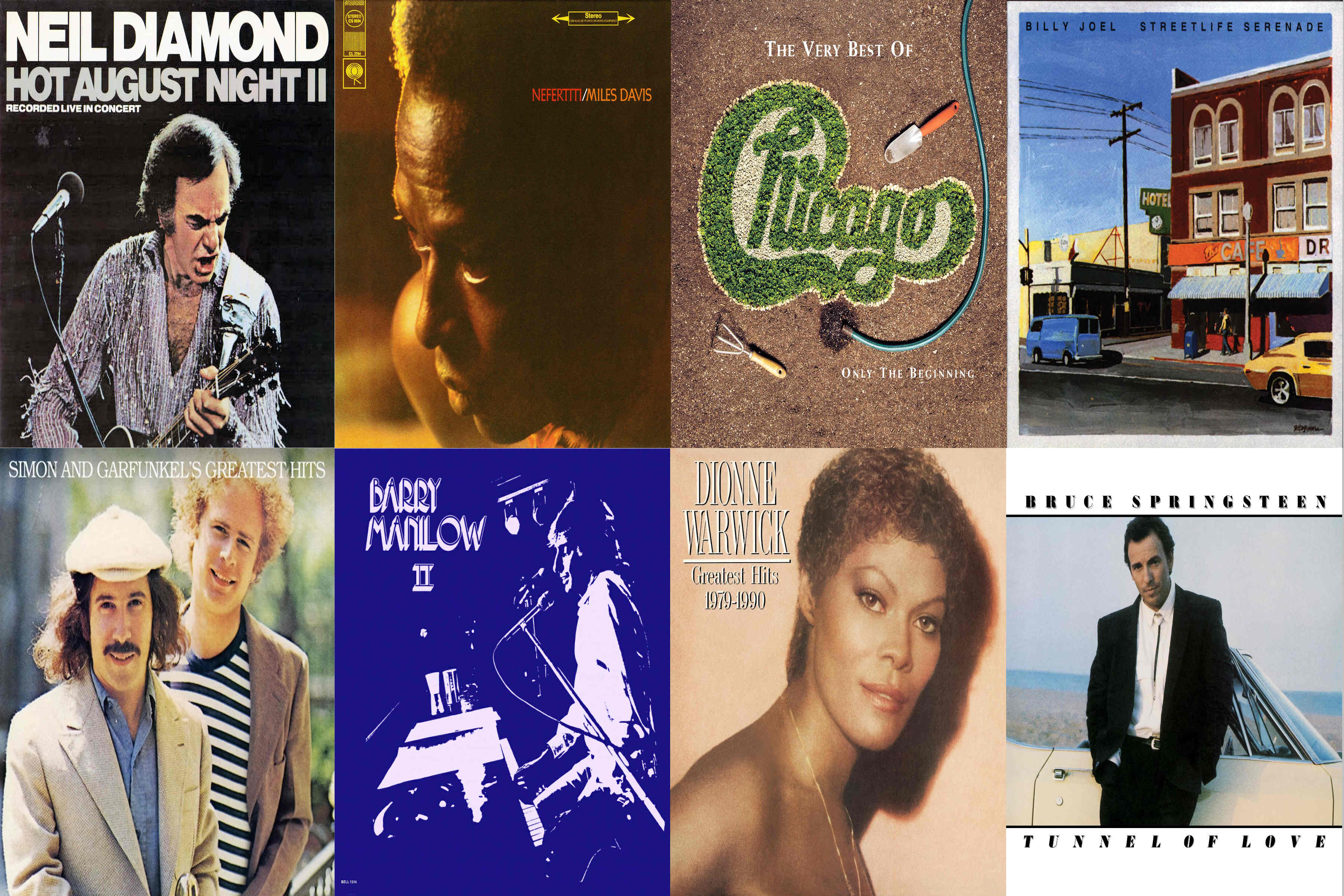
That was only one of Davis’ achievements in a resume that can never be entirely quantified. The album banner at the top of this page represents albums in my collection by artists whose careers were launched or influenced by Clive Davis. And that’s just a sample from my own middle-of-the-road tastes. Because the same guy who sold us on Barry Manilow and Dionne Warwick also sold us on Janis Joplin and Notorious B.I.G. If you look at all the recordings and careers and deals and labels to which Davis contributed, the title of the documentary based on Davis’s autobiography is justified: The Soundtrack of Our Lives. It’s true that, if Davis hadn’t arrived, someone else would have filled the vacuum. But maybe that alternate music world wouldn’t have sounded so in-tune with what we needed.
With every Arista artist album I enjoyed, despite my ignorance of the music industry’s complex machinations, I always understood that Clive Davis had something to do with it. But it was years later before I had a more complete appreciation of Davis’ work – a Harvard Law graduate who couldn’t play an instrument, but who invited us to croon with Luther Vandross after jamming with Earth, Wind & Fire. Imagine! A lawyer who was not only useful, but who accomplished great deeds of lasting value! It’s like a fable from a lost era.

A lot of Davis obituaries describe the man as having a “golden ear,” but I believe a “human ear” is more accurate. The long list of artists Davis worked with may not have covered the entire range of human listening experience, but show me someone who came closer. The music industry has rarely shown enthusiasm for diversity, but there was Davis, proving that we didn’t need to compartmentalize our musical tastes.
Of course, Davis wasn’t a saint. Harvard Law, remember? Calling music a “business” or an “industry” introduces a profit incentive, and everything that profit incentive implies. And, like all corporate heads, Davis expected a profit.
Maxwell’s Silver Dollar:
I’ve got the brains, you’ve got the looks / Let’s make lots of money
You’ve got the brawn, I’ve got the brains / Let’s make lots of money
–“Opportunities (Let’s Make Lots of Money)” by Neil Tennant and Chris Lowe–
There are two fundamental approaches to catering to popular taste:
- Ask people what they want: Barry Manilow’s first album sold poorly on its initial release by Bell Records. But Clive Davis attended a Dionne Warwick concert where Manilow was the opening act. Davis listened to the artist, but he also listened to the audience’s response. He could tell they wanted more, and when he formed Arista he kept Manilow on the roster. The result was the album Barry Manilow II, with hit singles “Mandy” and “It’s a Miracle,” and an enthusiastic re-release of the first album.
- Tell people what they want: When Columbia Records (no longer affiliated with Arista) signed teenager Alicia Keys, the label tried to mold Keys into a youth sex symbol performing impersonal pop tunes written by studio songsmiths. Davis was smart enough to sign Keys away from Columbia before her first album was even released. He sent Keys on a tour of small, diverse settings – “from his living room to New York’s Bottom Line club,” according to the L.A. Times – to introduce her to audiences, and gave Keys the creative freedom that Columbia had denied her. The result was Songs in A Minor in 2001. Audiences may not have known they wanted Keys’ mix of soul, R&B, pop, gospel, and classical, but Songs in A Minor sold 50,000 copies the day it was released and continues to receive critical praise.

Part of Clive Davis’ genius was his ability to both ask and tell. He listened and promoted. He served and shaped popular culture. This doesn’t imply that Davis accomplished a series of miracles single-handedly. Davis may indeed have been a “great” man, but he was shaped by the culture as much as he shaped it: he came of professional age in the 1960s, when the music industry was a free-wheeling hurricane of creativity and innovation. He was also one part of a vast network that includes musicians, recording studios, distributors, critics, and, of course, the audience. They all create a music culture – distinct from but overlapping with a music industry. We, as a culture, may not have needed Clive Davis, but we unquestionably needed someone with his passion for creativity.
Equally important, Clive Davis wasn’t always a nice guy. Again: Harvard Law. While he was president of Columbia Records, Davis was unimpressed with Tony Bennett‘s declining album sales of the late 1960s. He pressured Bennett to record Tony Sings the Great Hits of Today!, a collection of pop tunes that included “MacArthur Park” and “Eleanor Rigby.” Bennett described becoming physically ill in the process, critics (and the audience) felt about the same, and the sales slump continued. On the other hand, Davis opposed the Manilow dream project 2:00 A.M. Paradise Cafe, a saloon-tune jazz collection with not a power ballad in sight, but featuring such talents as Sarah Vaughan, Mel Torme, Shelly Manne, and Gerry Mulligan. Critics and audiences weren’t exactly overwhelmed – an outcome Davis had correctly predicted – but Manilow considers it one of his finest recordings, and this is one listener who agrees.

So Davis did commit commercial and creative errors. But isn’t that the point of a human ear rather than a golden one? Even the most diligent listener will overlook a note occasionally. Creativity often involves risk-taking. In a career of more than fifty years, Davis walked the tightrope between artistic innovation and corporate profits about as well as anyone could. We needed his, and our own, fallibility as much as we needed his passion for the arts.
I can’t find much about Davis’ opinions regarding streaming services or the impact of AI. (Can we all agree that instead of “artificial intelligence,” a more suitable term is “contrived ignorance”?) But in a 2014 interview, he expressed an expectation, perhaps naive, that streaming revenues from Spotify, iTunes, and the rest would compensate artists for reduced sales of physical albums. In this regard, Davis could hardly control the technological landscape, only look for optimal ways to profit from it.
Because in the maelstrom of creativity and profitability, technology has been a force of influence since before recorded music even existed.
People Who Don’t Need People:
They took the credit for your second symphony
Rewritten by machine on new technology
And now I understand the problems you could see
–“Video Killed the Radio Star” by Geoff Downes, Trevor Horne, and Bruce Woolley–
For all the technological change that Clive Davis witnessed during his career, should we count him lucky that he left the stage before the in-progress trainwreck of AI does its worst?
Technology has influenced music almost as long as humans have existed. There is no clear record of the development of early instruments such as rattles, bells, and drums. Over time, mouthpieces, keys, strings, and other components were added to amplify the human body and breath. At some point, however, technology began to overlap the human contribution before, in some cases, almost entirely eliminating it. Player pianos reduced the demand for conventional pianos and pianists, making music more accessible, if less impressive, to those who lacked the patience or time to learn the instrument themselves. Simultaneously, the industrial age introduced centrally-manufactured musical instruments, making instruments available to more people, while sending a lot of craftspeople to the unemployment line.

It’s hard to overestimate the significance of recorded music in terms of culture and quality of life. Listeners no longer needed to wait for professional musicians to come to town, and they no longer had to settle for Aunt Bessie belting out “My Old Kentucky Home” on the living room upright. We mere mortals could immerse ourselves in sonic delight. But what about the musicians? The lucky ones could get their work in front of a much larger audience. The demand for opera, for example, expanded considerably once more people could hear it. But the limitations of early recordings – wax cylinders followed by more durable discs – created a demand for shorter music and what would become the “hit single.” And, for better or worse, music became easier to experience alone, rather than in a group.
Every change in the way music is created, recorded, or distributed has affected musicians and listeners. The Beatles used recording techniques that were innovative for their time – overdubbing and positioning microphones closer to instruments, for example – and helped redirect the music culture around albums over individual singles. Disc jockeys using vinyl records and portable turntables helped create hip-hop. Synthesizers and digital technology simplified the creation of music, ultimately making it possible for anyone with a computer and some software to compose a symphony, without the expense of hiring an orchestra. Even MTV (back when it was Music Television) didn’t kill music, instead creating a whole new cultural prism that, at its best, integrated music with filmmaking. As an industry sprang up around those changes, the musicians almost always benefited the least, but enough prospered that it seemed that the music industry and a culture of music could coexist indefinitely. Artist personalities and broader tastes still mattered. We still had a culture of music.
Had. Because that culture, in 2026, appears to be knocking on heaven’s door. Appropriately termed “AI slop” is destroying the world faster than we can keep up. And we only have ourselves to blame.
Just the Way You Were:
By pressing down a special key / It plays a little melody
I’m the operator / With my pocket calculator
–“Pocket Calculator” by Ralf Hütter and Emil Schult–
If we define music as something that requires active listening, and noise as something that doesn’t, we have reached the noise phase of the story. In fairness, there has always been an aspect of music regarded as background noise. While “easy listening” music isn’t as easy as the label implies, most of us to varying degrees treat music as noise, something to generate airwaves while we avoid heavy thinking. The availability of recorded music – on the radio, on physical media, or in videos – had a lot to do with that. The easier it is to acquire something, the easier it becomes to take it for granted.

File sharing and streaming services – Spotify, iTunes, Napster (remember them?) – began the process of quantifying music to a degree it had never been quantified before. It also simplified music piracy and created even more obscurity in how artists are compensated by unleashing a flood of content backed by questionable accounting. Check out this 2020 Rolling Stone article on Spotify mathematics, involving quarterly streams, numbers of artists, record company royalties, publisher royalties, etc. Another downside to the big-data-fication of music is that, increasingly, only musicians from wealthy families can make it big. And this doesn’t even address algorithm bias in determining how songs and artists are “promoted” while isolating the listener in a stylistic bubble.
Now AI is here to finish the job that streaming started. Not only entire songs, but entire bands, have been “created” in AI’s sinister cauldron. It has already been five years since AI was used to complete Beethoven’s alleged Tenth Symphony. (Please, don’t listen to it. You’ll influence the algorithm.) And everyone’s work has been stolen to train these AI systems. Rick Beato on YouTube, Ted Gioia at the Honest Broker, and a lot of others have been warning us about this. But did we really need their cautions? Don’t we instinctively know that it’s a mistake to outsource creativity to the tools (weapons, really) created by tech-bros?
But we’ve gone along with it. We, the aptly named ignorant masses, have blindly fed our credit cards to iTunes. We’ve streamed AI “songs” on YouTube like cats playing with yarn; even “created” our own AI songs, which, obviously, isn’t creating at all. And even a lot of contemporary human-created music is…let’s say, unspectacular. There is still good stuff out there – the Anat Cohen Tentet, the Cactus Blossoms, J.S. Ondara, and Rhiannon Giddens are some “newish” artists in my personal library – but it’s a daunting task to find it through the deluge of noise. We had a culture of music with gems that we valued enough to commit to memory for decades. How many of today’s songs will be remembered in thirty, forty, or fifty years?

The same thing happened to our movie culture (I keep using that word for a reason): Netflix, followed by other streaming platforms, bombarded our eyes with algorithm-chosen content, and we, like drooling idiots, watched it simply because it was placed in front of us. Letterboxd, of which I am an enthusiastic free account holder, is diminishing the historic gate-keeping function of film critics, when they’re not being shouted down by online mobs of bigoted film-bros. Another thing: search YouTube for a trailer for your favorite recent film, and look at all the phony AI trailers presented as the real thing. Instagram has impacted photography (oh, sorry, “image-making,” yikes) in similar ways.
Evil corporations may have pushed this stuff on us, but we didn’t have to buy it. We share in the blame. And that means we’re also to blame for the end of the world.
The Dark Side of the Loons:
It’s the devil’s way now / There is no way out
You can scream and you can shout / It is too late now
You have not been paying attention
–“2+2=5” by Radiohead–
What does all of this have to do with Clive Davis?
Davis played an integral role in a long history of culture. Culture is often defined as some combination of beliefs, customs, values, and behaviors. And while national identity, religion, gender, and ethnicity can and do influence culture, they do not have to define or limit culture. The definition and relevance of “culture” is too deep a topic for this essay, but I believe you understand what I mean when I say that we had a culture of the arts – popular culture, to keep things simple – that included literature, motion pictures, music, visual arts, the stage, and, once in a while, some deep thinking. Smart-ish people created work, other smart-ish people (tastemakers, or gatekeepers, sometimes the same but not always) reviewed that work and promoted it – or not – for the rest of us to absorb as part of our culture. In the case of music, American Bandstand, Soul Train, Rolling Stone, disc jockeys (before Clear Channel bought all the radio stations), music stores, and shared mixtapes all contributed to this.
This wasn’t always a good thing: women, people of color, and LGBTQ+ individuals were often excluded; gatekeepers were sometimes dingbats; the culture sometimes promoted a bubble that made large numbers of people feel either superior or inferior, depending on whether they were inside or outside the bubble; cultural histories sometimes ignored entire regions of the world; and bad people sometimes used creative work to cover up their illicit deeds.
Ultimately, however, that culture became accessible to nearly everyone, and it was remarkable, and it was, over time, rich in diversity. The music of Duke Ellington, the films of the Coen Brothers, the writing of Virginia Woolf, the paintings of Georgia O’Keeffe – aren’t we all better off for these works? And the tastemakers produced a rich catalog of writing on those works that we’ll apparently have to do without in the future. To my detriment, I’ve not yet read a Toni Morrison novel, but I know who she was and I have some appreciation for the significance of her writing, because that is part of the culture. And to maintain that, we need the human ears (and eyes and minds) of flawed gatekeepers like Clive Davis a lot more than we need the “golden” ear of the algorithm.

Meanwhile, the whole point of AI is to flatten our culture – everyone’s culture – into the thinnest central range of content. AI doesn’t create, it absorbs all the content and spits out a piece of average content. But because so much of the content absorbed by AI is advertising, propaganda, or flat-out lies, the piece of average content it spits out is sometimes wrong or nonsensical. And now that AI has diluted our culture, and the Internet has eliminated our gatekeepers, and social media has taught us to hate each other, we’re reduced to zombified, emoji-regurgitating consumers of – LOL! – “intellectual property.” We’re learning the hard way that flawed tastemakers were better than having no taste at all. We’re losing our culture.
This didn’t start with AI, of course. Corporations, with government’s help, have been flattening the culture for decades. Car dependency and suburban sprawl isolate us from our neighbors and our neighborhoods. Chain restaurants create a safe, predictable, high-sodium “dining” experience. Big box retailers rubber-stamp identical consumer goods warehouses across the landscape. (Speaking of landscapes, big box retailers are doing a real number on our home landscapes, and we aren’t resisting that, either.) A loss of gatekeepers has correlated with a decline in journalism, and uninformed consumers are easy consumers. And along the way, a bloated self-help industry pampered us into loving ourselves without thinking much about our neighbors. It adds up to a strategy of reducing the bell curve – already a highly reductionist means of viewing a culture – to the boring middle, eliminating the fringes where the most exciting people and ideas often live.

Now, however, we’re not only losing our culture, we’re losing our planet and our lives, and some of the most grievous harm is being committed by tech-bros who have no culture. These narcissistic infant-men have no depth and no ambition beyond pandering to their random whims. They buy classic paintings, not because they appreciate art, but because their accountant told them it’s a good tax shelter. They selectively (and obsessively) quote J.R.R. Tolkein and Frank Herbert in a desperate attempt to sound philosophical. They live in a bubble of self-admiration while gleefully exploiting lopsided tax laws, non-existent labor laws, and unenforced consumer protection laws. The government has been fully complicit: one practically has to be a 10%-er to enter government service at the national level, and those people are as bubble-fied as their elite sponsors. (Higher-up politicos were caught off-guard by the recent reflecting pool snafu because only run-of-the-mill tourists care about such things, not serious players who traverse the city in chauffeur-driven, armor-plated SUVs.) We’ve given the keys to the car to a gang of loser thugs while we wallow in digital content and all the trinkets we’ve ordered by same-day Amazon delivery.
The mutually reinforcing causes and outcomes of our self-created vicious cycle becomes more painfully obvious every day: a decimated education system focused almost solely on job training fails to deliver the background in teamwork, history, and communication that we sorely need; the large-scale transfer of wealth begun during the Reagan years is nearing the point of unsustainability, making most of us economically irrelevant; the CEOs reassuring us that AI won’t cause mass layoffs are the same people who will benefit the most from mass layoffs (hint: the LLMs aren’t for us, we’re guinea pigs to trouble-shoot the systems); lab-grown and other artificial foods reduce the need for an agricultural industry and makes production easier to control by a small number of people; a larcenous healthcare system accelerates the deaths of those of us who don’t measure up; religious fundamentalism wedded to capitalism has convinced us that blind luck is equivalent to moral standing; anti-vax propaganda, and general anti-science propaganda, promoted by elites who typically make sure they and their families are fully vaccinated, weakens us for the next pandemic; heavily militarized police forces simplify election control and eliminate the potential for public gatherings that might lead to revolt; global climate change will make large regions of the planet uninhabitable while the elites shelter in their palatial bunkers. (The bunkers may not save them, but how many of us will survive to find out?)

Thankfully, Jeff Bezos hasn’t really said that we should die of thirst to feed his data centers. Not out loud, at any rate.
And if you think this essay mourning the loss of a listening genius has gone entirely off the rails, the bottom line is simple: the death of a gatekeeper like Clive Davis is a marker down the road of lost culture, and as we lose our culture we increasingly lose what it means to be a human society. And, from there, what are we?
Goodbye Stranger:
Yes, it’s been quite a day / And I should go to sleep
But tomorrow I will wake up and I’ll know / That I’ve got to begin again
–“Got to Begin Again” by Billy Joel–
Clearly, I’m not feeling optimistic these days. As I write this, I’m in northern France, where my capacity for optimism is being stretched by the hottest summer France has experienced as long as records have been kept. In addition, I’ve written before about struggling with the deaths of so many of my cultural touchstones as I get older; and a lot of the surviving touchstones are in their seventies or eighties. Whatever Clive Davis got wrong, I believe he made the world a better place, as did Sonny Rollins, Mark Snow, Len Deighton, and so many others who seem to have no capable successors on the ever-cloudier cultural horizon.

The best advice I can offer as a conclusion is to do what Clive Davis might recommend: do what it takes to put food on the table while leaving as much space as possible for creativity. Resist the temptation to doomscroll. Make a ‘zine like this artist suggests. Draw something. Paint something. Play the guitar, even if you play it badly. Replace your turfgrass with wildlife-friendly native plants. Cancel your Prime subscription. Listen to birds singing. Read a book from your public library and discuss it with someone. Go for a walk. Just do something. These individual choices might seem small, but collectively, and over time, saving the world is still within our grasp. And never stop listening, because you never know when you might catch a song that the whole world needs to hear.


Leave a Reply