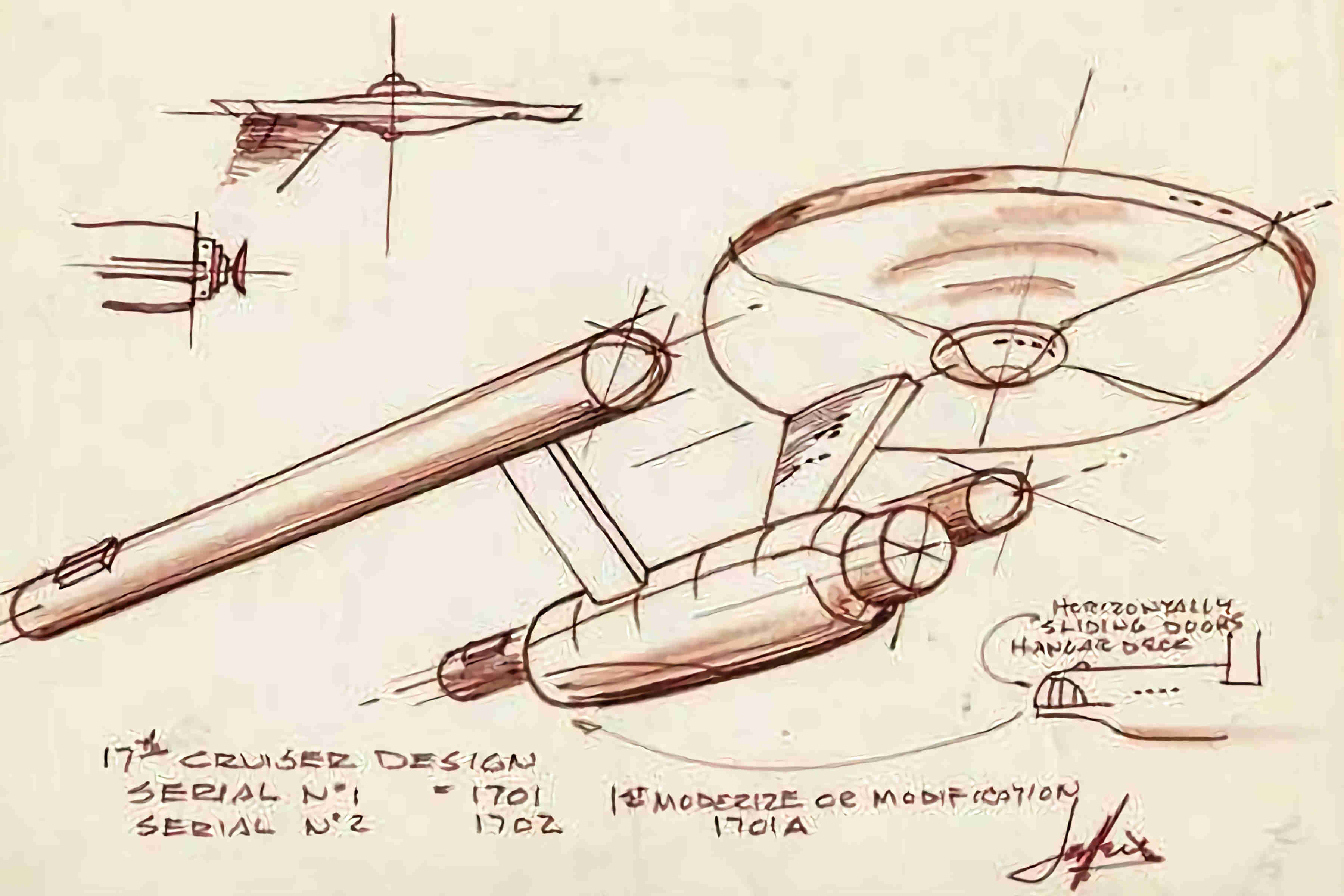
The first episode of Star Trek: The Original Series aired 8 September 1966 in the U.S. (6 September in Canada). In this essay I use “Star Trek” interchangeably to refer to both the original series and the overall franchise. The image above is concept art for the series by Matt Jefferies.
“There can be no thought of finishing, for ‘aiming at the stars,’ both literally and figuratively, is a problem to occupy generations, so that no matter how much progress one makes, there is always the thrill of just beginning.”
–Rocketry pioneer Robert H. Goddard–
I fell asleep the first time I watched Star Trek.
In fairness, I was maybe six or seven years old at the time. A friend slept over one night and persuaded me to stay up past midnight to watch a rerun of a show he promised I would love. I don’t even remember the friend’s name, but the episode was “Shore Leave,” I remember that clearly enough; Finnegan’s cavorting about makes for a memorable image. But I’ve never been much of a night person. I was too tired to invest in a strange new TV world and fell asleep. I’ve written about this before, but it’s important to remember that for us early viewers, just as for the people creating the show, we had no idea what we were getting ourselves into.

Eventually I woke (LOL!) and learned to appreciate the series. This would have been in the early 1970s, when we didn’t have fan web sites, Facebook groups, YouTube reviewers, or streaming platforms; in general we were blissfully lacking in the toxic “fandom” that has infiltrated popular culture. There were a few conventions, but I didn’t know about them and my parents wouldn’t have taken me anyway. Even the merchandising options were limited: I had an Enterprise bridge set with only Kirk and Spock action figures, which sorely limited my ability to recreate bold voyages. What we had, most of us, was just that original TV series, broadcast in syndication daily or weekly, depending on which part of the country you lived in and which TV channels you had access to. And we had our imaginations.

At that age, I was drawn to Star Trek because it involved fun adventures while traveling through space on a cool-looking ship. When my friends and I play-acted Star Trek at recess, I wanted to be Kirk because he was the bold explorer. But I also wanted to be Spock, because I loved to read, and Spock elevated a love of learning to the life-saving endeavor that it clearly is. Before long, I was old enough to appreciate the exotic women – another reason I wanted to emulate Kirk – women who looked surprisingly human regardless of what planet they came from. (It should be no surprise that during those playground years we never found girls interested in joining us as Uhura or Rand or Chapel.) And eventually I became old enough to appreciate that clothing all of those women in Frederick’s of Hollywood attire looked a little silly even in the 1960s. Consistently, though, I have understood why the crew remained focused on their mission instead of their personal lives: These people were engaged in a project so important, and so compelling, that they had neither the time nor the need for a personal life.

During the 1970s, Star Trek and reality reinforced each other in my ambition for the future. I missed the TV broadcast of the launch of Apollo 17 because I was in kindergarten and my parents wouldn’t let me stay up to watch the 12:33AM liftoff on the morning of 17 December 1972. (I probably would have fallen asleep anyway.) That turned out to be the last Apollo lunar mission, but the Skylab space station was launched in 1973. Skylab was occupied by three astronaut groups over the next ten months, and their experiments contributed to, among other things, the development of x-ray astronomy. The joint U.S.-Soviet Apollo/Soyuz mission took place in 1975, paving the way for the multicultural camaraderie depicted on Star Trek: cosmonaut Alexei Leonov became godfather to some of astronaut Deke Slayton‘s children, and Slayton delivered a eulogy at Leonov’s funeral in 2019. The Viking 1 and 2 Mars probes were also launched in 1975: between two orbiters and two landers, Viking expanded our knowledge of the historic presence of water on Mars, and properties of the Martian surface and atmosphere, knowledge that might be relevant to understanding our own planet.

We had landed on another planet! It was all so thrilling, and it was all real. Despite the vast difference in the distances traveled, real life clearly seemed to be approaching Star Trek. I took it for granted that everyone else agreed on the logic in this. No one on Star Trek worried about food, or shelter, or money, or healthcare. Lifespans were greatly extended. They understood the ignorance of killing each other over politics or money or religion, when missions of genuine importance awaited. No one noticed accents or different shades of skin color because such things are trivial. Star Trek opened our eyes to the silliness of bigotry (“Let That Be Your Last Battlefield“), compassion in responding to mental illness (“Dagger of the Mind“), the ability to transcend physical limitations (“Is There in Truth No Beauty?“), the necessity of uniting against our common enemy (“Day of the Dove“), the limitations of technology (“The Ultimate Computer“), the peril of consolidated power (pick any number of episodes), the self-sabotaging tendencies of an uninformed public (“For the World is Hollow and I Have Touched the Sky“), the eternal repulsiveness of Nazis (“Patterns of Force“), the benefits of cooperation (again, choose your episode), and, in general, the long-term rewards of being open-minded. Star Trek is as relevant today as it was sixty years ago. And look at the job security! The Enterprise crew had found their calling, and it just happened to involve arm-wrestling Klingons and cavorting with green-skinned Orion women. I counted myself lucky to be born when the world was on the verge of such a bright future.

So what happened to all the rest of you? We should all be living to 150 by now. Instead we have Viagra and GLP-1, provided you can live through the side effects.
I sometimes look to the Johnson presidency as what Abraham Lincoln might have called “the last best hope of earth.” Despite some of the same paranoid tendencies as his successor Richard Nixon, Lyndon Johnson appears to have been sincere in his Great Society ambition to expand civil rights, alleviate poverty, improve public health, and expand the frontiers of knowledge. (I’m eagerly awaiting volume five of Robert Caro‘s The Years of Lyndon Johnson for a final word on the matter.) But Johnson lost his way in Vietnam and the national divide has been expanding ever since. Robert F. Kennedy and Martin Luther King Jr, who both might have possessed the vision to recover what Johnson started, were assassinated in 1968, plunging the country into what Nixon openly described as a divide-and-conquer strategy.

Is it pure coincidence that Star Trek‘s final original episode aired in June 1969, less than five months after Nixon was inaugurated?
The path of human history since those years is known, if not entirely understood. As we have changed, Star Trek has changed, more often serving the market rather than shaping it. I’ve largely drifted away from the franchise ever since Just Joking Abrams scattered those God-awful lens flares all over his fake Star Trek movie in 2009. The various Trek iterations since then have had some talented actors – diverse casts that get us closer to infinite possibilities in infinite combinations – but I find the writing uninteresting at best, and too often preoccupied with cheap gags, cartoonish action set pieces, and soap opera-ish personal dramas instead of the sincere ethical quests of Kirk, Picard, Sisko, Janeway, and Archer.

I may be taking it all too seriously. After all, it’s just a TV show, as the Shat reminded us on Saturday Night Live. And Star Trek wasn’t a perfect show. Women were sometimes objectified; Abraham Lincoln showed up for no plausible reason; Kirk recited the Pledge of Allegiance, also for no reason; Zefram Cochrane was too dimwitted to figure out what to do with the gift of immortality; the crew insulted Spock with surprising cruelty; and Kirk made occasional boneheaded comments about capitalism and procreation. The show had its flaws, but that was the sixties, and it was light years ahead of most TV programming of the era.

But I’ve always felt Star Trek is at its weakest when it dwells on the characters’ personal lives. In the original series, we could trust that any romances would be forgotten by next week. But even The Next Generation tended to get bogged down over Geordi’s boring dating life or Worf’s whiny kid. One of my favorite moments from the first season of The West Wing (another classic series about camaraderie in service to a great cause), occurs in the episode “Five Votes Down”: White House Chief of Staff Leo McGarry (John Spencer), faced with losing his wife over his superhuman work hours, explains that during this time when he serves the presidency – a mission of four or eight years, instead of five – his job is more important than his marriage. The mission is vital, and the chance may never come again.

Maybe that seems heartless to casual viewers, but it’s one of the things I appreciated about Star Trek. The crew served the mission as fully as the mission served the crew. But as we have strayed from the mission in reality – increasingly losing our minds in bigotry, classism, fake “culture wars,” and general willful ignorance – so has Star Trek. Kirk gets in bar fights, Spock has whimsical exchanges with T’Pring or Uhura (or Chapel?), and Klingons keep gaining and losing foreheads. And one reason for that, I believe, is that we equated physical frontiers with the frontier.

After rich white guys ran out of physical frontiers to plant their flag in – the poles, the American West, Mount Everest, etc. – they lost their way. Mental, emotional, and cultural frontiers were beyond their comprehension, even though those were the true frontiers where Star Trek ventured. Stock options, social media, hypnotic gadgets, climate-destroying yachts: the elites went off the rails and we followed them. Of all the limitless frontiers we could explore, we keep choosing the most trivial. Like my childhood self watching that late-night Trek episode, we have collectively fallen asleep; there’s a reason Haynes Johnson titled his account of the U.S. in the 1980s Sleepwalking Through History. We abandoned our imaginations. And that’s why we have Nutrafol instead of a cure for dementia.

In the series finale of The Next Generation, Q sums up the bottom line for Picard, the true point of all that has happened and all that will happen:
“The trial never ends. We wanted to see if you had the ability to expand your mind and your horizons. And for one brief moment, you did. … For that one fraction of a second, you were open to options you had never considered. That is the exploration that awaits you. Not mapping stars and studying nebulae, but charting the unknown possibilities of existence.”

That’s why the personal life storylines bore me: we know them all. While these stories can still be entertaining and informative – When Harry Met Sally and The Princess Bride are classics for a reason – they are stories already told ad nauseam in rom-coms, sit-coms, soap operas, and melodramas. Those stories don’t need the unique possibilities of science fiction. Star Trek, at its best, doesn’t dwell on what is, but what could be. Star Trek is the moment that crystallizes the need to coexist with other species (“The Devil in the Dark“), or the reality that citizenship involves duties as well as rights (“The needs of the many outweigh the needs of the few.”), or that past misconceptions burden us from embracing positive change (The Undiscovered Country). That is the contemplation we need. That is the thinking that gets us to the most profound advances in human existence: Johannes Gutenberg refines the movable-type printing press, influencing the Renaissance and Reformation; Mahatma Gandhi defies his oppressors by refusing to raise a fist, awakening the world to the potential of peace; Dmitri Ivanovsky and Martinus Beijerinck identify the tobacco mosaic virus, paving the way for the field of virology and the subsequent development of vaccines that will save millions.

Science fiction’s highest ideal has always been to challenge and influence the market, not serve it. That’s why The Motion Picture has become more popular with time: even though the initial production was driven by market trends, Gene Roddenberry and Robert Wise set out to tell a story of wonder and exploration that, in the vein of 2001: A Space Odyssey, depicts the reality of Robert Goddard‘s words: “There can be no thought of finishing…” Kirk returns to exploration; Spock pursues the frontiers of thought and emotion; V’Ger, Decker, and Ilia advance the potential of evolution. Friendship and love are part of the journey, trust and loyalty give depth to a shared adventure, but they complement the mission while never overshadowing it.

The true frontiers are as infinite as the imaginary world of Star Trek. We can never know the complete story, because the story is never finished. Sometime in the future, Star Trek may come under the stewardship of people who return it to the mission. We might all come to our senses and do the same. But change is inevitable, and while the future is not preordained, there’s no promise that we’ll be happy with it. As much as I want to claim “my” Star Trek as the one and only, each generation gets what it wants, or, at least, what it accepts. And as I will hit sixty not long after Star Trek, I’m grudgingly accepting that the world will be in the hands of younger generations, to do, or accept, what they will.

Frontiers of mind and space are infinite, and the only thing we can guarantee is that the 23rd and 24th centuries won’t look the way they’ve been depicted in any version of Star Trek. Even in our own worst-case scenario of humanity’s self-destruction, millennia of evolution may guide another species to a greater level of awareness; evolution may endow them with the ability to decode our historic record and apply it to wise coexistence with the plant and animal life that we have treated so carelessly. Other species may develop on other worlds and bridge the distance in multigenerational ships; perhaps they’re already on their way. In a galaxy of over 100 billion stars, amidst a universe of hundreds of billions of galaxies, even our wildest imaginations can’t foretell the infinite possibilities. As Picard reminded us in “All Good Things”: “The sky’s the limit.” And that is no limit at all.


Leave a Reply